
The idea that “choosing a low-paying specialty with high loans ruins your finances” is exaggerated—and it’s scaring way too many of us.
Let me be blunt: you did not just permanently destroy your financial life by matching into primary care, pediatrics, psych, family med, or any other relatively low-paying specialty with big loans. You did, however, sign up for a decade-plus of needing to be very intentional. If you try to live like some derm or ortho attending while making a peds salary and ignoring your loan plan? Yeah, that can go ugly, fast.
But that’s not what you’re going to do.
You’re freaking out because you’re running the mental math:
“$300k+ loans. $250k-ish attending salary. Taxes. Interest. Rent. Maybe kids? Did I just trap myself?”
Let’s walk through this like someone actually living it, not like a textbook fantasy.
Step One: Reality Check—How Bad Is Your Situation?
You’re probably catastrophizing. I do it too. So let’s quantify the monster under the bed.
The big variables:
- Total federal loans (and interest rate range)
- Whether you have any private loans (this matters a lot)
- Your specialty & realistic attending income range
- How long you’ll train (3-year vs 4-year+ residency/fellowship)
- Whether you might qualify for PSLF (Public Service Loan Forgiveness)
Here’s a rough sketch of what you’re worried about:
| Item | Example Numbers |
|---|---|
| Total Med School Debt | $300,000–$400,000 |
| Interest Rate (federal) | 6–7.5% |
| Residency Salary (PGY-1) | ~$62,000–$70,000 |
| Attending in Primary Care | ~$200,000–$260,000+ |
| Attending in Peds | ~$190,000–$240,000+ |
You see those numbers and think:
“I’m going to be paying loans until I’m 50 and never own a house and never have kids and die in debt.”
That’s the anxious brain talking. Here’s the calmer version:
- Doctors—even in “low-paying” specialties—still have high, stable incomes relative to the general population.
- Federal student loan programs are designed with people like you in mind.
- PSLF is not a myth. It’s working now, and thousands of physicians have gotten it.
- What ruins people is usually lifestyle creep + no plan, not the specialty itself.
So no, you didn’t ruin your finances. But you did choose a path that absolutely requires a strategy.
Step Two: Income-Driven Repayment—Your Lifeline, Not Your Punishment
Here’s the thing no one told us clearly in M1: the monthly payment you see on the loan servicer site (like “Standard 10-year: $4,000/month”) is almost irrelevant for you.
You are not paying that. Not in residency. Probably not even as a new attending.
You’re going to be using an income-driven repayment (IDR) plan. For federal loans, the main ones now/soon:
- SAVE (replacing REPAYE, the big one for many people)
- PAYE (being phased out for new borrowers, but some still have it)
- IBR (less common but still out there)
The formula is roughly:
Payment = a percentage of your “discretionary income” (after a generous deduction based on federal poverty line).
So if your PGY-1 salary is, say, $65,000, your monthly payment might be more like $150–$300/month under SAVE, not $3,000.
Is that enough to fully cover interest? Probably not on $300k+ of loans. But SAVE does something huge: it limits how interest balloons.
Under SAVE, unpaid interest on subsidized and unsubsidized loans doesn’t capitalize as long as you make your required payments. In plain English: if your calculated payment isn’t enough to cover all the interest, the extra interest doesn’t get added to your principal. Your balance doesn’t snowball as insanely as it would’ve in older eras.
So residency + low-ish payments doesn’t mean your balance explodes the way it used to.
This is what calms me down at 2 a.m. sometimes.
Step Three: PSLF—Either Your Golden Ticket or a Non-Factor
Your next anxious question: “Will I have to do PSLF or I’m screwed?”
No. But if you can pursue PSLF, it can be game-changing—especially in a lower-paying specialty.
PSLF basics in human language:
- 120 qualifying monthly payments (10 years’ worth, but they don’t have to be consecutive)
- While working full-time for a qualifying employer (nonprofit 501(c)(3), government hospital, VA, academic center, FQHC, etc.)
- On a qualifying income-driven plan
- At the end, remaining federal loan balance is forgiven—tax-free
If you’re doing primary care, peds, psych, FM, IM at an academic or large nonprofit system? There’s a very real chance you’ll qualify.
Picture this path:
- 3 years of residency + 1 year of chief at a nonprofit hospital = 4 years of PSLF credit
- Then 6 years as an attending at a nonprofit academic center or community hospital = 6 more years
- Total: 10 years PSLF = forgiveness
All the while, your payments in residency were dirt-cheap because they’re income-based. When you become an attending, they go up but you’re still aiming for the 120 payments, not “paying it off” in the traditional sense.
Let me throw a simple chart at you to show why your specialty doesn’t doom you if PSLF is on the table:
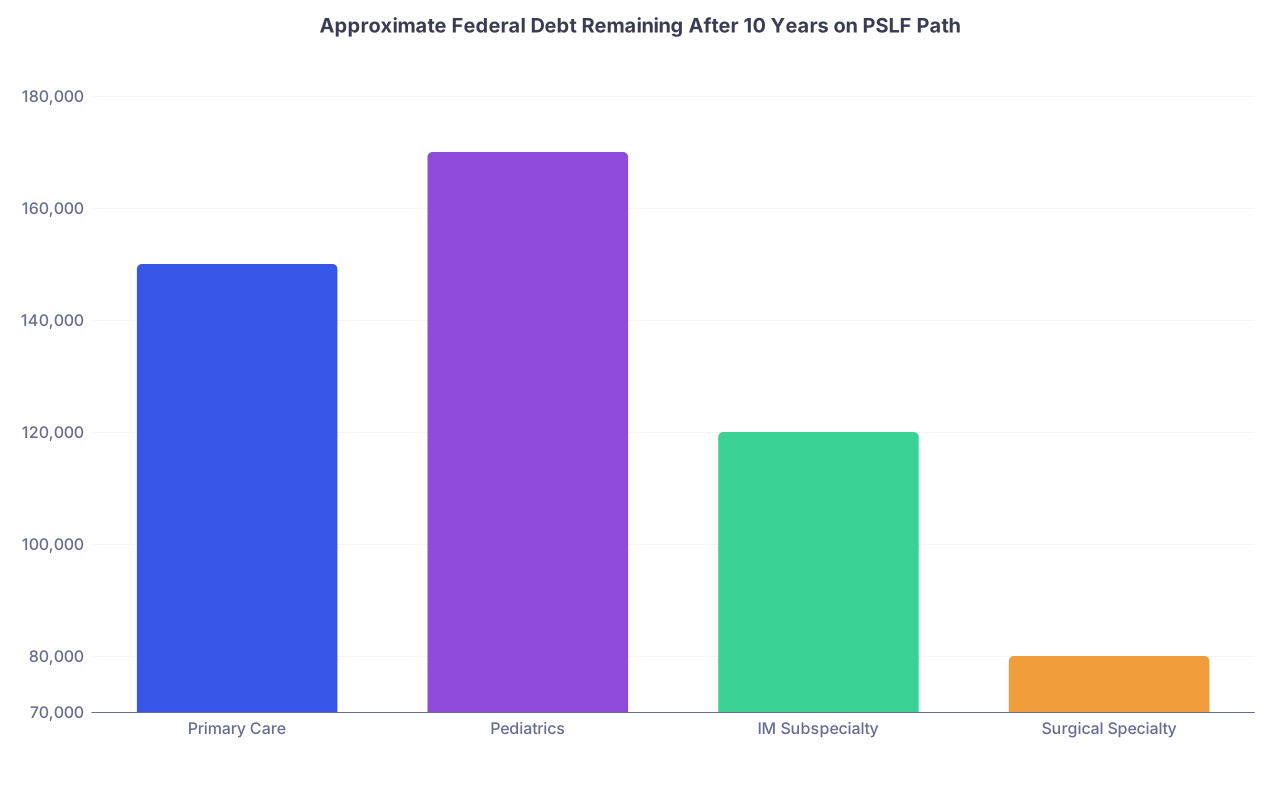
| Category | Value |
|---|---|
| Primary Care | 150000 |
| Pediatrics | 170000 |
| IM Subspecialty | 120000 |
| Surgical Specialty | 80000 |
Those aren’t exact numbers; they’re directional. The point: forgiveness can wipe out six figures whether you’re in peds or plastics. The differences are smaller than your anxiety suggests.
Now, if you hate academia, and your dream is private practice in a for-profit group in the suburbs? PSLF might be less likely. But even then, you’re not dead financially. You’re just on a different path.
Step Four: Worst Case—No PSLF, Just You vs. The Loans
This is the part my brain immediately jumps to: “What if PSLF gets canceled?” “What if I can’t stand academic medicine?” “What if all my jobs are for-profit?”
Let’s say PSLF is off the table.
You still have:
- SAVE or another IDR for long-term affordability
- 20–25 year taxable forgiveness (for some IDR plans)
- Option to refinance to private loans later when your income is stable (and you’re giving up PSLF on purpose, not by accident)
People don’t like to talk about the 20–25-year forgiveness because of the tax bomb at the end (the forgiven amount could be taxed as income under current law). That is a real issue. But for a lot of lower-paid specialties, it can still beat trying to crush the debt insanely fast.
What ruins people is forcing a “pay off in 5 years no matter what” mindset on a $220k salary in a high cost-of-living city while trying to buy a house, daycare, and pretend they’re rich. That’s how you end up totally burned out, resenting medicine, and still anxious.
A more realistic path without PSLF might look like:
- Residency + fellowship: minimal IDR payments under SAVE, balance grows slowly but doesn’t explode
- Early attending years: live a bit below your means, put extra money toward:
- A modest emergency fund
- Retirement accounts (yes, before killing all your debt—this matters)
- Some extra toward loans, but not every last cent
- Reassess in 2–4 years and decide:
- Stay on SAVE/IDR and aim for taxable forgiveness down the line
- Or refinance privately and pay aggressively over 7–15 years if PSLF really isn’t happening
None of those are “I’m ruined forever.” They’re just tradeoffs.
Step Five: The Lifestyle Trap You’re Terrified Of (Rightly)
Let me be harsh: the specialty didn’t ruin most doctors’ finances. Their choices did.
Things that blow up a low-paid specialty + high-loan scenario:
- Buying the attending house immediately (with minimal down payment)
- Two new luxury cars within 3 years
- Expensive private school “because we deserve it” while drowning in payments
- No budget at all because “I make six figures, I’ll be fine”
- Ignoring PSLF requirements and accidentally disqualifying payments
I’ve watched someone do this:
- Peds attending, ~$210k income
- $350k loans, no plan, never looked at PSLF rules
- Bought $900k house in a HCOL city year 1
- Two leased luxury SUVs
- Credit card debt on top of everything
Then at 38 they’re panicking: “Why am I still paycheck to paycheck?”
So yeah, if you copy that, your finances will be rough. But again—that’s not about pediatrics. That’s about denial + vibes-only planning.
Positive version: I’ve also seen a family med attending with ~$280k loans who:
- Rented modestly for a few years
- Drove a used car paid in cash
- Did PSLF at an FQHC
- Maxed out Roth IRA + some 403(b) contributions
- Ended up with six-figure retirement accounts and most of their massive loan forgiven in their mid-30s
Same rough specialty tier. Completely different outcomes.
Step Six: Where You Actually Have Control (Right Now)
You’re in residency or just matched. You don’t control your salary range dramatically. But you do control:
Whether all your loans are set up correctly
- Consolidate federal loans if needed for PSLF/IDR eligibility
- Make sure you’re on SAVE or another IDR, not Standard 10-year by accident
- Confirm your employer qualifies for PSLF if that’s your plan
Documentation
- Submit the PSLF form annually if you’re at a qualifying hospital
- Keep your own copies of employment certification forms, pay stubs, etc.
Lifestyle floor, not ceiling
- Set a “baseline” lifestyle that you’d be comfortable keeping even as an attending for a few years
- Decide your “first attending raise” goes to:
- Emergency fund
- Retirement
- Smart extra loan payments (if it fits your plan)
Learning enough to not be scammed or panicked
- Skim resources like:
- White Coat Investor
- Student Loan Planner
- Physician on FIRE
- Not to memorize everything. Just to get the big picture and not rely solely on random co-resident advice
- Skim resources like:
Tiny Example: Two Primary Care Docs, Same Loans, Different Paths

| Step | Description |
|---|---|
| Step 1 | Graduate with 320k loans |
| Step 2 | Doc 1 - PSLF path |
| Step 3 | Doc 2 - Private practice path |
| Step 4 | Residency at nonprofit |
| Step 5 | Attending at academic center |
| Step 6 | 10 years PSLF - loans forgiven |
| Step 7 | Residency at nonprofit |
| Step 8 | Attending at for profit |
| Step 9 | Refi loans |
| Step 10 | Pay off in 10-15 years |
Doc 1:
- Lower payments in residency
- Lower-but-steady payments as attending
- PSLF wipes out remaining balance in year 10
Doc 2:
- Also uses IDR in residency
- Higher payments after refi as attending
- Becomes debt-free in 40s with intentional planning
Neither is “ruined.” They just have different endgames.
A Few Hard Truths (That Are Weirdly Reassuring)
- You will feel poorer in your early attending years than your non-med friends who’ve been working since 22. That’s normal. It’s not a moral failure.
- You cannot fix 4 years of med school borrowing in 18 months without destroying your mental health. This is a long game.
- You’re allowed to care about money even if you chose a “caring” specialty like peds or psych. Wanting stability doesn’t make you less dedicated.
- Your anxiety will make you want to either ignore everything or overcontrol everything. Aim for the boring middle.
(See also: Afraid to Open Your Loan Statements? for gentle first steps.)
If I Were You, Here’s What I’d Do in the Next 30–60 Days
- Log into studentaid.gov and your servicer and write down:
- Total balance
- Interest rates
- Loan types (Direct, Grad PLUS, any private?)
- Decide: Am I probably PSLF-eligible in my current residency?
- If yes: consolidate if needed, enroll in SAVE, submit PSLF form
- If no: still enroll in SAVE (or best IDR) to keep payments low and interest in check
- Make a “barebones” monthly budget that fits your resident salary without using credit cards for basic living
- Pick a simple goal:
- Either “PSLF is my working plan”
- Or “I’ll reassess refinance vs long-term IDR 1–2 years after I’m attending”
That’s it. You don’t need a 30-year spreadsheet today. You just need to not stick your head in the sand.
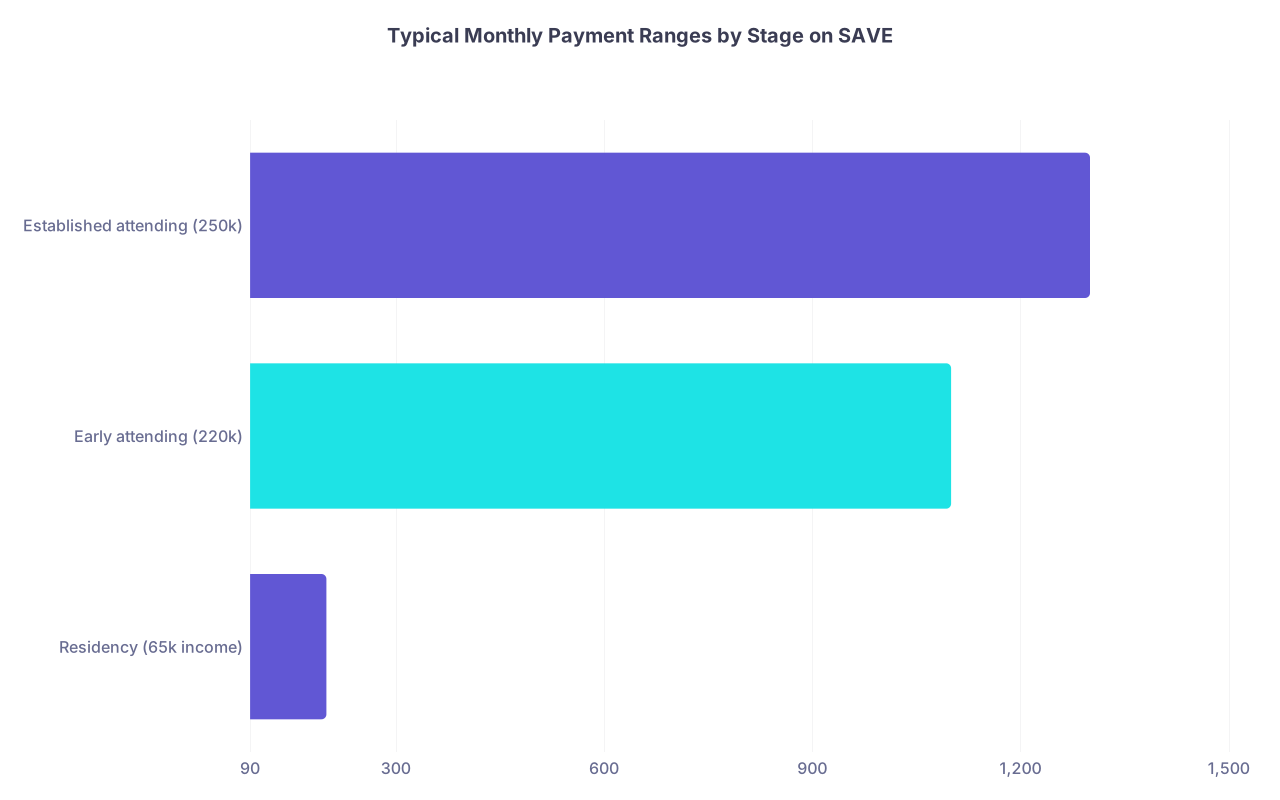
| Category | Value |
|---|---|
| Residency (65k income) | 200 |
| Early attending (220k) | 1100 |
| Established attending (250k) | 1300 |
These are rough, obviously. But you can see the pattern: the payments scale with income. You’re not making $4k payments in residency unless you’re ignoring options.
You Didn’t Ruin Your Life. You Just Removed the Option to Be Financially Clueless.
That’s the real truth.
Matching into a lower-paying specialty with high loans doesn’t equal financial doom. It equals:
- You must understand IDR
- You must think about PSLF seriously
- You must resist lifestyle creep for at least a few years
You can have:
- A house
- Kids (if you want them)
- Retirement savings
- Vacations that aren’t just sleeping through post-call
Just… probably not all at once, immediately, with a Tesla and a $1.2M house and no plan.
You’re not behind. You’re just in the chapter where everything feels tight and scary.

FAQ (Exactly the Stuff I Obsess Over)
1. My debt is around $400k and I matched into peds. Is that “too much” for my specialty?
It’s a lot. But “too much” is the wrong lens. The right questions are:
- Are your loans federal? If yes, you have IDR + PSLF options.
- Can you see yourself working at nonprofit/academic/children’s hospitals for at least 10 years total? If yes, PSLF can absolutely handle $400k+ balances.
- Are you willing to live like a reasonably frugal attending for the first few years? If yes, you can still build wealth.
I’ve seen peds people with $400k+ completely fine because they played the PSLF game correctly and didn’t pretend they were making $600k.
2. Should I switch specialties or try to re-match just for money?
Switching purely for money is dangerous. Residency is too hard to survive if you hate the work but love the paycheck.
If you genuinely feel misaligned with your specialty medically and there’s another one you’re strongly drawn to that also pays more—okay, that’s one thing. But jumping from peds to anesthesia just because of a salary graph when you actually like peds? That’s how people end up burned out, cynical, and still not “rich enough” to justify the misery.
You can make a low-paying specialty work financially with a clear plan. If you’re going to blow your life up to re-match, it better be about passion and pay, not just panic.
3. Is it ever smart to refinance my federal loans if I’m in a lower-paying specialty?
Sometimes, but not early.
Refinancing to private loans kills PSLF and federal IDR protections. That’s huge. It usually only makes sense when:
- You are absolutely sure you won’t use PSLF (for-profit group, no plans to move, etc.)
- Your income is stable and high enough to afford bigger fixed payments
- You’ve run real numbers and refinancing shortens your payoff timeline without destroying your cash flow
For most people in primary care/peds/psych/FM, I’d wait until at least 1–2 years into attending life before considering private refi, if ever. You need to see what your actual income, job stability, and PSLF eligibility look like in real life—not on a spreadsheet.
4. Will I ever be able to retire comfortably if I start with this much debt and a “lower” salary?
Yes, if you’re deliberate. No, if you wing it.
Key levers:
- Start something for retirement as early as possible—5% into a 401(k)/403(b) or Roth IRA is better than zero while you obsess about loans
- Use PSLF or IDR smartly so you’re not drowning in payments and can still save
- Avoid massive lifestyle inflation in your first 5 attending years; those years are rocket fuel if you get them right
- Stay in one place long enough to vest in retirement matches and avoid constant reset
I’ve seen primary care docs with mid-six-figure net worths by their early 40s despite starting with brutal loans. It required planning and saying “no” to some things early on. But it’s absolutely doable.
Key Takeaways:
- Matching into a lower-paying specialty with high loans is not financial doom—but it does demand a clear plan (IDR, PSLF, lifestyle).
- Federal loan programs (especially SAVE and PSLF) are built for exactly your situation; ignoring them is what truly wrecks people.
- Your specialty didn’t ruin your finances. A lack of planning might. And you’re already fixing that by asking these questions now.