
What if that “dream” job with a $100,000 loan repayment bonus quietly sets you back $200,000 over your career—and you do not realize it until you are 45?
That’s not hypothetical. I’ve watched residents jump on loan repayment offers, feel like they beat the system, and then wake up years later with less net worth than their classmates who just…paid their loans like normal adults.
Let’s dismantle the myth that “any loan repayment program is automatically a financial win.” It is not. Sometimes it is a trap with nice branding.
The Big Myth: “Free Money Toward My Loans? Of Course I Should Take It.”
Here’s the mindset I hear constantly on wards and in resident lounges:
- “That rural hospital is offering $50k per year in loan repayment. I’d be stupid not to take it.”
- “This job pays less but comes with 100% loan forgiveness after five years.”
- “As long as someone else is paying my loans, I do not care what the salary is.”
This is how you get played.
Loan repayment programs—NHSC, PSLF-linked positions, employer repayment bonuses, state programs, nonprofit gigs—are compensation structures, not charity. You are trading something: usually salary, flexibility, or geographic choice.
The right question is not:
“Is there loan repayment?”
It’s:
“What is the total financial picture over 5–10 years compared with my alternatives?”
And when you run the numbers instead of following vibes, the shine comes off a lot of these “amazing offers.”
Where People Quietly Lose Money: The Opportunity Cost Problem
Let me walk through a common scenario I’ve actually seen play out.
A primary care doc has $250,000 in federal loans at about 6.5%. Two options:
- Job A: Community health center (nonprofit), $190,000 salary, potential for PSLF after 10 years of qualifying payments.
- Job B: Private group, $240,000 starting salary (likely more with productivity), no formal repayment program.
Everyone around them: “Take the PSLF-eligible job. Free forgiveness!”
Reality: PSLF might be great here. Or it might be a distraction. Depends how you handle Job B.
Let’s put some structure on this.
| Scenario | Salary (Year 1) | Loan Help | Key Risk |
|---|---|---|---|
| Job A | $190,000 | PSLF-eligible, no employer dollars | PSLF rules / career rigidity |
| Job B | $240,000 | None | Requires discipline to self-pay aggressively |
At face value, people fixate on “forgiveness” in Job A and ignore:
- $50,000/year more in base salary
- Faster salary growth in private practice
- Ability to throw extra at loans if you’re not spending everything
I’ve watched residents choose the PSLF path, make only the minimum payments, and then act shocked 7 years later when:
- Their balance barely moved.
- They feel stuck in a setting they do not really like.
- They’re terrified PSLF rules change or their employment history has paperwork gaps.
Would PSLF mathematically win sometimes? Yes, especially for very high debt-to-income ratios where income-driven payments are low relative to the balance. But you cannot just look at the forgiveness number. You have to compare it to the extra earning power you walked away from.
Here’s another one, more concrete and painful.
Example: The Seductive $100,000 Repayment Offer
I watched a hospital recruit a hospitalist with this pitch:
“$50,000 per year in loan repayment for 2 years if you sign a 3-year contract.”
Offer 1 (Loan Repayment Job)
- Salary: $230,000
- Loan repayment: $50,000/year x 2 years = $100,000
- 3-year commitment, repayment is taxable as income
Offer 2 (Higher Salary, No Repayment)
- Salary: $280,000
- No loan repayment program
- Same area, similar schedule
On paper, everyone in the residency lounge went, “Obviously Offer 1, they’re paying your loans!”
On a calculator, Offer 2 quietly wins.
Let’s chart what actually happens over 3 years if the doc behaves like a rational adult and uses the extra salary from Offer 2 to attack loans.
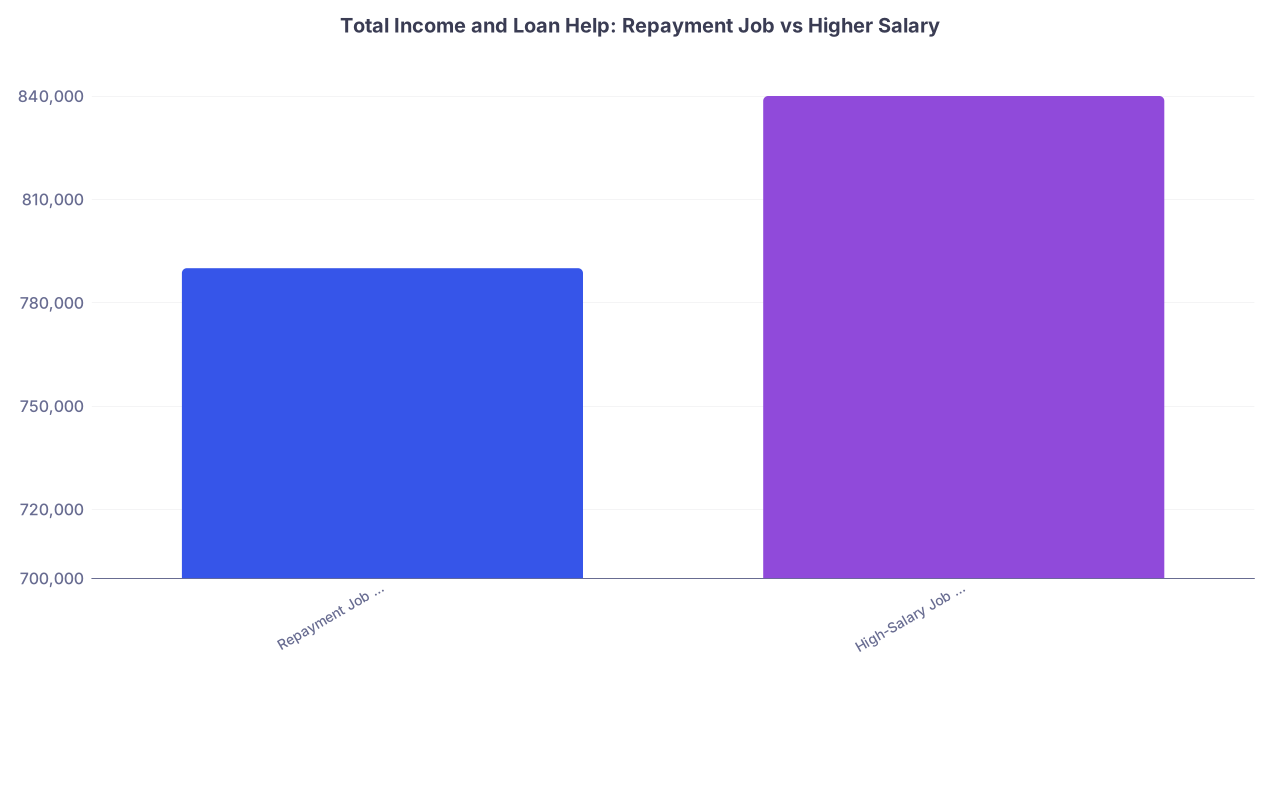
| Category | Value |
|---|---|
| Repayment Job (3 yrs) | 790000 |
| High-Salary Job (3 yrs) | 840000 |
Quick breakdown:
Repayment Job (3 years)
- Salary: $230k x 3 = $690k
- Loan repayment: $100k
- Total compensation before tax: $790k
High-Salary Job (3 years)
- Salary: $280k x 3 = $840k
- Total compensation before tax: $840k
Even before talking about taxes on the repayment, Offer 2 is already $50k ahead in gross pay. If that extra $50k is actually used to pay the loans, you effectively self-funded your own “forgiveness” and kept full control.
But here’s the real kicker:
That $280k job probably escalates faster with productivity. That $230k job with a repayment carrot? Often flat or tightly capped.
So the common myth—“loan repayment offers are always a win over no-repayment jobs”—falls apart once you look at total comp over time, not just the line item labeled “loan help.”
The Other Silent Costs: Taxes, Strings, and Golden Handcuffs
Loan repayment money often isn’t pure. Or simple.
1. Taxes turn “$50k” into something smaller
Most employer loan repayment benefits are taxable. You see $50,000 in the contract. The IRS sees $50,000 of income.
Depending on your bracket, that “$50k” can end up being more like $30–35k net benefit. Meanwhile, the lower base salary is taxed every year, not just the bonus.
I’ve seen people treat the gross repayment number as a 1:1 offset to their loan balance. Wrong by tens of thousands.
2. Clawbacks and commitments
Many programs have:
- Multi‑year commitments
- Clawback clauses if you leave early
- Geographic restrictions
So you get stuck in a job you’ve outgrown because leaving means you:
- Owe back a pro‑rated chunk of the “forgiveness”
- Lose future installments
- Disrupt PSLF or state program timelines
I’ve seen physicians stay in objectively bad situations: unsafe staffing, abusive admin, chronic burnout. Why? “I can’t leave, I’ll lose my loan repayment.”
That’s not financial optimization. That is a golden handcuff with nice branding.
3. PSLF and IDR forgiveness: policy risk is real
Public Service Loan Forgiveness (PSLF) and long‑term IDR forgiveness can be fantastic—when they work.
But chasing PSLF at all costs can backfire when you:
- Contort your entire career to remain “qualifying”
- Take lower-paying jobs than you otherwise would
- Only realize 7 years in that you’re miserable and the admin is toxic
Is PSLF a scam? No. It has actually worked well for many. But treating it as guaranteed and letting it dictate every job move is naïve. You’re tying your financial future to federal rule stability over a decade or more. That’s not nothing.
The Psychological Trap: “Someone Else Is Taking Care of My Loans”
Here’s the dangerous shift I’ve watched over and over:
When people do not have a loan program, they tend to attack their loans hard for the first 5–7 years. They refinance when appropriate, live slightly below their means, and by their mid-30s the student loans are a background noise, not the main arc of their life.
When people do have a repayment program, they mentally outsource the problem.
“The hospital is paying.”
“PSLF will wipe it.”
“The state will forgive it after X years.”
And then they:
- Make minimum payments only.
- Take on car loans, bigger houses, lifestyle creep.
- Arrive at year 6–8 with huge remaining balances and finally start reading the fine print.
One attending put it perfectly: “I treated PSLF like magic, not math. That was dumb.”
Exactly. The program isn’t the issue. The mindset is.
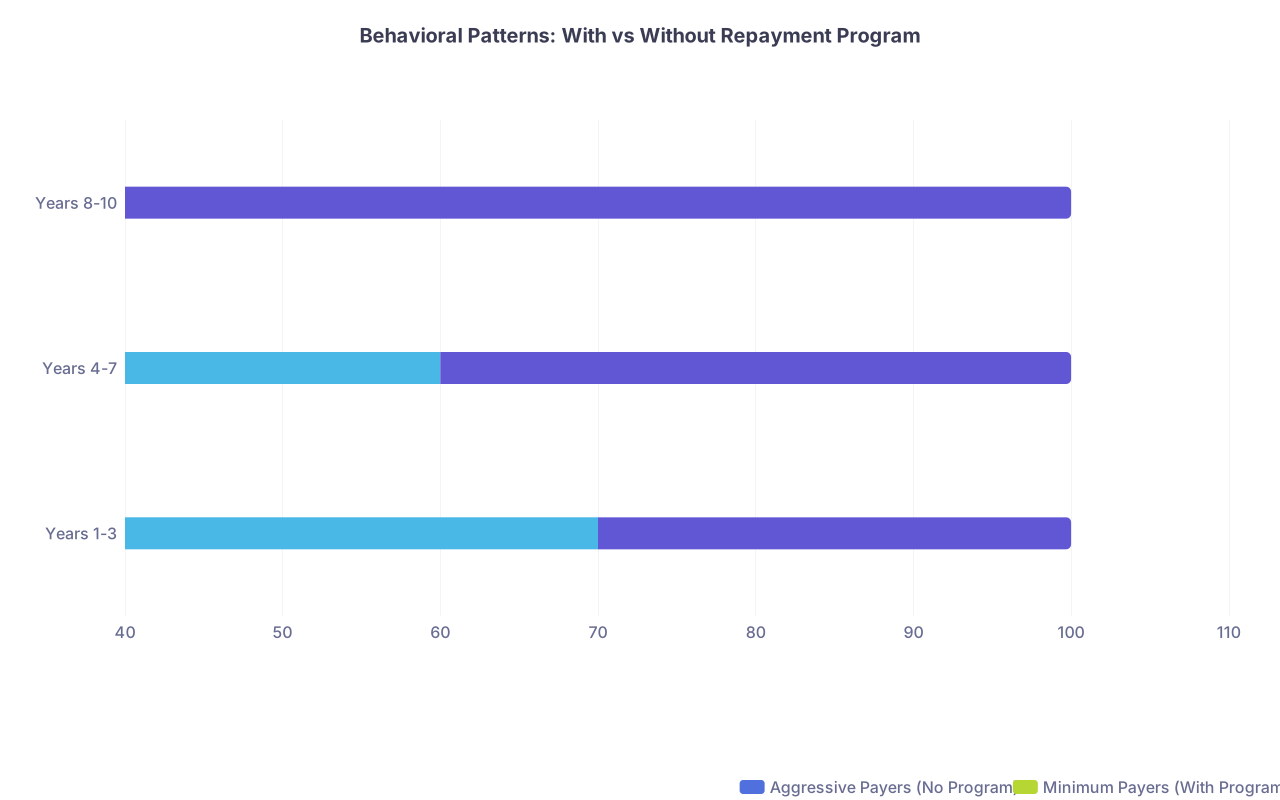
| Category | Aggressive Payers (No Program) | Minimum Payers (With Program) |
|---|---|---|
| Years 1-3 | 70 | 30 |
| Years 4-7 | 60 | 40 |
| Years 8-10 | 40 | 60 |
You can absolutely pair a program with aggressive payoff and win big. Most people don’t. They relax.
When Chasing Repayment Actually Makes Sense
So am I saying you should never take loan repayment deals? No. I’m saying you stop treating them as automatically superior.
They start to make sense when:
Debt is massive relative to income, and you’re realistically looking at IDR + PSLF as the optimal route.
Example: $400k+ debt, primary care at $180–200k, family commitments, not interested in grinding RVUs.You’d take the job anyway, even if the program vanished tomorrow.
You love community health, or VA work, or academia. Loan help is a bonus, not the anchor.Total comp is at least competitive with the broader market, not obviously lower.
Repayment dollars are on top of a fair salary, not being used to mask an under-market base.You’ve actually run the math vs alternative paths.
Not vibe checked. Not “my co-resident said PSLF is amazing.” Actual spreadsheets or at least back-of-the-envelope scenarios.
The red flag is when the only reason a job looks attractive is the loan angle. That’s usually how you buy yourself long-term frustration at a discount.
How to Evaluate a Loan Repayment Offer Like an Adult
You do not need a PhD in finance. You need to stop staring at the “forgiveness” number in isolation.
Here’s the stripped-down thought process I use when I walk through this with residents:
Calculate total 3–5 year compensation for each job:
- Base salary x years
- Likely bonuses (not fantasy projections)
- Employer retirement match
- Loan repayment dollars (after rough tax adjustment)
Compare that to what you could achieve on your own with higher salary:
- If Job B pays $40–60k more per year with no program, assume you send at least half of that difference to loans.
- See which path leaves you with a lower balance plus higher savings.
Stress-test your willingness to stay:
- If this job turns toxic, are you realistically going to stay 5–10 years just to preserve the loan deal?
- If the answer is “no way,” then don’t build a plan that assumes you stay.
Factor in taxes on repayment benefits:
- If the program is taxable, mentally chop 25–35% off the stated number to avoid kidding yourself.
Ask blunt questions:
- How many doctors here actually made it to the end of the repayment term?
- What’s the turnover rate?
- How many people thought they’d stay 10 years and left by year 4?
Those conversations are usually more revealing than any glossy brochure.
The Hidden Upside of Ignoring Repayment Programs
Here’s the part nobody markets to you because there is no brochure for it.
If you ignore the noise and simply:
- Take a solid-paying job you actually like.
- Live like a resident for a few more years.
- Pay your loans on a clear, aggressive schedule.
You tend to end up with:
- More control over your career moves.
- Less anxiety tied to federal policy changes.
- A much faster mental shift from “I am drowning in debt” to “This is manageable background math.”
You do not get to brag about forgiveness at conferences. Nobody sends you a certificate saying “Congrats, you did not overcomplicate your life.” But your net worth and your stress levels usually look a lot better by your late 30s.
I’ve watched both groups over time. The ones who treated repayment programs as a bonus, not a plan, tend to win. The ones who chased forgiveness like a lottery ticket often end up feeling boxed in.
The Bottom Line
Three things to keep in your head:
Loan repayment programs are just compensation structures, not free miracles. Always compare them to what you could earn—and do on your own—without them.
The cost of lower salary, less flexibility, or being trapped in a bad job can easily exceed the “forgiveness” you get. Opportunity cost is real money, just less obvious.
If you would not take the job without the loan carrot, be very suspicious of building your entire financial life around it. Programs should sweeten a good fit, not justify a bad one.