

Do You Really Need to Be Miserable in First Year to Match Competitive?
The idea that you must be miserable in first year to match a competitive specialty is garbage. Loud, persistent garbage—but still garbage.
You do not need to hate your life, lose your identity, and nuke your mental health in M1 to match derm, ortho, plastics, ENT, gas, or anything else. What you need is consistency, strategy, and the ability to not self-destruct chasing optics that do not move the needle.
Let me dismantle the myths one by one, with what the data and real match outcomes actually show.
The Myth of “Sacrifice Everything or You’ll Never Match”
The story you’ve been sold goes something like this:
- If you are not studying 12–14 hours a day as an M1, someone else is—and they’ll take “your” spot.
- If you go to the gym, sleep 8 hours, or have a social life, you are not “serious” about competitive fields.
- Miserable = dedicated. Balanced = complacent.
You hear this from:
- M4s who just matched competitive and have survivor bias.
- Residents who trained in a different era (pre–Step 1 Pass/Fail).
- Classmates flexing their screen time like it’s an Olympic sport.
Here’s the first truth: programs do not care how miserable you were in first year. They care about outputs they can see.
Those outputs are boringly predictable:
- Step 2 CK score (now the main standardized metric in many competitive fields).
- Clerkship grades and narratives.
- Quality of research (especially in competitive fields).
- Letters from people they trust.
- Professionalism and not being a problem.
Notice what’s missing:
- “Number of nights you cried in your call room–themed apartment as an M1.”
- “How many weekends you refused to see sunlight.”
- “Number of friends lost to ‘the grind.’”
What the Data Actually Shows (Not the Group Chat)
Let’s be concrete.
NRMP and AAMC data (Charting Outcomes, Program Director Surveys) repeatedly show the same pattern for competitive specialties:
| Factor | Matched Competitive (avg) | Unmatched Competitive (avg) |
|---|---|---|
| Step 2 CK | 250–255+ | 238–243 |
| Number of Abstracts/Pubs | 5–8 | 2–4 |
| AOA/Top Quartile | Common but not universal | Less common |
| Failures/Remediations | Rare | More frequent |
None of that requires you to be miserable. It does require you to be:
- Consistent over years
- Organized about research and relationships
- Not constantly in academic trouble
That “I studied 14 hours a day and that’s why I matched” narrative is mostly post-hoc ego dressing. What truly correlates with outcomes?
- Good study strategy → strong test performance
- Early, sustained research → enough output by M3/M4
- Reliable behavior → strong letters and no professionalism red flags
You can do all of that and still go home for dinner.
Time Misery vs. Time That Actually Moves the Needle
Let’s talk about time, because this is where first-years blow it.
There’s this fantasy that more hours = more success. Reality is more brutal: bad efficiency just converts into misery, not higher ranking.
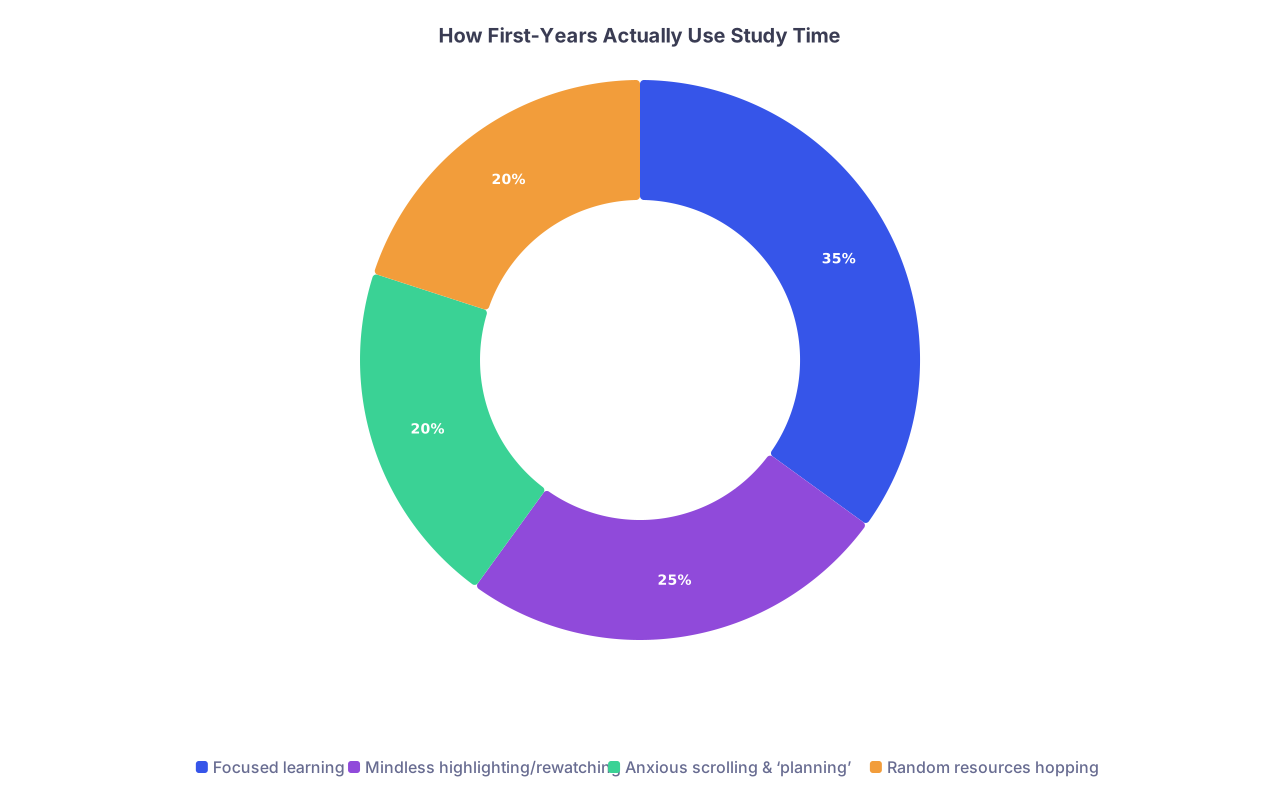
| Category | Value |
|---|---|
| Focused learning | 35 |
| Mindless highlighting/rewatching | 25 |
| Anxious scrolling & ‘planning’ | 20 |
| Random resources hopping | 20 |
The miserable M1 schedule usually looks like this:
- “Study” from 8am–11pm
- Actually do:
- 4–6 hours of real work
- 2–3 hours lost in YouTube “study with me” or rewatching lectures you didn’t need
- 2–3 hours of Reddit/Discord panic
- Then add guilt and sleep deprivation on top
Meanwhile, the balanced M1 who ends up with the same (or better) performance does this:
- 6–8 hours of focused, planned work
- Sleep 7–8 hours
- A workout or some real human connection
- Logs off when they said they would
I’ve watched both of these people take the same exams. The miserable one doesn’t win. They’re just more tired and more dramatic.
What Actually Matters in First Year for a Future Competitive Match
First year is the foundation, not the finish line. For competitive specialties, M1 is about setting up future wins, not maxing every metric on day 1.
Here’s what actually matters in M1.
1. Learning to Crush Exams Efficiently
No, you don’t need to be “gunning for 280 Step scores” from Week 2. But you do need to build:
- A reliable system for learning and retaining high-yield content
- Question-based learning early (Anki + QBanks when appropriate)
- Exam performance that keeps you out of trouble and, ideally, near the top half or better
Misery doesn’t help here. Focus does. Sleep does. A brain that isn’t fried by 2am does.
2. Avoiding Academic or Professional Landmines
Program directors care a lot more if you:
- Failed courses
- Needed remediation
- Have professionalism write-ups
- Took leaves of absence for burnout or crisis (especially preventable ones)
than if you:
- Scored “only” average on your first anatomy exam
- Didn’t attend every optional lunch talk
The irony: the “I must be miserable or I’ll fail” mindset actually pushes some students into the very problems that hurt their application—burnout, anxiety spirals, depression, missed deadlines, cheating shortcuts.
Balance is not a luxury. It is risk management.
3. Building Slow-Burn Relationships and Opportunities
M1 is your chance to:
- Get on a research project (even a small one) in a field you might like
- Get to know 1–3 faculty who will actually remember your name later
- Be reliable, show up to the things you commit to, answer emails like an adult
The miserable, over-maxed student says yes to everything, then flakes, because they’re exhausted and overscheduled.
The balanced student picks 1–2 things, shows up consistently, and becomes “reliable.” Guess who gets better letters and real opportunities by M3?
The “Derm-Ortho-ENT Means Misery” Lie
I’ll address the competitive bogeymen directly.
You’ve probably heard something like:
- “If you even think about derm, you should basically live in the library from Day 1 or forget it.”
- “Ortho people basically move into the anatomy lab.”
- “ENT and plastics are only for absolute machines.”
Here’s what’s actually true.
For these fields, you will eventually need:
- Strong Step 2 (often >250, though there’s a range)
- Research in the field (often multiple projects, ideally with at least a few first- or co-author outcomes)
- Great letters from people in that specialty
- Good clerkship performance (especially surgery-related for surg fields)
Notice the timing. Most of these things hinge on:
- M2–M3 for exam performance
- M1–M3 for research runways
- M3 for letters and clinical evaluations
What M1 needs to be:
- Solid academic base
- No disasters
- Early toe in the research water
- Exploration to see if you even like these fields
You do not need to sacrifice your entire identity in first year for derm/ortho/ENT. You might later choose to push harder for a period (e.g., M3 when you’re stacking auditions + Step 2), but that’s a targeted sprint, not a 4-year ultra-marathon of suffering.
What Healthy High Performers Actually Do Differently
The students I’ve seen land in the top specialties and stay relatively sane? They’re not soft. They’re sharp about where the effort goes.
Patterns I keep seeing:
They time box work.
“I’m done by 7pm unless there’s an exam this week.” And they actually respect that.They use fewer resources, ruthlessly well.
One main text / video source. One question bank. Anki or similar spaced repetition. They don’t chase every shiny new platform a classmate mentions.They protect sleep like it’s an exam.
Because cognitive performance is the exam. Chronic 4–5 hour nights are performance-reducing, not performance-enhancing.They keep 1–2 non-negotiable life things.
Lifting. Running. Weekly dinner with friends or partner. Religious or community activity. Something that reminds them they’re a person whose entire worth is not measured in NBME percentiles.
None of that screams misery. It screams discipline and boundaries. And yes, they still grind hard before big exams. But they don’t live in permanent crisis mode.
The Hidden Cost of “Miserable as Default” Mode
Here’s the part people underplay: the identity shift.
When you make misery your baseline, you start to think:
- “If I’m not suffering, I’m slacking.”
- “If I’m not anxious, I’m missing something.”
- “If I enjoy today, I’ll pay later.”
That mentality doesn’t stop after M1. It follows you into:
- Step prep
- Rotations
- Residency
- Attending life
And suddenly you’re 35, still equating peace with laziness and wondering why you feel hollow despite achieving everything you planned.
First year is when a lot of people permanently tie their self-worth to suffering. That’s not necessary to match competitive; it’s just a convenient trap for high-achieving, approval-seeking people who’ve been told their value lies in being “the hardest worker in the room.”
You don’t need that to get a derm spot. But it’s an efficient way to ruin your 20s.
A More Honest M1 Strategy for Future Competitive Matches
Let me give you something more concrete than “don’t be miserable.”
If you’re M1 and thinking “I might want something competitive,” aim for this:

| Step | Description |
|---|---|
| Step 1 | Start M1 |
| Step 2 | Master core study system by first 2 blocks |
| Step 3 | Fix system, get help early |
| Step 4 | Add light specialty exploration |
| Step 5 | Join 1 research project by end of M1 |
| Step 6 | Maintain sleep/exercise baseline |
| Step 7 | Reassess specialty interest M2 start |
| Step 8 | Passing comfortably? |
In plain English:
First 2–3 blocks:
- Obsess over process, not prestige.
- Become efficient and consistent. Your goal is: “I know how to learn this material with predictable results.”
Once you’re stable academically:
- Go to 1–2 interest group events for specialties you’re curious about.
- Introduce yourself to one faculty in a field you might like.
- Say, “I’m an M1, I’m interested in learning more about your field and possibly getting involved in research when it makes sense.”
Start small with research:
- One project. Not five.
- Something feasible, like chart review, case series, or basic retrospective work.
- Use it to learn the basics of how academic medicine actually functions.
Keep a life:
- Outsiders should still be able to recognize you as the same person you were pre-med school. Maybe slightly more tired, but not unrecognizable.
When It Will Feel Miserable (And Why That’s Different)
I’m not selling you a fantasy. There will be stretches in first year that feel bad:
- Exam weeks when you’re behind and it’s your own fault.
- Anatomy or biochem blocks that just don’t click.
- The first time you realize you are no longer automatically the smartest person in every room.
Temporary misery is part of the territory. But that’s very different from deciding your baseline lifestyle must be misery for four straight years “because derm.”
Short intense periods = normal. Chronic identity-level suffering = avoidable.
The Bottom Line: Misery Is a Choice, Not a Requirement
If you strip away the bravado, anonymous forums, and horror stories, here is what the data and real-world patterns actually say:
- You need strong performance, not self-inflicted suffering.
- You need consistency over years, not masochism in M1.
- You need enough fuel to go hard when it really counts (M2–M3), not to burn out proving something in your first semester.
Competitive specialties absolutely demand work. They do not demand that you despise your life as an M1.
Years from now, you won’t brag about how many nights you cried over Anki decks; you’ll remember whether you built a career—and a life—you can stand waking up to.


