

Being the smartest person in the room is not a shield against burnout. In medicine, it can actually be a risk factor.
I’ve watched the class geniuses crash harder than the “average” students they used to tutor. I’ve seen the 528 MCAT, 260+ Step-style scorer end up in student health, on SSRIs, wondering how it all went sideways when they “did everything right.” The myth is that intellect is armor. The reality: medical school doesn’t primarily test how smart you are. It tests how sustainable your life is.
Let’s dismantle this properly.
The Myth: “If I’m Smart Enough, I Won’t Burn Out”
The story many high-achievers bring into med school goes like this:
- “I never really had to study that hard before.”
- “If things get tough, I’ll just grind a little more.”
- “Burnout is what happens to people who can’t keep up.”
That last one is the quiet part. But it’s there.
What the data shows is almost the opposite. Meta-analyses of medical students worldwide consistently find burnout rates in the 40–50% range. Not “struggling a bit.” Actual burnout: emotional exhaustion, depersonalization, loss of meaning. And those rates don’t spare the top scorers.
Academic success is weakly protective at best and often unrelated once you control for other factors like:
- sleep
- perceived control
- social support
- coping style
And here’s the uncomfortable truth: the traits that make you “top of the class” on paper often map directly onto burnout risk.
Perfectionism. Over-responsibility. All-or-nothing thinking. Internalized worth = performance.
That’s not genius. That’s gasoline.
Medical School Isn’t an IQ Test. It’s a Load Test.
Med school doesn’t ask, “How smart are you?” It asks, “How much sustained cognitive and emotional load can you carry without breaking?”
Let me be specific. Your first year will hit you with:
- Volume: More information than undergrad per week
- Pace: New material while still behind on last week’s content
- Evaluation: High-stakes exams that compress your identity into one score
- Uncertainty: “Do I know enough? Am I falling behind? Is everyone else better?”
High intelligence helps with problem-solving and pattern recognition. Great. It does not magically grant you:
- more sleep cycles
- more emotional bandwidth
- more hours in a 24-hour day
- more resilience to chronic stress hormones
Think of yourself as a system under load. Intelligence is like having a faster CPU. Nice. But if you keep it at 100% utilization, 16 hours a day, with no cooling, it’ll still overheat. The system doesn’t care how elegant your processor is.
The people who survive first year intact aren’t the ones with the highest test scores. They’re the ones who manage load: energy, time, expectations, and recovery. The data from resilience and burnout research is brutally clear on this.
How Being “The Smart One” Actually Raises Your Burnout Risk
Here’s where the myth flips on its head.
1. You’ve built your identity on always being top-tier
If your entire self-concept is “I’m the smart one,” medical school is structurally set up to wreck you.
Because now:
- Everybody was the smart one.
- Exams are curved or at least normalized.
- Someone will outperform you. Repeatedly.
I’ve heard versions of this more times than I can count:
“I got a 76% and passed, but I felt like a failure because most of my friends were in the 90s.”
That’s not an intellect problem. That’s an identity problem. And identity-level hits are exactly what drive burnout: you don’t just feel tired; you feel hollowed out and defective.
Research backs this up: students with a “contingent self-worth” based on grades show higher anxiety, higher depression, and more burnout, regardless of actual performance. Top students are overrepresented in that group.
2. You’ve gotten away with bad habits for years
If you “never had to study much” in high school and college, here’s what often hides under that:
- Chronic procrastination masked by last-minute success
- Perfectionism that only turns on the day before the test
- Minimal experience failing and recovering strategically
That looks fine when the material is easy and stakes are lower. It collapses in medical school because:
- The volume is too high to cram effectively
- The exam style punishes shallow familiarity
- There’s always another exam coming — no real “off” period
Being smart delayed your encounter with the consequences of your habits. Now you meet those consequences in one of the highest-pressure environments in education.
That temporal mismatch? That’s how people break.
What the Data Actually Shows About Burnout Risk
Let’s move from theory to evidence. Across studies of medical students, these factors consistently correlate with burnout and distress:
- Poor sleep quality and short sleep duration
- High perceived stress and low sense of control
- Maladaptive perfectionism (not high standards; self-criticism)
- Low social support and isolation
- Passive coping (avoidance, doomscrolling, numbing)
Notice what’s missing: “Not smart enough.”
Intelligence, MCAT score, and academic ranking are weak predictors of well-being compared to the list above. Some studies even show higher burnout in the top academic quartile once you control for other variables, because those students report:
- greater fear of failure
- more internal pressure
- more competitive comparison
Here’s a simple way to think about it:
| Factor Type | Examples |
|---|---|
| Strong Protection | Sleep, supportive peers, exercise |
| Moderate Protection | Realistic expectations, faculty support |
| Neutral-ish | Raw IQ, MCAT score |
| Clear Risk | Perfectionism, isolation, poor sleep |
Your intellect is mostly neutral. Your habits and environment decide whether you burn out.
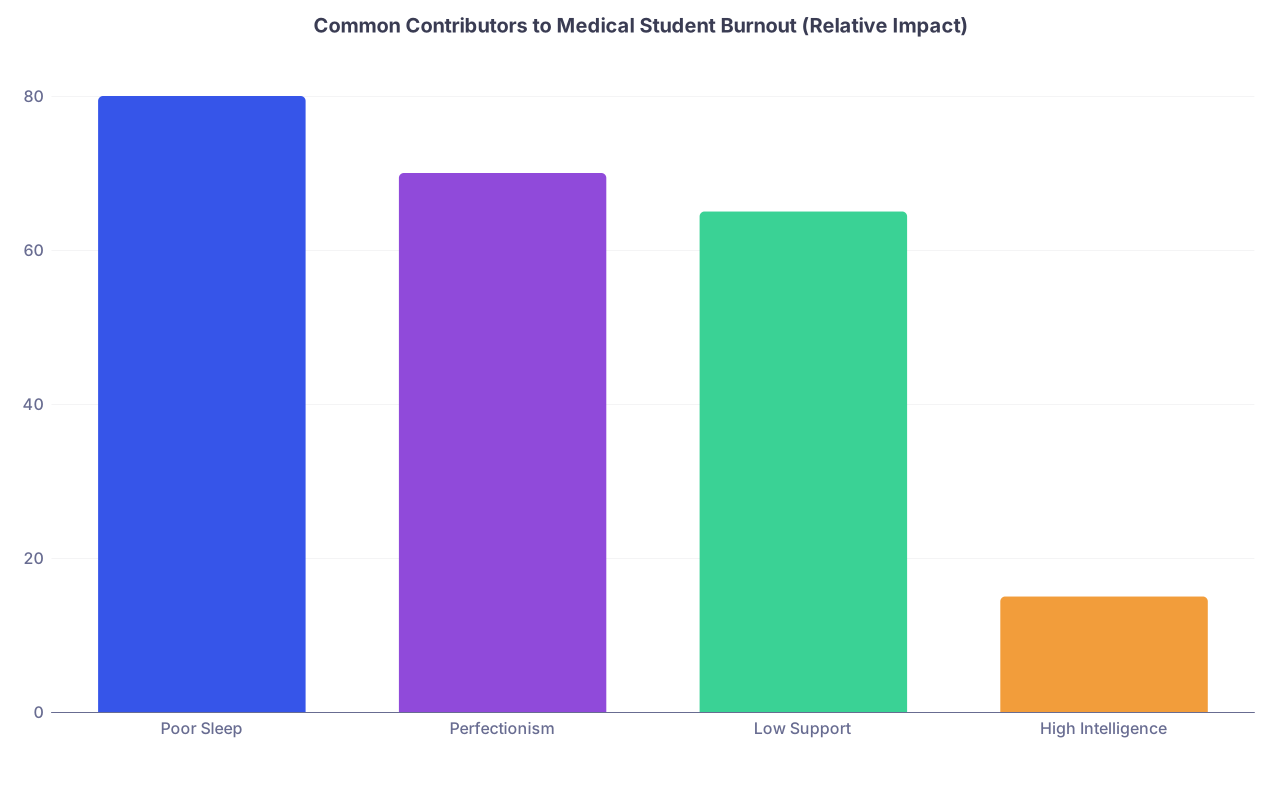
| Category | Value |
|---|---|
| Poor Sleep | 80 |
| Perfectionism | 70 |
| Low Support | 65 |
| High Intelligence | 15 |
Are those numbers exact? No. But they reflect the rough weighting you see across multiple studies: sleep, perfectionism, and support dwarf raw cognitive horsepower as drivers of burnout.
First Year Reality: Where “Smart” Stops Helping
Let’s walk through where being smart flat-out doesn’t save you.
1. The pace doesn’t slow down for you
Your neuroanatomy exam is still on Friday whether you “get it” or not. You can understand the brachial plexus beautifully and still not have enough spaced repetition to recall it three weeks later under pressure.
Medical school is a forgetting machine. Intelligence helps you compress material; it does not give you a bypass around the forgetting curve.
2. Emotional load is indifferent to your GPA
You’ll encounter:
- Your first patient death
- Classmates disclosing serious mental health issues
- Stories of abuse, trauma, neglect in standardized patient encounters
- Your own fear that maybe you chose the wrong path
None of that cares how quickly you can balance a Henderson–Hasselbalch equation.
Psychological resilience is its own domain. And academic talent doesn’t automatically confer it.
3. Chronic stress physiology doesn’t respect your “talent”
You can out-think an exam. You cannot out-think cortisol, sleep debt, and long-term autonomic dysregulation.
Four hours of sleep, six coffees a day, constant low-grade panic about “falling behind” — that will break you eventually, regardless of IQ. The literature on sleep and cognition is brutal: your working memory, executive function, and emotional regulation all tank with chronic sleep restriction. Smart or not.
If anything, smart students burn out in a more self-blaming way:
“I should be able to handle this. I’ve always handled everything. What’s wrong with me?”
That script is poison.
The Real Skill Set That Protects You
So, what actually helps you survive first year with your mental health somewhat intact?
No, it’s not just “grit.” That word’s become a lazy substitute for system-level support. Let’s be more precise.
1. Boring, unsexy consistency
The highest-yield “skill” I see in students who don’t burn out isn’t brilliance. It’s this:
They do a decent amount of work on most days. Then they stop.
Not hero days. Not 16-hour marathons followed by three days of collapse. Daily, predictable, sustainable output.
They:
- Pick a time to stop at night and honor it
- Use active recall and spaced repetition instead of passive rereading
- Accept not knowing everything and still go to sleep
The smartest students often struggle with this because they’re used to last-minute surges and perfection. That style is inflammation for your nervous system.
2. Flexible standards
Perfectionism is a well-researched burnout accelerant. The nuance here: having high standards is not the problem. It’s the rigidity and self-attack when those standards aren’t met.
Med students who cope better tend to think:
- “For this block, a solid pass with key concepts is good enough. I’ll go deeper before boards.”
- “I missed some questions. That’s feedback, not an indictment.”
Whereas the “smart kid identity” whispers:
- “If I’m not at the top, I’m failing.”
- “If I don’t honor every Anki card perfectly, I’m doomed.”
That second mindset keeps the sympathetic nervous system locked on high for months. Eventually, your brain taps out. That’s burnout.
3. Real support, not performance support
There’s a difference between:
- classmates you flex scores with
- and people you can actually say, “I’m not okay” to without shame
Students who weather first year best usually have:
- at least 1–2 non-med friends or family they stay connected to
- at least 1–2 classmates they can be fully honest with
Social connection strongly predicts lower burnout and depression scores. Again: no correlation to “smartest in class.”

| Step | Description |
|---|---|
| Step 1 | Starting Med School |
| Step 2 | Inconsistent habits, overwork, perfectionism |
| Step 3 | Chronic stress and sleep debt |
| Step 4 | High burnout risk |
| Step 5 | Build sustainable routines & support |
| Step 6 | Manageable workload and expectations |
| Step 7 | Lower burnout risk |
| Step 8 | Rely mainly on raw intelligence? |
Practical Shifts for the “Smart But Burning Out” Student
Let’s talk tactics. If you’re reading this as the person who’s always been “the smart one” and now you’re circling burnout, here’s the uncomfortable medicine.
1. Stop treating every exam like a referendum on your worth
You need an internal distinction between:
- Exams that truly require maximal effort (Step exams, maybe some key shelf exams later)
- Routine block exams where “good enough” really is good enough
For first year exams, passing solidly and building durable understanding usually beats chasing the class-high score by sacrificing sleep and sanity.
You’re not here to win M1 biochem. You’re here to become a doctor who can still function in 10 years.
2. Cap your daily effort
Set an upper bound: “X focused hours a day, Y days per week.” For many students, that’s something like 6–8 truly focused hours on weekdays, less on weekends.
And then — this is the part smart students hate — you stop when you hit the cap. Even when you “could do a bit more.” That’s how you build resilience instead of just squeezing more out of yourself until you inevitably break.
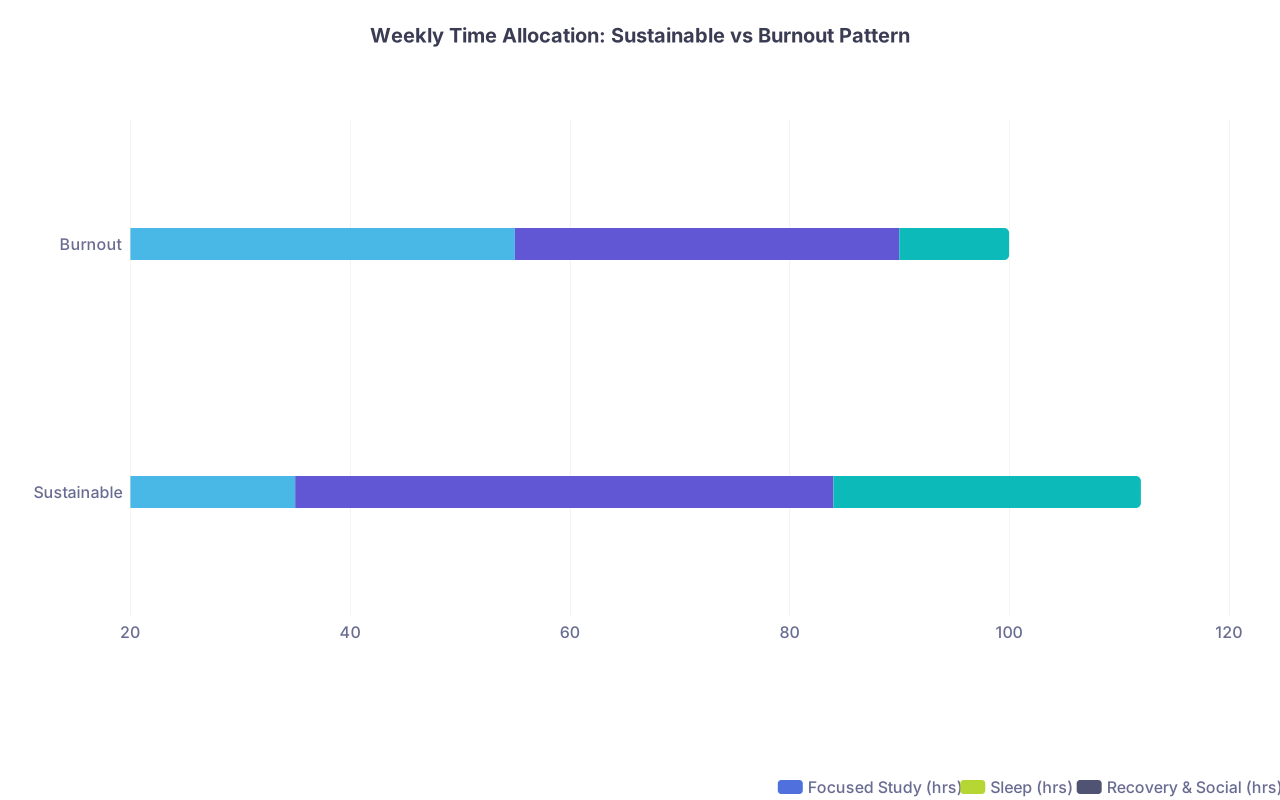
| Category | Focused Study (hrs) | Sleep (hrs) | Recovery & Social (hrs) |
|---|---|---|---|
| Sustainable | 35 | 49 | 28 |
| Burnout | 55 | 35 | 10 |
The point isn’t the exact numbers; it’s the pattern. Burnout students keep pushing study time up while stealing from sleep and recovery. Smart ones just last longer before it shows — then crash harder.
3. Treat sleep as a non-negotiable exam prep tool
Sleep isn’t self-care fluff. It’s memory consolidation, emotional regulation, and impulse control all rolled into one biologic function.
Students chronically sleeping <6 hours don’t just feel worse; they perform worse, especially on higher-order reasoning. The research is boringly consistent.
If you’re “too smart” to prioritize sleep, you’re not being efficient; you’re being arrogant.
4. Build a life outside the score report
If your only sources of validation are:
- exam scores
- pre-clinical honors
- research productivity
You’re setting yourself up for long-term emptiness. You need at least one domain of your life that has nothing to do with medicine where you are:
- not being evaluated
- not trying to optimize
- allowed to be bad at something and enjoy it anyway
People who protect those domains — music, running, gaming with non-med friends, whatever — tend to remain more human and less crispy.

The Harsh but Healthy Reframe
Let me put this bluntly:
If your main plan to avoid burnout is “I’m smart; I’ll be fine,” you’re already on the wrong side of the statistics.
You do not get bonus tolerance to stress because you crushed the MCAT. You do not get a pass on building sustainable habits, boundaries, and support systems. You actually need them more, because the pressure you place on yourself is usually higher.
Being smart is a tool. That’s it. Whether that tool builds something sustainable or cuts you apart depends on how you use it.
So here’s the short version you should remember when M1 and M2 start to squeeze:
- Intelligence is not protective against burnout; habits, sleep, boundaries, and social support are.
- The “smart kid identity” — perfectionism, worth = performance — is gasoline on burnout, not a shield.
- Sustainable consistency beats heroic overwork. Your goal isn’t to be the smartest M1. It’s to still want to practice medicine ten years from now.
You can be brilliant and broken. Or you can be smart enough to design a life that doesn’t require you to be superhuman just to get through first year. Your call.


