

Research in M1 does not matter more than your mental health. And the people acting like it does usually fall into three groups: those chasing prestige, those selling you something, and those who never actually looked at the data.
Let me be blunt: the “you must start research immediately or you’ll never match derm/ortho/ENT” line is wildly overstated, often wrong, and sometimes harmful. What does matter is playing a long game where you’re still functional by the time applications actually go out.
Let’s separate myth from reality.
What Programs Actually Care About (And When)
Residency programs do not evaluate you as an M1. They evaluate you as an M4. The stuff that matters most either:
- Is not visible yet in M1 (clinical grades, Step 2 CK), or
- Gets better with time (research productivity, letters, leadership).
There is data here.
| Factor (NRMP PD Survey) | Weight/Importance* |
|---|---|
| Step 2 CK Score | Very High |
| Clinical (Core) Clerkship Grades | Very High |
| Letters of Recommendation | Very High |
| Class Rank/MSPE | High |
| Research Experience/Pubs | Moderate–High |
| Extracurriculars/Leadership | Moderate |
*Based on aggregated NRMP Program Director Survey findings across specialties.
Notice what’s missing: “Started research in M1 instead of M2/M3.” Programs don’t care when you started. They care whether you have:
- Something to show (posters, papers, meaningful project), and
- A real mentor who can vouch for you.
Those two things often come later, not in the first 6 frantic months of med school.
And here’s the uncomfortable truth for the grindset crowd: if chasing research in M1 wrecks your Step 2 performance, drains you before clinicals, or tanks your mental health enough that your clerkship performance slips, you just traded long-term high-yield metrics for low-yield early noise.
The Myth: “If You Don’t Start Research in M1, You’re Already Behind”
This is the line I hear from panicked M1s every year:
“Everyone else already has projects, my class GroupMe is full of people posting about research mentors, I feel behind.”
You are not behind. You are surrounded by anxious 24-year-olds amplifying each other’s insecurity.
Let’s talk timelines.
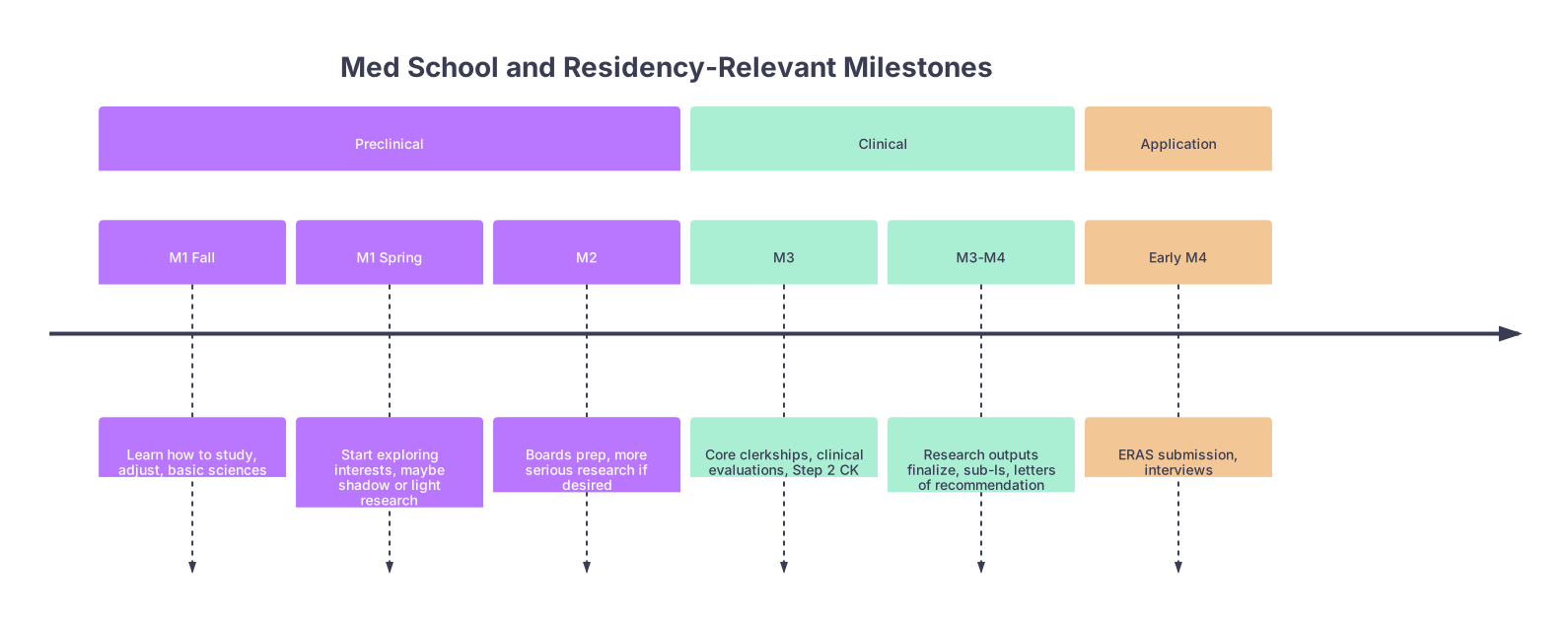
| Period | Event |
|---|---|
| Preclinical - M1 Fall | Learn how to study, adjust, basic sciences |
| Preclinical - M1 Spring | Start exploring interests, maybe shadow or light research |
| Preclinical - M2 | Boards prep, more serious research if desired |
| Clinical - M3 | Core clerkships, clinical evaluations, Step 2 CK |
| Clinical - M3-M4 | Research outputs finalize, sub-Is, letters of recommendation |
| Application - Early M4 | ERAS submission, interviews |
Programs care about what they see in your application file:
- Step 2 CK score (taken late M3 / early M4)
- Clerkship grades (M3)
- Research outputs (often submitted or accepted by M3–M4)
- Letters from attendings who’ve actually seen you function on the wards (M3)
You can absolutely:
- Start research in late M1 or M2
- Ramp up in M2/M3
- Have posters, abstracts, maybe a paper or two by application time
I’ve seen plenty of people match competitive specialties with:
- Zero research in M1
- 1–2 focused projects started M2
- A couple posters and maybe one publication by M4
I’ve also seen the opposite: M1s who joined five “projects,” did grunt work for 18 months, and had nothing concrete by the time ERAS opened. Being involved early is not the same as being productive.
Early research is only “high yield” if:
- The project is well-designed
- The mentor actually publishes
- You stay in long enough to see it through
That usually doesn’t hinge on starting in your first semester.
What the Mental Health Data Actually Shows (Not Just Vibes)
This is where the “grind at all costs” crowd really loses touch with reality.
We have solid evidence that:
- Medical students have higher rates of depression, anxiety, and burnout than age-matched peers.
- Burnout and distress increase across training if nothing changes.
- Poor mental health is linked to worse academic performance, professionalism issues, and in extreme cases, leaving medicine altogether.
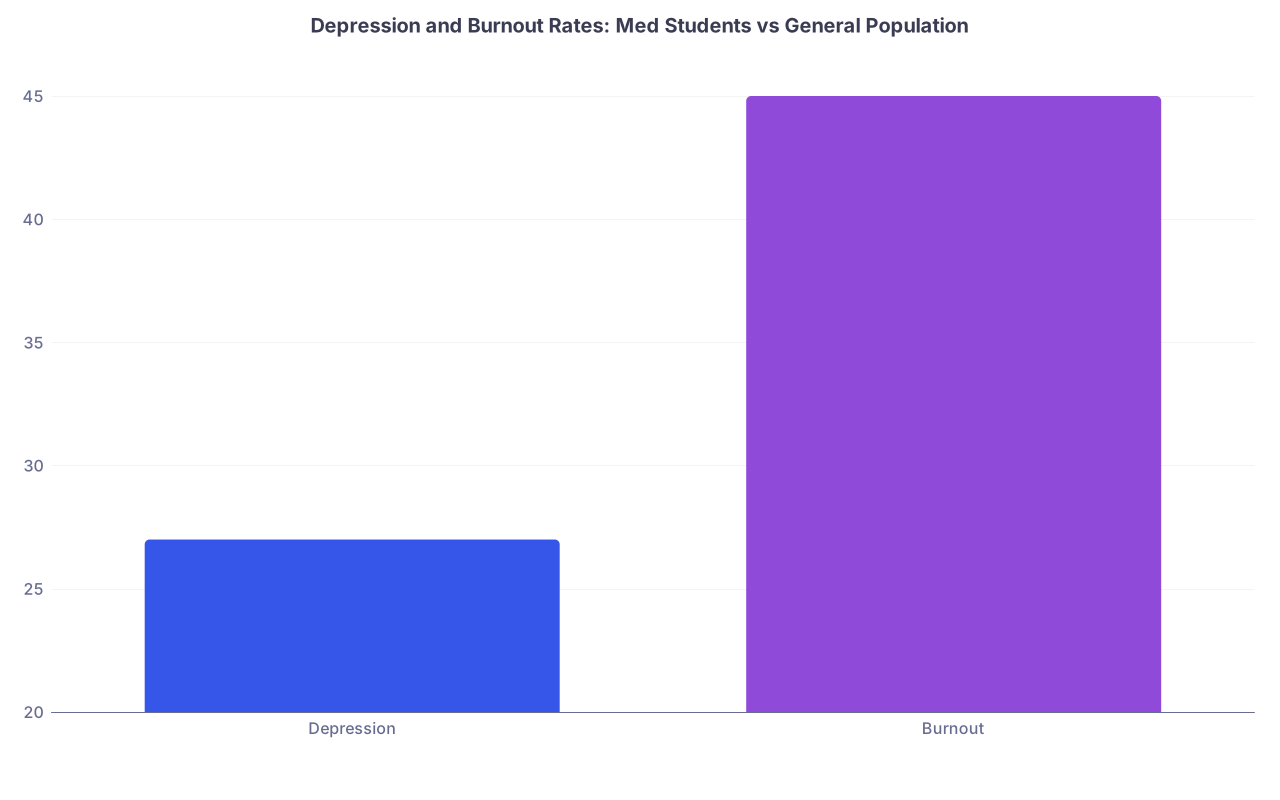
| Category | Value |
|---|---|
| Depression | 27 |
| Burnout | 45 |
(Think of those values as rough percentages often cited in the literature for medical students—far higher than baseline populations.)
Now connect that to M1 reality:
- New city, new school, new expectations
- First exposure to firehose-paced volume
- Social comparison on steroids (“everyone else is coping better than me”)
- On top of that, you’re supposed to start research immediately?
For many students, early overcommitment leads to:
- Chronic sleep debt
- Constant low-level anxiety
- Grade slippage when exams actually matter
- Early cynicism and disengagement
No, a single research position doesn’t suddenly “break” you. But the pattern does:
“I should say yes to every CV-building activity right now, because if I don’t, I’m done.”
That mindset is corrosive.
Mental health isn’t some soft, optional extra. It’s a performance variable. If you can’t sleep, can’t focus, and are emotionally exhausted, you don’t learn well, you don’t test well, and you don’t show up well on the wards. That shows up in the metrics programs do care about.
Competitive Specialty Reality Check: Does Early Research Help?
Let’s talk about the derm/ortho/plastics/neurosurgery anxiety.
Yes, competitive specialties tend to have higher research counts among matched applicants. No, that doesn’t mean “start five projects in October of M1 or you’re out.”
| Specialty | Avg Research Outputs (Matched)* |
|---|---|
| Dermatology | ~15-20 |
| Plastic Surgery | ~13-18 |
| Neurosurgery | ~15+ |
| Orthopedics | ~10-15 |
*These are ballpark figures from recent NRMP data and specialty reports, not exact numbers.
Now the part nobody explains clearly:
- A “research experience” on those stats can be a case report, poster, abstract, or paper. Not all are RCTs in NEJM.
- A lot of those numbers are padded with undergrad research, gap year work, or a dedicated research year, not just stuff you did during M1.
- These averages include MD/PhD and hardcore academic-track students who massively inflate the numbers.
Also: programs don’t just count lines. They read context.
Two focused ortho projects, one poster, one solid paper with a real ortho mentor who writes you a strong letter can beat ten fluff posters no one remembers.
What early M1 research might give you in these fields:
- A head start building a relationship with a specialty mentor
- More time for projects to mature into publications
- A sense of whether you actually like that field
That’s beneficial. But “beneficial” is not the same as “mandatory,” and it absolutely does not justify sacrificing your mental health if you’re already drowning.
The Real Tradeoff: Marginal Research vs Functional Brain
You don’t need me to tell you this, you’ve felt it:
- Sleep-deprived you reads the same sentence five times and remembers none of it.
- Anxious you spends two hours “studying” while mostly spiraling on Reddit.
- Burned-out you stops caring about details, cuts corners, and starts hating medicine.
Now compare two M1 paths over the first year:
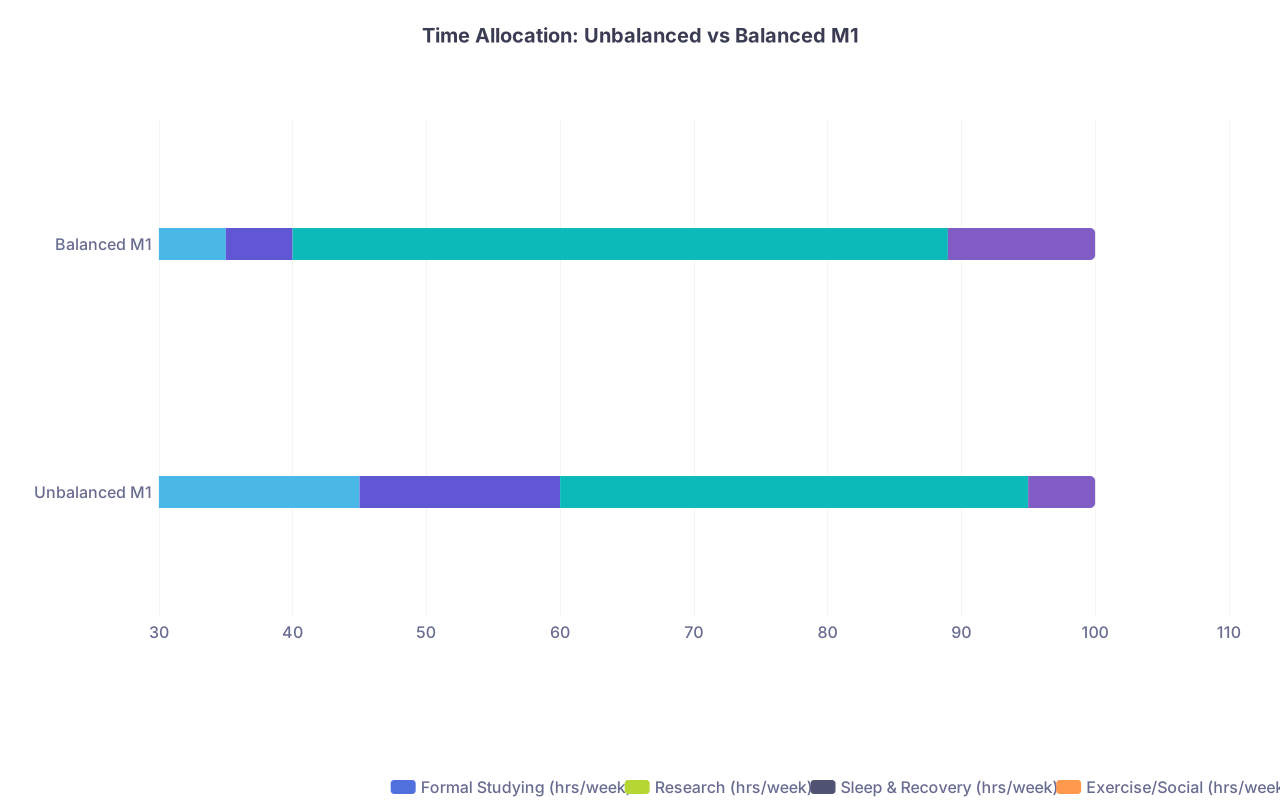
| Category | Formal Studying (hrs/week) | Research (hrs/week) | Sleep & Recovery (hrs/week) | Exercise/Social (hrs/week) |
|---|---|---|---|---|
| Unbalanced M1 | 45 | 15 | 35 | 5 |
| Balanced M1 | 35 | 5 | 49 | 11 |
Unbalanced M1 might net you:
- One shaky research project you’re not even sure you like
- Mediocre recall on foundations you’ll need for Step 2 and wards
- Habitual sleep restriction and chronic stress patterns
Balanced M1 might net you:
- Stronger academic base
- Actual energy when you decide to start research in late M1/M2
- A mind that isn’t already in survival mode by the time things really matter
Residency selection is not won in your first semester. It’s won across four years of not imploding.
When M1 Research Is Worth It (And When It’s Not)
Let’s get concrete. I’m not saying “never do M1 research.” I’m saying stop treating it as sacred.
M1 research is usually worth it if:
- You genuinely have spare bandwidth. Your grades are stable, you’re sleeping, you’re not constantly on edge.
- The project is with a reliable mentor who has a track record of publishing, not just “we have lots of ideas.”
- You’re exploring a field you might care about (especially for highly competitive specialties) and want early exposure.
- The time commitment is actually small and defined (e.g., chart review 3–5 hours/week, not “this will ramp up a lot later” from the start).
It’s usually not worth it if:
- Your basic study system is not stable yet. You’re still swinging wildly between overstudying and bombing practice questions.
- You’re already sacrificing sleep or your mood is tanking.
- The project is vague: “We’re still designing it, just start collecting articles for now.” Red flag.
- The PI is impossible to reach, disorganized, or expects instant replies at all hours.
- You’re saying yes out of panic, not interest.
Put simply: if the cost is your ability to function and learn, the return on early research is rarely high enough.
How to Protect Your Mental Health Without Sabotaging Your Future
You want a practical way to frame this so you’re not stuck in analysis paralysis?
Use a hierarchy.
- Non-negotiables: Sleep, physical safety, basic mental stability
- Foundations: Learning medicine well enough that Step 2 and clerkships are not a disaster
- Multipliers: Research, leadership, niche projects, extra shadowing
The mistake M1s make is treating multipliers like non‑negotiables. They’re not. They only multiply what already exists.
If you’re functioning well and grades are solid:
- Start with one small, defined project. Not five.
- Reassess after 4–6 weeks: Is this draining or energizing? Is this PI legit?
- If it’s bad, leave early. Sunk-cost fallacy destroys a lot of students.
If you’re not functioning well:
- Drop or defer research. Be explicit:
“I overcommitted early in M1 and my academic and personal bandwidth isn’t where it needs to be. I need to step back to stabilize. I hope we can reconnect later when I can contribute reliably.”
Reasonable mentors will respect this. The ones who don’t are not the people whose names you want on your CV anyway.
What You’ll Actually Remember Later
Talk to residents a few years out. Here’s what they usually remember about M1:
- The anatomy exam that almost broke them
- The one friend they vented to at 1 a.m. in the library
- The moment they realized they needed therapy and finally went
- Maybe one or two early mentors who were kind when it counted
Very few say, “I’m so glad I sacrificed my sleep and sanity that first year for that one vague research project that never published.”
The irony is this: the mindset that says “research matters more than your mental health” is exactly the mindset that leads to worse long‑term academic and professional outcomes.
You’re not a robot generating lines on a CV. You’re the person who has to carry this brain and body through four years of medical school, residency, and a multi‑decade career. Protecting that isn’t weakness. It’s strategy.
Years from now, you won’t be proud that you white‑knuckled your way through M1 for a half‑baked research line. You’ll be proud that you built a sustainable way of working so you could show up fully when it actually counted.


