

If you’re routinely pulling all‑nighters in medical school, you’re doing it wrong.
You don’t need zero all‑nighters. But you absolutely can’t build a sustainable M1 year on caffeine, panic, and 3 a.m. Anki marathons. There is a reasonable threshold, and most students blow past it because no one ever gives them an actual number.
Let me fix that.
The Real Answer: How Many Is “Too Many”?
Here’s the blunt version:
- Occasional emergency all‑nighter: fine.
- Habitual all‑nighters: you’re burning your Step score, mental health, and memory.
If you want numbers:
| Frequency (per exam block) | Interpretation | Long‑Term Impact |
|---|---|---|
| 0 | Ideal | Best retention, health |
| 1 | Acceptable | Occasional crunch OK |
| 2–3 | Yellow flag | System problem, fix now |
| 4+ | Red flag | Burnout and score risk |
And over an entire M1 year (usually 6–8 exam blocks):
- 0–3 all‑nighters total → You’re doing great.
- 4–8 → Manageable but you need better systems.
- 9+ → You’re compensating for chronic disorganization or overload. This will catch up with you.
So:
If you’re pulling an all‑nighter before every exam, that’s already “too many.”
If you’re pulling multiple all‑nighters per exam block, that’s a serious problem.
You can stop reading here if you just wanted the number.
But if you want to not wreck your brain and still pass — keep going.
Why All‑Nighters Work Short‑Term and Fail Long‑Term
All‑nighters can bump a quiz or small exam score. I’ve seen students cram histology slides all night, walk in half‑awake, and still pull an 88.
But here’s what actually happens in your brain:
- You fragment what you “learn” into short‑term memory.
- You skip the sleep cycles that consolidate that into long‑term memory.
- Your recall 2–4 weeks later is garbage.
Which matters because medical school isn’t a string of disconnected exams. It’s cumulative:
- Physiology foundations show up again in pathology.
- Biochem “you crammed and forgot” comes back on Step.
- That random pharm detail? Shows up on shelf exams.
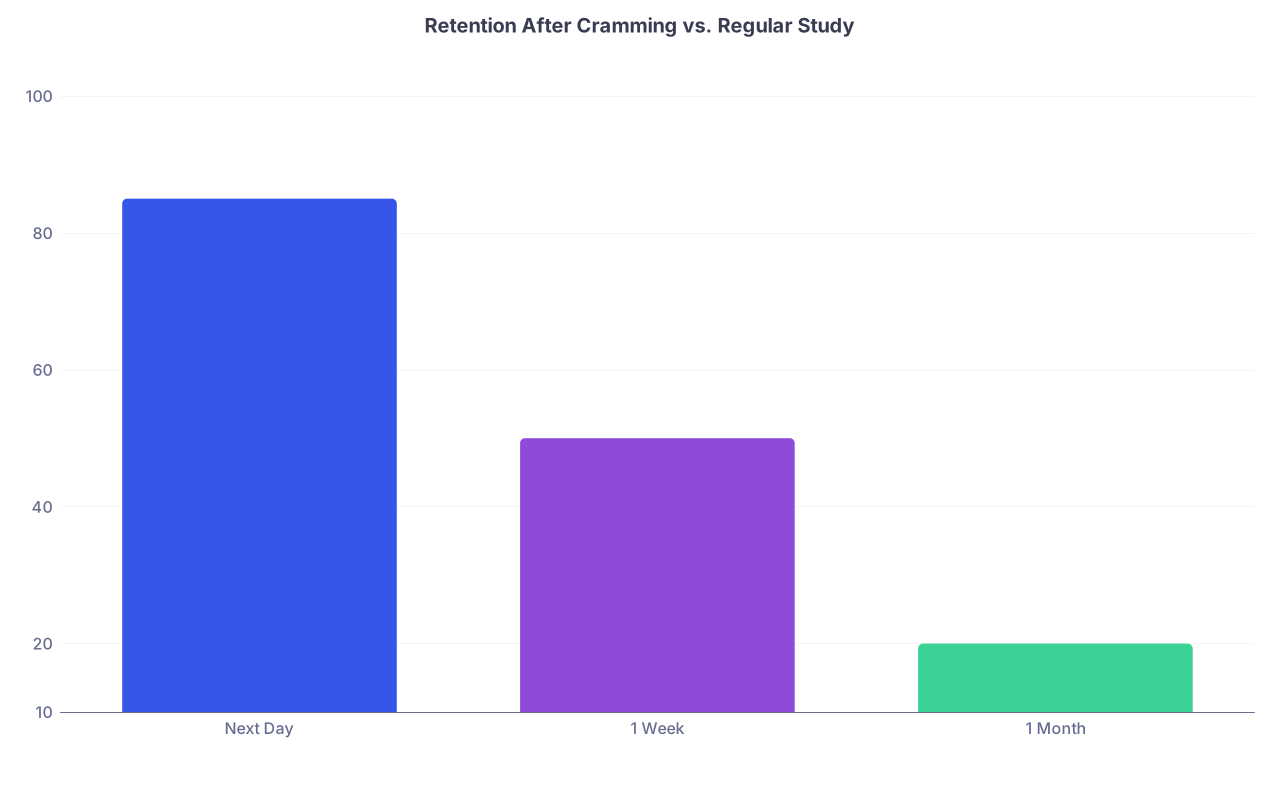
| Category | Value |
|---|---|
| Next Day | 85 |
| 1 Week | 50 |
| 1 Month | 20 |
Rough idea of what I’ve actually seen: cramming gives you good “next‑day” recall, then it falls off a cliff.
So if your plan is to survive M1 on adrenaline and panic: yes, you might pass. But you’ll feel like you’re learning everything for the first time again for Step 1/2.
Short‑Term Damage: What All‑Nighters Actually Do to You
Forget theory. Here’s what shows up the next day when you don’t sleep:
- Slower reaction time. You read the question, re‑read, still feel foggy.
- Worse working memory. Multi-step questions (classic medicine) feel impossible.
- Higher anxiety, more irritability. Tiny things feel huge.
- More careless mistakes. You knew the answer, but misread the question.
- Cravings and trash eating. Sugar, carbs, more caffeine. Cycle continues.
And during rotations (yes, this bleeds into clinical years):
- You’ll snap at nurses and classmates easier.
- You’ll struggle with basic tasks at 3 a.m. on call.
- You’ll feel constantly “behind” no matter how many hours you’re awake.
It’s not about willpower. Chronic sleep loss quietly makes you worse at the exact cognitive skills exams test.
When an All‑Nighter Is Actually Reasonable
I’m not going to pretend you’ll never need one. Sometimes the math really doesn’t work.
Reasonable scenarios:
- You had a family emergency and lost 3–4 days before a big exam.
- You’re sick, missed lectures, and urgently need a salvage attempt.
- You catastrophically misjudged an exam’s difficulty once and need to guarantee a pass.
A “reasonable” all‑nighter looks like this:
- Happens rarely (1–2 times per semester, max).
- Is followed by recovery sleep within 24 hours after the exam.
- Comes with a post‑mortem: what system failed that forced this?
If you’re treating every exam like a crisis, that’s not “grinding.” That’s poor planning masquerading as hustle.
If You’re Already Doing Too Many: What It Actually Means
Frequent all‑nighters are a symptom, not the disease.
They usually signal one (or more) of these:
You’re starting too late each block.
You coast the first 1–2 weeks, then realize there are 300 slides of renal phys the night before the test.You’re using passive study methods.
Rewatching lectures at 1.5x speed. Highlighting PDFs. “Reviewing notes” without active recall or questions.You’re overcommitted.
Four clubs, two leadership roles, research, tutoring, and you’re still pretending you have 40 focused hours for school.You’re underestimating fatigue.
You try to study 12 hours/day, 7 days a week. Spoiler: your brain taps out, you procrastinate, and you cram.There’s an underlying mental health issue.
Anxiety, depression, ADHD — they all sabotage consistency and time sense. Then you “fix” it with panic‑cramming.
The fix is not “try harder.” It’s diagnose why you always end up at 3 a.m. with 80 slides left.
A Concrete Framework: How to Avoid Needing All‑Nighters
You want a method, not platitudes. Here’s a simple structure that works for most first‑years.
1. Decide Your Non‑Negotiable Sleep Floor
For most med students: 6–7 hours minimum, even in exam week.
Does that mean no late nights? No. But you stop the 0–3 hour zombie nonsense.
Example exam‑week rule:
- Night −3: 7 hours
- Night −2: 6–7 hours
- Night −1: 5–6 hours (your “hard push” night, not zero sleep)
This alone saves a ton of all‑nighters. You compress your effort earlier instead of at the very end.
2. Use a Simple Exam‑Block Plan
Say you have a 3‑week block before a big exam. Rough pattern:
Week 1:
- Light content review + start making/doing cards or questions.
- Goal: Get exposure to all material once.
Week 2:
- Heavy active recall (Anki, Qbank, practice questions).
- Identify weak topics early.
Week 3:
- Focus almost entirely on questions and weak areas.
- Only targeted rewatching/reading for what you keep missing.
Most people cram because they don’t define weeks 1 and 2. They kind of “attend” and “watch” and think it counts. It doesn’t.

| Step | Description |
|---|---|
| Step 1 | Week 1: First Pass |
| Step 2 | Week 2: Active Recall |
| Step 3 | Week 3: Questions & Weaknesses |
| Step 4 | Exam Day |
3. Cap Your Daily Study Hours, Raise the Intensity
If you’re “studying” 12–14 hours/day and still behind, you’re not studying. You’re sitting next to your books.
Aim for something like:
- 6–8 hours of real, focused work on weekdays
- 4–6 hours on one day of the weekend
- One half‑day fully off (yes, really)
Use a timer or Pomodoro (25–50 minutes on, short breaks). Phones in another room. Laptop only for what you’re actively doing.
4. Prioritize Methods That Reduce Cramming
Two big ones:
- Spaced repetition (Anki or similar): Cards every day, no matter what.
- Questions early: Don’t wait until you “finish content.” Do questions with imperfect knowledge.
The more often your brain has seen and retrieved something, the less you’ll feel the need to “touch everything” the night before.
How to Handle the Night Before an Exam (Without Destroying Yourself)
You’re the night before a big test. You’re behind. You’re panicking. What now?
Here’s a stepwise decision process.
Do a quick reality check.
- How many lectures/chapters are truly untouched?
- What are your highest‑yield remaining topics?
Set a hard stop for sleep.
Decide: “I’m sleeping from 2 a.m. to 7 a.m.”
You may push later than ideal, but you refuse to go full all‑nighter.Triage, don’t “review everything.”
Focus on:- Common exam themes (cardio phys, renal, acid‑base, etc.)
- Conceptual frameworks > obscure details
- Topics heavily emphasized in lectures/learning objectives
Use high‑yield formats only.
- Practice questions
- Concept maps
- Rapid‑fire recall with a friend
Not: making new pretty notes at midnight.
Stop input, protect output.
Last 30–60 minutes before your sleep:- No new content.
- Just reviewing what you already kind of know, lightly. Calm your brain down.
You’ll score better on 80% coverage + 5 hours of sleep than 100% coverage + no sleep. Every time.
When All‑Nighters Signal a Bigger Problem
There’s a point where this stops being a “study skills” issue and starts being a wellness and support issue.
Red flags:
- You always start studying and then freeze. Anxiety spiral, scrolling, avoidance.
- You need intense pressure (the exam is tomorrow) to even begin.
- You’re constantly exhausted regardless of sleep.
- You’re failing or barely passing despite brutal all‑nighters.
At that point, you’re not lazy. You’re struggling. And trying to solve it with more caffeine and 3 a.m. sessions is like treating sepsis with Tylenol.
What to do:
- Talk to your school’s learning specialist or academic support.
- See a counselor or therapist, especially if anxiety or depression are on the table.
- Get evaluated for ADHD if time blindness and task initiation have always been nightmares.
- Loop in your advisor before things blow up into formal remediation.
You’re not the first med student who hit that wall. But the ones who recover fastest are the ones who stop pretending they can brute‑force it alone.
Quick Comparison: Sustainable vs. Self‑Destruct Mode
| Pattern | Sustainable Student | All‑Nighter Student |
|---|---|---|
| Sleep (exam week) | 6–7 hrs/night | 0–4 hrs/night |
| Questions start | Week 1–2 | Night before exam |
| Stress curve | Mild bump, stable | Low → panic spike |
| Retention 1 month out | Solid | Spotty, relearn from scratch |
| Mental health | Tired but functional | Anxious, burnt, cynical |
You already know which one you are. Or which one you’re drifting toward.
FAQ: All‑Nighters in Medical School
1. Is it ever okay to pull an all‑nighter before a big exam?
Yes, rarely. If a genuine emergency derailed your prep and you’re choosing between a likely fail vs. an all‑nighter, I’d take the hit to sleep once. The key word is “once.” If you’re doing this multiple times a block, it’s not an emergency anymore — it’s your default strategy, and it’s a bad one.
2. What’s worse: sleeping 3 hours or not sleeping at all?
No contest: 3 hours is better than 0. Even a short sleep window gets you some memory consolidation and reduces the worst cognitive impairment. The “I might as well stay up since it’s only 3 hours” logic is nonsense. If you can sleep, sleep.
3. How many nights of 4–5 hours of sleep in a row is too many?
String together more than about 3–4 nights of 4–5 hours and you’re in performance decline territory — slower thinking, higher errors, worse mood. If your “normal” exam‑block pattern is a week of 4‑hour nights, that’s effectively like doing mini‑all‑nighters repeatedly. Not sustainable, and not necessary with better planning.
4. My classmates all seem to be up late; am I hurting myself by going to bed?
No. Some of them are lying, some are exaggerating, and some are quietly burning out. The students who do best long‑term — on shelves, Step, and rotations — are almost always the ones who protect sleep reasonably. It’s not a flex to brag about studying until 4 a.m. It just means your system doesn’t work.
5. I already feel stuck in an all‑nighter cycle. What’s the first thing I should change?
Don’t try to fix everything at once. Start with one rule: pick a non‑negotiable sleep window for the week before your next exam (for example, never less than 5.5–6 hours). Then work backward: adjust daytime study, cut low‑yield tasks, say no to extras. After that exam, sit down for 30 minutes and do a brutally honest review: what actually forced you to consider an all‑nighter this time? Address that root cause next block.
Bottom line:
- One all‑nighter in a rare emergency won’t ruin you. Building your M1 year on them will.
- If you’re pulling more than 1 all‑nighter per exam block, your study system is broken — not your willpower.
- Protecting 6–7 hours of sleep, doing questions early, and fixing the root causes of last‑minute panic will help you more than any extra pot of coffee at 3 a.m.


