

Most advice for “being organized in med school” is useless if you have ADHD.
If you’re starting medical school with ADHD, you already know this. People tell you to “use a planner” and “manage your time better” like you haven’t been trying that your whole life. You are not lazy. You are not broken. But you do need different structures than your neurotypical classmates.
I’m going to walk you through the structures that actually help, specifically for first-year med school life and exams. Not vibes. Not motivational posters. Concrete systems you can implement this week.
I’ll assume a realistic scenario: heavy Anki culture, recorded lectures, small groups, lots of pre-reading, and you’re trying to not drown by October.
Step 1: Build a “Default Week” So You Stop Re-Deciding Everything
If you have ADHD, decision fatigue crushes you faster than the content does. The trick is to reduce “What should I do now?” moments.
You need a Default Week: a rough template of where your time goes. Not a perfect schedule. A default.
Here’s what that means:
- You decide ahead of time:
- When you wake up and go to bed on weekdays
- When you do Anki
- When you watch lectures
- When you do practice questions
- When you rest and see other humans
Then you treat this template like “clinic hours.” It only changes for good reasons (exams, mandatory sessions), not because your brain “doesn’t feel like it.”
Example for a 1st-year with ~25 hrs/week of content:
| Block | Time | Task Focus |
|---|---|---|
| Morning Block 1 | 7:30–9:00 AM | Anki + review |
| Morning Block 2 | 9:30–11:30 AM | Lectures (2x speed) |
| Midday | 12:00–1:00 PM | Lunch + break |
| Afternoon Block | 1:30–3:30 PM | Lectures/Notes |
| Late Afternoon | 4:00–5:00 PM | Practice Qs / Lab |
| Evening | 7:00–9:00 PM | Light review / admin |
You will not follow this perfectly. That is fine.
The point is:
- When it’s 9:30 AM on a Tuesday, you’re not asking “What now?”
- You already know: “This is my lecture block.”
- ADHD brain loves structure it doesn’t have to constantly rebuild.
Two rules that matter:
- Keep the first 90 minutes after you wake consistent. This is where your best focus goes.
- Put Anki and retrieval work early in the day, not at 10 PM when your willpower is gone.
Step 2: Use Anki and Question Banks Without Letting Them Take Over Your Life
If you have ADHD and you’re in med school, spaced repetition is your friend. But it can become a black hole.
The only way Anki works with ADHD: hard limits
You need:
- A daily review cap (e.g., max 250–300 reviews/day during heavy blocks)
- A new card cap (20–40/day depending on speed)
If you don’t cap this, you’ll end up skipping days, and then 800 reviews hit you like a truck and you abandon it entirely.
Use these simple rules:
- If you miss a day: do not “catch up” everything. Just:
- Turn off “bury related” for that day if needed
- Do today’s reviews + as many overdue as you can in 45–60 minutes
- Anything left over gets pushed; not ideal, but better than quitting
- Hard stop Anki after 60–75 minutes per day. No “I’ll just finish this stack at 2 AM.”
How to integrate Anki into real studying
Do not make cards for everything. ADHD brain will happily over-engineer a deck and never actually study.
Use Anki for:
- High-yield facts
- Processes that need repetition (pathways, mechanisms)
- Tiny details you can’t afford to re-learn 10 times
Don’t waste time making:
- Beautiful, perfect cards
- Cards with multiple unrelated facts
- Long paragraphs
If card-making is a trap for you:
- Use shared decks (e.g., AnKing, school decks)
- Only lightly edit them for clarity
- Make your own cards only when:
- You miss something in a question or practice session
- A professor outright says “You’ll be tested on this”
Step 3: Control Your Study Environment Like It’s a Medication
ADHD is massively context-dependent. You cannot rely on “just focusing harder” in chaotic environments.
You need two primary study environments:
- Deep work zone (heavy focus)
- Light admin zone (emails, schedule, basic review)
Deep work zone
This is for:
- Anki
- Practice questions
- Exam crunch time
Good options:
- Quiet floor of library with headphones
- Small study room booked in advance
- Same coffee shop corner, same seat, same time
Rules for deep work:
- Phone out of reach. Not “face down.” Across the room or in bag.
- Only one tab open: your study material or question bank.
- Use a single app or extension to block trash sites (Freedom, Cold Turkey, Forest).
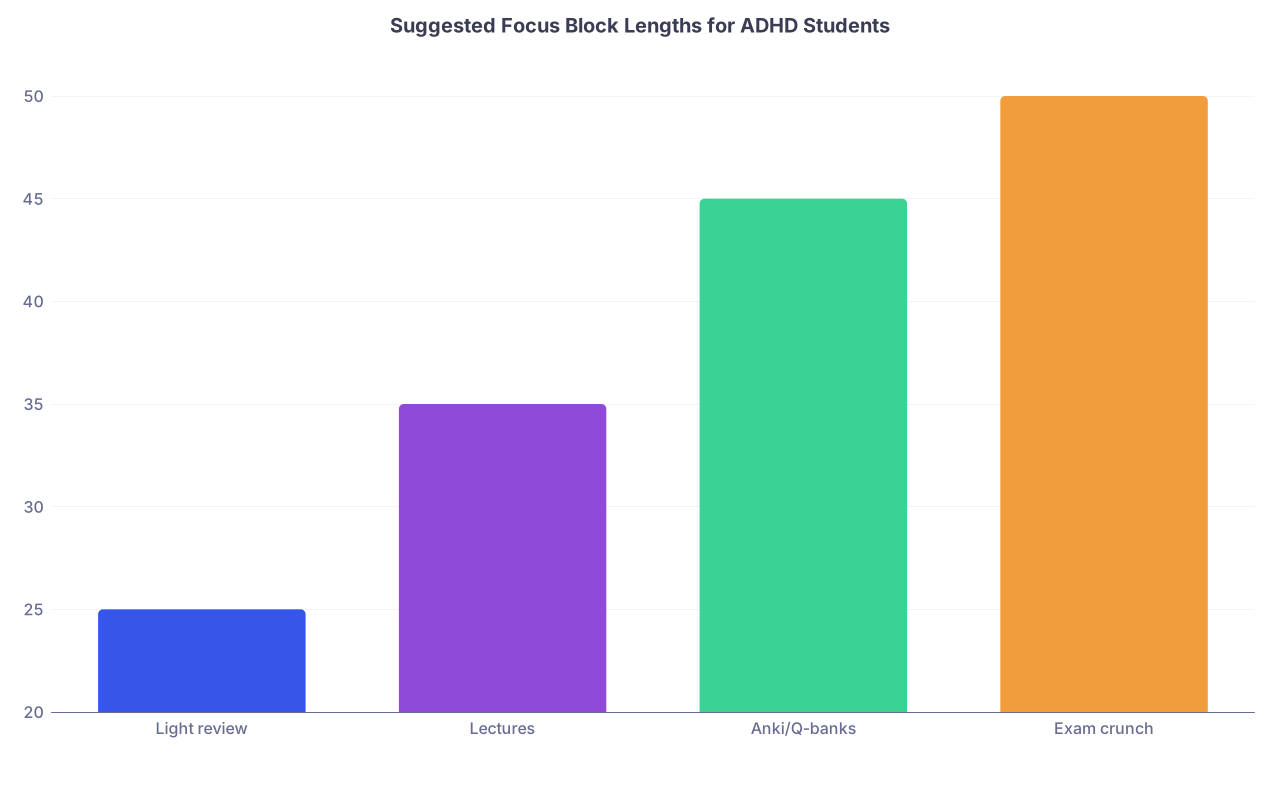
Time blocks that ADHD brains can handle
You probably cannot do 3 hours straight. Don’t pretend you can.
Try:
- 25 minutes on / 5 minutes off (classic Pomodoro)
or - 45 minutes on / 10–15 minutes off for heavier stuff
Important twist: pre-plan what you’ll do in each block. Example:
- Block 1 (9:00–9:45): Anki reviews, cap 150 cards
- Block 2 (10:00–10:45): Watch 1 lecture at 1.5–2x speed, light notes
- Block 3 (11:00–11:45): 10 practice questions, review explanations
Your break should not be: scrolling TikTok until your soul leaves your body. Try:
- Bathroom + water
- 5 pushups or quick stretch
- Stare out a window, no phone
You’re not trying to be moral. You’re trying to not nuke your dopamine.
| Category | Value |
|---|---|
| Light review | 25 |
| Lectures | 35 |
| Anki/Q-banks | 45 |
| Exam crunch | 50 |
Step 4: Turn Assignments and Exam Prep into a Visible System
If it’s not visible, it’s basically gone. Out of sight, out of working memory.
You need a single source of truth for:
- Exam dates
- Quiz deadlines
- Lab reports
- Required assignments
Don’t scatter this across 5 apps. Pick one:
- Google Calendar
- Notion
- Apple Calendar + Reminders
- A physical weekly planner you actually keep open on your desk
The triple-reminder system
For each exam or major assessment, set:
- A reminder 2 weeks before: “Plan study for [Exam X]”
- A reminder 1 week before: “Practice questions + weak areas – [Exam X]”
- A reminder 2 days before: “Finalize review + logistics (print, links, timing)”
Why three? Because your executive function is not to be trusted with one.
Weekly “reset” ritual
Once a week—Sunday works, but pick any day—you do a 30–40 minute reset:
- Open the LMS: check all upcoming assignments and tests
- Put them into your calendar or planner
- Decide:
- What days are for heavy study (3–4 focused blocks)
- What days will be lighter (labs, social, errands)
- Adjust your Default Week only for this week’s realities
Do this consistently and your “oh crap, there’s a quiz tomorrow?” moments drop fast.
Step 5: Use Your ADHD Brain’s Strengths Instead of Fighting Them
ADHD is not just a deficit. You’ve got some unfair advantages—if you use them properly.
Hyperfocus: weaponize it, don’t waste it
You know those days you suddenly tear through 6 hours of work like it’s nothing? Hyperfocus. You can’t force it, but you can be ready to exploit it when it shows up.
When you feel it coming:
- Drop low-priority tasks
- Shift to:
- Practice questions
- Hardest content
- Cumulative review
And, yes, set an alarm to:
- Eat
- Pee
- Sleep at something resembling a human time
Interest-based motivation: stop trying to study in ways you hate
If you hate:
- Taking expensive pretty notes
- Rewriting PowerPoints
- Listening to 1x speed lectures
Then do not build a system around that. You will not use it.
Instead:
- Use higher-speed video (1.5–2x) with active pausing, not re-writing the slides
- Study with a body double: another person working next to you, even virtually on mute
- Turn review into quick teaching: explain a pathway to a classmate or to your wall
ADHD brains love:
- Novelty
- Challenge
- Social connection
- Immediate feedback
So leverage:
- Question banks (immediate right/wrong, explanation)
- Short review sessions with classmates
- Teaching mini-summaries out loud

Step 6: Get Accommodations Early—Not After You’re Drowning
Here’s the blunt truth: waiting to “see how it goes” before asking for accommodations is a trap. By the time you admit you’re struggling, the damage is already done, and now you’re dealing with shame, low confidence, and maybe remediation.
If you have a prior ADHD diagnosis, or even a strong suspicion and some history (504 plan, IEP, old testing), talk to disability services before or during orientation.
Common accommodations that actually help:
- 1.5x or 2x exam time
- Reduced-distraction exam room
- Permission to use noise-cancelling headphones or earplugs
- Breaks during long exams
- Flexibility for deadlines in documented flare periods
Here’s the pattern I see constantly:
- Student thinks: “I don’t want special treatment; maybe I’ll be fine.”
- First unit hits. Scores tank or come in way below potential.
- Panic. Shame. Now they’re trying to rescue the semester and get evaluated at the same time.
You’re not cheating. You’re removing friction so your actual knowledge shows up on paper.
If you do not have a formal diagnosis but strongly suspect ADHD:
- Ask your PCP for referral now (not in October)
- Understand it may take 1–3 months to get full testing, sometimes longer
- In the meantime, build the external structures anyway—they help regardless
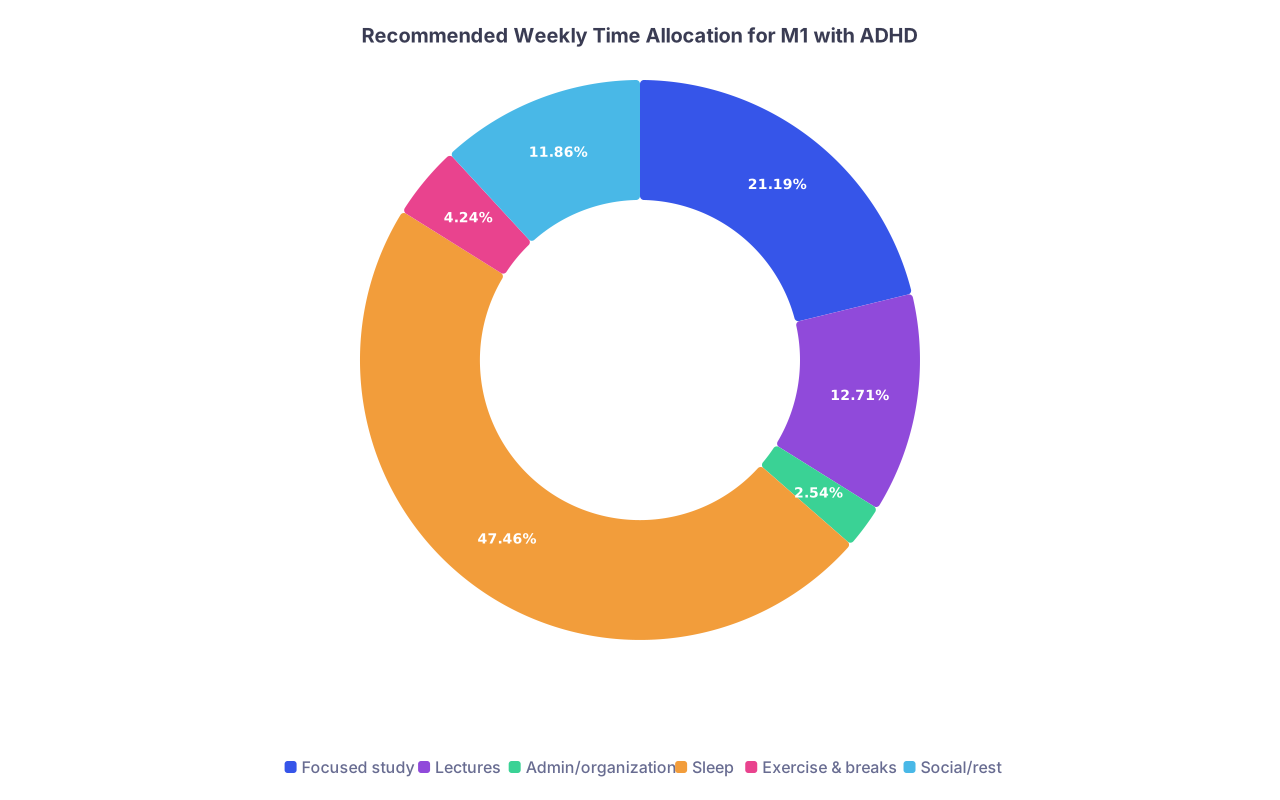
Step 7: Manage Energy, Not Just Time
Med school will happily consume every hour you give it. ADHD brains burn out faster if you never hit the brakes.
You can’t “time manage” your way around exhaustion. You need energy management.
Concrete rules that help:
- Pick one weeknight that is completely off from studying (or 90% off). Protect it.
- Protect sleep like tuition is tied to it. 6 hours night after night is slow suicide for your focus.
- Move your body 3–4 times a week, even if it’s just a 20-minute walk between study blocks.
Your brain is your main tool now. Treat it like equipment you have to maintain.
| Category | Value |
|---|---|
| Focused study | 25 |
| Lectures | 15 |
| Admin/organization | 3 |
| Sleep | 56 |
| Exercise & breaks | 5 |
| Social/rest | 14 |
Step 8: Fix the Two Most Common First-Year ADHD Failure Modes
I’ve seen the same two patterns repeat in M1 students with ADHD:
Failure mode #1: All catching up, no consolidation
Signs:
- You’re perpetually “behind on lectures”
- You watch lectures, feel relief, but don’t test yourself
- On exams, everything feels “familiar” but you can’t retrieve details
Fix:
- For every 60 minutes of “input” (lectures, reading), aim for at least 30 minutes of output:
- Anki
- Practice questions
- Whiteboard summaries
If time is tight, cut input, not output. You’re not graded on how much content you consumed.
Failure mode #2: Perfectionism that leads to paralysis
Signs:
- You can’t start because you “don’t have the perfect setup”
- You redo schedules constantly but never settle
- You rewrite notes more than you review them
Fix:
- Adopt the 80% rule: if a method works at ~80% effectiveness, it’s good enough.
- Use “minimum viable session”:
- “I will do 10 Anki cards and 2 practice questions.”
9 times out of 10, once you start, you’ll keep going.
- “I will do 10 Anki cards and 2 practice questions.”
And if you don’t keep going? You still did more than zero. That matters.

| Step | Description |
|---|---|
| Step 1 | Start of Study Block |
| Step 2 | 5-10 min movement + water |
| Step 3 | Decide task: Anki, Qs, Lecture |
| Step 4 | Set 25-45 min timer |
| Step 5 | Single-task until timer ends |
| Step 6 | Log what you did + next step |
| Step 7 | Energy OK? |
| Step 8 | Continue? |
Step 9: Social Structures That Quiet the Chaos
You do not have to announce your ADHD diagnosis to the world. But going through med school in complete isolation is a bad idea.
Useful social structures:
- One or two reliable classmates you can text:
- “What’s actually due this week?”
- “Did they say this was on the exam?”
- A small study pod (2–4 people, max) that:
- Meets once or twice a week
- Reviews high-yield concepts
- Does practice questions together
Ground rules for ADHD-friendly pods:
- Set a clear goal at the beginning (“We’re doing 15 questions on cardio phys.”)
- No 30-minute tangents about how much you hate the block
- Time-bounded sessions (60–90 minutes, then everyone leaves)
Also: seriously consider therapy or coaching with someone who knows ADHD and med training. Not for “fixing you.” For:
- Accountability
- Distress tolerance
- Reframing constant self-criticism
Step 10: Talk to Your Faculty Before It’s a Crisis
You will have blocks where your ADHD hits harder. Sleep gets off. Mood drops. Focus tanks.
If you ghost everyone and wait until you’re failing, you have fewer options.
Instead:
- Identify:
- Course directors
- Advising dean
- Someone in student affairs you can tolerate
- Early in the year, send a short, professional email:
- “I have ADHD and work with disability services. If issues come up, is it okay if I reach out to you for guidance on course-specific strategies?”
Then, if you start slipping:
- Email sooner than feels comfortable:
- “I’m noticing [specific problem]. I’d like to adjust early rather than waiting until it’s too late. Do you have 15 minutes in the next week to talk?”
Most schools would rather help you early than remediate you late. Use that.
FAQ (Exactly 4 Questions)
1. Should I tell my classmates and faculty that I have ADHD?
You’re not obligated to tell anyone except disability services (and even there, you’re not “telling,” you’re documenting). For classmates, share on a need-to-know basis. If you have a close study partner, it can help to say, “I have ADHD, so structure and reminders help me a lot; if I seem scattered, that’s what’s going on.” For faculty, it’s enough to say you’re registered with disability services if you’re discussing exam logistics. You do not need to give your life story.
2. What if I already feel behind, and it’s only the first month?
Stop trying to “catch up” on every missed lecture. Triage. Look at the exam blueprint or ask upperclassmen what was high-yield. Prioritize: current week’s material + practice questions + minimal Anki. If you have time, selectively review older high-yield topics. Book a meeting with someone in academic support and be blunt: “I have ADHD and my current system isn’t working. I need a simple, sustainable plan for the next 2–3 weeks.”
3. How do I handle back-to-back exams with ADHD when my brain is fried?
Between exams, don’t cram every available hour. That just guarantees worse focus. Instead, use short, high-yield blocks: 45 minutes of questions + review, then a real break. Sleep becomes non-negotiable. Use checklists for exam logistics (time, location, what to bring), so you’re not wasting brainpower on details. If your school allows spaced exams or specific accommodations for cognitive fatigue, ask disability services what’s possible.
4. What if medication alone isn’t fixing my focus in med school?
That’s normal. Meds raise the floor, they don’t build the structure. If you’re relying only on meds and vibes, you’ll still struggle. Combine medication with: a Default Week, external reminders, blocked-off deep work time, and some social accountability (study pod, coach, therapist, or even a friend who checks in). If your meds wear off too early or make sleep terrible, follow up with your prescriber—dose, timing, or formulation may need adjusting under this new workload.
Key takeaways:
You’re not going to “willpower” your ADHD away in med school. You need simple, repeatable structures: a Default Week, capped Anki, visible deadlines, and controlled environments. Get accommodations early, use your strengths (hyperfocus, interest-driven learning), and ask for help before things implode. That’s how you survive—and actually do well—in first year with ADHD.


