

The hidden curriculum of medical school punishes students without doctors in the family.
If you are the first doctor in your family, you’re not imagining it: your classmates with physician parents are playing a different game with different rules. They already know the unspoken stuff—what matters, what doesn’t, which attendings to impress, how to email a dean without sounding desperate. You’re trying to learn biochemistry and an entire professional culture at the same time.
This is survivable. But only if you stop pretending you have the same starting point as everyone else and build yourself a roadmap on purpose.
Below is what to do, step by step, during first year—specifically if you’re the first in your family to do this and feel like you’re missing “insider info.”
1. Accept That You’re Playing on Hard Mode (And Stop Blaming Yourself)
The first trap: thinking your struggle means you’re not cut out for medicine.
You see classmates who seem calm, know what “Step 1” means on day one, already have shadowing stories with “my mom, the cardiologist,” and you’re still figuring out how to log into Anki. Easy to turn that into: “I’m behind. I’m not smart enough.”
No. You’re not “behind.” You’re under-informed.
Here’s the real situation:
- Students with physicians in the family grow up hearing “third-year rotations,” “match,” “Step scores,” “away rotations,” “malpractice,” at the dinner table.
- They know early that a bad first exam doesn’t kill your career, what specialties are DOA with low scores, how important letters of recommendation actually are.
- They often have built-in mentors. Their parent calls a friend at the hospital to get them a summer research spot. You don’t.
This isn’t about intelligence. It’s about access.
So your job in first year is twofold:
- Learn medicine.
- Rapidly acquire the “hidden curriculum” your classmates inherited.
You cannot control what your family background is. You absolutely can control how aggressively you close that gap.
Stop judging yourself for not knowing what no one ever explained. Replace the shame with strategy.
2. Build a “Replacement Family” Inside the System
If your family can’t walk you through this, you need a surrogate network. That sounds transactional. It is. It also works.
You want three types of people around you:
- A near-peer guide (MS2 or MS3)
- An institutional adult (faculty/Dean/learning specialist)
- At least one non-medical friend or family member who keeps you sane
How to get a near-peer mentor (without being awkward)
Do not send a vague “Can you mentor me?” email to random people. That puts work on them. Instead, be specific and light.
Use:
“Hi [Name],
I’m an MS1 interested in getting my bearings with first year and board prep. You’re one year ahead and seem to have done well. Would you be open to a 20-minute chat about:
– What you wish you’d done differently MS1
– How you approached studying for [course/boards]
– Any big pitfalls I should avoid
I’ll come with specific questions and can work around your schedule.
Thanks for considering it,
[Your Name]”
Where to find them:
- Your school’s mentorship program (if they have first-year–second-year pairing, sign up yesterday)
- Student orgs (SNMA, LMSA, APAMSA, specialty interest groups)
- The person who gives a student talk during orientation and clearly knows what they’re doing
Your goal for that first meeting is not a life mentor. It’s information:
- How did they study for anatomy?
- What resources were actually useful vs hype?
- How early did they start thinking about boards?
- What surprised them about first year?
If it goes well, you say: “This was incredibly helpful. Would it be okay if I reach out again during the semester with questions as they come up?”
Now you have a guide.
Get at least one “inside” adult
You need one faculty/staff person who:
- Knows your name
- Knows you’re first-gen / first doctor in your family
- Is explicitly okay with you asking “basic” questions
Candidates:
- Your learning specialist / academic support office
- An assistant dean of student affairs
- A faculty advisor assigned to your small group
- Director of your first-year course
Script for the first meeting:
“I’m the first in my family going into medicine, so I don’t have much background in how med school works beyond the official handbook. I’d really appreciate your advice about what actually matters first year and what traps to avoid. Also, if there are things I should be thinking about now for later (boards, rotations, residency), I’d rather not miss them because no one told me.”
You have now officially told an adult: “Someone needs to tell me the hidden stuff.”
That matters. They’ll say things in passing like, “This exam isn’t heavily weighted,” or “You don’t need research this year,” or “Don’t worry, one failed quiz never shows up in residency applications,” that your classmates’ parents would’ve told them already.
3. Create Your Own Roadmap: What Actually Matters in First Year
If you don’t know what the game is, you can’t play it strategically. Your anxiety skyrockets because everything feels equally important. It’s not.
Here’s the hierarchy for M1, simplified:
| Priority Level | Focus Area |
|---|---|
| Critical | Pass courses reliably |
| Very Important | Build study system |
| Important | Understand exams/boards |
| Helpful | Early career exposure |
| Optional | Extra research/clubs |
1. Pass your classes with as little wasted effort as possible
Residency programs do not care if you got 92% vs 85% on your first anatomy exam. They care that you:
- Passed all your preclinical courses
- Didn’t repeat a year
- Handle volume and complexity without breaking
So your question is not “How do I get the highest grade?” It’s “What is the minimum effective way to consistently pass while staying functional?”
That means:
- Go to required sessions; skip non-required lectures if recorded and that time is better used studying.
- Use one primary resource per course (e.g., lecture slides + Anki, or Boards & Beyond + syllabus). Not five.
- Figure out from MS2s: “For this course, what did people who did well actually use?”
2. Build a sustainable study system by the end of first semester
You need a stable routine more than you need the “perfect” resource stack.
Pick something like:
- 3–4 hours of focused studying during the day between classes
- 2–3 hours in the evening if needed
- A weekly review block (half-day on weekend)
- One real day off every 1–2 weeks to not lose your mind
You’re aiming for: “I know what I do on a regular Tuesday,” not panic-cramming every week.
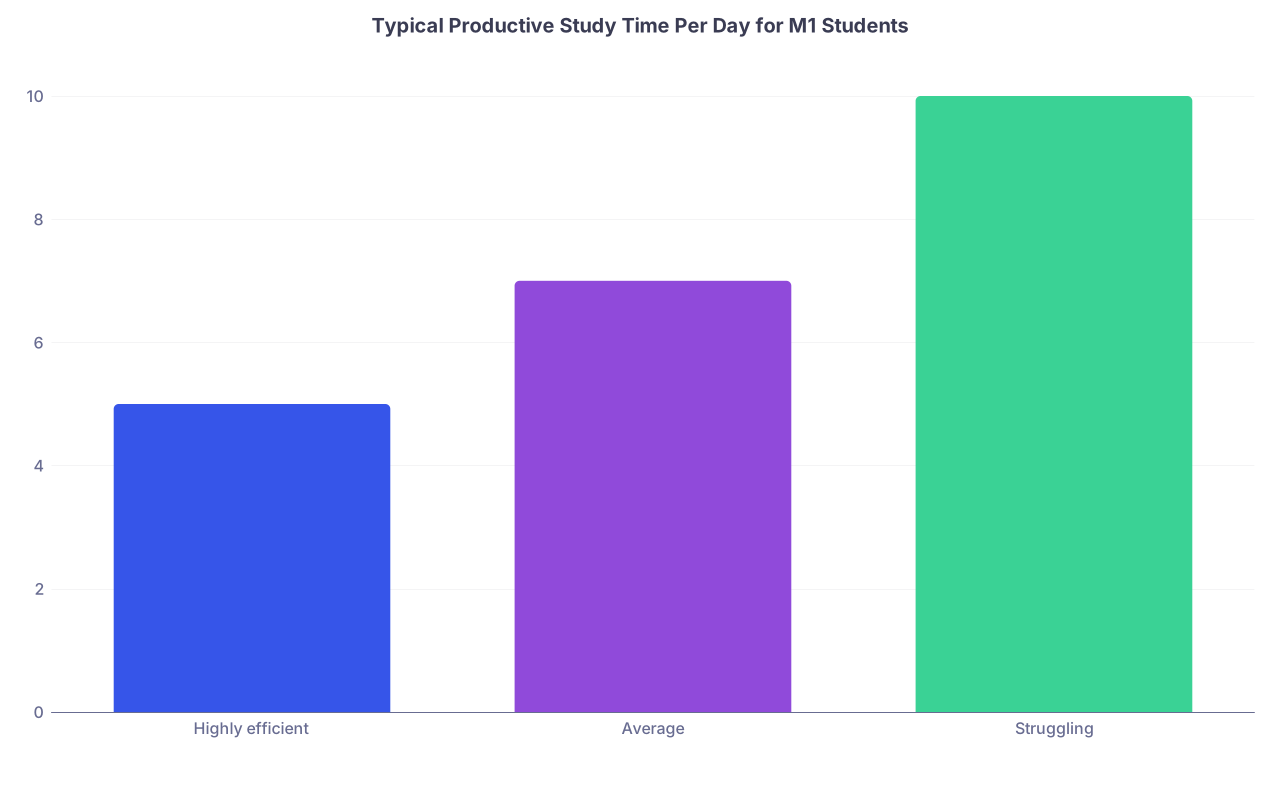
| Category | Value |
|---|---|
| Highly efficient | 5 |
| Average | 7 |
| Struggling | 10 |
Observation: The students who are quietly crushing it are not studying 14 hours a day. They’re using 5–7 focused hours and then unplugging. You can learn that.
3. Understand the board exam landscape at a basic level
You don’t need to start hardcore board prep day one. You do need to know the big pieces:
- Step 1 is now pass/fail, but “pass” doesn’t mean “doesn’t matter.” It’s still a gatekeeper.
- Step 2 CK carries more weight for competitive specialties.
- Your school may have NBME-style exams that mimic boards.
Ask a trusted MS2:
- “If you could go back and change how you used first year to prepare for boards, what would you do?”
- “When did you start dedicated board prep, and what do you wish you’d done earlier?”
You’ll hear patterns. Usually:
- Pay attention to physiology and pathology. They’re the spine of everything.
- Don’t ignore school exams; they build the same muscles you’ll need later.
- Doing some board-style questions earlier (lightly) can help.
4. Decode the Hidden Curriculum: Things No One Explains Clearly
Here’s the kind of stuff students with physician parents learn by osmosis. You’re going to learn it deliberately.
What grades actually mean
At many schools:
- Preclinical years are pass/fail or pass/high pass/honors.
- A single low exam rarely matters, but a pattern of failures raises flags.
- Remediating a course is recoverable. Repeating a year is more serious but still not death.
You want clarification from your dean/advisor:
- “How are M1 grades reported in the MSPE (Dean’s Letter)?”
- “Do residency programs see my individual exam scores?”
- “What’s considered a red flag academically here?”
Once you know where the cliffs are, you stop treating every speed bump like an existential crisis.
What “professionalism” really means in practice
You’ll hear that word constantly. Almost no one defines it clearly.
In real life it’s mostly:
- Show up on time. Or slightly early.
- Answer emails from faculty and staff within 24 hours—even if it’s just: “Received, thank you, I’ll follow up by [date].”
- If you’re struggling (illness, family issues, mental health), tell someone early rather than disappearing.
- Don’t gossip about patients or classmates in public or in writing. Yes, even in “private” group chats.
You don’t need a doctor-parent to tell you this. But it helps to realize: professionalism issues usually aren’t about one small thing. They’re about a pattern.
5. Managing Family Expectations When They Don’t Understand Med School
You have a second full-time job: explaining your life to people who think “you’re in school, so you’re free during the day” or “you’re basically already a doctor, right?”
This is emotionally draining. Especially if your family sacrificed a lot to get you here.
You’re allowed to set boundaries. You just have to be clear and concrete.
Explain your reality like you’re explaining a work schedule
Don’t say: “I’m busy.” That sounds vague and optional. Instead:
“Med school is more like a full-time job plus overtime. I’m usually working from 8am to 7pm most days, including studying. I can reliably talk on [X evenings] and one weekend morning. If we schedule in advance, I can make it work. But I can’t do last-minute calls all the time.”
You can even sketch a “typical week” and send a photo. Make the invisible visible.
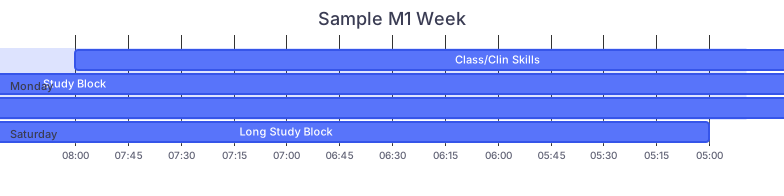
| Task | Details |
|---|---|
| dateFormat HH | mm |
| axisFormat %H | %M |
| Monday: Class/Clin Skills | 08:00, 04:00 |
| Monday: Study Block | 13:00, 03:00 |
| Monday: Review/Light Study | 17:00, 02:00 |
| Saturday: Long Study Block | 09:00, 05:00 |
When family needs conflict with exams
If you’re first-gen, you may also be:
- Translating documents
- Helping with finances
- Managing siblings’ stuff
- Handling crises your classmates never deal with
You need a rule: nothing gets to silently wreck your exams without at least one adult at school knowing about it.
If there’s a serious family issue:
- Email your course director or student affairs: “There’s a significant situation in my family right now that’s affecting my ability to study. I’m the primary person handling it. Can we talk about options around the upcoming exam and what documentation you might need?”
Do this early. I’ve seen students wait until after they fail 2–3 exams, then show up in tears and say, “My dad’s been in the ICU for a month and I’ve been driving home every weekend.” Faculty are humans. They usually help when they are brought in early.
6. Mental Health When You Can’t “Just Call Home for Advice”
Being the first doctor in your family is isolating. Your relatives may be proud but totally unable to help with the specifics:
- They say “Just do your best!” when you’re asking whether to use UWorld now or later.
- They tell you “We believe in you” when you’re trying to decide whether to remediate a course or take a leave of absence.
You need two kinds of support:
- Emotional support from people who love you
- Tactical guidance from people who know this system
Don’t mix those up. Your mom’s job is not to understand the residency match algorithm. Your friend who’s an attending’s job is not to process your childhood baggage.
Use your school’s counseling services. Most med schools have someone who works specifically with health professions students. They’ve seen this exact profile:
- First-gen
- High achiever
- Feels like an impostor
- Carrying family pressure
You are not “weak” for going. You’re being efficient: offloading emotional weight so your brain can do what it needs to academically.
Also, do not underestimate the value of one classmate you can be honest with. Not the person you flex your grades to. The one you can tell, “I’m barely holding it together this week.” That person might be another first-gen student or someone dealing with different invisible pressure (illness, finances, whatever). Find them.
7. Stop Trying to “Catch Up” to Imaginary People
The worst productivity killer in med school: constantly comparing yourself to a fantasy composite of your classmates.
That composite:
- Wakes up at 5am
- Works out daily
- Honors every exam
- Does 300 Anki cards
- Researches on weekends
- Calls their attending parent for advice
- Never procrastinates
- Is not real
You are not trying to “catch up” to that. You’re trying to become competent and functional over four years.
What actually matters over the long run:
- You pass your classes
- You don’t burn out
- You build a basic reputation as reliable and teachable
- You gather a few good letters of recommendation
- You learn enough medicine to not be a danger to patients
You can absolutely do that as the first doctor in your family.
The silver lining? You’ve probably been “figuring things out without a roadmap” your entire life. This is just another level of the same game.
FAQ (Exactly 4 Questions)
1. Do I need to pick a specialty during first year if I’m behind on “insider knowledge”?
No. First year is for survival and exposure, not commitments. You can start noticing what you like—do you enjoy physiology, anatomy, behavioral stuff—but you don’t need to declare anything. The only action I’d take is going to a few interest group talks, maybe shadowing once or twice a semester, just so you hear words like “residency,” “fellowship,” and “match” in context. Real decisions come later, usually M3.
2. Everyone around me talks about research; am I screwing myself if I don’t start right away?
Not in first year. Students with physician parents might get plugged into a lab immediately because of connections, which can make you feel behind. You’re not. For most fields, starting research late M1 or early M2 is totally fine. Your priority is building a stable academic base. Once you’re passing comfortably, then ask MS2s and a faculty advisor: “Which projects in [field] are realistic for a first-year with limited time?” You want focused, doable projects, not prestige for its own sake.
3. What if I already failed an exam and feel like I’m confirming my worst fears?
One failed exam is not a prophecy. It’s a data point. The key is what you do next week, not what happened last week. Sit down with:
- An MS2 or tutor: “Here’s exactly how I studied and what my score was. Where’s the mismatch?”
- Your course director or learning specialist: “Can we dissect my performance and build a new plan for the next block?”
You’re not trying to redeem your worth as a person. You’re trying to adjust inputs (time, resources, methods) to change outputs (exam performance). That’s a solvable problem.
4. How do I deal with feeling guilty for not being as present for my family while I’m in med school?
Guilt is almost universal for first-gen students. You feel like you “left” them to chase this huge goal. The reality: being fully present during a few protected times is better than being half-present, constantly distracted, 24/7. Pick scheduled, sacred contact times—maybe Sunday afternoon calls, a weekly group text update, short video calls. Tell them: “These windows are yours; outside them, I’m usually in class or studying so I can actually become the doctor we’re all working for.” You’re not abandoning them. You’re investing in a future where you have more power, money, and knowledge to help them long-term.
Key points to walk away with:
- You are not behind; you’re just missing information that others inherited. Your job this year is to aggressively acquire that hidden curriculum through near-peers and supportive faculty.
- Protect your bandwidth. Pass your classes with minimum effective effort, build a stable study routine, and stop trying to live up to an imaginary perfect med student with doctor parents.


