

You will lose some friends when you start med school. The trick is: that doesn’t mean you’ll lose your people.
That’s the part nobody says out loud on interview day when they smile and tell you about “finding community.” You’re smart enough to see what’s coming, and your brain is already spiraling: I’ll be buried in Anki while my friends are getting drinks after work. They’ll stop inviting me. I’ll become that person who only talks about exams and pathology. My world will shrink to medicine-only and I won’t even notice until it’s too late.
Let’s not sugarcoat it. You’re right to be worried. But you’re also underestimating how much control you actually have if you stop pretending “balance” just magically appears.
I’m going to walk through what actually happens to friendships when you start medical school, what’s realistically savable, what probably isn’t, and how to not end up isolated and resentful by M2.
The Ugly (But Honest) Baseline: Your Life Is About to Drift Away From Theirs
Picture this:
It’s October of M1. You’ve just survived your first anatomy practical. You’ve slept maybe 10 hours this week. You open your phone and see:
- 47 unread messages in the college friends group chat about someone’s engagement
- A text: “Come out tonight?? We’re all here you ghost”
- Your screen time notification telling you you’ve spent 8 hours a day on Anki
And your gut reaction is exhaustion, not FOMO. You think, If I go out, tomorrow’s lecture will kill me.
That’s the drift. It doesn’t happen in one big blow-up fight. It happens in a thousand tiny “I can’t tonight” texts.
To be blunt, most people outside medicine have no clue what your schedule is like. Why would they? They only see the movie-version of med school: scrubs, coffee, and some dramatic Grey’s Anatomy monologue. Not: 300 new flashcards, 8 am – 5 pm lectures, then practice questions, then guilt for not doing more.
So yes. If you do nothing, if you just “see what happens,” some of your friendships will fade. Not because anyone’s evil. Just because inertia is real.
That’s the bad news.
The good news: “balance” isn’t an all-or-nothing thing. It’s not “either I see my friends three times a week or they vanish forever.” There’s middle ground you can hold if you’re deliberate instead of reactive.
Which Friendships Actually Survive Med School?
Let me be very clear: not every friendship should survive med school.
Some friends are “same environment” friends. You were close because you saw each other daily in the dorm, or at the same job, or in the same club. Once that environment disappears, the friendship needs more effort and more depth to stay alive. Sometimes it doesn’t have it. That’s not a failure; that’s just reality.
The friendships that tend to survive med school have at least one of these:
- They respect hard things. They don’t roll their eyes when you say you have to study. They might not fully get it, but they don’t make you feel ridiculous for trying.
- They accept “less frequent but still real.” You can go from daily memes to a long call every few weeks and they still feel close, not rejected.
- They’re not keeping score. They don’t say, “Well, I called last time” in a passive-aggressive tone every single time.
- They’re genuinely curious about your life, not just waiting to talk about theirs.
The fragile ones?
The ones that probably won’t make it?
- The friend who sees your new schedule as a personal insult: “So med school is more important than me now?”
- The one who constantly jokes, “You’re such a nerd now, come live a little,” but never once says, “How are you holding up?”
- The people who only text you when they’re bored, not because they actually care what’s happening with you
That last group will fade no matter what you do. And you will grieve them a little. But you also don’t want to build your life around people who need you to be available on demand to prove you care.
The Schedule Problem: There Actually Isn’t Enough Time
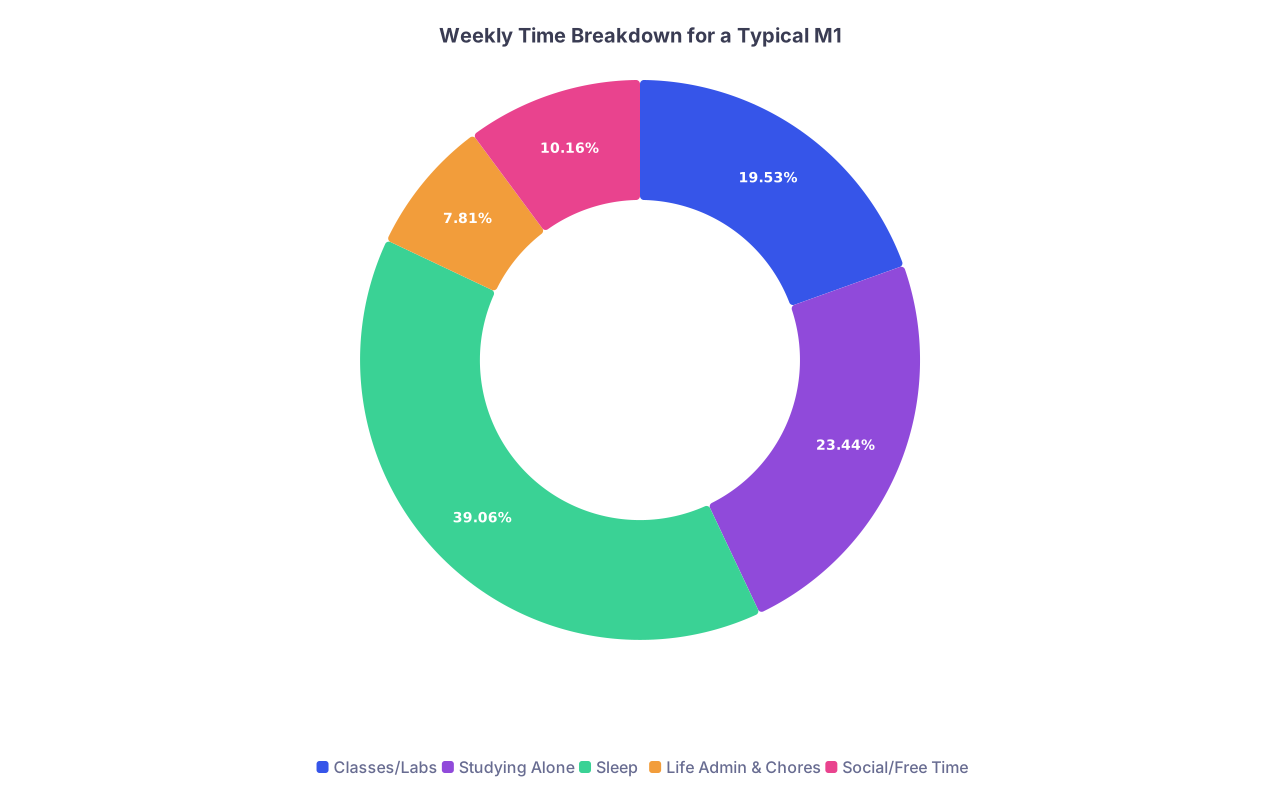
You’re not being dramatic: your time really will be brutal.
| Category | Value |
|---|---|
| Classes/Labs | 25 |
| Studying Alone | 30 |
| Sleep | 50 |
| Life Admin & Chores | 10 |
| Social/Free Time | 13 |
Look at that. In a 7-day week:
- A full-time job worth of class
- Another job’s worth of studying
- Then normal human stuff (laundry, cooking, collapsing)
You’re left with scraps of “free time.” And it’s fragmented. An hour here. Twenty minutes there.
This is why “I’ll see my friends whenever I’m free” blows up. You never feel free. There’s always more to review.
So the question isn’t: “Can I have a normal social life?”
It’s: “What does a realistic social life look like when I’m not normal anymore?”
And the answer is: smaller, slower, but still meaningful if you’re intentional.
How to Not Become the Friend Who Disappeared Without a Word
Silence kills friendships faster than busyness.
What hurts people usually isn’t: “I can’t hang out this week.”
It’s: disappearing for months, then popping up wildly stressed, then disappearing again.
You don’t owe everyone a detailed explanation of your life, but you do owe your real friends some communication. Especially early, before med school swallows you.
Here’s what actually helps:
Have the “My Life Is About to Get Weird” conversation before school starts.
Literally say something like:
“Hey, I need to be honest. Med school is going to wreck my schedule. I’m scared I’m going to disappear and I don’t want that. I probably won’t be as available, but I do want to stay close. Can we figure out what that looks like?”It feels dramatic in your head. It isn’t. It gives them context.
Name the specific ways you can still show up.
Not vague “we’ll keep in touch.”
More like:- “I can probably do a long FaceTime like once every week or two.”
- “I’m better with texting during little breaks than big nights out.”
- “If you call and I don’t answer, I promise it’s not because I don’t care. I’m likely in lecture or dead on my bed.”
Be honest about exam weeks.
Say:
“The week before exams I go full cryptid. If I go dark, it’s not you. It’s histology.”You’d be shocked how much frustration disappears when people know the rules of engagement.
The Fear Behind the Fear: “What If I Turn Into Someone I Don’t Recognize?”
There’s the practical worry: schedules, time, logistics.
Then there’s the deeper one you’re probably not saying out loud:
“I’m scared that in four years I’ll be a weird, burnt-out, medicine-only husk who can’t relate to normal people anymore.”
You’ve seen it. The resident who only hangs out with other residents. The med student who laughs at everything with “that’s not high yield.” The person whose entire identity is wrapped around what specialty they’ll match into.
Here’s the brutal truth: med school pulls you toward that if you let it. Because it rewards obsession. The more you sacrifice, the more gold stars you collect: grades, honors, research, glowing evals.
But obsession has a cost: you slowly become unrecognizable to the people who knew you before you were “future Dr. ___.”
So you can’t just “hope you stay balanced.” You have to choose to protect non-med parts of yourself like they’re on the exam.
Stuff like:
- Keeping one hobby that has nothing to do with medicine. Gaming, painting, pickup soccer, playing piano. Actual hobby, not “more studying in a cute coffee shop.”
- Setting a hard cut-off one night a week. Maybe Sundays after 7 pm are no-study zones unless there’s an exam the next morning.
- Staying in those non-med group chats and responding, even if it’s just memes and quick replies. That stupid inside joke thread? That’s your lifeline to a non-med identity.
Long-Distance Friendships: Low Frequency, High Intensity
Let’s say your close friends are in other cities doing normal-human jobs. That adds another layer: no quick coffee, no “drop by my place,” no shared routines.
But weirdly, distance friendships can sometimes survive med school better than local ones. Why? Expectations are already lower-frequency.
The model that works here is: low frequency, high intensity.
You might not talk every day, but when you do, you’re fully there. No rushing them off the phone in 10 minutes to get back to Anki.
Think of it like this:
| Type of Friend | Realistic Contact Pattern | Risk Level |
|---|---|---|
| Best non-med friend | 1 call every 1–2 weeks | Low |
| Close college group | Group chat + monthly call | Medium |
| Casual acquaintances | Social media only | High |
| Med school classmates | Daily in-person | Low |
You can’t maintain 15 “talk every week for an hour” friendships. That’s fantasy. You can pick 2–3 non-med friends you refuse to let go of and treat those calls like sacred appointments.
Does it feel weird to literally put “Call Sam” in your Google Calendar on Wednesday nights? Yes. Do it anyway. Spontaneity is a luxury you don’t always get in med school.
When Your Friends Don’t Get It (And Kinda Judge You)
Someone will say it.
“Med school can’t be that bad. You’re being dramatic.”
Or: “My job is stressful too, but I still make time to hang out.”
You’ll feel this rush of defensiveness and shame and anger. You’ll want to send them your schedule, your NBME scores, your sleep log. You’ll want to prove your suffering.
Don’t.
Fighting for them to understand the exact weight of your schedule is a trap. Most people won’t. It’s like explaining a code blue to someone who’s only ever seen it on TV: they’ll nod, but they still don’t get the adrenaline, the smell, the panic.
The healthier goal is smaller:
Do they respect your boundaries even if they don’t fully understand them?
If the answer is yes, keep them.
If the answer is no, and they keep pushing, guilt-tripping, mocking your priorities… that’s data. It hurts, but it’s data.
You’re allowed to outgrow people who need you to stay small and available to feel secure.
The Flip Side: Don’t Become the Med School Snob
There’s another failure mode you need to watch for. It’s ugly, but it’s real.
You start quietly thinking your life is more important than your friends’ because it’s “saving lives someday.” You roll your eyes internally when they talk about office politics, annoying bosses, roommate drama.
You stop asking about their days and just info-dump about exams and OSCEs.
Then they pull away. And you tell yourself, “Guess they couldn’t handle me being in med school.”
But actually, you stopped being a good friend.
So check yourself:
- When you’re on the phone, are you asking as many questions about their life as they ask about yours?
- When they share something big (promotion, breakup, move), are you reacting like it matters? Or like your test is automatically the bigger crisis?
- Do you ever say, “I know I’ve been talking a lot about school—how are you really doing?”
If you want friends outside medicine, you have to act like their non-med lives are just as real and valid and serious as yours. Because they are.
Building Two Worlds That Actually Talk to Each Other
The real “balance” isn’t choosing between your med world and your outside world. It’s letting them overlap in small, intentional ways.
You can:
- Introduce your non-med friends to a couple med friends on a group FaceTime or when they visit. Now you’re not managing totally separate universes.
- Share the human side of med school, not just the gory details. Tell them about the patient who reminded you of their grandma. Or the professor who said something kind when you bombed a quiz.
- Ask them to share their world too. “Send me a pic of your new office,” “Show me the restaurant you keep talking about,” “Record me a voice note on your commute.”
You’re building little bridges. So when you feel like medicine is swallowing you, you still have a foot on the other side.
Here’s what this blending can look like over time:

| Step | Description |
|---|---|
| Step 1 | Start M1 |
| Step 2 | Schedule Regular Check-ins |
| Step 3 | Share Med School Stories |
| Step 4 | Visit or Video Chat Occasionally |
| Step 5 | Friends Feel Included |
| Step 6 | Less Guilt, More Support |
| Step 7 | Stronger Identity Outside Medicine |
| Step 8 | Set Expectations with Friends |
The Silent Terror: What If I End Up With No Real Friends Anywhere?
Here’s the nightmare scenario your brain is quietly constructing at 2 am:
- You drift from your non-med friends
- You don’t quite click with your med classmates
- You end up…untethered. No one knows the whole you anymore
That fear is valid. It happens to people. They wake up mid-M2 and realize they have “people to study with” but no one to call when they get bad news.
You lower the odds of that happening by doing three things consistently, even when you’re tired:
Anchor yourself to 2–3 non-med people and refuse to fully let go.
Not 10. Just a tiny, stubborn core.Let at least 1–2 med school friends see the non-achiever side of you.
The messy, panicked, not-okay version. Real intimacy, not just venting about exams.Keep one non-med activity alive.
That hobby, that recurring event, that space where nobody cares about your UWorld percentages. It might be small—an hour a week—but you protect it.
That’s how you avoid becoming socially homeless: you build smaller, deeper connections in both worlds and stop chasing quantity.
One More Hard Truth: You Won’t Do This Perfectly
You will miss birthdays.
You will forget to answer texts until three weeks later and then feel like a monster.
You will have a week where all you do is study and cry in the shower and ignore everyone.
This doesn’t make you a bad friend. It makes you a med student.
What matters is what you do after those moments:
- Do you send the “I’m sorry I vanished, I’ve been drowning, I care about you” text instead of ghosting out of shame?
- Do you own it when you’ve been self-absorbed?
- Do you try again instead of telling yourself “too much time has passed, that friendship is dead”?
Most people aren’t expecting perfection from you. They’re expecting sincerity. They want to know they weren’t just “pre-med you” placeholders.
What You Can Do Today
Don’t let this all stay abstract.
Right now, before med school starts (or before the next block eats you alive), do one concrete thing:
Pick two non-med friends you’re most scared of losing. Text each of them today and say something like:
“Random sappy moment, but med school is getting intense and I’m scared of losing touch with people who matter. You’re one of those people for me. I’m going to be busier, but I don’t want to drift. Can we try to do a regular call or check-in, even if it’s short?”
That’s it. Two texts.
Then, open your calendar and block off one recurring 30–45 minute slot each week labeled with one of their names.
Not “social time.” A real person. A real relationship you’re choosing to keep.
That’s how you don’t lose everyone outside medicine: not by hoping, not by “finding balance,” but by protecting a small number of people fiercely, on purpose.


