
What do you do when your chair says, “We want you to increase telehealth volume,” but your RVU report already looks like a bad joke?
If you’re an academic physician, you’re in a weird spot. Administration loves to talk “digital front door,” “access,” and “innovation.” Your contract loves to talk “wRVUs,” “productivity,” and “thresholds.” Those two conversations are often not aligned. At all.
You are not crazy if you’re thinking: “If I move my in-person clinic to video visits, I’m going to get crushed on RVUs, no-shows, and uncompensated portal messages.” I’ve watched this play out in multiple departments. Same pattern every time:
- Leadership pushes telehealth.
- Faculty shift some clinics.
- Billing, scheduling, and templates stay built for in-person.
- RVUs tank.
- Faculty quietly shift back to in-person to survive.
You can avoid that. But only if you treat telehealth as a business model problem, not a tech problem.
Let’s walk through how to integrate telehealth and protect (or even increase) your RVUs.
Step 1: Know Exactly How Telehealth Is Valued in Your System
Before you change anything on your schedule, you need answers to some unsexy but critical questions. Most physicians skip this step and pay for it later.
You need to know:
- How video visits are billed and credited
- How phone visits are billed and credited
- How portal messages are billed and credited (if at all)
- Whether telehealth RVUs are “discounted” in any internal formula
Start here: email or call three people (yes, three):
- Your departmental finance or business manager
- The billing/compliance office
- The practice plan or faculty group practice admin
And ask surgical-level questions.
Sample email you can basically steal:
I’m planning to convert part of my clinic to telehealth and want to make sure this aligns with our RVU expectations. Could you clarify:
- Are telehealth video visits billed using the same E/M codes and wRVU values as in-person visits?
- Are there any internal discounts or adjustments to wRVUs for telehealth (e.g., only a percentage of CMS wRVUs counted)?
- How are audio-only visits and portal-based e-visits credited for wRVUs in our system?
- Is there a department or practice plan policy document on telehealth billing and RVU credit you can share?
If the response is hand-wavy (“it’s basically the same”), push for specifics. Printed tables. Policy PDFs. Exact CPT codes.
You’re looking for something like this:
| Visit Type | Typical Codes | Example wRVUs Credited |
|---|---|---|
| In-person new | 99203–99205 | 1.6–3.5 |
| In-person established | 99213–99215 | 1.3–2.8 |
| Video visit (new) | 99203–99205 + modifier | 1.6–3.5 (same) |
| Video visit (established) | 99213–99215 + modifier | 1.3–2.8 (same) |
| Phone visit | 99441–99443 | 0.25–0.75 |
| Portal e-visit | 99421–99423 | 0.25–0.75 |
If your table doesn’t look roughly like that, you need to adjust your strategy. Hard.
Step 2: Design Telehealth Sessions That Are RVU-Positive, Not “Nice to Have”
Your worst move is to “sprinkle in” telehealth. One or two video visits between in-person visits, no protected MA/nurse support, no telehealth-specific slots. That’s how you lose time and money.
You need intentional telehealth blocks that are built around RVU efficiency.
A. Build Telehealth Blocks, Not Random Slots
Pick 1–2 half-days to convert to almost entirely telehealth. Do not scatter one-off telehealth visits throughout the week if you can avoid it.
A typical pattern that works:
- Keep your highest-acuity and procedure-heavy day fully in-person.
- Convert a follow-up-heavy half-day to telehealth.
- Use another half-day as a mixed “tele + in-person” access clinic if admin insists.
The math you’re aiming for:
- If an in-person half-day yields ~10–12 visits and ~18–22 wRVUs…
- A telehealth half-day should aim for ~12–16 visits and ~20–25 wRVUs.
You hit that by trimming dead time.
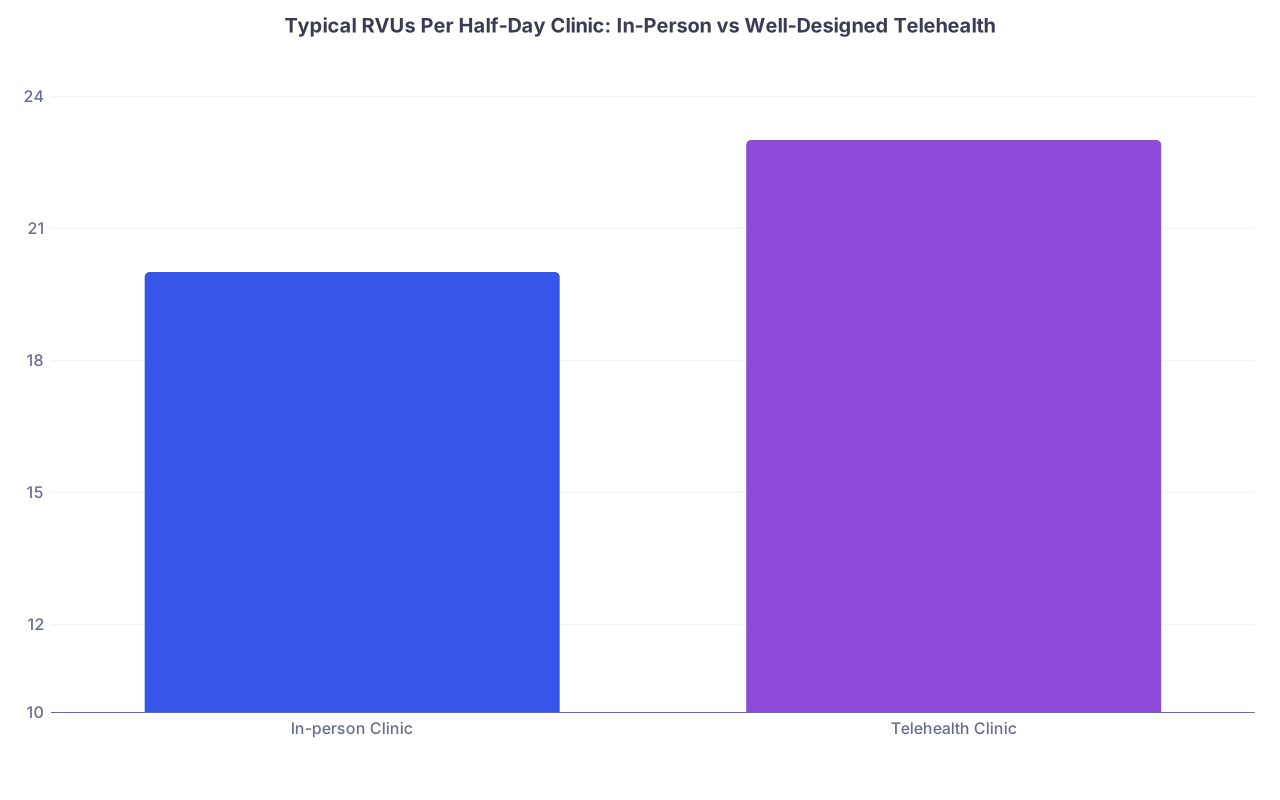
| Category | Value |
|---|---|
| In-person Clinic | 20 |
| Telehealth Clinic | 23 |
Notice: telehealth is not lower if you do it right. Sometimes it’s better.
B. Tighten Visit Lengths (But Only Certain Ones)
In telehealth, observation is worse, exam is limited, and patients tend to be more focused. Most follow-ups can be shorter without compromising safety.
Where you can safely shave time:
- Simple medication adjustments
- Stable chronic disease follow-up
- Lab/imaging review
- Post-op or post-discharge check-ins where exam is minimal
Example:
- In-person follow-up template: 20-min slots, 3 no-shows per half-day
- Telehealth template: 15-min slots, 1 no-show per half-day
You’ve just added 2–3 extra visits in the same block.
C. Don’t Accept “Telehealth Lite” Documentation
Some people get sloppy: “It’s just telehealth, quick note, whatever.” That’s how you end up downcoding yourself.
You must document to the correct level:
- Time-based billing is your friend in telehealth.
- Many telehealth visits naturally qualify for time thresholds because of counseling and coordination.
Example (post-hospital follow-up):
- You spend 32 minutes: chart review, medication reconciliation, counseling on follow-up plan.
- That often supports a 99214 or 99215 time-based. But only if you document it.
Time-based wording that actually works:
Total time spent on this patient today was 32 minutes, including chart review, medication reconciliation, counseling regarding disease management and follow-up plan, and documentation.
Use a macro. Make it boring and repetitive. But get paid.
Step 3: Get Your Support Staff and Workflow Aligned to Telehealth
Telehealth without MA/RN/clerical support is just you doing three jobs on camera. That’s how your RVUs sink.
You need to replicate the in-person workflow in digital form.
A. Pre-Visit Work That Saves You Minutes Every Time
You want your staff doing:
- Medication reconciliation before the visit
- Vitals collection (home BP, weights, etc.) via portal or phone
- Standardized pre-visit questionnaires (PHQ-9, pain scores, symptom checklists)
- Tech check (“Can you connect? Do you know how to log in?”) for older or tech-challenged patients
Those 3–4 minutes you aren’t burning at the start of every visit? That’s how you keep templates tight.
B. Clear Division: What Is a Visit vs a Message vs a Nurse Task
If you do not decide this up front, your telehealth day turns into 8 “visits” and 32 unpaid messages.
Sit with your nurse/MA and literally outline:
- What triggers scheduling a video visit vs a message response
- What messages get routed to RN pool first
- What messages are converted to billable e-visits (if your system allows it)
Put this in writing. Even a simple one-page “Telehealth Workflow – Dr. X” that lives in the clinic shared drive is better than nothing.
Step 4: Protect Yourself from the Portal Message Black Hole
You know this already: telehealth and portal heavy practices lead to message creep. Patients think, “Why schedule when I can just message?” Admins talk about “access” and “patient satisfaction.” Nobody talks about who’s paying you.
You have three realistic options:
- Bill e-visits aggressively (if your institution allows it)
- Get explicit RVU credit for portal work (requires negotiation)
- Limit what gets handled via portal vs scheduled as a visit
A. If Your Institution Bills E-Visits – Use It Like a Professional
Most places underuse e-visit codes. Typical scenario: clinicians do 12–15 minutes of chart review, counseling, and med changes over three messages and bill nothing.
If your system allows 99421–99423 (portal e-visits), clarify:
- Who may create the charge? You, RN, or auto-trigger?
- What documentation is required?
- How much RVU credit you actually receive for each code?
Then practice this sentence with your team:
“If this takes more than about 5 minutes or requires medication changes, we convert it to a visit or an e-visit.”
That’s the line. Use it.
B. If You Get Zero Credit for Portal Work
Then unilateral telehealth expansion is a trap.
You have to either:
- Get portal/RN triage work recognized in your RVU target (e.g., lower targets for telehealth-heavy clinicians)
- Or strictly limit your non-visit work and push complex issues into scheduled telehealth visits.
Harsh truth: “But I answer my patients quickly and thoroughly” does not keep you from missing your RVU threshold and losing a bonus.
You are not paid to be a messaging concierge. If your institution wants that, it should be in your job description and compensation plan. In writing.
Step 5: Negotiate Telehealth Expectations Into Your Contract or Annual Review
If telehealth is more than an experiment, it has to show up in the documents that control your money: offer letter, annual expectations letter, or compensation plan.
Do this before you massively shift your panel online.
A. Decide Your Ask
You might push for one of these:
Telehealth-neutral RVU credit
“Telehealth visits at the same wRVU credit as in-person, no internal discount.”Adjusted RVU targets for tele-heavy practices
“RVU thresholds reduced by X% for clinicians with >Y% of visits via telehealth.”Separate bucket for ‘digital care’
“Portal work, asynchronous review, and e-consults get tracked in a separate metric that is recognized in compensation or protected time.”
Pick one to prioritize. If you go in asking for five changes, you’ll walk out with none.
B. Put Concrete Numbers on the Table
If you’re already doing some telehealth, pull data from the last 3–6 months:
- Percentage of visits done by telehealth
- RVUs per clinic session in-person vs telehealth
- Time spent on portal/MyChart work on telehealth-heavy days
Use that data. Chairs and chiefs respond to numbers, not vibes.
Example story to show your chair:
“On my in-person Tuesday, I average 11 visits and 21 wRVUs. On my telehealth Thursday, I’m doing 13 visits but only 17 wRVUs, plus 45–60 minutes of uncompensated portal messages. If we’re going to grow telehealth, I need either full RVU credit for telehealth plus e-visit billing, or a lower RVU threshold that reflects the digital care load.”
That’s mature, specific, and frankly hard to argue with.
Step 6: Use Telehealth Where It’s Actually RVU-Advantageous
Telehealth is not great for everything. But there are sweet spots where it’s a net win for both you and the system.
Three high-yield use cases:
1. Rapid-Access Follow-Up Clinics
Example in GI, neurology, oncology, cardiology: a “results review” clinic.
Structure:
- Telehealth-only half-day each week
- 15-minute established visits
- Narrow indications: test results, med titration, post-hospital follow-up, quick status checks
You increase visit count because there’s no room turnover, no patient walking in from parking, no gowning, etc. Patients love it, and your wRVUs can match or exceed in-person if you code based on time and complexity.
2. Geographic Reach / Satellite Coverage
If your department is trying to cover community sites or outreach clinics, telehealth is often positioned as “extra work.” Flip that.
Instead of you driving 90 minutes for four new patients and six follow-ups:
- Do new patients in person at the academic site.
- Shift most follow-ups from the satellite to telehealth.
Same patients, same wRVUs, but you gain 3–4 hours of travel time back and can see more patients.
3. Multi-Disciplinary or Team-Based Visits
Telehealth actually makes it easier to coordinate:
- You, a dietitian, and a pharmacist
- You and a social worker
- You and a subspecialist colleague
If billing is set up correctly, some of these models let you maintain high-level E/M codes because of the complexity and time.
Step 7: Track Your Own Numbers Monthly
If you rely on the quarterly “Productivity Dashboard” PDF to tell you whether telehealth is working, you’ll discover the problem months too late.
You need a simple, ugly, self-maintained tracker for at least the first 6–12 months.
Track per clinic session:
- Number of visits
- Number and type of telehealth visits (video vs phone)
- wRVUs generated
- No-show rate
- Time spent on portal/messages that day (estimate if needed)
You do not need a fancy system. A basic spreadsheet works:
| Date | Type | Visits | wRVUs | No-shows | Msg Time (min) |
|---|---|---|---|---|---|
| 3/5 Thu | Telehealth | 14 | 22 | 1 | 30 |
| 3/12 Thu | Telehealth | 12 | 17 | 2 | 55 |
| 3/19 Thu | In-person | 11 | 20 | 3 | 20 |
Patterns will jump out fast. If your telehealth day is always underperforming, you’ll know why:
- Too many short phone visits
- Under-coding
- Excess portal work not being billed
- Too many low-complexity issues that should have been handled by nursing
Then you adjust your workflow, not your whole career.
Step 8: Don’t Let Admin Hide Behind “Telehealth is Good for Patients” While Docking You
Let me be blunt: “It’s great for access” is not a substitute for fair compensation.
You can support telehealth and insist on sane RVU policies. Those are not mutually exclusive.
When you hear:
- “We’re all just going to have to pitch in.”
- “We can’t change the comp model right now.”
- “This is our strategic priority as a department.”
Your response should sound something like:
“I’m fully on board with expanding telehealth. But if it’s a strategic priority, it needs to be reflected in the compensation structure and expectations. Otherwise, faculty who take on more telehealth will be financially penalized. How can we align the RVU model with this strategy?”
Then stop talking. Let them answer.
You are not being “difficult.” You’re pointing out a structural mismatch. They may not fix it instantly, but you have to put it on the record.
A Concrete Example: How a 0.5-Day Telehealth Clinic Can Increase RVUs
Let’s run a realistic scenario.
You’re a gen med academic doc. Before telehealth:
- Tuesday afternoon in-person clinic
- 3 new (40 min), 8 follow-ups (20 min)
- Average: 11 visits, ~20 wRVUs, 2 no-shows
After reworking to telehealth:
- Same afternoon, now telehealth-heavy
- Template: 12 follow-ups (15 min) + 2 new patients (30 min)
- No-show rate drops to essentially 1
If you document and code well:
- New visits: 2 x 99204 = ~5.6 wRVUs
- F/U visits: mix of 99213/99214 = maybe ~1.5–2.0 wRVUs each
- Total F/U wRVUs: let’s say 12 visits x 1.7 avg = 20.4
- Total telehealth session: ~26 wRVUs
Even if you’re at 22–24 wRVUs after some downcoding, that’s still above your prior 20. You’re more productive, not less.
Now imagine you stack that with appropriate e-visit billing and a bit less uncompensated messaging.
Telehealth is not the enemy of RVUs. Sloppy telehealth is.
Step 9: Watch for Burnout Signals Early
One last piece that no one talks about: a poorly structured telehealth practice burns you out faster than almost anything else in ambulatory medicine.
Red flags you’re headed there:
- You’re constantly “finishing notes later” because visits are back-to-back with no margin.
- Your message inbox is unmanageable after telehealth days.
- You feel more drained after a 3-hour tele clinic than a 5-hour in-person session.
- You’re starting to resent your own patients for “bothering” you online.
When you see this, do not just “try harder.” Change something structural:
- Add 5-minute protected buffer blocks every 3–4 patients.
- Reduce total slots until your RVU/visit ratio stabilizes.
- Push more portals into scheduled tele-visits with clear scripting from your staff.
You cannot white-knuckle your way through a broken model.
Where This Leaves You
You’re in an era where telehealth is not going away. Academic centers are doubling down on digital care, remote monitoring, virtual second opinions – all of it. That can either erode your RVUs and your sanity, or it can be something you actually use to make your practice more efficient and more flexible.
If you:
- Understand your institution’s telehealth billing rules
- Build deliberate telehealth blocks instead of random scatter
- Protect yourself from the message black hole
- Get expectations into writing, tied to compensation
- Track your own numbers and adjust based on reality
You can be the person who actually makes telehealth work in an academic environment without quietly tanking their bonus.
From here, your next move is obvious: carve out that first telehealth half-day, get your workflows and staff aligned, and run the experiment with your eyes open and your numbers tracked. Once you prove it works at small scale, then you can decide how big you want telehealth to be in your long-term career.
And when you’re ready to think about how this telehealth-heavy practice sets you up for future roles – medical director of virtual care, system-level leadership, or even a hybrid academic/private setup – that’s the next stage of the journey.