
What do you actually do when you’re charting past midnight again, fantasizing about quitting clinic, but you’re terrified telemedicine will just be the same misery… from your living room?
Good. That’s the right level of fear. Telemedicine can be a lifeline, or it can be clinic burnout with worse boundaries and fewer protections.
Here’s how to trial telemedicine in a way that protects your license, your sanity, and your bank account—without blowing up your current job before you know if it’s for you.
1. Get Honest About Why You Want Telemedicine
You do not start with job boards. You start with your own motives.
Common patterns I see in burned-out clinicians:
- “I cannot do another 25-patient day with 4 double-booked physicals.”
- “I want to move, but I’m tied to this health system.”
- “I need schedule control, not another wellness webinar.”
- “I’m done with hallway interruptions, drive time, and office politics.”
Some of these problems telemedicine can actually fix. Some it absolutely cannot.
Telemedicine can help with:
- Commute time (zero)
- Control over shifts (often yes)
- Environment (your space, your rules)
- Certain types of patient interactions (shorter, more focused)
- Reducing physical exhaustion
Telemedicine will not fix:
- Crappy boundaries (you’ll answer messages at midnight from home instead)
- Poor documentation habits (EMR is still there, just in a different window)
- Difficult patients (they also have internet)
- Productivity pressure (RVUs and click quotas still exist)
Before you do anything else, write down three sentences:
- “I want telemedicine because…”
- “If I switched to telemedicine and it felt just like clinic, it would be because…”
- “For a telemedicine trial to be a success, these 2–3 things would have to improve…”
Those answers will drive what kind of telemedicine gigs you even consider.
2. Protect Your License First, Ego Second
You are not just “trying something fun from home.” You’re practicing medicine in a regulatory minefield.
Licensure and jurisdiction
Telemedicine is location of the patient, not you.
You can be sitting in Colorado in your sweatpants, but if the patient is in Florida, you need a Florida license (or compact coverage if applicable).
Here’s the no‑nonsense checklist:
- Make a list of states where you already hold licenses.
- Check if you are in the Interstate Medical Licensure Compact (for MD/DO) or APRN compact (if applicable).
- Do not see a single patient in a state you are not licensed in, no matter what some shady recruiter implies.
If a company says things like:
- “We’re working on getting credentialed there, just start for now.”
- “Everyone does it, it’s fine.”
You hang up. They do not get your DEA number.
Malpractice coverage for telemedicine
Do not assume your current malpractice or your hospital system policy covers:
- Separate telehealth work
- Work for another employer
- Multiple states
You want in writing:
- Who covers malpractice?
- Claims-made or occurrence?
- Tail coverage if you leave?
- Are all your licensed states covered?
If your current employer covers “any professional activity,” clarify explicitly whether external telemedicine work is included (it almost never is).
One practical move: Call your current malpractice carrier and say:
“I’m planning to pick up independent telemedicine shifts on the side. What do I need to ensure I’m fully covered for multi-state virtual practice?”
Let them tell you what’s missing; they have skin in this game.
3. Choose Trial Structures, Not All‑In Commitments
You’re not joining a cult. You’re running an experiment.
There are three safer ways to trial telemedicine:
Internal telemedicine within your current system
Best for: Lower legal risk, more support
Worst for: Less flexibility, same bureaucracyPer‑diem or 1099 telemedicine shifts with reputable companies
Best for: True side-gig trial, clear hours
Worst for: Income variability, quality of platforms all over the mapSmall private telemedicine practice (cash-pay or niche)
Best for: Maximum control, specialized care
Worst for: Complexity, marketing, slow initial volume
Let me be blunt:
If you’re burned out and exhausted, starting a solo telemedicine practice as your first step is like signing up for a marathon while you’re limping. You might get there, but you’re going to bleed on the way.
Start with option 1 or 2.
4. Vet Telemedicine Companies Like a Paranoid Malpractice Attorney
This is where people get burned. They see “$150/hr remote!” and stop asking questions.
Here’s what I actually ask companies when clinicians send me contracts:
“What is your average patients per hour expectation?”
- If they can’t answer, or it sounds like urgent care on steroids (6–8+/hr), expect chaos.
“Are visits scheduled, on-demand, or mixed?”
- Scheduled is generally safer and less frantic.
- Pure on‑demand can mean big dry spells and then surges.
“Who sets clinical policies and protocols?”
- If it’s clearly physician-led or has credible clinical leadership, that’s better.
- If it’s some tech bro with “disruption” all over his LinkedIn, be careful.
“What is your documentation expectation?”
- Time allowed between visits?
- Required templates or macros?
- Messaging expectations?
“What percentage of your visits are:
- acute / urgent
- chronic disease management
- behavioral health
- medication management (including controlled substances)”
If 50%+ is basically “Z‑Pak and Adderall requests,” I’d pass.
“Do you allow or expect prescribing of controlled substances?”
- If yes: What safeguards? PDMP integration? Local labs? Follow-up requirements?
Red flags:
- No clear policy on controlled substances.
- Pressure to prescribe for patient satisfaction.
- No consistent expectations on how to handle red flag symptoms (chest pain, neuro deficits, suicidal ideation).
This isn’t just preference. This is your name and license on every note.
5. Draw Hard Clinical Boundaries Before Your First Shift
You need your own “no” list. In writing. Before you log in.
Examples of healthy boundaries:
Conditions you will not manage virtually except for triage:
- Chest pain, SOB in undiagnosed patient, new neuro deficits
- Complex abdominal pain
- High‑risk pregnancy issues (if not OB)
Medications you will not prescribe via telemedicine:
- New benzodiazepines for chronic anxiety in unknown patients
- New ADHD stimulants without records and proper evaluation
- Chronic opioids outside a tightly defined protocol
Age groups or complexities you limit:
- Maybe you do not see under age 2 virtually if you’re not confident.
- Maybe you decline complex oncologic or transplant patients for primary care telehealth.
You can be explicit with the company:
“Here’s what I will and will not do via telemedicine. If this doesn’t fit your model, I’d rather not waste your time or mine.”
If they push back with “but our patients really expect…” that’s code for “we’re going to hang you out to dry when something goes wrong.”
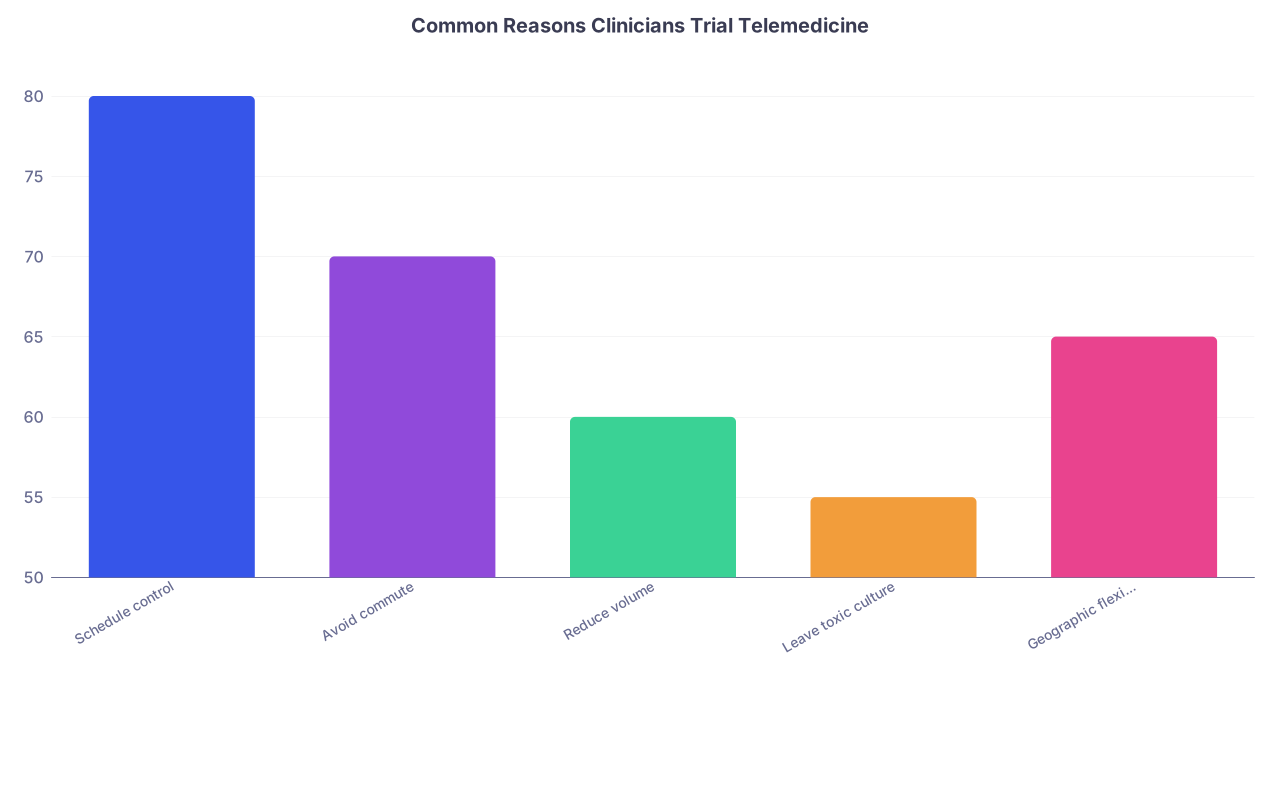
| Category | Value |
|---|---|
| Schedule control | 80 |
| Avoid commute | 70 |
| Reduce volume | 60 |
| Leave toxic culture | 55 |
| Geographic flexibility | 65 |
6. Test the Waters Without Torching Your Current Job
If you’re post‑residency and already employed, you cannot just disappear from clinic and “see if this works.” You have a contract, a reputation, and possibly a non‑compete.
Step 1: Read your current employment contract
Specifically look for:
- “Exclusive employment” language
- Moonlighting or outside clinical work clauses
- Non‑compete radius and scope (telemedicine across state lines gets messy)
- Requirements to seek written permission for outside work
If the contract says you can’t moonlight, you have three options:
- Ask for an exception (sometimes granted, especially if telemedicine is outside system’s geography)
- Wait until renewal and negotiate
- Start with internal telemedicine within the same system
Step 2: Build a 3‑month trial plan
A reasonable structure:
Month 1:
- Onboard with 1–2 telemedicine companies or internal telehealth program
- Do minimal shifts (2–4 shifts total) just to experience the workflows
Month 2:
- Increase to 1 shift per week
- Pay strict attention to: exhaustion after shifts, documentation time, tech frustrations, patient mix
Month 3:
- Decide:
- Keep it as side gig?
- Scale up and reduce clinic time (if allowed)?
- Walk away?
Do not resign from your main job after two decent telehealth shifts. You need enough time to hit a couple of bad days and see how it feels when things are not smooth.

7. Set Up Your Physical Space Like a Professional, Not a Hobbyist
Telemedicine is still medicine. The “office” is just in your house.
Bare minimum requirements:
- Private room with a door that closes and a clear “do not disturb” rule for whoever you live with.
- Reliable high‑speed internet. If your video freezes three times in 15 minutes, both your patients and your company will hate it.
- Neutral, non‑distracting background. No piles of laundry. No political posters.
Good investments:
- External webcam with decent resolution and lighting.
- Headset or good microphone (patients will forgive many things; not hearing you is not one of them).
- Dual monitors: one screen for video, one for EMR/notes.
Also, establish what I’ll call home office boundaries:
- No back‑to‑back shifts longer than X hours. (Most people die around 4–6 hours.)
- At least 10–15 minutes between blocks of patients for standing, water, and eye rest.
Burnout in telemedicine doesn’t appear on your step counter. It shows up in your brain fog and your chart backlog.
8. Design Your Trial Like a Research Study (You Are the Subject)
We’re not going to just “see how it feels.” That’s how you drift into another bad setup.
You are going to collect data on yourself and your work.
Before starting
Rate, on a 1–10 scale:
- Emotional exhaustion at work
- Sense of control over your schedule
- Ability to be present at home after work
- Physical fatigue
- Charting time after hours
Write those numbers down.
During your 3‑month trial
After every telemedicine shift, jot:
- Start/stop time
- Number of patients seen
- Time spent charting after the last patient
- One line: “Overall stress level today: X/10”
- One line: “One thing that worked / one thing that sucked”
End of each week, compare this to your in‑clinic days. Which leaves you more depleted? More angry? More numb?
After 3 months
Ask three questions:
- “Compared to clinic, how do I feel after a telemedicine shift—better, worse, or just different?”
- “Did telemedicine meaningfully improve the specific pains that drove me to consider it?”
- “Would I trust this model of care and these workflows for my own family members?”
If the answer to #3 is no, you already know what you need to do.

| Step | Description |
|---|---|
| Step 1 | Decide to Trial Telemedicine |
| Step 2 | Review Contract and Licensure |
| Step 3 | Set Boundaries and No List |
| Step 4 | Month 1 - Minimal Shifts |
| Step 5 | Month 2 - Weekly Shifts |
| Step 6 | Month 3 - Evaluate Data |
| Step 7 | Maintain Mixed Practice |
| Step 8 | Negotiate Less Clinic Time or New Job |
| Step 9 | Return Focus to Current Role |
| Step 10 | Continue, Scale, or Stop |
9. Money, Taxes, and the Boring Stuff That Will Bite You Later
If you’re used to a straight W‑2 employed situation, telemedicine money can surprise you. In good and bad ways.
Typical scenarios:
- Internal telemedicine: W‑2, similar paycheck model, maybe small differential.
- External telemedicine company: often 1099 independent contractor.
With 1099:
- No taxes withheld. If you don’t set money aside, you will be worshipping at the altar of the IRS every April.
- No benefits. You handle your own health insurance, retirement, etc.
- You can deduct home office and equipment expenses if you meet criteria, but do not play games here. Get a CPA.
If you’re adding telemedicine on top of full‑time clinic, remember:
- Your marginal tax rate on side income may be high. That $120/hr might feel more like $65–80/hr after taxes and overhead.
- Overworking to chase telemedicine dollars will just trade one burnout for another.
Another point: Some companies pay per visit, not per hour. If volume is low, your hourly drops. If volume is insane, your stress spikes. I tend to prefer hourly with clear expectations in a trial phase.
10. When (and How) to Move More Fully into Telemedicine
Suppose your three‑month trial looks like this:
- You feel less drained after tele visits.
- Documentation is manageable.
- Patient mix is tolerable.
- You don’t hate your life.
Now what?
Option A: Stay hybrid intentionally
There’s a reason a lot of smart clinicians land here:
- Keep 0.5–0.7 FTE in‑person clinic or hospital work.
- Add 0.2–0.4 FTE telemedicine.
Why this works:
- Keeps your procedural skills and bedside exam sharp.
- Preserves second income stream and employer benefits.
- Lets you lean into tele more or less over time.
Option B: Transition to mostly or fully telemedicine
If your goal is full remote work, treat it like a real career move, not panic escape.
Steps:
- Get a realistic handle on full‑time telemedicine income using your own trial data (patients/hr, charting time, energy).
- Apply to multiple organizations; compare their expectations and support honestly.
- If leaving a current job, honor your notice period and assure clean handoffs. People talk.
And keep an exit plan. The telemedicine market is evolving. Regulations change. Reimbursements change. Have a plan B that isn’t “I guess I’ll just go crawl back to the same clinic that burned me.”
FAQ (Exactly 5 Questions)
1. Can I do telemedicine while still in a full‑time clinic job without telling my employer?
Usually no, and it’s a bad idea to try. Most employment contracts have language restricting outside clinical work or requiring written approval. If you quietly moonlight telemedicine and they find out, you risk termination for cause and potential reporting issues. Read your contract, then either seek written permission or pick internal telemedicine shifts within the same system as a safer starting point.
2. Is telemedicine actually less stressful than clinic, or is that a myth?
It depends on the setup. Scheduled, well‑structured telemedicine with clear protocols is often less chaotic and physically draining than in‑person clinic. But high‑volume, on‑demand telemedicine with no boundaries (especially around controlled substances and “urgent” issues) can be just as bad or worse. That’s why a planned 3‑month trial with specific metrics is smarter than jumping all‑in on a promise.
3. What specialties transition to telemedicine most safely post‑residency?
Primary care, psychiatry, endocrinology, rheumatology, sleep medicine, and some cardiology follow‑up roles adapt well to telemedicine because much of the work relies on history, labs, and imaging—things you can review remotely. Procedure‑heavy fields (GI, surgery, EM) can do tele‑triage or follow‑ups but usually cannot go fully remote without sacrificing core skills and income. Early‑career physicians in cerebral rather than procedural specialties usually have more options.
4. How many states should I get licensed in for a telemedicine trial?
For a trial, I’d start with one to three states max—ideally ones you already hold. More licenses equal more fees, more paperwork, and more regulatory risk. Only consider expanding licenses once you know telemedicine fits you, and only if the company or model justifies that expansion (and ideally supports the cost and admin burden).
5. What’s one big mistake burned‑out clinicians make when moving to telemedicine?
They treat it as an emotional escape instead of a structured test. They resign, sign the first telemedicine contract waiving half their rights, and then discover the company expects eight patients an hour with scripted care and heavy pressure to keep customers happy. The fix: keep your current job while you run a controlled trial, set your non‑negotiable clinical boundaries up front, and be willing to walk away from any telemedicine role that feels like your current burnout in a different outfit.
Open your calendar and pick one concrete step for the next 7 days: either “Review employment contract for moonlighting/telehealth language” or “Schedule calls with two telemedicine companies and ask the hard questions above.” Put it on a specific day and time. That’s how you stop fantasizing about telemedicine and actually test whether it can be your way out.