The idea that telemedicine is “just a side gig” for physicians is outdated — full‑time telemedicine is absolutely a real long‑term career, but it’s not the dream some recruiters sell you.
If you want a straight answer: yes, you can build a stable, full‑time, multi‑year career in telemedicine. Plenty of physicians already do. But it requires being very deliberate about how you structure it, who you contract with, and what you expect for income, benefits, and professional growth.
Let’s cut through the marketing fluff and the doom posts and talk about what’s actually true right now.
1. The Real Question: Not “Is It Real?” but “Under What Conditions?”
You can practice full‑time telemedicine long‑term if you get these three things reasonably right:
- A consistent source of patient volume
- Contracts that don’t trap you in race‑to‑the‑bottom pay
- A clinical niche that actually works well via video/async care
If you nail those, you can practice entirely remote for years. I’ve seen hospitalists, psychiatrists, family docs, and urgent care types do exactly that.
Where people get burned is assuming that:
- Any telemed company paying per‑visit = stable income
- “Work from anywhere” = you’ll always have enough shifts
- Telemed is easier = it’ll feel less draining long‑term
Those assumptions are wrong. And they’re why you see jaded threads from docs burned by $15/visit platforms.
So yes, full‑time telemedicine is real. Long‑term. Sustainable. But only if you treat it like building a practice, not just clicking “accept shift” on random platforms.
2. Specialties: Who Can Actually Do This Long‑Term?
Some specialties translate cleanly to remote work. Some sort of work. Some absolutely do not.
Here’s the blunt version.
Good long‑term fits for full‑time telemedicine:
- Psychiatry (particularly med management)
- Primary care / family medicine (longitudinal tele‑primary care)
- Endocrinology (lots of chronic disease management, labs, data)
- Rheumatology (follow‑ups, med titration)
- Sleep medicine
- Weight management / obesity medicine
- Some urgent care / virtual on‑demand care, if volume is high and reliable
Usually bad fits for pure telemedicine:
- Procedural anything (surgery, GI, interventional cardiology, IR, EM, anesthesia)
- Fields where the physical exam is the main event (ortho, some neurology, ENT)
Does that mean a surgeon can’t use telemedicine? No. They can do post‑ops, consults, follow‑ups. But that’s not a full‑time telemed career. That’s hybrid care.

If you’re in a tele‑friendly specialty, you have three main full‑time paths:
- Employed telemedicine (single employer, W‑2)
- Contract/locums-style work with multiple telemed platforms (1099)
- Build your own telepractice (solo or group)
All three are real, long‑term options. They just carry different risks.
3. Money: How Much Can You Actually Make Long‑Term?
Here’s where people either overhype or catastrophize.
Typical ballpark for full‑time telemedicine (40ish hours/week equivalent):
| Model | Common Range (USD) | Notes |
|---|---|---|
| Employed Tele-Psych | $260k–$350k | Often with benefits |
| Employed Tele-Primary Care | $190k–$260k | Usually panel-based, salaried |
| Platform Urgent Care (1099) | $150k–$260k+ | Highly volume and rate dependent |
| Direct Pay Telepractice | $200k–$400k+ | Practice-building required |
Notice the spread. The ceiling is decent. The floor can be ugly.
The riskiest models long‑term:
- Low per‑visit platforms (e.g., $15–$30 per completed visit)
- Pure volume‑dependent, no-guarantee contracts
- Single‑state licensure with a company that throttles visit volume
Those can work as side gigs. As a career? You’re asking to be anxious about money every month.
Better long‑term setups:
- Salaried or RVU‑plus‑salary models with minimum guarantees
- Multi‑state licensure with companies that route more volume to multi‑licensed docs
- Panel‑based primary care models (you’re paid for managing a defined panel, not just per click)
If your only telemed job plan is “I’ll sign up for three random urgent care apps and hope for 20+ visits per shift forever,” that’s not a long‑term career. That’s gig work with a medical degree.
4. Stability, Burnout, and Career Progression
Let’s talk about the big fear: “Will I be stuck doing 10‑minute UTI and URI visits on an app forever?”
You can be. If you’re not intentional.
Tele‑urgent care, high‑volume, short‑visit work is notorious for:
- High cognitive load (no vitals sometimes, limited data, tons of legal risk)
- Repetitive content (cough, rash, “need work note”)
- Pressure to keep patients happy = pressure to over‑prescribe
Can you do that full‑time for 10 years? Maybe. A lot of people don’t last more than 2–3 years before they want something more meaningful or intellectually satisfying.
More sustainable patterns I’ve seen:
- Longitudinal tele‑primary care: panels of 600–900 patients, 20–30 min visits, chronic disease management, actual relationships
- Tele‑psych: 30–60 min intakes, 20–30 min follow‑ups, stable patient panels
- Tele‑specialty consults: scheduled visits, predictable follow‑ups, clear scope
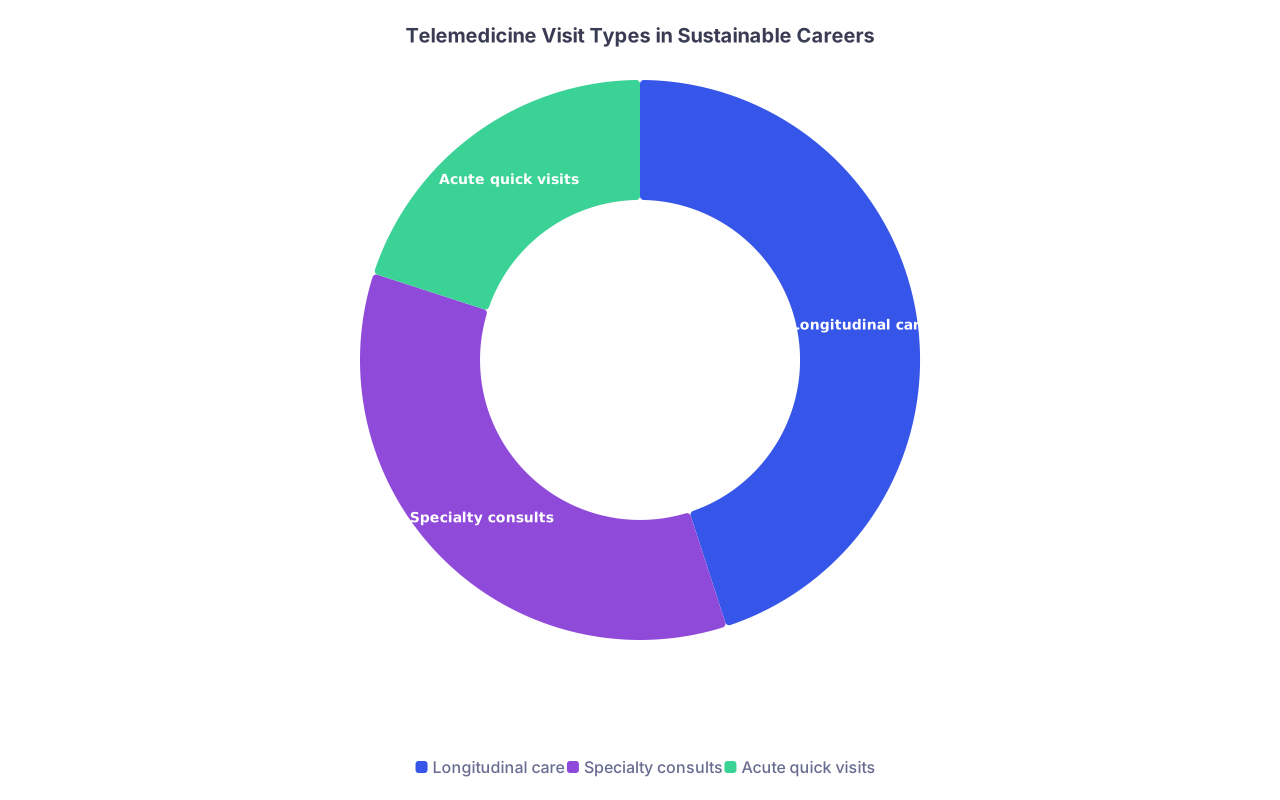
| Category | Value |
|---|---|
| Longitudinal care | 45 |
| Specialty consults | 35 |
| Acute quick visits | 20 |
Career progression is the other concern. In a hospital, you can become lead, medical director, committee chair, etc. In telemedicine, real upward paths exist, but only in more structured organizations:
- Medical director roles for a telemed company
- Regional or national oversight of clinical quality
- Building your own telemedicine group and scaling it
If you lock yourself into anonymous platform work, you’re not building much leverage. You’re a replaceable producer. Doesn’t mean it’s bad. But call it what it is.
5. Lifestyle: The Good, the Bad, and the Delusional
Let’s be blunt: the lifestyle is the main reason people ask this question.
The good:
- No commute, ever
- Flexible scheduling (usually)
- Control over your environment (your own chair, your own coffee, your own thermostat)
- Easier to live somewhere cheap but keep “big city” pay
- Easier to scale down or up hours around family, side projects, or semi‑retirement
The bad:
- Isolation. No hallway consults, no informal teaching, no team banter
- Blurry work/life boundaries if you’re not disciplined
- Staring at screens all day, every day
- Home internet and tech issues are 100% your problem
- If you’re 1099: no automatic benefits, no employer retirement match
Let me kill a myth: “Telemed is easy.”
It’s not. It’s different.
You lose nonverbal cues from patients. You get worse data. You have to explicitly ask about things you’d otherwise see when you walk in the room. You sign the same level of legal responsibility, often with fewer tools.
You have to like the medium itself — talking to a camera, documenting fast, making decisions with bounded information. If that sounds awful to you, full‑time telemedicine will feel like slow torture.
6. Legal, Licensing, and Technical Reality
Full‑time telemedicine long‑term means you need to think like a business owner even if you’re “just” an employee.
Licensing:
- Multi‑state licensure is almost mandatory for 1099 high‑volume work
- The Interstate Medical Licensure Compact helps, but not every state participates
- Psychiatry and primary care telepractices often strategically pick 3–5 high‑yield states rather than chasing 25+ licenses
Liability:
- You still need malpractice insurance (some employers cover, some do not)
- Telemedicine‑specific policies exist and are not optional
- Standard of care = same as in‑person for that specialty in that state
Tech:
- You need a reliable, boring tech setup: wired internet, backup hotspot, good webcam, proper mic, dual monitors
- Secure EHR, e‑prescribing access, and possibly remote access to lab and imaging systems
- Headphones you actually like, because they’ll be on your head most of the day

| Step | Description |
|---|---|
| Step 1 | Finish Residency |
| Step 2 | Choose tele model |
| Step 3 | Hybrid in person plus tele |
| Step 4 | Get multi state licenses |
| Step 5 | Secure stable contract or build panel |
| Step 6 | Optimize tech and workspace |
| Step 7 | Evaluate income and burnout yearly |
| Step 8 | Tele friendly specialty? |
If you want this to be long‑term, you treat all of that like core infrastructure, not afterthoughts.
7. Who Should Seriously Consider Full‑Time Telemedicine?
You’re a good fit for a telemedicine career if:
- You like talking and thinking more than doing procedures
- You’re reasonably tech‑comfortable (not a coder, just not tech‑phobic)
- You value schedule control and location flexibility more than prestige
- You’re willing to accept that your “team” might be Slack, email, and occasional Zoom
You’re probably not a great fit if:
- You live for the adrenaline of codes, procedures, and in‑person drama
- You get your energy from physical proximity to colleagues and patients
- You’re chasing the absolute top 1% comp in your specialty
- You hate documentation — there’s no MA quietly helping in the background here
There is nothing “less real” about a physician seeing patients by video instead of across an exam table. It’s still medicine. But it does change the feel of your day.
8. How to Build a Telemedicine Career That Actually Lasts
If you’re serious about this as a long‑term path, do not wing it. Use a simple framework.
Pick your model
- Employed tele‑only role
- Hybrid job with tele as majority
- 1099 multi‑platform plus maybe a small private panel
- Fully independent telepractice
Run the math
- Know exactly: hourly pay, visit pay, benefits value, licensing costs, malpractice, tech costs
- Aim for: at least comparable net income to an in‑person job you’d actually accept, or a clear tradeoff you’re consciously taking (less pay for better life)
Secure redundancy
- If 1099: at least two solid platforms or a platform plus your own patients
- If W‑2: understand what happens if volume drops – are you still paid?
Protect your future options
- Keep some in‑person work part‑time if you’re early career and worried about skill atrophy
- Maintain CME, board certification, and malpractice tail properly
- Don’t let your network die just because you’re not physically in a hospital
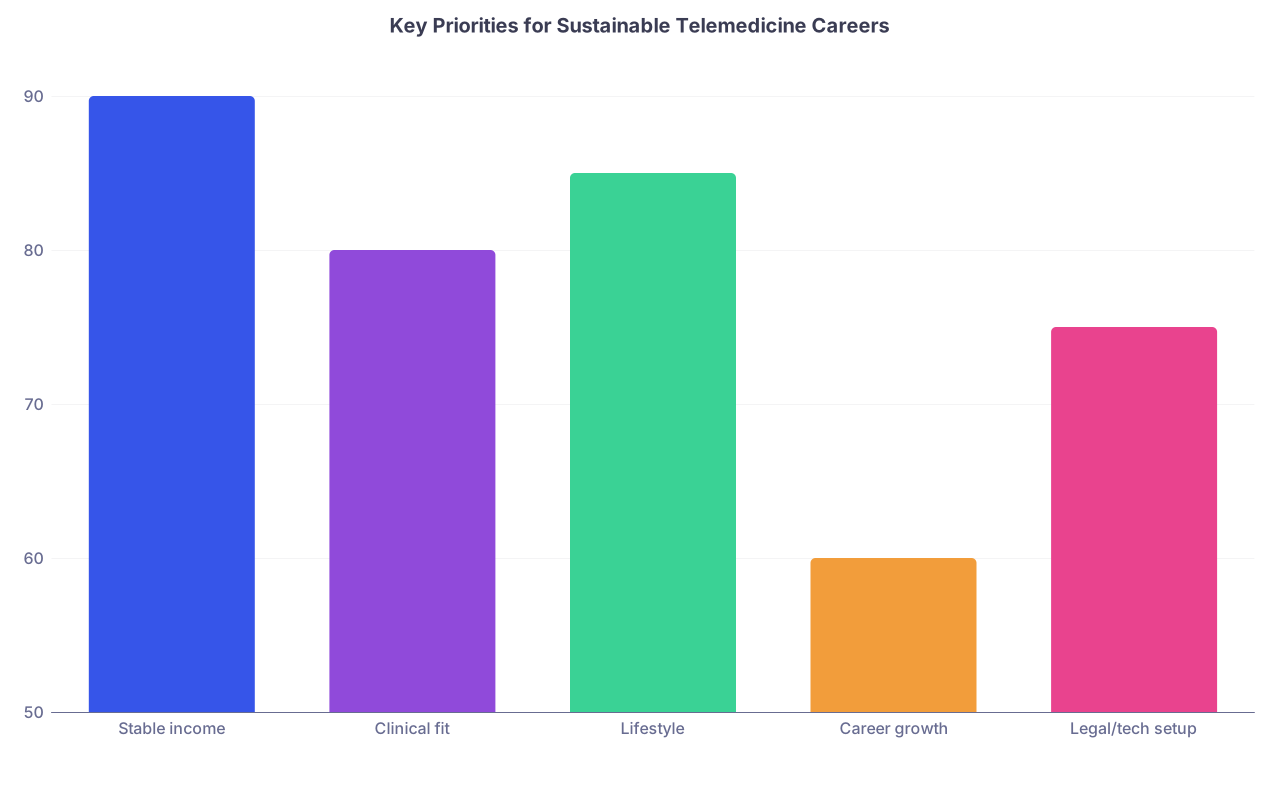
| Category | Value |
|---|---|
| Stable income | 90 |
| Clinical fit | 80 |
| Lifestyle | 85 |
| Career growth | 60 |
| Legal/tech setup | 75 |
Do those things and yes — full‑time telemedicine can be your main career from your 30s into your 60s. Not a stopgap. Not a “while I figure things out.” An actual career.
FAQ: Full‑Time Telemedicine Careers
1. Will doing only telemedicine hurt my clinical skills long‑term?
It can, depending on your field and how narrow your work is. If your telemed is mostly low‑acuity urgent care with no physical exam and minimal follow‑up, your procedural and complex diagnostic skills will atrophy. In cognitive specialties (psych, endocrine, rheum, sleep) that rely heavily on history and data interpretation, the effect is much smaller. Early‑career physicians often hedge by keeping one in‑person day a week or doing short stints of locums to stay sharp.
2. Can new grads go straight into full‑time telemedicine after residency?
They can, but I don’t love it as the only plan. You don’t know what you don’t know in your first few years out, and losing easy access to mentors and in‑person teams can slow your growth. A better approach: first job with a strong in‑person base and some tele built in, then shift more heavily to telemed once you’re confident in your independent practice style. If you do jump straight into tele, be obsessive about CME, case discussion, and getting second opinions when needed.
3. Are benefits usually worse in telemedicine jobs?
Not always, but often. W‑2 telemedicine positions at larger organizations (Kaiser, academic systems, big national telehealth groups) can have reasonable health insurance, retirement plans, and PTO, comparable to many outpatient jobs. The 1099 platform work that dominates social media absolutely does not — you’re buying your own health insurance, funding your own retirement, and covering your own malpractice and licenses. That doesn’t make it bad, but you have to add those costs back into your mental “is this good money?” calculation.
4. How many state licenses do I need for a solid full‑time telemed income?
For panel‑based primary care or psych with an employer, sometimes just 1–3 states is enough if the employer has strong presence there. For high‑volume urgent care or multi‑platform work, most full‑time tele docs I’ve seen end up with 5–15 licenses, often through the Interstate Medical Licensure Compact. Past a certain point, extra licenses add complexity without much extra income, so be strategic: prioritize states where your companies or target patient populations are concentrated.
5. What about job security? Can telemedicine companies just cut volume overnight?
Yes, and they sometimes do. Volume can drop with seasonality, competition, payer contracts changing, or new corporate priorities. That’s why I like either: 1) salaried roles with minimum guarantees, or 2) multiple 1099 streams plus your own patient panel. If your entire income depends on one app sending you visits, you’re exposed. Treat telemedicine jobs like any other: ask about historical volume, seasonality, and what happened to physicians during previous slowdowns.
6. Will I be stuck doing only minor acute complaints forever?
Only if you choose jobs that only offer minor acute complaints. The market has shifted: there are now tele‑first primary care companies, chronic disease management companies, tele‑psych groups, and subspecialty tele‑consult services. Those let you manage hypertension, diabetes, bipolar disorder, RA, sleep apnea, etc. The quick‑visit cold/UTI platforms are loud and common, but they’re not the entire telemedicine universe. You have to deliberately seek roles that match the kind of medicine you want to practice.
7. Is full‑time telemedicine respected, or will colleagues see it as “selling out”?
You’ll get some side‑eye from certain hospital‑centric colleagues who still equate “real doctor” with “on the wards at 6 a.m.” Ignore them. Patients don’t care where your chair is, they care whether you help them. That said, if all you do is churn through 6‑minute visits, refuse complex cases, and stack “easy” problems only, your peers will notice and judge accordingly. If you’re thoughtful, evidence‑based, and choose substantial tele roles (primary care, psych, specialty care), you’re practicing real medicine — just through a different channel.
Key points to walk away with:
- Full‑time telemedicine is absolutely a real, long‑term career — for the right specialties and with the right structure.
- Stability comes from solid contracts, diversified income sources, and clinical work that goes beyond endless low‑acuity quick visits.
- If you’re intentional about model, money, and clinical fit, you can build a decades‑long career in telemedicine without stepping back into a clinic unless you want to.