
The harsh truth: most telemedicine platforms are optimized for their investors, not for you. Your job is to figure out which ones are legit before they waste your time, risk your license, or lock you into garbage pay.
Here’s a practical, no-BS checklist to evaluate any telemedicine platform as a physician.
1. Start With These Two Deal-Breaker Questions
Before you look at the shiny app, the “provider success team,” or the recruiter’s friendly tone, answer two questions:
- Can I safely practice good medicine here?
- Am I being fairly compensated for the risk and effort?
If the answer is not a clear “yes” to both, walk away. No “but it’s easy side money” rationalizing. No “I’ll just try it for a bit.” That’s how people end up doing 30 RVUs of work for $40/hour while their name is on the malpractice line.
Let’s break down how to actually evaluate these platforms.
2. Licensing, Malpractice, and Legal Structure
This is where your license lives or dies. Do not skim this part.
A. Who is the “treating provider” legally?
Ask directly:
- Who is the rendering provider on the claim?
- Who is listed as the treating provider in the chart?
- Who signs the notes and prescriptions?
If they say anything vague like “the platform” or “the company handles that,” that’s a red flag. Your name should be clearly the treating provider when you’re providing the service. If they’re using “medical directors” or shell PCs in weird ways, you need to understand exactly how.
B. Malpractice coverage
You want specifics in writing, not “we cover you.”
Minimum standard for a legit platform:
- Claims-made or occurrence policy clearly stated
- Policy limits (e.g., $1M / $3M)
- Whether it applies to all states you practice through them
- Whether you need your own supplemental coverage
If they say you must use your own malpractice but they’re setting the protocols, scripts, and workflows, that’s a bad power dynamic: they control care, you eat the risk.
| Setup Type | Generally Acceptable? | Who Holds Main Risk? |
|---|---|---|
| Platform-provided, clear limits | Yes | Shared |
| Your own tail + platform protocols | Cautious | Mostly you |
| No written policy details | No | Unknown (you lose) |
C. Corporate practice of medicine and state rules
Especially in states with strict corporate practice of medicine laws (CA, TX, NY, CO, etc.), you should know:
- What legal entity actually employs/contracts with you (professional corporation vs tech company)
- How medical decisions are separated from business decisions
- Who sets clinical policies (physician leadership vs operations/marketing)
If you ask, “Who is your chief medical officer and what’s their role?” and they stumble—that’s not a great sign.
3. Clinical Scope, Standards, and Safety
You are still practicing medicine even if it feels like chat support. You get judged by medical board standards, not app standards.
A. Clinical scope boundaries
A legitimate telemedicine platform has a clearly defined scope:
- What conditions are in-bounds vs out-of-bounds
- Clear criteria for when to escalate to in-person care or urgent/ED referral
- Normal workflows for labs, imaging, and follow-up
If it’s an urgent care-style platform that wants you to prescribe antibiotics for “possible sinusitis” in 2 minutes with no exam options and no consistent follow-up, you need to ask: Is this practice defendable?
B. Visit length and expectations
Ask for hard numbers, not vibes:
- Average visit length (video and async)
- Expected patients per hour
- Whether there are hard time caps (e.g., must close visit in 5 minutes)
You can’t practice safe medicine with absurd volume expectations. If they brag about docs seeing 25–30 video patients per hour, that’s not efficiency, that’s risk.
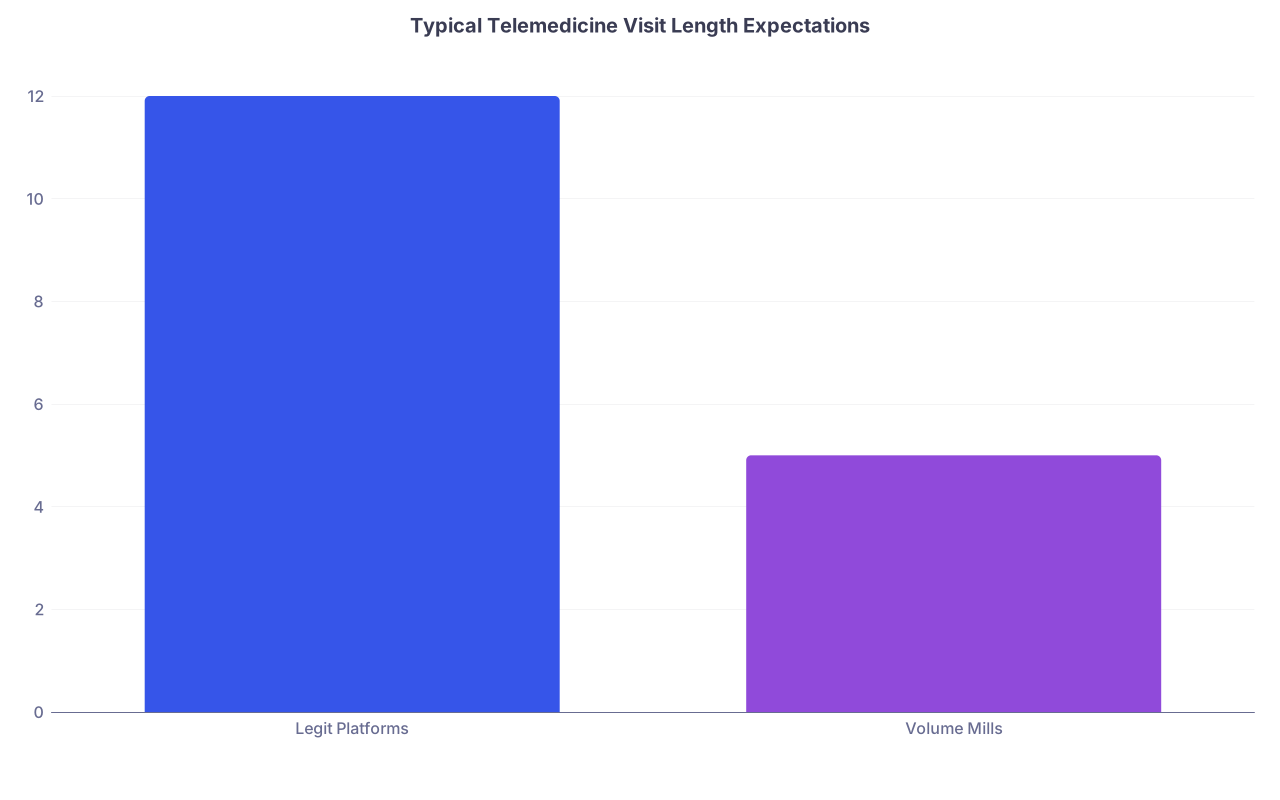
| Category | Value |
|---|---|
| Legit Platforms | 12 |
| Volume Mills | 5 |
C. Protocols vs cookbook medicine
Ask to see examples of:
- Clinical guidelines, pathways, or protocols for common conditions in their scope
- How much freedom you have to deviate and document why
- What happens if your judgment conflicts with “business metrics” like completion time
You want protocols that support judgment, not scripts that replace it. If they push “standard scripts” and punish deviation by cutting your shifts or pay, that’s not a physician-first platform.
4. Compensation, Productivity, and Time Traps
This is where most telemedicine platforms quietly exploit physicians.
A. Understand exactly how you’re paid
Common models:
- Per visit flat fee (e.g., $20–$40 per synchronous visit, $10–$20 per async)
- Hourly rate with or without productivity targets
- RVU-based with or without minimums
- Hybrid (small hourly + per-visit bonus)
You need to translate this into effective hourly and make sure it’s not a joke.
Ask for:
- Typical physician earnings per hour actually realized (not “up to”)
- What portion of your time is unpaid admin: messages, charting, queues, callbacks
- Non-clinical work they expect you to do (chart review, QA, internal comms) and whether it’s paid
If your actual take-home shakes out below $80–$100/hour for most non-surgical specialties in 2025 telehealth, the platform is probably underpaying you unless it’s extremely low-stress, ultra-flexible, and purely “side gig” level.
| Red Flag | Why It Matters |
|---|---|
| “Up to $200/hr” with no data | Often cherry-picked best case |
| Unpaid patient messaging | Hidden time sink |
| No minimum volume or pay floor | You can sit logged in for $0 |
| Mandatory trainings unpaid | Death by a thousand cuts |
B. Beware of queue-based models
Many platforms say, “Log in, take visits from the queue, super flexible.” Ask:
- Are you paid for availability or only per completed visit?
- What happens in low-volume periods?
- Are there minimum shift lengths or penalties for logging off?
I’ve seen physicians sit in a queue on a Sunday afternoon for 3 hours and get 3 visits at $25 each. That’s $25/hour gross before taxes, CME, and overhead. For a board-certified attending. No.
C. Pay cuts and moving goalposts
Legit platforms are transparent about:
- If/when they’ve cut rates before and why
- Whether you’re locked in to a rate with a contract term
- How they handle new grads vs experienced attendings
If they start with, “We used to pay more but now we’ve… optimized,” that’s code for “we’ll cut again when investors ask.”
5. Technology, Workflow, and Support
You’re not a data-entry clerk. The platform should actually enable you to practice medicine, not fight software.
A. EHR and documentation
Ask for:
- Screenshots or demo of the clinician interface
- Average number of clicks per visit
- Whether there are smartphrases, templates, or structured fields that actually help
If every simple UTI visit takes 10 minutes to document because of clunky tools, your “$100/hour” will evaporate quickly.
B. Tech support and downtime
Judge them by their worst days, not their best:
- What’s the process if the platform goes down mid-shift?
- Is there live tech support during all clinical hours you work?
- Do they compensate for downtime if it prevents you from seeing patients?
If they say “email support” for live clinical shifts, that’s amateur hour.
C. Patient access tools
Legitimate platforms take continuity and patient safety seriously:
- Easy access for patients to review after-visit summaries
- Clear instructions for follow-up and emergent concerns
- Reasonable mechanisms for you to review prior visits, labs, and messages
If you’re flying blind every visit (no prior notes, meds, or labs), your ability to practice safely is compromised from day one.
6. Culture, Leadership, and Physician Voice
You can tell a lot from how they talk about physicians when they think you’re not listening.
A. Who’s actually running clinical ops?
Ask:
- Who is the Chief Medical Officer? Are they full-time?
- How many physicians are in leadership vs pure business/tech?
- How often do they meet with frontline clinicians?
A telemedicine company with 300+ clinicians and a part-time CMO who still practices 0.1 FTE surgery somewhere else is not serious about clinical governance.
B. How do they handle complaints and conflicts?
Scenarios to ask about:
- Patient complaints about not getting a desired prescription (e.g., antibiotics, controlled substances, GLP-1s)
- Disagreements about clinic metrics vs clinical judgment
- Policy changes that increase volume expectations
Ask them directly: “Can you give me an example where a physician pushed back on a policy and what happened?” Their answer tells you everything.
C. Reputation among physicians
Do some basic digging:
- Glassdoor reviews (filter for “physician,” “provider,” “doctor”)
- Physician forums (Reddit r/medicine, r/telemedicine, specialty boards, private Facebook groups)
- Search: “[Company name] telemedicine review physician”
You’ll quickly see patterns: either “great side gig, low drama, okay pay” or “trash pay, constant pressure, unsafe expectations.”
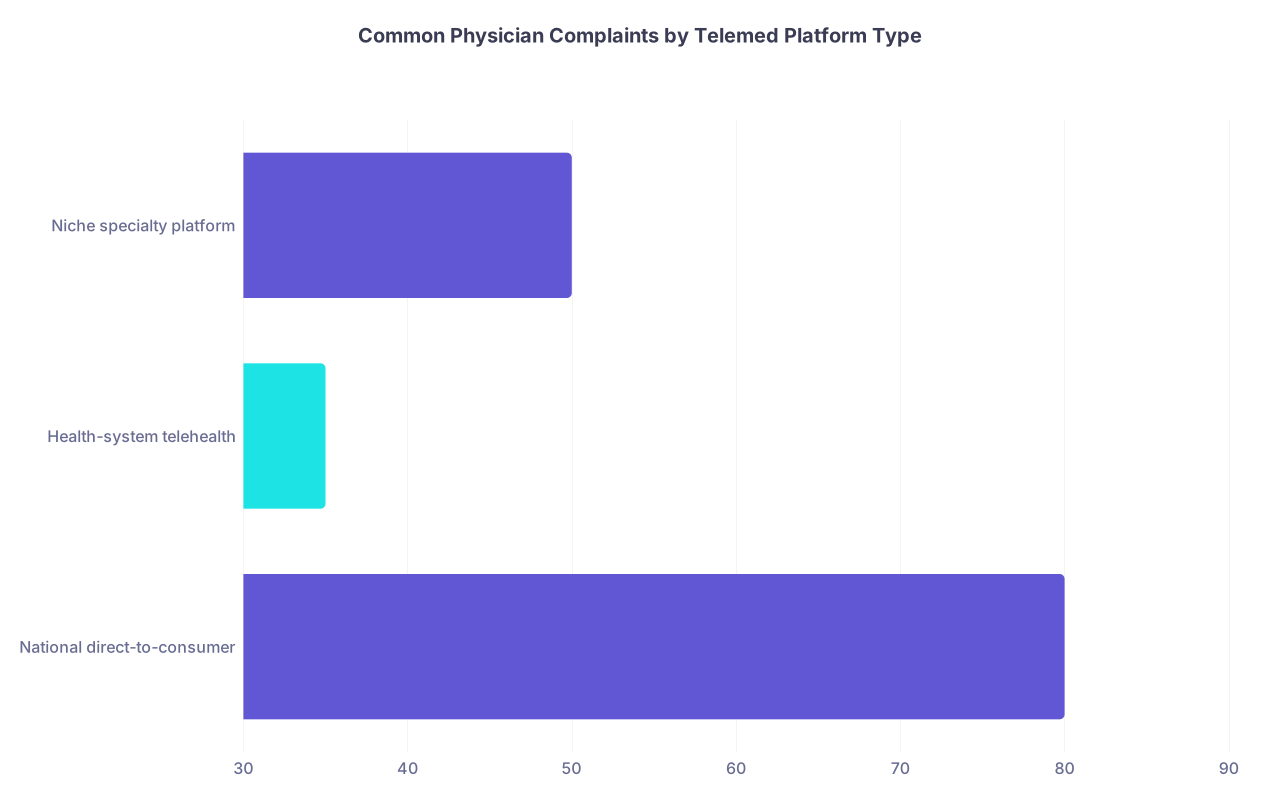
| Category | Value |
|---|---|
| National direct-to-consumer | 80 |
| Health-system telehealth | 35 |
| Niche specialty platform | 50 |
(Values represent approximate “complaint intensity” based on typical feedback: higher is worse.)
7. Data, Prescribing, and Ethical Red Lines
This is where providers get in trouble with boards and the DEA.
A. Prescribing pressure
Clarify:
- Policies on antibiotics, benzos, stimulants, controlled substances, GLP-1s, testosterone
- Whether platforms tie your metrics or schedule to “conversion” or prescription rates
- How they handle “customer satisfaction” when you appropriately say no
If they’re marketing directly to the public with “fast ED treatment,” “weight loss meds now,” or “anxiety meds online in minutes,” you’d better understand how much of that expectation lands on you.
B. Data usage and surveillance
Ask:
- Are your visits being recorded? If so, how are they stored and for how long?
- Are your metrics shared back with you (completion times, prescribing patterns, complaints)?
- How are patient data and your clinical data used for “product development” or AI tooling?
You don’t want to discover your clinical notes were used to train an AI chatbot without robust de-identification and proper guardrails explained.
C. Conflicts of interest
Watch out for:
- Platforms that strongly push the company’s pharmacy, lab, or branded services
- Incentives for you to recommend paid add-ons, subscriptions, or upgrades
- Sales-y scripts disguised as “counseling”
If they want you to be half physician, half salesperson, that’s a no.
8. Fast-Look Checklist: Is This Telemedicine Platform Legit?
Here’s a practical snapshot you can run through after a recruiter call.
| Category | Green Flag Example | Red Flag Example |
|---|---|---|
| Malpractice | Written policy, $1M/$3M, clear coverage | “We cover you, don’t worry about it” |
| Clinical Scope | Clear protocols, escalation pathways | “Just keep visits under 5 minutes” |
| Pay | Realistic $/hr with paid admin time | Only per-visit pay, unpaid messaging |
| Tech | Demo EHR, live support during shifts | Email support only, clunky interface |
| Leadership | Named full-time CMO, active clinical input | No visible physician leadership |
| Ethics | Conservative controlled-substance policies | Heavy DTC marketing for “quick meds” |
| Autonomy | Freedom to decline unsafe cases | Penalized for “over-referring” or not prescribing |
If you see more than two clear red flags, you already have your answer.
9. How to Test a Platform Without Getting Burned
You don’t need to marry the first telehealth company you meet.
Here’s a sane approach:
Start with 1–2 platforms max. More than that and you’ll drown in logins, training, and competing policies.
Ask to do a very small number of shifts or a defined trial period (e.g., 20–30 visits) before committing major time.
Track your own numbers for that trial:
- Total hours logged in (including pre/post charting)
- Number of completed visits
- Total pay received
- Any “this feels sketchy” clinical encounters
Calculate your real hourly rate and your stress level. If either looks ugly, stop. Do not talk yourself into “it might get better later.”
Always keep your main license, credentials, and reputation top priority. Side money you can replace. Your license you cannot.

| Step | Description |
|---|---|
| Step 1 | Hear about platform |
| Step 2 | Check legal and malpractice |
| Step 3 | Reject platform |
| Step 4 | Review clinical scope and workflows |
| Step 5 | Analyze pay and time |
| Step 6 | Check leadership and culture |
| Step 7 | Do limited trial shifts |
| Step 8 | Calculate real $ per hour and risk |
| Step 9 | Continue or expand work |
FAQ (7 Questions)
1. What’s a reasonable hourly rate for telemedicine for an attending?
For most non-surgical specialties in the current market, I’d consider anything under $80/hour poor, $80–$120/hour fair for low-intensity work, and $120–$180/hour good for flexible, part-time telehealth. Some niche areas (psychiatry, derm, sleep) can go higher. Context matters: if they want ED-level decision-making at urgent care pay, that’s not a good deal.
2. Is it safe to do telemedicine as my first job out of residency?
I strongly prefer physicians have at least some in-person practice foundation first, even if it’s part-time. Pure telemedicine as your only job right out of residency can stunt your clinical growth and make nuance harder, especially in fields like IM, FM, EM, and peds. If you do it, pick a platform with strong mentorship, clear protocols, and realistic visit lengths.
3. Should I use my own malpractice instead of the platform’s?
If the platform offers solid coverage with clear limits, I’d generally use theirs for that work. If they require you to carry your own malpractice, you need to:
- Confirm your policy covers telemedicine in all states you’ll see patients
- Understand tail coverage
- Make sure their protocols don’t push you into care you’re uncomfortable defending.
Paying for your own malpractice to protect a company that underpays you and overrules your judgment is backwards.
4. Are asynchronous visits (text-only) more risky than video?
They can be—because you’re operating with less data and significant pressure to be “fast.” For simple, very narrow-scope problems (e.g., certain derm follow-ups, stable chronic care with good documentation), async can be fine. For acute, diagnostic problems, it’s easier for boards and lawyers to argue that a reasonable standard required a proper exam or at least real-time interaction.
5. What about telemedicine platforms focused on weight loss, hormones, or ED meds?
Approach these with maximum skepticism. Many of these are marketing engines wrapped in thin clinical workflows. Check:
- How they handle initial evaluation and contraindications
- Whether they pressure you to prescribe specific meds/plans
- How they manage follow-up and labs
If you feel like a subscription salesperson instead of a physician, you’re in the wrong place.
6. Can telemedicine work eventually replace a traditional full-time job?
For some physicians, yes—but not on garbage platforms. To make telemedicine your primary income:
- You need stable, predictable volume
- Solid pay, ideally with a mix of hourly and productivity
- Reasonable shifts that don’t fry your brain
- A platform or combination of platforms that you trust clinically
Most people end up with a hybrid model: part telehealth, part brick-and-mortar, or multiple telehealth gigs balanced together.
7. What’s the single biggest red flag in a telemedicine platform pitch?
Any version of: “You can see a ton of patients very quickly; our top doctors make X per hour.” High volume is not a flex when your license is on the line. A legit platform leads with: safety, standards, malpractice, oversight, and then compensation. If the sales pitch is all about speed and money and barely mentions clinical governance, move on.
Key points: your license, your time, and your clinical judgment are the assets here—not the platform’s app. Look for clear malpractice coverage, realistic clinical expectations, and pay that reflects the work. If something feels off in your gut during the early conversations, trust that.