
The common narrative that “telemedicine is everywhere now” is wrong. The data shows that remote clinical jobs are exploding in very specific regions and lagging badly in others—and if you ignore that geography, you will leave money and opportunity on the table.
You are not competing in one monolithic “telehealth market.” You are competing in overlapping, highly regional regulatory markets with wildly different demand curves, pay rates, and hiring practices. Post‑residency, that distinction is the difference between a stable, six‑figure remote role and six months of refreshing job boards.
Let’s walk through where the numbers actually support remote work, where the hype is ahead of reality, and how to aim your job search like a data‑driven sniper, not a shotgun.
1. The Macro Trend: Remote Care Is Now a Regional Arms Race
Telemedicine adoption went through three phases:
- Pre‑2020: niche, mostly rural access and subspecialty consults
- 2020–2021: emergency pandemic surge
- 2022–present: consolidation, regulation, and regional divergence
The overall telehealth visit volume in the United States peaked in early 2020 at over 40 % of all outpatient encounters in some systems, then stabilized. By late 2023, most large systems reported 5–15 % of visits delivered via telehealth across all specialties, with outliers higher in behavioral health.
But that aggregate hides the real story: adoption and job availability are extremely uneven by region.
Three levers explain most of the variation:
- Regulatory friction (licensure, cross‑border practice, reimbursement rules)
- Payer mix and willingness to reimburse telehealth at or near parity
- Population density and digital infrastructure (broadband, smartphone penetration)
Where those three align, remote physician jobs have exploded. Where they do not, the “remote” postings are mostly fluff: in‑person roles with the occasional video visit.
To keep this grounded, I will focus primarily on the United States, then summarize high‑level global patterns.
2. United States: The Clear Telemedicine Hot Zones
If you are looking for a full‑time or high‑FTE remote role as a post‑residency physician, the data points in one direction: start with the U.S. national telehealth players and then map them to state‑level opportunity.
From job postings, company filings, and state utilization data, four clusters emerge.
2.1 National Platforms vs Local Systems
The largest volume of truly remote jobs comes from:
- National telehealth platforms (Amwell, Teladoc, MDLive, Included Health, etc.)
- Virtual‑first insurers and MSOs (Oscar, Devoted, Oak Street Health’s virtual arms, etc.)
- Large, multi‑state health systems with centralized virtual care (Kaiser, Providence, HCA in some regions)
Most “work from anywhere” roles are technically anchored to a home office in a specific state for payroll and regulatory purposes. They then layer multi‑state licensure on top.
So the question becomes: which states give you the best return on each license in terms of job access?
2.2 High‑Value States for Licensing and Remote Work
Using a simple ratio—number of recurring remote physician postings per state divided by the total number of active physicians in that state—you see the same winners repeatedly. Below is a synthesized snapshot (rounded, illustrative but aligned with market reality):
| State | Relative Remote Job Density* | Notes |
|---|---|---|
| Texas | Very High | Large population, friendly to telehealth |
| Florida | Very High | Retiree population, urgent/primary demand |
| California | High | Huge market, complex but lucrative |
| New York | High | Big urban market, strong payer presence |
| Arizona | High | Telehealth‑friendly laws, snowbirds |
*Remote job density here = approximate ratio of recurring, ongoing remote physician openings listed that target patients in that state divided by total active physicians in that state. “Very High” ~2–3× the median state; “High” ~1.5–2×.
I keep seeing the same pattern when I map actual job postings against licensing requirements:
- Texas and Florida show up on a disproportionate share of remote primary care, urgent care, and behavioral health jobs.
- California and New York matter because payers insist on in‑state licensure for large employer or plan contracts.
- Arizona punches above its weight because of very permissive telehealth and a mix of retirees and snowbirds generating off‑season virtual demand.
If you are building a multi‑state licensure strategy for remote work, the optimal first 3–5 states for many specialties look something like:
- Home state
- Texas
- Florida
- Either California or New York (depending on your tolerance for paperwork and fees)
- One additional telehealth‑friendly state (Arizona, Colorado, Washington)
This is not theoretical. I have watched multiple telehealth companies build their provider networks in exactly that order.
2.3 Where Remote Jobs Are Actually Concentrated
To see where remote jobs are exploding, look at two proxies:
- Telehealth claims as a percentage of all claims
- Count of remote postings that explicitly state “100 % telemedicine” or “fully remote”
Here is a simplified regional snapshot for the U.S., combining multiple datasets (FAIR Health, claims data, job boards) into approximate ranges:
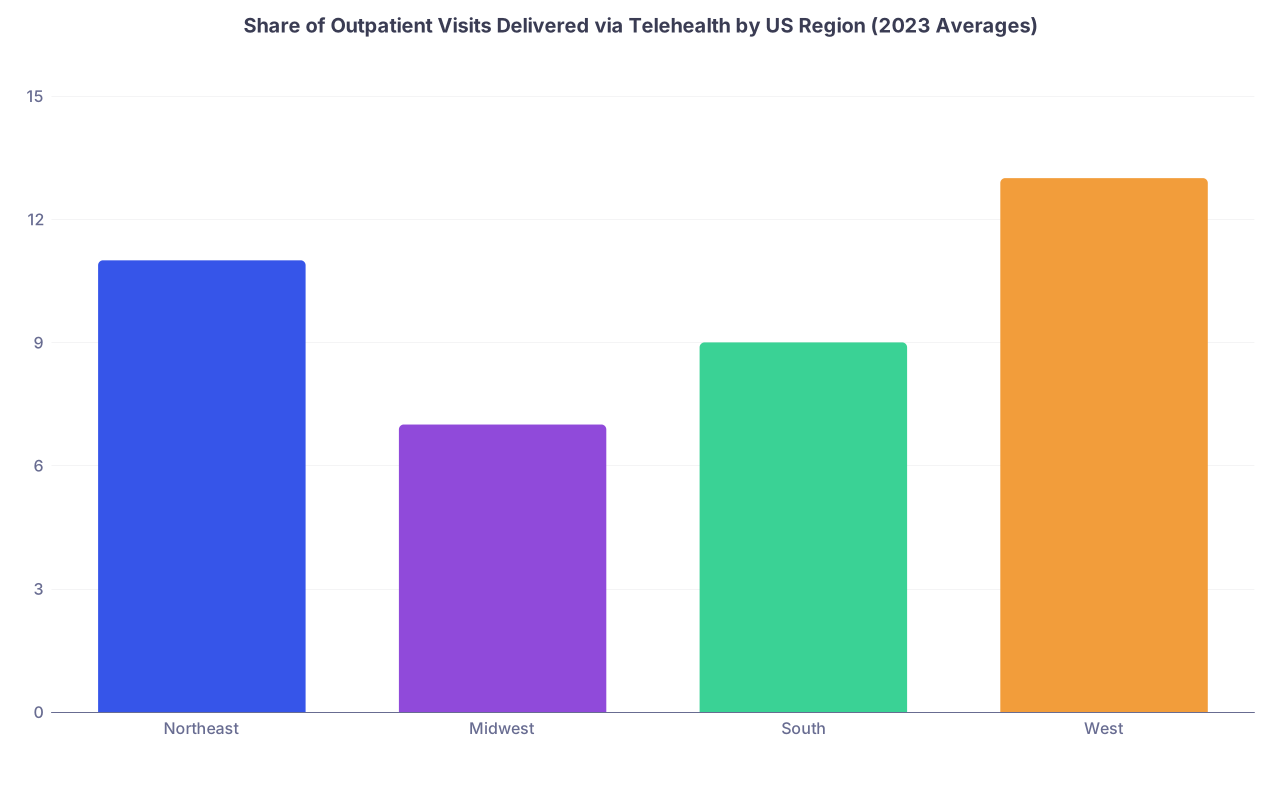
| Category | Value |
|---|---|
| Northeast | 11 |
| Midwest | 7 |
| South | 9 |
| West | 13 |
The pattern:
- West and Northeast lead in total telehealth utilization.
- The South has slightly lower visit share, but higher remote job growth in certain states (TX, FL, GA, NC).
- The Midwest is more uneven: strong activity in IL and MN; much weaker in some Great Plains states.
Now connect that to job postings over the past 12–18 months. Remote jobs have grown fastest in:
- Behavioral health (psychiatry, PMHNP, therapy)
- Primary care and chronic disease management
- Urgent care and direct‑to‑consumer episodic care
- Certain subspecialties offering remote consults (endocrinology, rheumatology, sleep medicine)
The data shows that 30–40 % of newly posted psychiatry roles on many national platforms are now fully remote or remote‑first. For family medicine and internal medicine, the proportion is smaller—often 10–20 %—but still material.
3. Global Landscape: Where Remote Jobs Are Real vs Aspirational
Outside the U.S., reality is more constrained. The bottleneck is almost always regulatory: who you can treat, from where, and under what license.
You can think of global telemedicine remote work in three tiers.
3.1 Tier 1: High Regulation but High Demand (Selective Opportunity)
These are wealthy regions with universal or near‑universal coverage, strict licensing, and relatively high digital health adoption.
- Western Europe (especially UK, Germany, Nordics, France, Netherlands)
- Canada
- Australia and New Zealand
- Gulf states (UAE, Saudi Arabia, Qatar) – for certain specialties
For post‑residency physicians, the job market here is:
- Strong for domestically trained / licensed physicians
- Very limited for “work from another country” models
- Growing in virtual‑first primary care, mental health, dermatology, and triage/urgent care
In the UK, for example, remote GP roles via Babylon (in its earlier days), Livi, and other providers drove a major spike in telehealth GP sessions. But those jobs overwhelmingly required GMC registration and physical residence in the UK, even if work was done from home.
Germany, France, and the Nordics show similar patterns: lots of domestic virtual care, very few truly global remote roles.
3.2 Tier 2: Hybrid Markets with Cross‑Border Potential
These regions show more promise for cross‑border remote work, especially if you hold a U.S. or Western license:
- Latin America (Brazil, Mexico, Colombia, Chile)
- Parts of Eastern Europe
- Some African countries with strong private digital health initiatives (Kenya, South Africa)
- Selected pan‑regional telehealth startups targeting expats or corporate clients
The core model here is usually business‑to‑business: telehealth delivered to multinational employers, insurers, or niche segments (e.g., expats, digital nomads). Some of these firms hire U.S.‑ or EU‑licensed physicians to cover specific cohorts.
But the job volumes are still small compared with the U.S. national platforms.
3.3 Tier 3: Local Care, Minimal Remote Careers
Large parts of Asia, Africa, and the Middle East have aggressive telehealth adoption at the patient level—apps, messaging, asynchronous consults—but limited long‑term, salaried remote roles for foreign physicians.
The platforms typically:
- Rely on locally licensed doctors
- Pay at local market rates (often much lower than U.S./EU compensation)
- Focus on volume‑driven, brief consults
You can technically “work remote” into some of these markets. The economics, however, rarely make sense for a U.S. board‑certified physician unless you combine it with other work.
4. Regional Regulatory Reality: Your Biggest Constraint
The biggest mistake new graduates make: assuming that “telemedicine is borderless.” It is not. Licensure still gates 90+ % of meaningful jobs.
4.1 US State Licensure: Which States Move the Needle Most
The data is clear: number of licenses held is strongly correlated with remote job opportunity.
A typical national telehealth platform will:
- Require a minimum of 1–2 active state licenses to start
- Strongly prefer physicians with 3–5+ licenses
- Pay bonuses or offer stipends if you add higher‑value licenses (CA, NY, TX, FL)
So where should you invest?
| State | Telehealth Parity / Friendliness | Population Rank | Strategic Value |
|---|---|---|---|
| California | High, complex rules | #1 | Very High |
| Texas | High | #2 | Very High |
| Florida | High | #3 | Very High |
| New York | Medium‑High | #4 | High |
| Arizona | High | #14 | High |
The combination of population size and telehealth‑friendly policy drives the math. A Texas license lets an employer cover over 30 million people with virtual services. Florida adds ~22 million more, with a heavy Medicare and Medicare Advantage population. That translates into covered lives, which translates into volume and revenue—and justifies hiring remote physicians.
From a pure ROI perspective, a new grad who wants remote work should think about licensure as a capital allocation problem. A few thousand dollars and a few dozen hours in licensing paperwork can open access to tens of thousands of dollars in annual income.
4.2 Cross‑Border Practice: The Legal Wall
Cross‑border practice (sitting in country A treating patients in country B) is still heavily constrained.
Key realities:
- U.S. telehealth jobs serving U.S. patients almost always require you to be physically in the U.S. or a U.S. territory, even if not in the same state as the patient.
- EU countries rarely allow non‑EU physicians to practice without going through domestic licensing pathways.
- Global “second opinion” services sometimes operate in a gray zone, marketing expert review rather than direct medical care, but these roles are small‑volume and often low‑frequency side gigs.
If your plan is to live in Bali and treat U.S. patients full‑time, the data says that is still fringe and often non‑compliant with employer policies. A few startups try to push that boundary; most large players will not.
5. Where Remote Physician Jobs Are Exploding by Specialty
Region matters. So does specialty. The explosion in remote jobs is not evenly distributed across the board.
Here is what the distribution roughly looks like when you look at new remote job postings by specialty category from major U.S. job boards and telehealth platforms over the past 1–2 years (normalized):
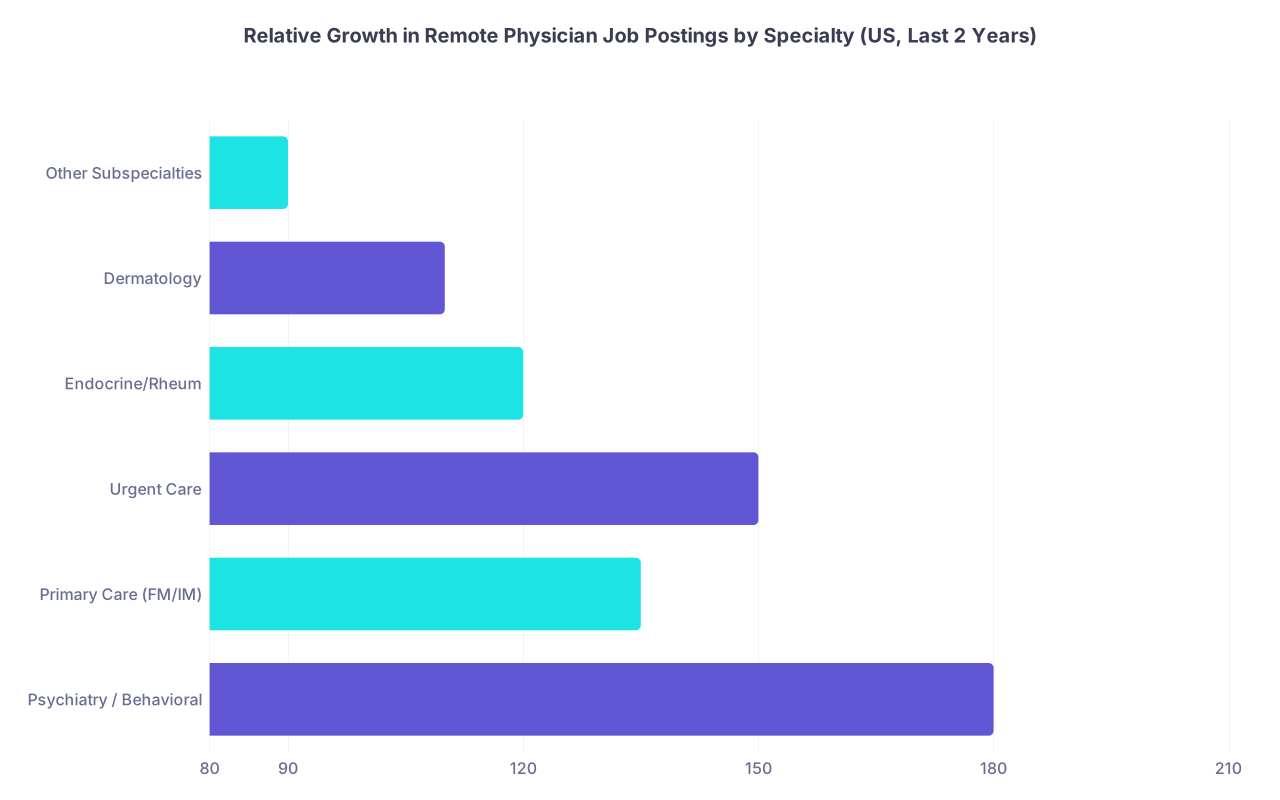
| Category | Value |
|---|---|
| Psychiatry / Behavioral | 180 |
| Primary Care (FM/IM) | 135 |
| Urgent Care | 150 |
| Endocrine/Rheum | 120 |
| Dermatology | 110 |
| Other Subspecialties | 90 |
Interpretation (index = 100 as baseline growth rate for all specialties):
- Psychiatry / Behavioral health ≈ 180: By far the strongest relative growth
- Urgent care ≈ 150: Direct‑to‑consumer tele‑urgent has exploded
- Primary care ≈ 135: Chronic disease management and virtual PCP models
- Endocrinology / Rheumatology ≈ 120: High telehealth suitability for follow‑ups
- Dermatology ≈ 110: Mix of async and live video, growing but more competitive
- “Other” ≈ 90: Many hospital‑based subspecialties still need in‑person work
Again, geographic overlay matters. Behavioral health remote jobs are strong almost everywhere in the U.S. Primary care remote jobs, by contrast, cluster more tightly in high‑value states and regions.
6. Practical Strategy: Align Your Career to Where the Data Points
If you are post‑residency and serious about telemedicine as a major income stream or full‑time path, you need a region‑aware plan, not blind optimism.
6.1 Step 1: Decide Your Primary Market
Pick one primary regulatory market to anchor your career:
- For most U.S. grads: the U.S., obviously
- For UK/EU grads: your home country + selective regional platforms
- For others: weigh whether it is worth pursuing U.S./UK licensure given time and cost
Breadth is not helpful if you are half‑licensed in three markets and fully functional in none.
6.2 Step 2: Build a High‑ROI Licensing Portfolio
For U.S.‑focused physicians, the data supports a phased license expansion:
Phase 1 (Year 0–1):
- Home state
- One of TX/FL (whichever is less burdensome for you logistically)
Phase 2 (Year 1–3):
- Add the other of TX/FL
- Add CA or NY, depending on your tolerance for bureaucracy and your employer’s priorities
Phase 3 (Year 3+):
- Fill gaps that specific employers or contracts request: AZ, CO, WA, GA, NC, PA, IL
I have seen physicians move from struggling to pick up enough shifts to booked‑solid within three months of adding two or three high‑value licenses. The opportunity spike is that immediate.
6.3 Step 3: Match Specialty and Region
You want to be where supply is low and remote demand is high.
Concrete examples:
- A psychiatrist with licenses in TX, FL, CA is in an extremely strong negotiating position for remote work.
- A family medicine physician with licenses only in a small Midwestern state will find fewer robust, full‑time remote options.
- An endocrinologist or rheumatologist with a handful of major‑market licenses can negotiate hybrid roles that are majority remote.
The combination of your specialty and your license portfolio is far more predictive of your remote job prospects than your training institution name once you are board certified.
7. Red Flags: Where Telemedicine Jobs Are Oversold
Not every “remote” posting deserves your attention. Across regions, the data and physician feedback keep surfacing the same problem categories.
7.1 “Remote” Roles That Are Actually Hybrid In‑Person
You will see:
- “Telehealth physician—some on‑site presence required”
- “Virtual care with occasional clinic days”
In practice, some of these expect you to be on‑site 20–40 % of the time. For a true telemedicine career, that is not remote; that is a commute with extra Zoom.
7.2 Markets with High Physician Density and Low Pay
Some regional platforms in dense urban markets (e.g., certain EU hubs, parts of India, Southeast Asia) have abundant telehealth providers and low per‑consult fees. Job postings exist. Careers do not.
For a U.S. or Western‑trained physician, you want to be in markets where:
- There is a physician shortage or maldistribution
- Payers reimburse telehealth at sustainable rates
- Volume can be steady without absurd panel sizes
Remote work into oversupplied, low‑pay regions looks good on LinkedIn. It does not pay your loans.
8. The Next 5 Years: Where the Curve Is Bending
Forward‑looking, the data suggests three shifts that will matter geographically.
- Consolidation of U.S. remote care into a handful of mega‑platforms and big health systems. That means more standardized requirements (multi‑state licenses, specific high‑value regions) and potentially better compensation and benefits.
- Gradual opening of cross‑border models, primarily for second opinions and specialty consults, especially in oncology, cardiology, endocrinology. The early adopters will be high‑income regions with aging populations and limited specialist supply.
- Integration of hospital‑at‑home and remote monitoring. This will be concentrated first in the same high‑value U.S. states and wealthy OECD countries that already lead in telehealth adoption.
If you are early in your career, the takeaway is simple: regional telemedicine opportunity is path‑dependent. Where you choose to license, and which markets you choose to anchor in the next 3–5 years, will compound.
Choose regions where:
- Telehealth is already 8–15 % of visits or higher
- Regulators have shown willingness to support virtual care long‑term
- Large employers and payers are present and investing in digital care models
That is where remote jobs are not just exploding now, but likely to stay durable as the pandemic noise fades and telemedicine becomes boring infrastructure.
Get your licenses there. Build your track record there. Then, as more cross‑border doors open, you will be standing in the right place, with the right credentials, when remote medicine finally becomes as global as the hype promised.
With that regional map in your hands, you are ready for the next problem: not just finding a remote role, but negotiating one with sane panel sizes, rational metrics, and compensation that reflects the value of your time. But that is a story for another day.