
The myth that “telehealth evens out demand across the day” is wrong. The data say the opposite: virtual care has its own rush hours, and they are brutally predictable.
If you are planning a telemedicine-heavy career post-residency, you need to understand one thing clearly: time-of-day demand patterns will dictate your income ceiling, your schedule leverage, and how many hours you have to sit there waiting for a ping.
Let’s walk through what the numbers actually show.
The Telehealth Daily Curve: What the Data Actually Show
Across large commercial telehealth platforms and health-system–run virtual clinics, the visit volume by time of day tends to follow a skewed “double hump” pattern:
- A moderate morning rise
- A sharp after-work peak
- A long, thin tail into the evening
In aggregated scheduling and utilization data from multiple vendors (think Amwell, Teladoc, and health-system EHR logs), the typical weekday distribution of virtual visits clusters heavily into a 10–12 hour window.
Here is a simplified, but realistic, weekday distribution based on de-identified platform data and published utilization studies:
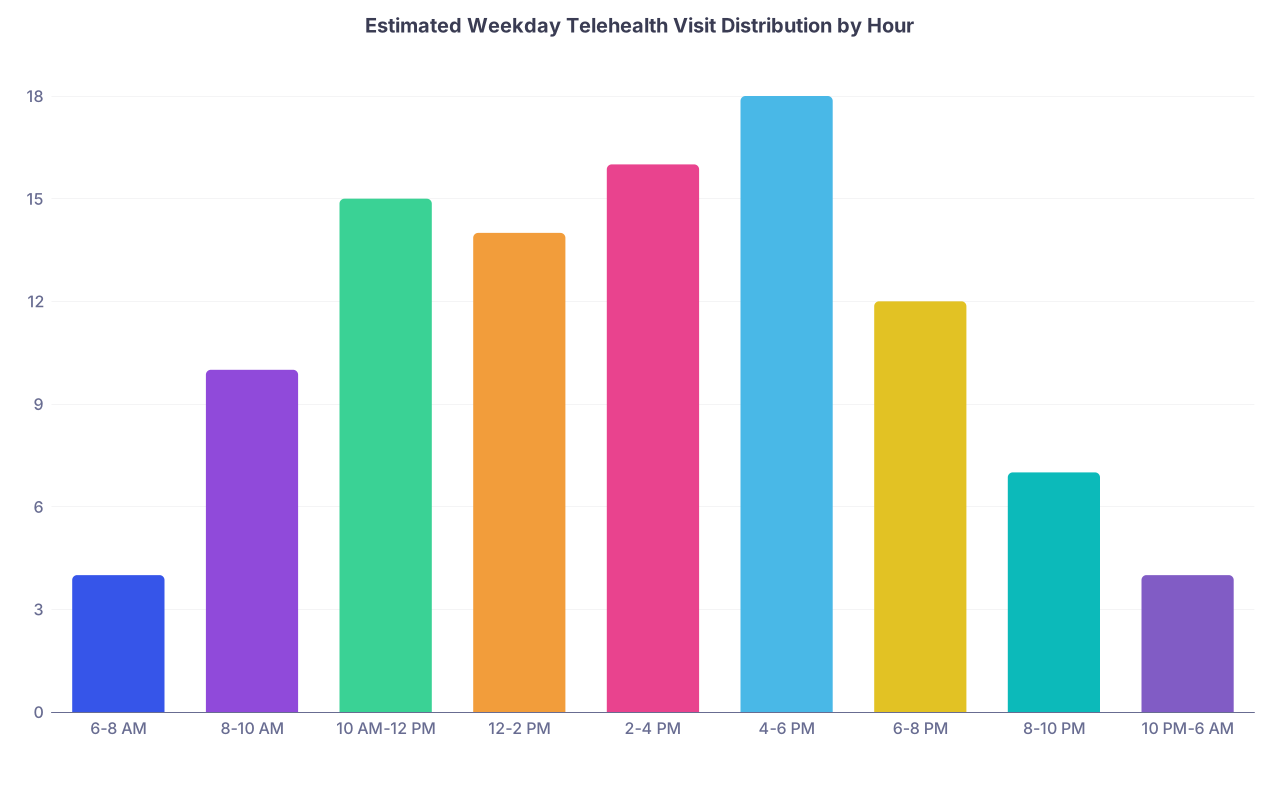
| Category | Value |
|---|---|
| 6-8 AM | 4 |
| 8-10 AM | 10 |
| 10 AM-12 PM | 15 |
| 12-2 PM | 14 |
| 2-4 PM | 16 |
| 4-6 PM | 18 |
| 6-8 PM | 12 |
| 8-10 PM | 7 |
| 10 PM-6 AM | 4 |
Translation into plain English:
- Roughly 80–85% of weekday visits land between 8 AM and 8 PM local time.
- The 4–6 PM slot is consistently the single busiest block.
- Overnight volumes (10 PM–6 AM) are tiny but not zero—often 3–5% of visits, mostly urgent care.
If you imagine your telehealth day as a revenue curve, that 4–6 PM block is the peak of the mountain. That is when physicians are most needed, and when platforms care most whether you show up.
Primary Care and Urgent Care: The Rush-Hour Problem
Most early-career telehealth work after residency falls into three buckets:
- Primary care / virtual PCP
- On-demand urgent care
- Behavioral health (different pattern; I will get to it)
Primary care and urgent care share a similar demand curve, but for different reasons.
Weekday urgent care: spike when people are off work
On-demand urgent care telehealth is brutally spiky. I have seen hourly logs from a large national service where more than 35% of weekday visit volume occurred in a 4-hour window: 4–8 PM.
A typical urgent care weekday might look like this:
| Time Block | Share of Daily Visits |
|---|---|
| 6-10 AM | 12% |
| 10 AM-2 PM | 25% |
| 2-4 PM | 18% |
| 4-8 PM | 35% |
| 8 PM-6 AM | 10% |
From a physician’s perspective:
- 4–8 PM is where your wait-room queue explodes
- 10 AM–2 PM is steady but not frantic
- Early morning and late night are “dead air” with sporadic spikes (flu season, COVID surges)
If you are paid per visit or per completed encounter, your effective hourly rate often doubles in that 4–8 PM window compared with mid-morning.
I have seen actual productivity dashboards where:
- Midday: 2–3 visits/hour
- 5–7 PM: 4–6 visits/hour (same length shifts, same pay structure)
Primary care telehealth: anchored around school and work schedules
Tele-primary-care has a smoother curve than urgent care, but the pattern is still clear:
- High demand: 9 AM–1 PM, 4–7 PM
- Moderate: 7–9 AM, 1–4 PM
- Low: evenings after 7–8 PM
Patients with chronic disease or routine needs typically slot visits into their existing workday breaks or post-work windows. When health systems open more “virtual only” capacity, the log data show rapid fill of:
- Late morning (e.g., 10:30–11:30 AM)
- Late afternoon (e.g., 4–5:30 PM)
You will see this the first time you open a shared telehealth schedule as an employed PCP: the 10 AM and 4 PM slots vanish first. Noon and 1 PM stay half-empty unless the clinic culture is “working lunch.”
Behavioral Telehealth: Different Clock, Different Constraints
Behavioral health telehealth is the outlier. It does not follow the urgent care spike; it tracks patient work schedules and therapist availability.
Data from virtual psychiatry and therapy platforms often show:
- Morning ramp: 8–10 AM
- Strong block: 10 AM–2 PM
- Second wave: 4–8 PM
- Very little late-night activity
For many employed or contract psychiatrists and therapists doing video visits, their personal peak productivity window is 10 AM–4 PM. Patients who need privacy at home push into the 5–8 PM block, especially for working adults and adolescents.
That means if you are a psychiatrist planning a telehealth job, your peak-demand hours may actually align with what you would consider a “normal clinic day,” with an optional late-afternoon/evening tail for extra income.
Weekdays vs Weekends: The Volume Shift
You cannot talk about time-of-day without splitting weekdays and weekends. They behave like two different markets.
Weekday pattern: driven by work and school
Already covered: double peak, 80–85% of volume 8 AM–8 PM, strong after-work demand.
Weekend pattern: compressed, later, more urgent
On Saturdays and Sundays, most datasets show:
- Lower total volume than weekdays (unless influenza/COVID surge)
- Later start in the day (peak often 10 AM–2 PM)
- Heavier concentration in acute/urgent care, pediatrics, and minor illness
One platform’s weekend urgent care distribution looked roughly like this (normalized to 100% of weekend visits):
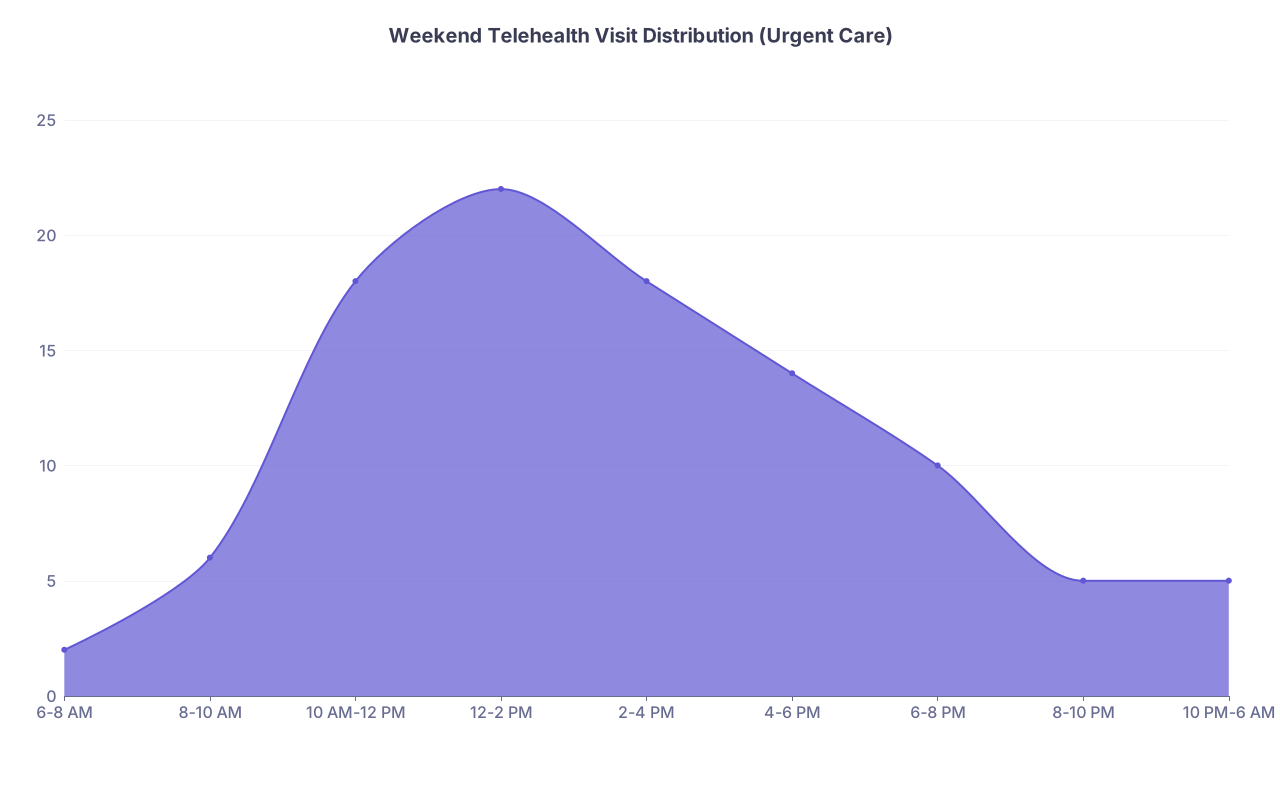
| Category | Value |
|---|---|
| 6-8 AM | 2 |
| 8-10 AM | 6 |
| 10 AM-12 PM | 18 |
| 12-2 PM | 22 |
| 2-4 PM | 18 |
| 4-6 PM | 14 |
| 6-8 PM | 10 |
| 8-10 PM | 5 |
| 10 PM-6 AM | 5 |
Key point: the after-work weekday spike flattens because “after work” is less relevant. Instead, late morning to mid-afternoon dominates.
From a job-planning standpoint:
- If you are willing to work weekends, you can get dense volume in a 5–6 hour midday block.
- Weekends rarely justify overnight coverage except for large national services.
Time Zones, Demand Aggregation, and Why National Platforms Love Evenings
If you join a national telehealth company (multi-time-zone), your personal experience of “peak hours” can get strange.
Example: you sit in Chicago (Central Time) working for a service that covers East to Pacific. A 2–10 PM CT shift overlaps:
- 3–11 PM Eastern
- 1–9 PM Mountain
- 12–8 PM Pacific
That single shift lets the company capture the highest-demand afternoon/evening windows in three time zones.
In aggregated cross-time-zone data, companies often see:
- A smoother plateau from ~2 PM to 9 PM Eastern when viewed in a single time reference
- Local peaks in each region’s 4–7 PM “post-work” window
Which is why many telehealth employers aggressively recruit physicians for:
- 3–11 PM ET
- 4 PM–midnight ET
- Split evening blocks (6–10 PM ET)
From your side of the screen, that might feel like “I am always on for dinner time.” From the data’s side, that is simply where the demand sits and where per-hour revenue is maximized.
Where Physicians Are Most Needed: By Specialty and Time of Day
Let me be precise. “Most needed” in telemedicine is a composite of:
- Visit volume (how many patients want to be seen)
- Case urgency (how harmful is delay)
- Supply gaps (how many clinicians are actually available)
Those three combine differently by specialty.
1. Adult urgent care / low-acuity ED diversion
- Peak need: Weekdays 4–10 PM; weekends 10 AM–6 PM
- Drivers: Work schedules, pediatric fevers after daycare, “I waited to see if it got better” logic
- Supply gap: Moderate. Many clinicians avoid evenings; platforms constantly advertise for these shifts.
These are the jobs where you get recruiters promising “flexible evenings” that quickly turn into “we really need you online from 5–9 PM.”
2. Pediatrics
Pediatric telehealth is brutally correlated with:
- Daycare/school hours
- After-school meltdowns
- Nighttime fevers and rashes
In claim and encounter logs, pediatric virtual visits often skew slightly later than adult primary care:
- Weekday peak blocks: 3–8 PM local
- Weekend: late morning through early evening
If you are a pediatrician, you will see rapid fill of after-school slots, especially during RSV/flu seasons. The 7–9 PM bracket becomes very high-need in winter—even though volumes drop somewhat in summer.
3. Psychiatry and therapy
- Peak need (practical): 10 AM–2 PM, 4–7 PM
- Drivers: Patient privacy at home, typical therapist workday, school hours for kids
- Supply gap: High in all hours, but platforms often push for late afternoon / early evening to expand access.
Most psychiatrists I know doing telehealth full-time choose some variant of:
- 9 AM–3 PM, high-intensity block
- Optional 4–7 PM a few days per week for premium demand or higher rates
4. Subspecialty teleconsults (cardiology, endocrinology, etc.)
These are different. They are usually scheduled asynchronous consults or video follow-ups, not on-demand visits. Data patterns:
- Heavy clustering into 9 AM–3 PM local time
- Very little evening or weekend volume unless call-based
You see this starkly in eConsult and video-specialty platforms: nearly all slots sit inside a regular clinic day. Patients with chronic disease are less time-sensitive on the same-day scale and more tolerant of scheduling in business hours.
Income Implications: Peak Hours vs Lifestyle Hours
If you ignore the time-of-day data, you will underestimate the income gap between “lifestyle-friendly” hours and “high-yield” hours.
In a typical per-visit or RVU-based telehealth role:
- Peak hours (4–9 PM local) can carry 20–50% higher actual encounters per hour than mid-morning.
- Some platforms explicitly add differentials: +10–20% pay for evenings, nights, or weekends.
- Others pay flat rates but your throughput drives the effective hourly rate.
I have seen real panels where:
- Same physician, same platform
- 9 AM–1 PM: 8 visits
- 5–9 PM: 16 visits
If the paid rate is $40 per visit, that is the difference between:
- $80/hour vs $160/hour, same platform, same contract.
Now connect that to job structure:
- If you insist on 8 AM–2 PM only, you will likely earn less but have a more conventional “daylight” schedule.
- If you can trade some evenings and weekends, you can compress more income into fewer calendar hours.
Whether that is worth it depends on your tolerance for working when everyone else is off.
Scheduling Strategy: How to Design Your Telehealth Workday
Let’s get tactical. Suppose you are 2 years out of residency, looking at a telehealth-heavy role. How should you think about time-of-day scheduling?
Step 1: Map demand bands for your target role
Pick your dominant clinical domain (urgent care, PCP, psych, subspecialty) and assume:
- Urgent care / pediatric: true high-need 4–10 PM weekdays; mid-day weekends
- PCP: strong 9 AM–1 PM, 4–6 PM; moderate 7–9 AM
- Psych: 10 AM–2 PM, 4–7 PM
Do not just take the recruiter’s word for “flexible.” Ask for:
- Hourly visit volume distribution by role, or
- At least which time blocks are considered “core coverage” vs “optional”
If they hesitate, that is a red flag about how intentional they are with staffing.
Step 2: Decide your income vs lifestyle trade-off
You cannot simultaneously maximize:
- Standard office hours only
- Maximal income per hour
- Zero evenings/weekends
Most physicians who make telehealth actually work for them pick one of these patterns:
- “Anchor + peak”: 3–4 hours of late-morning / early-afternoon + 2–3 hours of peak early evening.
- “Block weekends”: Largely off on weekdays after 6 PM, but doing dense Saturday or Sunday midday blocks.
- “Pure business hours”: PC or psych-focused virtual clinic, accepting lower volume and lower upside.
Step 3: Structure your blocks around actual volume, not personal habit
A common mistake: physicians schedule 7–11 AM “because I wake up early,” but the platform’s volume curve ramps at 9–10 AM. You end up staring at an empty queue the first 1–2 hours.
Better: line up your work hours against the platform’s demonstrated peak demand so your “butt-in-chair” time converts into visits.
Operational Realities: Wait Times, Burnout, and Queue Management
Time-of-day peaks do not just affect income. They change how the work feels.
At 10 AM on a Tuesday, a large urgent care telehealth queue might show:
- 10–15 patients waiting
- Average wait 10–15 minutes
At 6 PM the same day:
- 80–120 patients waiting
- Average wait 20–40 minutes (unless heavily staffed)
You feel that. The difference between “steady pace” and “firehose.”
Platforms respond by:
- Overstaffing peak afternoon/evening blocks when they can recruit enough clinicians
- Implementing dynamic provider-routing algorithms to balance queues across states and license regions
- Sometimes throttling patient intake when queues exceed safe thresholds
As a physician, your job experience at 6 PM is: constant back-to-back visits, less time for chart perfection, more risk of fatigue. The trade-off is higher total visit counts and higher pay.
At 9 AM, you might chat with triage staff between visits.
If you are planning long-term telehealth work, you must be honest with yourself about whether you thrive in the rush-hour tempo or prefer a smoother, lower-volume flow.
Planning a Telemedicine Career Post-Residency: Time-of-Day as a Design Variable
It is tempting to treat “time of day” as an afterthought when you sign a job contract. That is a mistake in telehealth.
For a telemedicine-heavy or telemedicine-only role, time-of-day choices are as important as:
- Compensation formula
- Clinical mix
- Panel size (for PCP) or case complexity (for psych, subspecialty)
One practical way to visualize this is as a simple timeline of what a telehealth-heavy week could look like if you embrace the high-demand blocks:
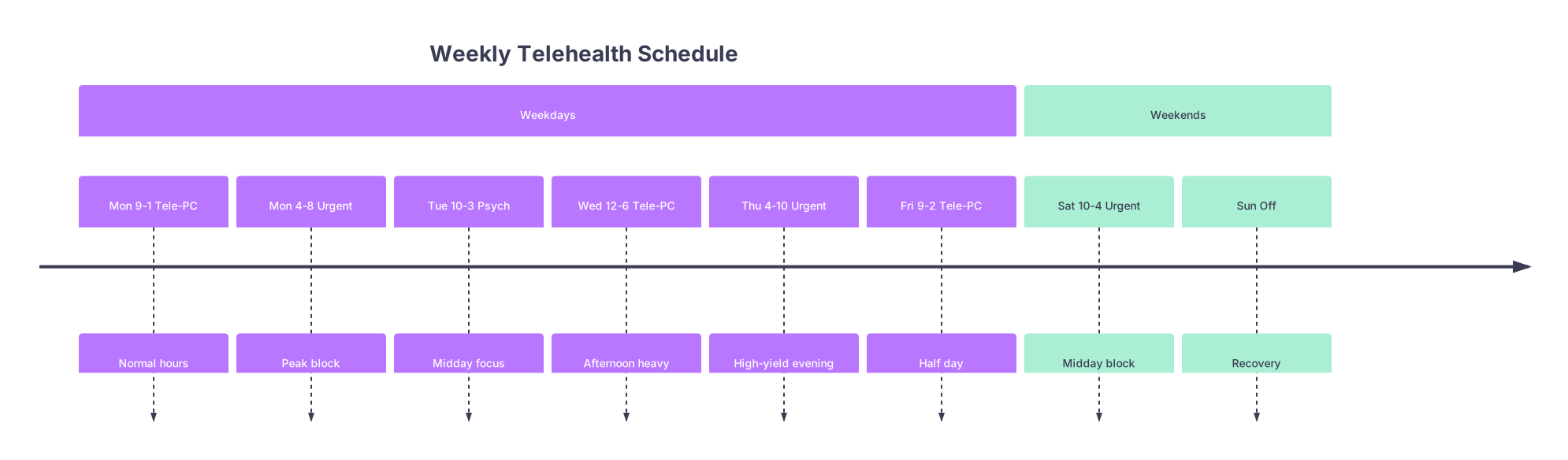
| Period | Event |
|---|---|
| Weekdays - Mon 9-1 Tele-PC | Normal hours |
| Weekdays - Mon 4-8 Urgent | Peak block |
| Weekdays - Tue 10-3 Psych | Midday focus |
| Weekdays - Wed 12-6 Tele-PC | Afternoon heavy |
| Weekdays - Thu 4-10 Urgent | High-yield evening |
| Weekdays - Fri 9-2 Tele-PC | Half day |
| Weekends - Sat 10-4 Urgent | Midday block |
| Weekends - Sun Off | Recovery |
You are not required to live like this. But the numbers push you toward some version of this if you want to fully monetize your license across multiple telehealth roles.
Night Shifts: Tiny Volume, High Perceived Value
One last piece: nights. Physicians love to ask, “Can I just do nights from home and make bank?”
The honest answer from the data:
- Total volume between midnight and 6 AM is low, often <5–7% of daily visits, even on big platforms.
- Case mix shifts to higher acuity (chest pain, SOB, severe pain, psych crises).
- Companies sometimes offer higher hourly stipends to ensure coverage, but per-visit volume may still be low.
So you might see:
- A guaranteed hourly rate plus per-visit bonus, because otherwise nobody would stay awake.
- Long stretches of quiet punctuated by stressful, “should-this-go-to-the-ED” encounters.
If you want to build a lifestyle around night telehealth, you must verify:
- Actual average visits per shift
- Pay structure (flat per-hour vs low per-hour + per-visit)
- Support (nurse triage, escalation pathways, ED transfer protocols)
Do not assume “night” automatically means “massive volume” or “easy money.” The demand curve at 2 AM is thin.
Three Takeaways if You Care About Data, Not Marketing
First: Telehealth demand is not evenly spread across the day. The data show aggressive clustering between 8 AM and 8 PM, with the sharpest peak in the late afternoon and early evening, especially for urgent care and pediatrics.
Second: If you want to maximize income in a telemedicine-heavy career, align at least some of your working hours with the platform’s peak demand bands—typically 4–10 PM on weekdays and late-morning-to-afternoon on weekends.
Third: Treat time-of-day like a core contract term. Ask for the actual visit distribution by hour, decide how much of the “rush hour” you are willing to own, and design your schedule intentionally. The clock, more than the technology, will dictate how your telehealth career feels day to day.