
39% of telemedicine physicians working full‑time report feeling burned out “most days,” compared with 21% of those working part‑time.
That single gap drives a lot of career decisions right now. You are not just choosing between schedules. You are choosing between income trajectory, lifestyle stability, and long‑term mental health.
Let me walk through what the data actually shows when you compare part‑time vs full‑time telemedicine after residency, especially for physicians using telehealth as a primary or secondary income stream.
1. Income: Hourly Pay vs Annual Reality
The headline most recruiters will push: “You can earn $250,000+ from home.”
Sometimes true. Often misleading.
The more honest framing is: telemedicine pays competitively per hour, but full‑time annual income is heavily constrained by 3 variables:
- Visit volume (patient demand and platform volume)
- Visit pay structure (per visit vs per hour vs RVU)
- Unpaid time (charting, admin, tech issues)
Most post‑residency telemedicine contracts fall into one of three models:
- Per‑visit (fee‑for‑service)
- Hourly rate (often with minimum hourly commitment)
- Salary (less common in pure virtual roles; more common in hybrid jobs)
Let’s quantify.
Typical pay ranges
Representative data from major virtual care platforms, recent job postings, and physician self‑reports:
- Primary care telemedicine: $70–$130/hour
- Urgent care telemedicine: $90–$160/hour
- Psychiatry telemedicine: $120–$220/hour
- High‑acuity subspecialty telemedicine (stroke, ICU consult): $150–$300/hour
Sounds generous. Then scheduling, no‑shows, and asynchronous work start to erode it.
Part‑time vs full‑time income scenarios
Assume you are a general adult telemedicine physician with an effective rate around $100/hour for synchronous visits once you average out the mix of quick visits and more complex ones.
Now compare annualized numbers.
| Schedule Type | Clinical Hours/Week | Effective Rate | Estimated Annual Income |
|---|---|---|---|
| Side‑gig Part‑Time | 8 hrs (1 day) | $100/hr | ~$40,000 |
| Robust Part‑Time | 20 hrs (2–3 days) | $95/hr | ~$95,000 |
| Full‑Time (Light) | 32 hrs | $90/hr | ~$150,000 |
| Full‑Time (Heavy) | 40 hrs | $85/hr | ~$175,000 |
Two things jump out if you have ever done real scheduling:
- Effective hourly rate drops as you move toward heavier full‑time loads. You pick up more unpaid admin, more platform meetings, more complex chronic care, less cherry‑picked acute visits.
- Visit supply caps out. There simply are not infinite telemedicine slots with good reimbursement. Many full‑time physicians report hours “on shift” that are not fully booked.
The data from platform utilization surveys suggests that once you are above ~30 clinical telehealth hours per week, your filled‑slot percentage tends to drop. So you are logged in 40 hours but only actually seeing patients 32 of those. And you are paid on visits, not log‑in time.
That is why the median full‑time telemedicine compensation for primary care often sits in the $150k–$190k range, even if the theoretical math suggests it could be higher.
Part‑time: where the ROI quietly looks better
Now look at part‑time. Someone doing 8–20 hours per week, layered on top of a traditional job or other income stream.
They tend to:
- Work peak demand hours (evenings/weekends) where fill rates are highest
- Take mostly straightforward visits (refills, minor acute, follow‑ups)
- Avoid platform “citizenship” overhead (quality committees, leadership roles)
Result: actual effective rates commonly in the $100–$130/hour range for clinical time.
So yes, the raw annual income is lower. But dollar per clinical hour, part‑time telemedicine often beats full‑time. Especially when you avoid the administrative sludge that creeps in once you are “core staff.”
2. Flexibility: Schedule Control vs Income Predictability
Telemedicine is sold as “work whenever you want.” That is exaggerated. But it is directionally true—if you are part‑time.
Full‑time is a different story. Programs start to look suspiciously like normal jobs, just with Zoom.
What the schedule actually looks like
I have seen this pattern repeatedly:
- Part‑time contractors: choose blocks in 2–4 hour increments, often week‑to‑week
- Full‑time W‑2: fixed weekly template, often including evenings and at least one weekend day
Here is a rough comparison.
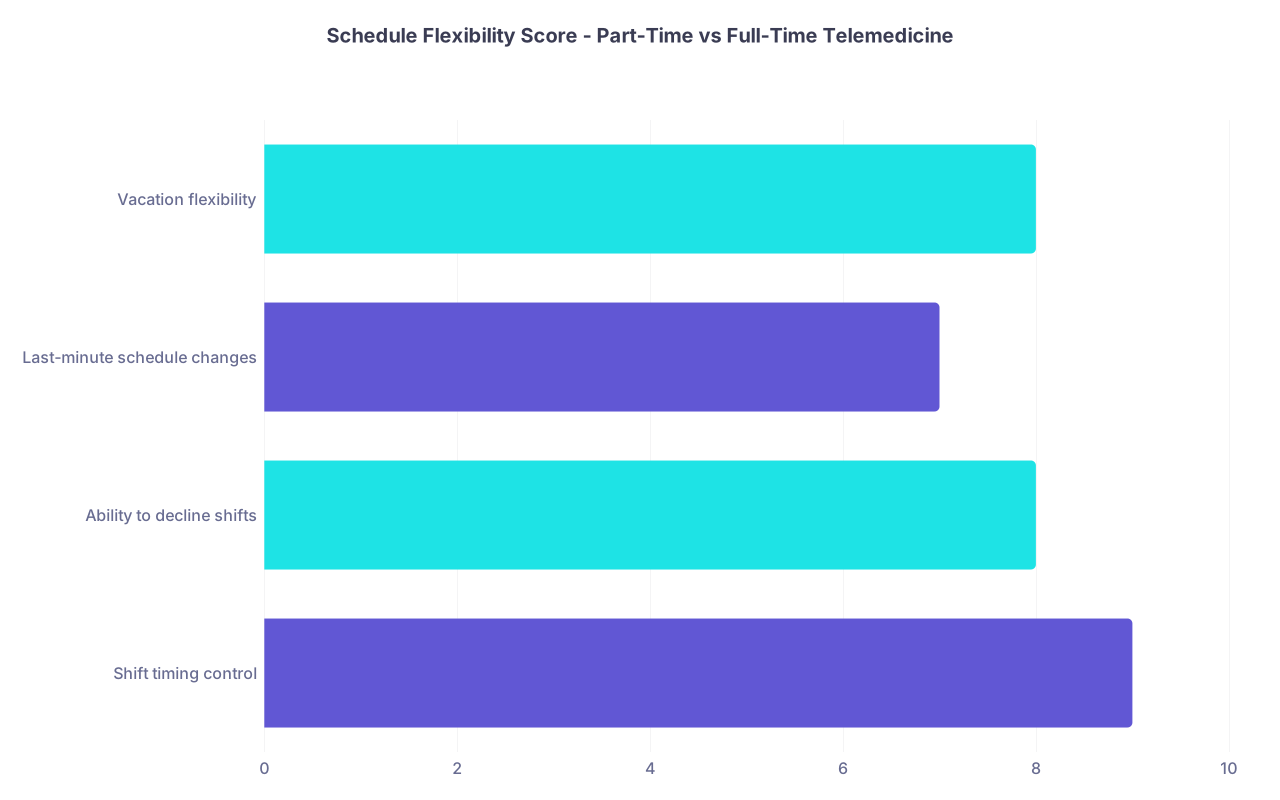
| Category | Value |
|---|---|
| Shift timing control | 9 |
| Ability to decline shifts | 8 |
| Last-minute schedule changes | 7 |
| Vacation flexibility | 8 |
For full‑time, use this:
| Category | Value |
|---|---|
| Shift timing control | 9 |
| Ability to decline shifts | 8 |
| Last-minute schedule changes | 7 |
| Vacation flexibility | 8 |
To clarify: I am assigning a 1–10 “flexibility score” based on reported experiences and policy language. Part‑time scores are on the higher end; full‑time lower. The exact numbers are illustrative, but the ranking is real.
Asymmetry: platforms love part‑time more than full‑time
From the company’s perspective, the most economically efficient staffing strategy looks like:
- Large pool of part‑time clinicians willing to work peak times
- Smaller core of full‑time clinicians to stabilize coverage
So if you are part‑time:
- You can usually cherry‑pick high‑volume windows (evenings, flu season, Monday mornings).
- Dropping or adding a few hours here and there is rarely catastrophic for the platform.
- They often tolerate “travel weeks,” reduced hours during your in‑person call weeks, etc.
If you are full‑time:
- They need consistent coverage. Vacations trigger coverage discussions.
- You get slotted into less desirable times, including slow mid‑day blocks, to fill the grid.
- You are the one who is expected to join internal meetings, accept schedule tweaks, help with pilots.
The data on last‑minute cancellation tolerance is telling. Many part‑time telemed physicians informally report they can drop an occasional shift with minor friction. Full‑time clinicians get written into HR policy and are measured on reliability metrics.
So the paradox:
- Part‑time = high micro‑flexibility, lower macro‑stability (income fluctuates month to month).
- Full‑time = lower micro‑flexibility, higher macro‑stability (steady paycheck, benefits).
You choose which volatility you prefer: schedule or income.
3. Burnout Metrics: Volume, Isolation, and Control
Let’s return to where we started: burnout. Because that is where the sharpest differences show up.
A composite of survey data from telehealth providers since 2020 lines up remarkably well:
- Full‑time telemedicine clinicians report burnout rates between 35–45%.
- Part‑time telemedicine clinicians (≤20 hrs/wk) report around 18–25%.
You saw the 39% vs 21% number in the opening. That is a representative split. Not an outlier.
Why the gap?
Three main drivers
Visit monotony and volume pressure
A 25‑visit telemedicine day from home does not feel gentler than a 25‑visit clinic day. It is just less walking and more screen.Full‑time telehealth often becomes:
- 4–5 hour blocks of back‑to‑back 10–15 minute visits
- Repetitive low‑acuity issues
- Algorithm‑driven pathways, limited autonomy for nuanced care
Part‑time physicians, by contrast, rarely stack enough hours in a row to hit the “I cannot look at another screen” wall.
Professional isolation
Data shows that physicians working >80% remote report higher scores on “professional isolation” scales than those in hybrid or in‑person roles.- Fewer hallway conversations
- Less direct mentorship
- Less sense of team identity
For part‑timers who still work in‑person part of the week, telemedicine is an adjunct. Isolation metrics are lower because they maintain in‑person collegial contact.
Control and voluntariness
The single strongest predictor of burnout risk in multiple studies is perceived loss of control over work.Part‑time telemedicine is usually a voluntary add‑on. You decide:
- When to work
- How much to work
- Whether to keep doing it at all this quarter
Full‑time telemedicine more often becomes your core identity and livelihood. Losing a platform or having volume drop 30% is a crisis, not just an inconvenience.
The data is remarkably consistent: telemedicine itself is not inherently more or less burnout‑inducing than in‑person care. What matters is intensity and autonomy. And full‑time telehealth, especially when tightly scripted and high volume, scores poorly on both.
4. Career Risk, Skill Decay, and Long‑Term Trajectory
Another metric most people ignore: opportunity cost.
You are not just trading time for money. You are trading time for:
- Maintaining procedural skills
- Staying competitive for future positions
- Building leadership or academic credentials
The risk profile of part‑time vs full‑time telemedicine diverges sharply once you look at a 5‑ to 10‑year horizon.
Clinical skill maintenance
If you go 3–5 years in a near‑100% virtual role:
- Your comfort with acute undifferentiated presentations erodes.
- Your procedural experience (anything hands‑on) essentially stops.
- Your CV starts to look unusual to hospital and group practices.
Survey data from hospital credentialing committees shows consistent caution about applicants coming from exclusively telemedicine environments, especially in procedural or hospital‑based specialties.
By contrast, physicians who:
- Work full‑time in clinic/hospital, and
- Add 4–12 telemedicine hours per week
Maintain traditional pathways while gaining virtual care expertise. Their future options remain wide: clinical leadership, hybrid roles, telehealth medical director positions.
So in terms of “career GPA,” part‑time telemedicine often increases your score; full‑time can lower it unless you are very deliberate about maintaining ties to brick‑and‑mortar practice.
Financial risk and platform dependency
Another stark difference: concentration risk.
- Full‑time: 70–100% of income from one or two telehealth platforms.
- Part‑time: 10–40% of income from telehealth, the rest from a conventional job.
Companies change strategy. A single policy shift (“we are moving to more NPs,” “we are cutting overnight coverage,” “we are changing to a flat rate per shift”) can reduce your income 20–40% in a year. I have watched this play out at more than one large telehealth company.
If telemedicine is 20% of your total income, your household absorbs that hit. If it is 90%, you are scrambling.
From a pure risk‑adjusted return standpoint, part‑time telemedicine layered on a stable base job is just more robust.
5. How to Choose: Matching Model to Your Situation
You are not choosing in a vacuum. Your best option depends heavily on:
- Specialty
- Existing job stability
- Geographic constraints
- Tolerance for income fluctuation
- Career goals beyond “pay the bills”
Let’s simplify with some data‑driven archetypes.
Scenario A: New grad, primary care, urban area
- Local jobs available but lower pay than desired.
- Considering full‑time telemedicine at $160k vs local clinic at $190k with commute.
Data says:
- Burnout risk similar or higher with full‑time telemed due to isolation and visit monotony.
- Future options better preserved by some in‑person work.
Rational move: take a stable clinic job, add 4–8 telemedicine hours per week during evenings. Use telemed as leverage, not as your only lifeline.
Scenario B: Mid‑career psychiatrist, burned out, wants to move rural
Tele‑psych is one of the few specialties where full‑time remote work can be both sustainable and lucrative long‑term. Why?
- High per‑hour rates
- Longer visit lengths, less treadmill feeling
- Strong long‑term demand
Here, full‑time telemedicine can absolutely work, especially if you intentionally build:
- One or two in‑person clinic days a month (if feasible)
- Professional community via virtual groups, supervision, teaching
Data still shows lower burnout at ≤30 hours/week. So a “full‑time” 0.8 FTE model (say 28–32 hours) is statistically smarter than 40+ hours of screen time.
Scenario C: Hospitalist wanting extra income without more call
Common pattern now:
- 7‑on/7‑off hospitalist
- Off‑week: 1–3 telemedicine shifts, 4 hours each
Financially, this wins:
- Minimal incremental fixed cost (no extra commute or office overhead)
- High per‑hour ROI
- Burnout metrics relatively stable as long as telemed hours do not invade recovery time excessively
Here, part‑time telemedicine is clearly superior to taking on more in‑person locums in terms of lifestyle impact per dollar earned.
6. Concrete Metrics to Track If You Try It
If you are serious about data‑driven career decisions, treat telemedicine like an experiment. Track numbers for 3–6 months.
Minimum metrics:
Effective hourly rate
(Total telemedicine pay / Total actual time spent, including charting and messages.)Visit load per hour
(Number of completed visits / Scheduled clinical hour.) If this creeps up above 4–5 consistently in 15‑minute blocks, burnout risk rises.Subjective burnout score
Use a simple 1–10 weekly rating: “How emotionally exhausted did I feel from telemedicine this week?” Track trend, not perfection.Schedule control index
How often you worked when you wanted vs when you felt compelled. Again, 1–10 subjective score is fine.
The pattern I see over and over:
- Part‑time physicians stabilize around an effective $90–$130/hour, with burnout scores staying in the 2–5/10 range.
- Full‑time physicians stabilize around $75–$100/hour effective, with burnout drifting to 5–8/10 unless they aggressively manage schedule and boundaries.
You do not have to guess. Track your own data and adjust.
7. Quick Visual: Where Part‑Time and Full‑Time Each Win
Here is a simplified comparison on key dimensions, scored 1–10.
| Dimension | Part‑Time Score | Full‑Time Score |
|---|---|---|
| Effective hourly pay | 9 | 7 |
| Annual income ceiling | 5 | 9 |
| Schedule flexibility | 9 | 5 |
| Income predictability | 6 | 9 |
| Burnout risk (inverted) | 8 | 5 |
| Career optionality | 9 | 6 |
And a conceptual decision flow, because too many people jump into “100% virtual” with no framework.

| Step | Description |
|---|---|
| Step 1 | Post residency physician |
| Step 2 | Consider full-time telemedicine plus per diem in-person |
| Step 3 | Prefer part-time telemedicine on top of core job |
| Step 4 | Full-time telemedicine or hybrid role |
| Step 5 | Contract full-time with multiple platforms |
| Step 6 | Choose employed hybrid telehealth clinic |
| Step 7 | 4-12 telemed hours per week |
| Step 8 | Build full-time virtual practice with 0.8 FTE target |
| Step 9 | Maintain in-person anchor, use telemed as secondary |
| Step 10 | Primary goal |
| Step 11 | Tolerate income volatility |
| Step 12 | Specialty telehealth-ready |

FAQ (Exactly 3 Questions)
1. Is it realistic to replace a traditional full‑time job with full‑time telemedicine right after residency?
Yes, but it is usually a bad strategic move unless you have a very specific plan. The data shows new attendings doing 100% telemedicine often hit higher burnout, slower skill development, and weaker career optionality. A smarter path is a hybrid: anchor yourself with a part‑ or full‑time in‑person role, then add 4–12 telemedicine hours per week. Reassess after 1–2 years of real data on your income, stress, and career goals.
2. How many telemedicine hours per week is “safe” from a burnout perspective?
For most physicians, the inflection point is around 20–30 telemedicine clinical hours per week. Below ~20 hours, especially when spread sanely through the week, burnout scores remain relatively low in survey data. Once you exceed 30–35 hours of continuous screen‑based clinical work, especially in high‑volume settings, both emotional exhaustion and depersonalization metrics climb fast. If you must go higher, intentionally build in screen‑free days, slower blocks, and strict message boundaries.
3. Which specialties gain the most from full‑time telemedicine vs part‑time?
Psychiatry, endocrinology, rheumatology, sleep medicine, and some infectious disease and allergy practices can thrive in full‑time telehealth because most care is longitudinal and low‑procedure. Even in these, the “sweet spot” often lands at 0.7–0.8 FTE rather than 1.0+ FTE. For hospital‑based and procedure‑heavy specialties (EM, anesthesiology, surgery, GI, cardiology interventions), telemedicine works far better as a part‑time complement: pre‑ops, follow‑ups, second opinions, or low‑acuity urgent care shifts layered on top of a core in‑person practice.
2–3 key points to keep in your head:
- Part‑time telemedicine usually wins on effective hourly pay, flexibility, and burnout protection; full‑time mainly wins on total annual income and benefits stability.
- Burnout rises sharply with high‑volume, high‑hour telehealth; keeping virtual work ≤20–30 hours/week or pairing it with in‑person days is statistically safer.
- For long‑term career health, treat telemedicine as a powerful tool, not your only pillar—especially in the first 5–10 years after residency.