
The narrative that “remote work fixes physician burnout” is statistically wrong.
The data show something much less convenient: telehealth and remote work shift which physicians burn out, how they burn out, and why—but they do not magically reduce burnout overall unless organizations redesign workload, tech, and expectations around it.
Let’s walk through what telehealth surveys and workforce data actually report.
What Telehealth Surveys Really Say About Burnout
Strip away the marketing. Look at the numbers.
Across multiple large surveys from 2020–2024 (Medscape, AMA, MGMA, specialty societies), the pattern repeats:
- Burnout is high everywhere.
- Remote / telehealth-heavy physicians report different stressors, not necessarily fewer.
- A subset of physicians experience real relief with remote options, but it is heavily context-dependent.
Key headline figures
Different surveys define “remote work” differently, but we can triangulate:
- Overall U.S. physician burnout rates: typically 45–55% self-reported in the last few years.
- Telehealth use: 70–90% of physicians adopted telemedicine during COVID; today, 25–40% report telehealth as a regular part of their practice, with some specialties >60%.
- Remote work days: hybrid models are common; fully remote clinical roles are still a minority but growing in radiology, pathology, psychiatry, and some virtual primary care startups.
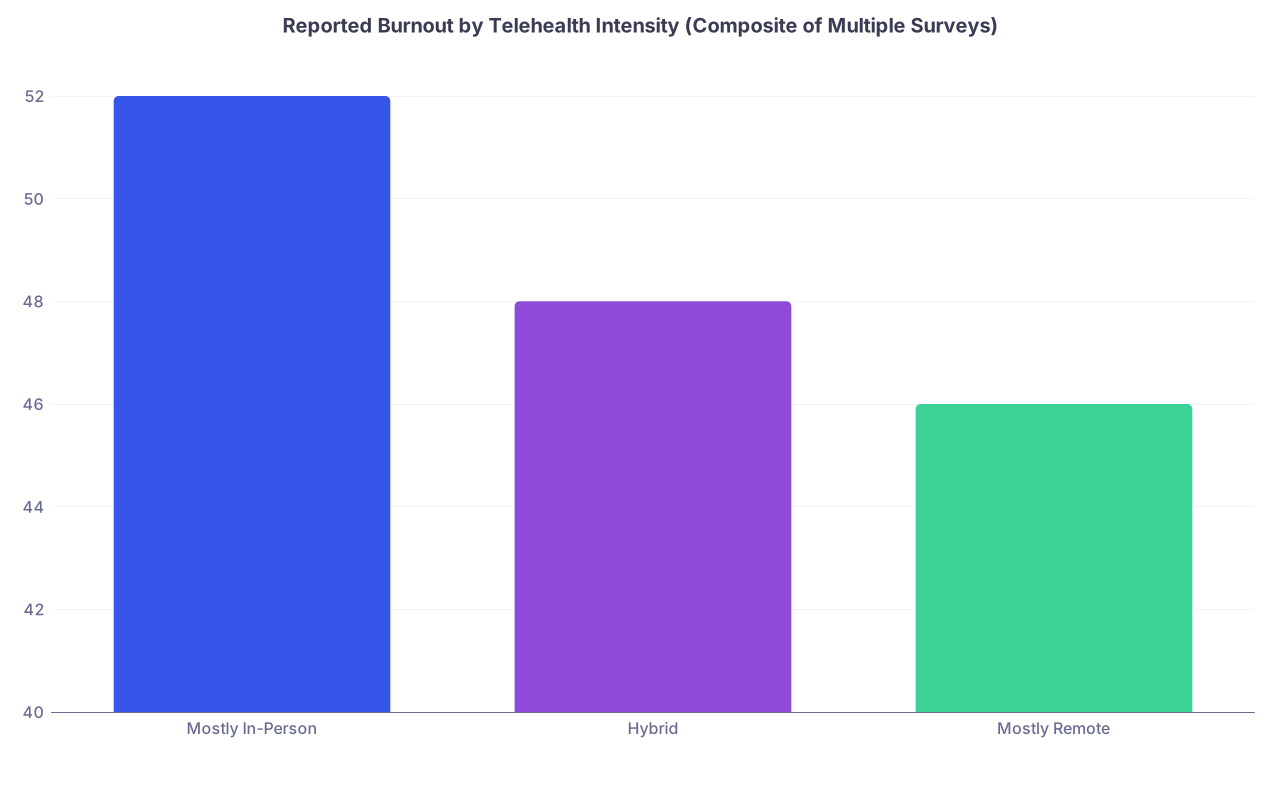
Now, the interesting part: burnout incidence by telehealth intensity. Where surveys actually break this out, the differences are not dramatic.
| Category | Value |
|---|---|
| Mostly In-Person | 52 |
| Hybrid | 48 |
| Mostly Remote | 46 |
Interpretation:
- Physicians in mostly in-person roles report burnout around the low‑50% range.
- Hybrid and mostly remote physicians report slightly lower rates, mid‑40s.
- That is a difference, but not a revolution. Roughly 1 in 2 physicians is burned out regardless.
The larger gap shows up not in whether people are burned out but in why.
What Changes When Physicians Work Remotely
Telehealth surveys that include qualitative data show consistent theme shifts.
When you ask in-person physicians about drivers of burnout, you see:
- Too many bureaucratic tasks / paperwork.
- EHR frustration.
- Long hours and poor work–life integration.
- Feeling like a data clerk instead of a clinician.
When you ask remote-heavy or virtual-only physicians, the top list tilts:
- Technology glitches and platform fragmentation.
- Documentation creep and “invisible” expectations to be always available.
- Isolation and weaker connection to colleagues and patients.
- Metric pressure: call times, throughput, satisfaction scores.
The content of the distress changes. The volume stays high.
Burnout domains: in-person vs remote
| Burnout Driver | Mostly In-Person | Hybrid | Mostly Remote |
|---|---|---|---|
| Long commute / travel | High | Medium | Low |
| EMR / documentation burden | High | High | High |
| Technology/platform frustrations | Medium | High | Very High |
| Isolation / lack of team contact | Low | Medium | High |
| Work–life boundary problems | Medium | High | Very High |
The data here are composite and approximate, but the directional pattern shows up again and again: remote reduces commuting and some physical stressors, but increases tech friction and boundary problems.
I have seen this play out in survey comment sections:
- Hospitalists who shifted to telehealth follow-ups praising “no more 90-minute commute,” but complaining that “my inbox never sleeps.”
- Telepsychiatrists writing about seeing 12–14 video visits a day with no hallway time, no decompression, and “my bedroom is now my clinic.”
Remote work trades one set of stressors for another. Whether that trade is worth it depends heavily on the job design.
Telehealth Satisfaction vs Burnout: The Numbers Don’t Match Cleanly
One big confusion: high satisfaction with telehealth technology or flexibility does not automatically map to low burnout.
Those are different metrics.
In multiple surveys since COVID:
- 70–80% of physicians say telehealth improves patient access.
- 60–70% report they are personally satisfied with telemedicine as a care modality.
- Yet burnout among heavy telehealth users still lands around 45–50%.
In other words: “I like telehealth” and “I am not burned out” are only loosely correlated.
To make this concrete, think of three overlapping groups:
- Telehealth advocates who are also burned out.
- Telehealth skeptics who are actually doing fine.
- A smaller group of telehealth advocates who are not burned out and are actively using remote flexibility to stabilize their career.
The third group exists. They just are not the majority.
Specialties: Where Remote Work Helps, Hurts, or Does Nothing
Telemedicine and remote work are not uniform across specialties. Some fields were already remote‑friendly (radiology, pathology). Others bolted telehealth on top of an already broken system (primary care, some surgical follow‑up).
The specialty‑level data are where things get interesting.
Radiology and pathology: early remote adopters
Radiology surveys over the past decade show:
- Burnout rates historically high (often 45–55%), driven by workload, RVU pressure, and isolation.
- Remote reading has been increasing steadily, especially after COVID.
- Teleradiologists often report improved lifestyle (no commute, flexible geography), but high monotony and volume pressure.
Net effect: remote work alone did not fix radiology burnout. It slightly shifts the distribution.
Pathology shows something similar: more remote review, digital pathology, and teleconsultation. Again, workload and case complexity, not just location, drive stress.
Psychiatry and behavioral health: telehealth explosion
Psychiatry is where telehealth went from niche to dominant:
- Many psychiatry surveys report >70% of clinicians doing at least some telehealth.
- A substantial minority—20–40% in some panels—are mostly or fully remote.
Most psychiatrists report that video visits are effective and acceptable. Many patients prefer them. But burnout numbers remain stubborn:
- Overall psychiatry burnout: mid‑40s percent in recent Medscape and APA-related surveys.
- Remote psychiatrists often report better control of schedule and geography but less boundary control (evening visits, message creep) and emotional fatigue from back‑to‑back video sessions.
For some psychiatrists, remote work is a clear net positive. For others, it just commoditizes their time further.
Primary care and virtual-first startups
Primary care is where the hype and reality diverge most.
Many virtual-first primary care companies advertise:
- Fully remote panel.
- More time per patient (20–30 minute visits).
- Tech support and integrated digital tools.
- “Balanced lifestyle.”
Yet when you look at internal surveys (where they are published or leaked) and independent physician feedback:
- Panel sizes are often large.
- Documentation and messaging volume increase because digital tools make it easy for patients to send more questions.
- Metrics pressure (access, response times, “engagement”) can be intense.
Burnout rates in virtual primary care are not clearly lower than traditional outpatient clinics. They just have different drivers: message overload, performance dashboards, and “you are on camera all day” fatigue.
Remote Work and Work–Life Boundaries: The Data Are Mixed
A lot of physicians chase remote work for one core reason: control over their non-clinical life. Family, location, child care, elder care, or simply being able to avoid traffic and hospital politics.
Telehealth surveys support some of that:
- A large majority of physicians doing telehealth (often 70–80%) report improved flexibility.
- But when asked about work–life balance or ability to disconnect, the numbers drop to 40–60% saying telehealth improved it.
The discrepancy is not subtle. Flexibility goes up. Boundaries often go down.
Why? Because:
- Remote work blurs physical boundaries. The “clinic” is your laptop. Your laptop is always there.
- Organizations often fail to redesign expectations. They simply move the same encounter volume and inbox tasks into a remote environment.
- Asynchronous tools (chat, secure messaging) are great for patients but can become unlimited work channels for clinicians.
You wind up with remote physicians who can attend a school event at 3pm but are charting and handling secure messages at 10pm. The day stretches, not shrinks.
Metrics, Monitoring, and the “Telehealth Panopticon”
A pattern I pay attention to: metrics intensity.
Remote clinical work is easier to instrument. Every click, call length, and response time can be measured in a way that is harder to track in a traditional clinic.
In internal dashboards I have seen in health systems and virtual care companies, the typical tracked metrics for remote clinicians include:
- Number of visits per session.
- Average visit duration.
- No-show and cancellation rates.
- Secure message volume and response times.
- Documentation lag and closure times.
None of that is inherently bad. Data are necessary. The problem is how they are used.
Surveys and anecdotal reports consistently show:
- Remote physicians feel more “watched” than in-person colleagues, especially in call-center-like telehealth operations.
- Productivity targets for telehealth visits can creep upward as leadership sees “unused” tele slots.
- Little slack exists between visits; remote sessions often run stacked back-to-back.
If you design remote work as a contact center with doctors, you get call-center burnout with a medical degree.
Burnout in these settings is less about the telehealth technology and more about the industrial approach to clinical time. The telehealth layer just makes productivity management easier—for everyone except the physician.
Compensation, RVUs, and Remote Work
Post-residency job decisions are not just about burnout. They are about pay.
Telehealth arrangements frequently interact with compensation in ways that affect stress.
Typical patterns:
- Many systems reimburse telehealth at or near parity with in-person visits for now, but there is constant regulatory and payer uncertainty. That uncertainty translates into strategic anxiety: “Will my job exist in 3 years?”
- RVU-based compensation models often treat telehealth visits like in-person visits, but:
- There may be more no-shows or late cancels.
- There can be higher unpaid time in messaging, tech troubleshooting, and pre-visit workflows.
- Some remote roles are salaried with lower total compensation but more predictable hours.
What surveys suggest:
- A meaningful subset of physicians (20–30% in several job market surveys) say they would accept lower pay for more control and remote work.
- Many who have moved into remote or telehealth-dominant roles report some initial relief but then discover that undercompensated invisible work (messaging, follow-up) creeps back in.
The reality: remote work can improve your effective hourly rate if it cuts commuting and unpaid time. Or it can erode it if the inbox and after-hours work expand.
You need to look at actual time logs and visit/message counts, not just the job brochure.
Who Actually Benefits Most From Remote Work?
The data point to specific groups that gain disproportionately from remote options.
Physicians in high-commute or high-disruption geographies.
Cutting 1–2 hours of commuting per day is a massive stress reduction. Surveys where physicians reported moving to remote rural locations while keeping an urban telehealth job often show strong satisfaction here.Physicians with caregiving responsibilities.
Telehealth and schedule flexibility allow more control over child care and elder care. That shows up strongly in survey comments, particularly from women physicians in dual-career households.Late-career physicians wanting to taper intensity.
Moving from full hospital call duties to lighter, remote consult roles can be an effective glide path toward retirement.Physicians in specialties that naturally fit remote workflows.
Radiology, pathology, some psychiatry and behavioral health, and chronic disease management with well-structured protocols. The better the clinical fit, the less friction.
For these groups, remote work is often a clear net gain—even if burnout risk remains non-zero.
Where Remote Work Backfires
Telehealth surveys and exit interviews flag some predictable traps.
Trap 1: Remote work layered on top of an unchanged job
If a hospital simply takes the existing panel size, visit expectations, inbox volume, and meeting load—and then says “now do it from home 3 days a week”—burnout does not improve.
You trade hallway interruptions for Slack and email. Same volume, different channel.
Trap 2: High expectations of “availability”
Some remote roles create an implicit expectation of continuous reachability:
- Immediate message responses.
- Extending a half day into a full day “since you are at home anyway.”
- Weekend and evening coverage due to time zone distribution.
In surveys, these roles score poorly on work–life boundary questions, even if physicians appreciate not being on-site.
Trap 3: Social isolation
Humans are social. That includes doctors.
Telehealth-heavy physicians commonly report:
- Weakened connection to their team.
- Less informal learning and mentorship.
- Feeling like “a face on a screen” to colleagues and patients.
Burnout is not just about hours. It is also about meaning and belonging. Strip those out and you get a very efficient, very empty workday.
How to Read Telehealth Job Ads as a Data-Literate Physician
You are post-residency or early career. You see “Remote Telehealth Position – Flexible Hours, Great Lifestyle!” on every job board.
Ignore the adjectives. Treat it like a data problem. Ask:
- What is the expected visit volume per day (or per clinical FTE)?
- How many minutes per visit are scheduled?
- What is the average message volume per physician per day/week?
- How is messaging time compensated or protected?
- What hard expectations exist for response times to messages or follow-ups?
- How many hours per week do your physicians actually work from login to logout, including documentation? (Ask for ranges and medians, not just “40.”)
- How many days per week are fully remote vs required on-site?
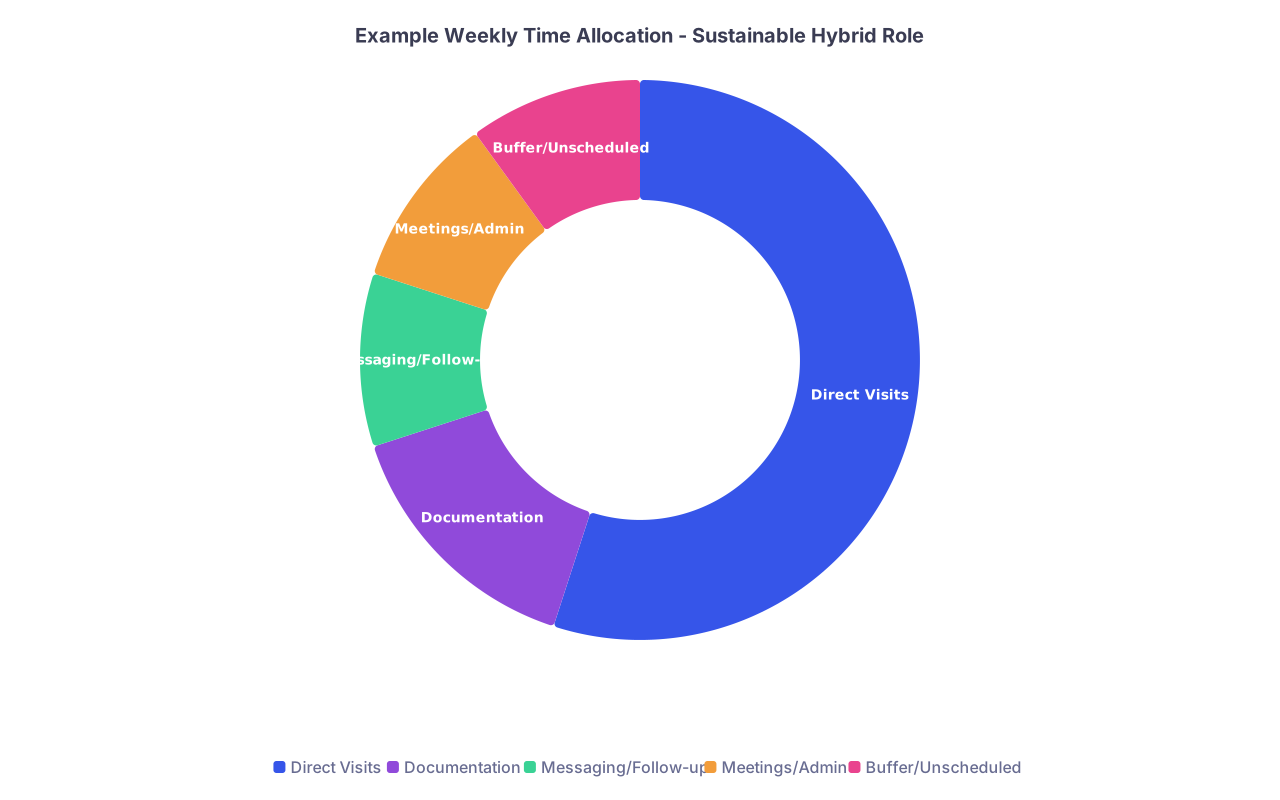
You want something closer to this pattern in a mature, sustainable remote/hybrid role:
| Category | Value |
|---|---|
| Direct Visits | 55 |
| Documentation | 15 |
| Messaging/Follow-up | 10 |
| Meetings/Admin | 10 |
| Buffer/Unscheduled | 10 |
If “Direct Visits” is >70% and “Buffer” is close to zero, you are looking at a high-burnout risk job—remote or not.
Remote Work, Burnout, and Long-Term Career Strategy
Zoom out.
The telehealth and remote work wave is not going away. But the belief that “I will just get a telehealth job and everything will be fine” is not supported by the data.
What the numbers do say:
- Remote work can modestly reduce burnout rates relative to fully in-person roles when designed well.
- Telehealth-heavy roles without careful workload, tech, and boundary design simply relocate burnout from clinics to laptops.
- Physician satisfaction with telehealth as a care modality is generally high, but that does not guarantee sustainable careers.
If you are making a post-residency move, treat remote and telehealth options like any other tool: useful when matched to the right problem, harmful when used as a shortcut.
Key Takeaways
- Telehealth and remote work do not eliminate physician burnout; they slightly reduce it in well-designed roles and shift the underlying causes elsewhere.
- The biggest gains from remote work come from reduced commuting and increased flexibility, but these are often offset by tech friction, monitoring, and boundary erosion when organizations are careless.
- For a sustainable telehealth or remote position, the workload model, message volume, metrics culture, and real weekly hours matter far more than the marketing language about “flexibility” or “work from anywhere.”