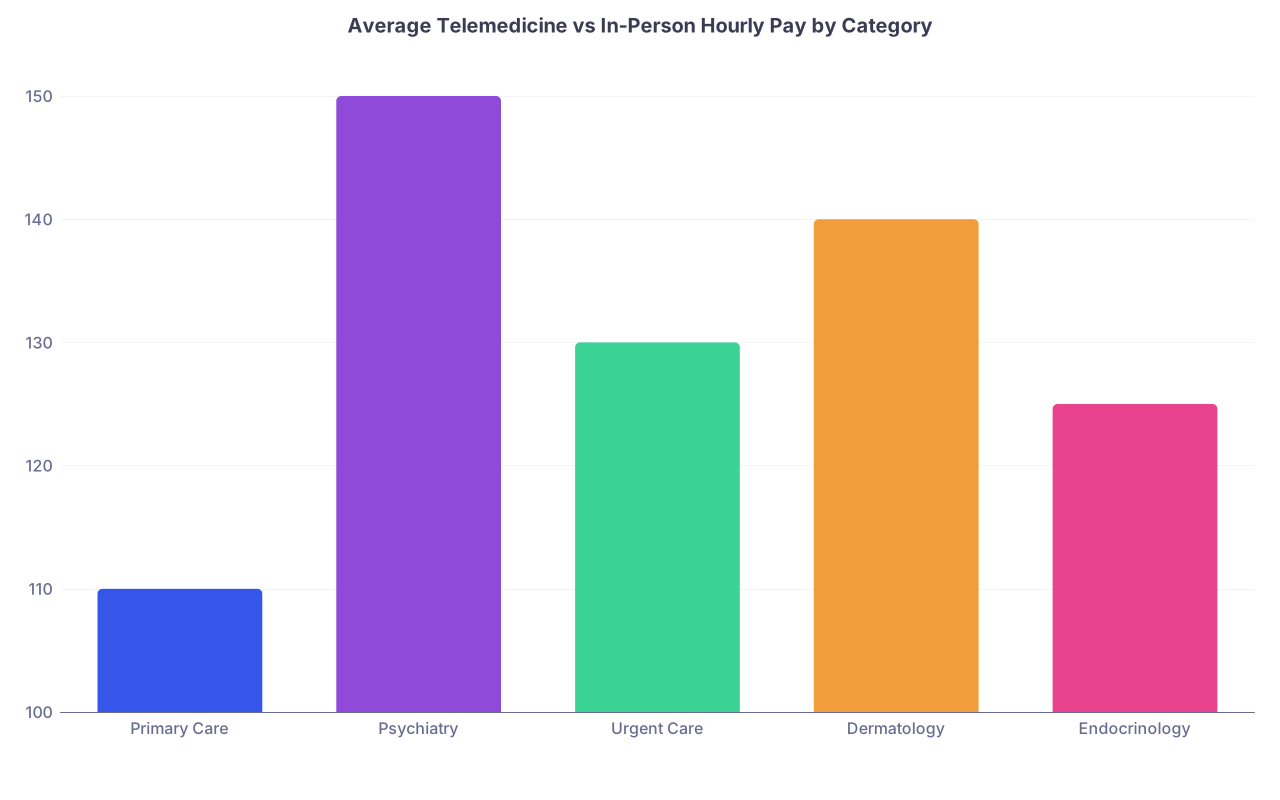
| Category | Value |
|---|---|
| Primary Care | 110 |
| Psychiatry | 150 |
| Urgent Care | 130 |
| Dermatology | 140 |
| Endocrinology | 125 |
Telemedicine pay is not “extra money for easy work.” The data shows a structured, predictable discount compared with in‑person care, and that discount varies dramatically by specialty and by how your contract is written.
If you treat telemedicine as a side hustle without understanding the rates, you leave thousands on the table. If you treat it as a core FTE without understanding productivity expectations, you burn out.
Let’s quantify it.
1. The basic economics: how telemedicine pay is structured
Ignore the marketing speak for a moment. Telemedicine pay in the post‑residency market typically falls into four buckets:
- Pure hourly rate (no RVUs, no upside, no downside).
- Hourly base + RVU/visit bonus.
- Pure productivity (RVU‑based or per‑encounter).
- Salary anchored to an assumed RVU load, with “tele” just being the encounter modality.
The “telemedicine discount” usually shows up in one of three places:
- Lower hourly rate than in‑person clinic time.
- Lower RVU credit per encounter (e.g., 1.0 RVU for what would be 1.3 in person).
- Higher expected encounters per hour for the same pay.
Here is a simplified comparison using realistic 2024 numbers for full‑time work (roughly 1,800 clinical hours/year).
| Category | In‑Person Annual | Telemedicine Annual | Difference |
|---|---|---|---|
| Primary Care | $220k–$260k | $190k–$230k | −10–15% |
| Psychiatry | $260k–$320k | $240k–$300k | −5–10% |
| Urgent Care | $240k–$300k | $220k–$270k | −5–10% |
| Derm (general) | $350k–$450k | $260k–$340k | −20–30% |
| Endocrinology | $230k–$280k | $200k–$240k | −10–15% |
Notice the pattern: cognitive specialties (psych, primary care, endocrine) take a relatively modest hit. Procedure‑heavy or high‑RVU in‑person specialties (derm, GI, cardiology) take a much larger one because tele strips away the procedures that drive RVUs.
2. Hourly rates: what the market is actually paying
Let’s talk hourly, because that is how most large national tele platforms quote their offers. Numbers vary, but the ranges below reflect what I consistently see in job postings, contracts, and physician reports in 2023–2024 for U.S. telemedicine roles.
2.1 Typical telemedicine hourly ranges (post‑residency)
Full board‑certified, no supervision requirement, 1099 or W‑2 mix.
| Specialty / Role | Typical Range ($/hr) |
|---|---|
| Adult Primary Care (FM/IM) | $90–$130 |
| Urgent Care / On‑Demand | $100–$150 |
| Psychiatry (adult) | $140–$210 |
| Child/Adolescent Psych | $160–$230 |
| Endocrinology | $100–$140 |
| Rheumatology | $110–$150 |
| Neurology (epilepsy, gen) | $120–$170 |
| Dermatology (asynchronous) | $60–$110 (per case model often) |
| Dermatology (live video) | $120–$180 |
Now compare those with typical in‑person hourly equivalents. I convert common salary figures to hourly by dividing by 1,800 clinical hours per year.
- Primary care: $230k / 1,800 ≈ $128/hr.
- Outpatient psych: $300k / 1,800 ≈ $167/hr.
- Urgent care: $270k / 1,800 ≈ $150/hr.
- Endocrinology: $250k / 1,800 ≈ $139/hr.
So for a mid‑range, tele tends to cluster around:
- Primary care: 80–95% of in‑person hourly.
- Psych: 85–105% (tele sometimes pays the same or slightly better because demand is insane).
- Urgent care: roughly 85–100%.
- Endocrine/rheum/other subs: 75–95%, depending on how procedure‑heavy the in‑person role is.
I will put that visually:
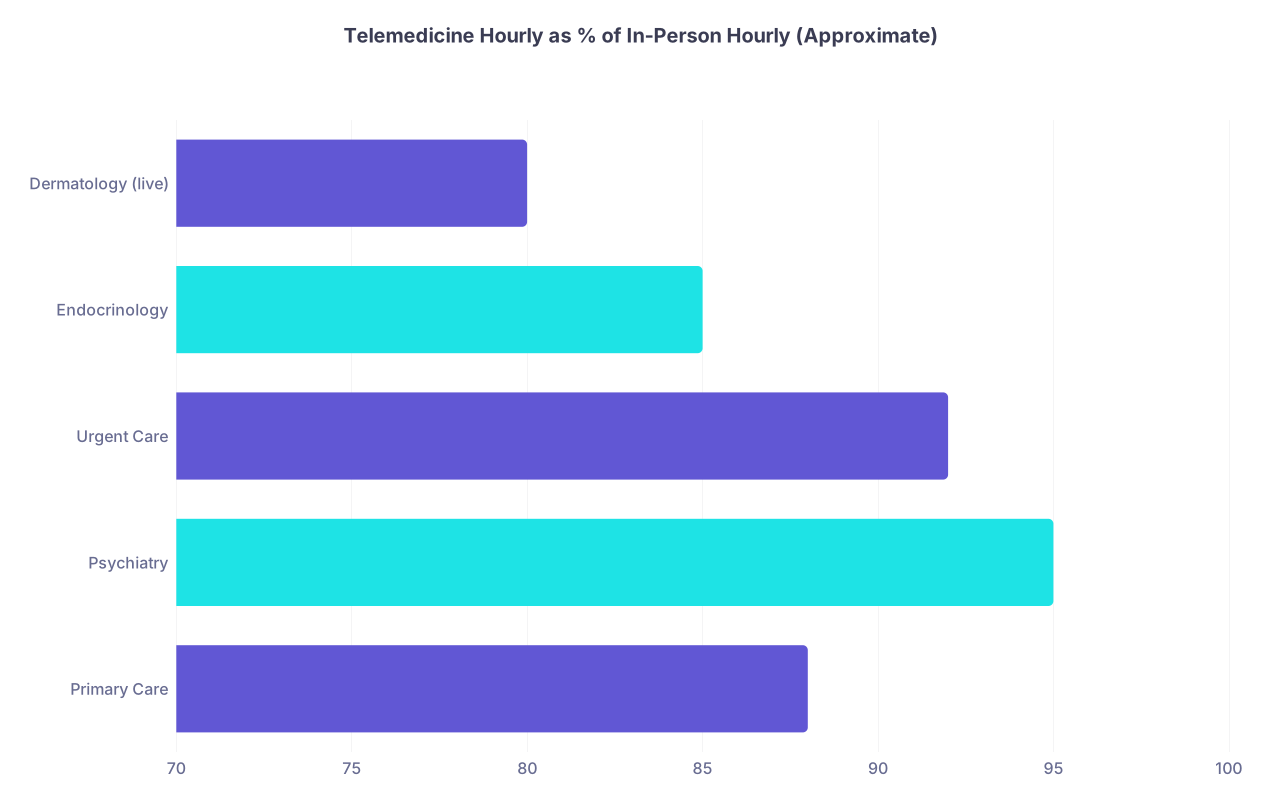
| Category | Value |
|---|---|
| Primary Care | 88 |
| Psychiatry | 95 |
| Urgent Care | 92 |
| Endocrinology | 85 |
| Dermatology (live) | 80 |
The outlier is asynchronous derm. Those “$25 per case, read 8 cases/hour” models can quietly drop you to the $80–$100/hr range once you time‑track the work.
3. RVUs: where the real telemedicine haircut lives
If your post‑residency job uses RVUs, you cannot ignore how telemedicine encounters are coded and credited. That is where comp quietly shifts.
3.1 Typical RVU benchmarks
Most RVU‑based physician comp ties a dollars‑per‑wRVU figure to a target:
- Primary care: ~$45–$60 per wRVU.
- Psych: ~$50–$70 per wRVU.
- Medical subspecialties (endo, rheum): ~$55–$75 per wRVU.
- Procedural subspecialties: all over the map; total comp is dominated by procedures.
Common office visit RVUs (2024 CPT):
- 99213 (level 3 established): ~1.3 wRVU.
- 99214 (level 4 established): ~2.0 wRVU.
- 99203/99204 new patient: ~1.6–2.6 wRVU.
Telemedicine visits use the same E/M codes when done properly. However, many systems encourage or default to:
- Shorter visits.
- Lower levels (fewer “complex” visits coded as 99214).
- Tele‑specific codes (G2012, virtual check‑ins, etc.) which are tiny RVU generators.
Result: your RVUs per hour drop even if your patient volume rises.
3.2 Example: primary care, in‑person vs tele RVU productivity
Let us run numbers for the same physician in two settings.
In‑person clinic (standard)
- 18 patients/day, 4 days/week → 72 visits/week.
- Mix: 60% level 4 (99214, 2.0 RVU), 40% level 3 (99213, 1.3 RVU).
- Average RVU/visit = 0.6×2.0 + 0.4×1.3 = 1.72.
- Weekly RVUs = 72 × 1.72 ≈ 124 RVUs.
- At $50/RVU → $6,200/week → $322k/year (ignoring overhead adjustments and call).
Telemedicine clinic (compressed, high throughput)
- 22 video visits/day, 4 days/week → 88 visits/week (more volume).
- Mix shifts: 40% level 4, 60% level 3 (less complexity coded).
- Average RVU/visit = 0.4×2.0 + 0.6×1.3 = 1.58.
- Weekly RVUs = 88 × 1.58 ≈ 139 RVUs.
- At the same $50/RVU → $6,950/week → $361k/year.
So if your RVU rate and coding support are identical, tele with higher volume can pay more. But that is the idealized version.
What actually happens in a lot of systems:
- Tele RVU credit gets reduced (internal policies, “virtual visit modifier” logic).
- Or your per‑RVU rate for tele FTE is set lower (yes, this happens).
Say they pay $42/RVU for tele instead of $50. Your 139 RVUs/week now pay:
- 139 × $42 = $5,838/week → ≈ $304k/year.
You worked harder (more visits), got more RVUs, and still made less than the in‑person role at $50/RVU and 124 RVUs/week.
That is the telemedicine RVU trap. Productivity looks high, but the rate card is quietly lower.
3.3 Example: psychiatry – why tele can match or beat in‑person
Psych is the classic counterexample.
- Tele visits are usually 30–60 minutes, similar to in‑person.
- Coding patterns do not change much (E/M + add‑on codes; or time‑based).
- Demand is extremely high; no shortage of filled slots.
Suppose:
- 30‑minute med‑management follow‑ups, 4 days/week, 14 patients/day → 56 visits/week.
- Average 1.5 RVUs per follow‑up.
- Weekly RVUs = 56 × 1.5 = 84.
If your in‑person per‑RVU rate is $60, that is $5,040/week → ≈ $262k/year.
Now a tele‑only company pays flat $180/hour, 32 clinical hours/week:
- Weekly = 32 × $180 = $5,760/week → ≈ $300k/year.
At that point, you ignore RVUs entirely. You have traded some upside but locked in a strong floor. For psych, the tele/home premium often offsets the typical “tele discount.”
4. Per‑encounter pay: the side‑gig telemedicine reality
A lot of physicians do not take a full tele FTE role. They add 5–15 hours/week via 1099 per‑encounter work. That market is much more fragmented, but patterns still emerge.
Common models:
- Flat fee per synchronous visit (e.g., $25–$40 for a 10–15 min urgent care encounter).
- Tiered by visit length (e.g., $30 for 10 min, $45 for 20 min, $70 for 30 min).
- Asynchronous “store‑and‑forward” (derm, minor conditions): $8–$25 per case.
Let us put some actual math to this.
4.1 Urgent care tele – flat per‑visit model
Job ad says: “$30 per completed video visit, average 4–6 per hour.”
If you actually average 5 visits/hour, that is $150/hr gross. Looks good. But:
- 10% no‑shows or tech failures → unpaid time.
- Extra time on EHR messaging, charting, refills.
- Credentialing/licensing overhead (unpaid).
Realistically:
- 5 scheduled visits/hour.
- 0.5 of those evaporate or get bogged down in tech.
- Net 4.5 paid visits/hour → 4.5 × $30 = $135/hr.
Still strong, but now compare to your in‑person urgent care rate. Many W‑2 urgent care jobs in metro areas pay $150–$200/hr with benefits. So you are trading 10–30% of hourly pay for remote work, schedule flexibility, and no physical exposure.
For many physicians, that trade is rational. But pretending the pay is equivalent is fiction.
4.2 Asynchronous dermatology
A typical asynchronous derm tele job:
- $15 per case.
- They say “you can read 8–12 cases/hour.”
At 8/hour → $120/hr. At 12/hour → $180/hr.
If you are reviewing full‑quality images, writing clear plans, and dealing with patient messaging follow‑ups, the 12/hour assumption is fantasy. I have seen experienced derms top out around 7–9/hour in sustainable fashion.
At 8/hour sustainable:
- $15 × 8 = $120/hr.
Compare to a standard in‑person derm job:
- $400k–$600k/year is routine.
- Using 1,800 hours → ~$220–$330/hr.
So you are taking somewhere between a 45–65% pay cut to do pure tele, almost entirely cognitive, no procedures. Totally reasonable as a controlled side job, far less reasonable as a main career path unless lifestyle and geography are your absolute priority.

5. Specialty‑by‑specialty: who wins and who loses moving to tele
Let me group specialties by how well tele pay stacks up against in‑person, both hourly and in RVU terms.
5.1 Relative winners
These are specialties where telemedicine can pay close to, equal to, or occasionally more than in‑person, when normalized for hours.
Psychiatry (adult, child/adolescent)
- High demand, long waitlists.
- Minimal procedural revenue lost.
- Many tele startups fighting for supply → competitive hourly.
Primary care / virtual primary care
- For full‑time virtual primary care roles with salary + RVU, the total comp is often within 5–15% of standard outpatient FM/IM.
- Add lower commute time, lower overhead, and many physicians accept a modest pay cut.
Endocrinology, rheumatology, some neurology
- Mostly cognitive, longitudinal management.
- Tele follow‑ups work extremely well, and RVU loss from fewer procedures is limited.
- Gap to in‑person: often 10–15% at most, if the comp plan is honest.
5.2 Relative losers
Procedural subspecialties (GI, cardiology interventional, ortho, ENT, urology, etc.)
- Tele captures only consultative work.
- The procedure‑driven RVUs (EGDs, caths, scopes, OR time) vanish.
- Converting a significant chunk of your time to tele is almost guaranteed to lower your blended hourly.
Dermatology (if predominantly asynchronous)
- See the earlier math: $100–$140/hr effective vs. $220–$330/hr in traditional practice.
- Live video derm at $150–$180/hr is better, but still typically a discount.
Emergency medicine / acute care if tele coverage only
- Many tele‑EM roles pay similar or slightly less hourly than in‑person ED shifts but require the same malpractice risk and irregular hours.
- The “easy shift from your couch” narrative rarely matches reality when you account for intensity and liability.
6. Non‑cash variables that distort the comparison
If you only look at hourly pay, you miss half the equation. The tele vs in‑person choice is a multi‑variable problem.
Here is the trade‑off matrix I actually use when physicians send me their contracts:
| Factor | Telemedicine (Typical) | In‑Person (Typical) |
|---|---|---|
| Commute | 0–10 min | 20–60 min |
| Schedule control | High if 1099, moderate if employed | Moderate, often rigid clinic templates |
| Admin overhead | Lower in pure tele platforms | Higher: committees, hallway consults |
| Procedures | Very limited | Main revenue driver in many subspecialties |
| Benefits | Often weaker for 1099 roles | Stronger for employed hospital roles |
| Malpractice | Sometimes lower limits, cheaper | Higher; employer usually covers |
Translate that into money:
- No commute: saving 30–90 minutes per day. Over 4 days/week, that is 2–6 hours/week of your life back.
- Lower wardrobe/meal/parking costs: not huge but real.
- Flexibility: ability to stack 10–20 extra tele hours/month during off times.
If the pure wage gap is 10–15%, these non‑cash gains often justify tele for many people, especially in cognitive specialties.
If the wage gap is 40–60% (procedural fields, asynchronous derm, low‑pay urgent care tele), the non‑cash benefits rarely close that hole.

| Step | Description |
|---|---|
| Step 1 | Evaluate Tele Offer |
| Step 2 | Side gig only or reject |
| Step 3 | Tele FTE can be reasonable |
| Step 4 | Limit tele to follow ups or niche work |
| Step 5 | Compare $/hr or $/RVU |
| Step 6 | Cognitive or low procedure specialty |
7. How to benchmark a telemedicine offer against your alternatives
You should not accept or reject an offer based on a single headline number. Do a quick three‑step normalization:
7.1 Convert everything to effective hourly
For salary/RVU jobs:
- Estimate clinical hours per week (exclude admin time if separate).
- Annual comp / (weeks worked × clinical hours/week) = effective hourly.
For per‑encounter tele:
- Take the company’s claimed visits/hour.
- Reduce by 10–20% for no‑shows, tech failures, and messaging.
- Multiply adjusted visits/hour × pay/visit.
Then compare apples to apples. If your in‑person clinic pays $130/hr equivalent and tele pays $115/hr, you are taking about a 12% discount for remote work. Decide if that is acceptable.
7.2 Adjust for RVU rate differences
If RVUs are involved:
- Ask explicitly: “Is the per‑RVU rate for tele encounters exactly the same as for in‑person?”
- Look at your expected RVUs/hour. Do not just accept daily/weekly targets.
For example:
- In‑person: 5 RVUs/hr at $55/RVU → $275/hr.
- Tele: 4.5 RVUs/hr at $48/RVU → $216/hr.
You might be told “RVU target is similar,” but your effective hourly just dropped by 21%. That is the number that matters.
7.3 Incorporate benefits and taxes
Common mistake: comparing a 1099 tele rate directly to a W‑2 hospital job.
Rough rule of thumb:
- A 1099 rate needs to be ~15–25% higher than a W‑2 rate to be equivalent, once you factor in self‑employment tax, unpaid benefits, and lack of retirement match.
So if:
- W‑2 clinic = $130/hr with benefits.
- Tele 1099 = $140/hr without benefits.
Those are not equal. Effective “W‑2 equivalent” of $140/hr 1099 might be closer to $115–$120/hr depending on your situation.
8. Regional and platform variability: not all tele is created equal
I see wide variance by:
- Platform type (big national urgent care vs health system virtual clinic vs niche subspecialty tele).
- Region (even tele roles get priced relative to coastal vs Midwest markets, oddly).
- Payer mix (commercial vs Medicaid‑heavy).
Two consistent patterns:
- Large, VC‑backed direct‑to‑consumer platforms tend to push the lowest per‑visit rates and highest throughput expectations. They bank on volume and clinician churn.
- Health‑system virtual care extensions often mirror in‑person pay scales more closely but saddle you with traditional EHR pain and local politics.
As a rule:
- If the platform advertises “work from anywhere, as much or as little as you want” to thousands of clinicians, expect the bottom of the pay range.
- If the tele role is embedded in a serious subspecialty program (e.g., virtual epilepsy clinic, transplant follow‑up), pay will usually track your in‑person peers much more closely, because they cannot replace you easily.
9. Practical takeaways by career goal
Let’s translate all this into simple guidance, specialty by specialty, post‑residency.
If you are:
Psychiatry: Tele FTE at $160–$200/hr with solid scheduling and documentation support is competitive with many in‑person jobs. The pay gap is small, sometimes reversed. Reasonable to build an entire career tele‑first if you accept potential isolation and platform risk.
Family medicine / internal medicine (outpatient): For a full‑time tele FTE, you should push for comp that is at least 85–90% of your best realistic in‑person offer on an hourly basis, and insist on identical RVU credit if RVUs are used. Side‑gig tele urgent care at $110–$140/hr is fine as supplemental income.
Endocrinology / rheumatology / cognitive subspecialties: Blending 30–50% tele with 50–70% in‑person usually yields the best financial outcome. Pure tele at a large discount (more than 15%) is usually a bad trade unless you are geography‑locked.
Dermatology: Use tele as an adjunct. Store‑and‑forward roles that push you below $130/hr effective are clearly underpaying you compared with the market value of your training. Live video derm at $150–$180/hr can be a part‑time lifestyle choice, not an economic maximizer.
urgent care / EM: Be very cautious with per‑visit pay models that require high throughput to hit $150/hr. If you are already getting $180–$220/hr in‑person, tele at $130/hr is a luxury choice, not a smart financial one, unless burnout or safety are the real drivers.
10. The bottom line
Three points matter.
Telemedicine usually pays less per hour or per RVU than in‑person work, but the typical discount for cognitive specialties is around 10–15%, not 50%. That is the true comparison to focus on, after normalizing for hours, RVUs, benefits, and taxes.
RVU policies and per‑RVU rates are where tele roles quietly underpay. If your tele encounters generate fewer RVUs per hour or a lower dollars‑per‑RVU rate, your apparent productivity increase does not translate into proportional pay.
Telemedicine makes the most financial sense for cognitive specialties (especially psychiatry and virtual primary care) and as a side‑gig for others. For procedure‑driven fields, replacing large chunks of in‑person time with tele is nearly always a significant pay cut masked by convenience.
Run the numbers before you sign. The data is rarely as rosy—or as terrible—as the recruiters make it sound.