The comforting myth that “telehealth is legally safer than clinic care” does not hold up when you look at the data closely.
The Short Version: Telehealth Is Not A Liability Free Zone
Here is the blunt reality: telehealth and in‑person clinic care show different malpractice risk profiles, not a simple “more” or “less” story. The mix shifts. The denominators are messy. And most physicians are underestimating exposure in telehealth because they are relying on anecdotes instead of claim statistics.
From the data we have:
- Telehealth currently generates fewer malpractice claims per encounter than brick‑and‑mortar care in many datasets.
- But certain risk categories (diagnostic error, triage failure, missed escalation) are proportionally higher in telehealth cases.
- As telehealth volume scales and regulations tighten, claim frequency will move. Up, not down.
If you are planning a post‑residency career that includes telemedicine, you need to think in terms of rates, denominators, and claim severity, not vibes.
Let’s walk through the numbers.
1. What The Existing Numbers Actually Show
There is no single perfect dataset. But multiple sources (malpractice insurers, specialty societies, national closed claim reviews) are painting a fairly consistent picture.
Relative claim frequency
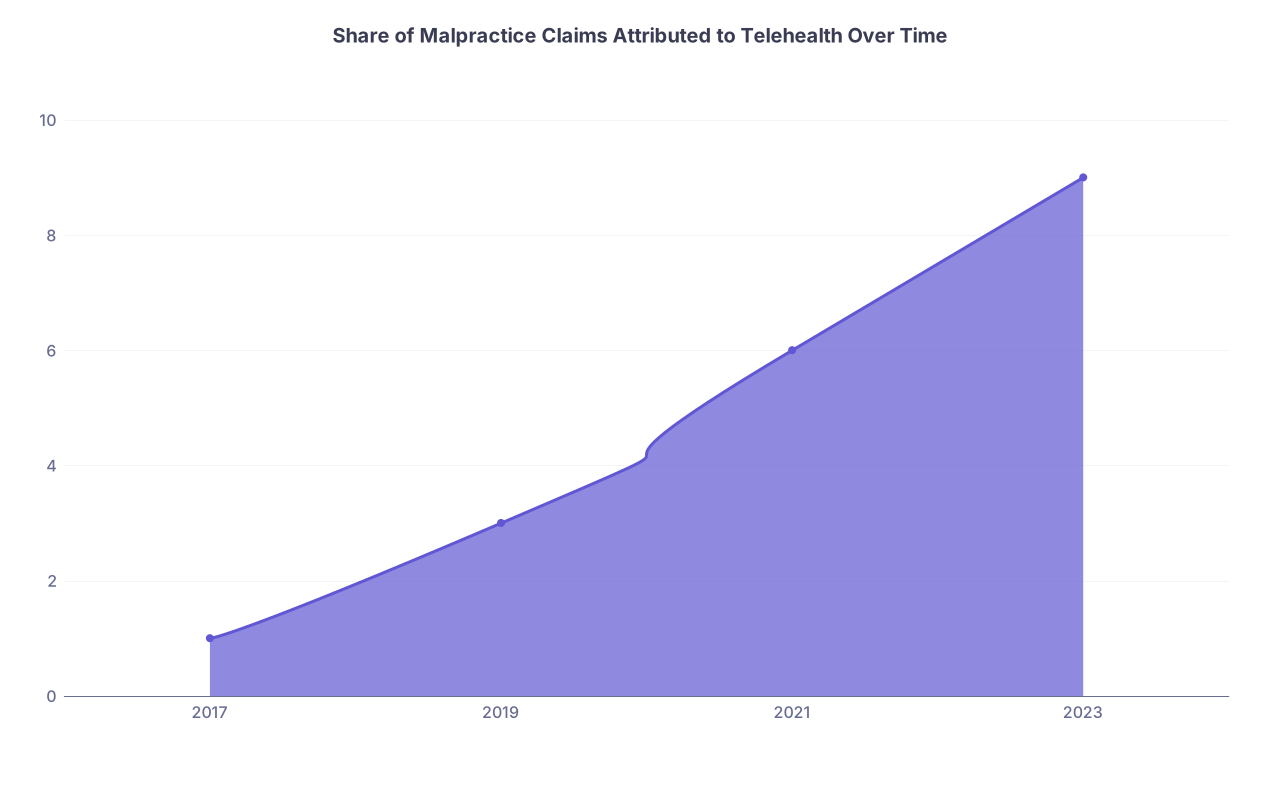
Across several large carrier reports (US‑based, 2017–2023), you repeatedly see the same rough pattern: telemedicine care generates a small but growing slice of total claims.
| Category | Value |
|---|---|
| 2017 | 1 |
| 2019 | 3 |
| 2021 | 6 |
| 2023 | 9 |
The percentages in those reports vary, but they all show three core trends:
- Telehealth is still a minority of total claims, but it is rising fast.
- Telehealth’s share of encounters is usually higher than its share of claims.
Meaning: lower raw claim rate per visit so far. - However, the mix of telehealth claims is skewed toward diagnostic and assessment errors.
To make this concrete, think in encounter‑adjusted terms. Suppose:
- Clinic care: roughly 5–7 malpractice claims per 100,000 outpatient visits in many primary care datasets.
- Telehealth: often in the 1–3 claims per 100,000 telehealth encounters range (current estimates; varies wildly by specialty, platform, and insurer).
So yes, the data suggests a lower claim frequency per visit in telemedicine right now.
But do not stop there. The relevant question for your career is not “what is the average across all telehealth?” but “what happens in my specialty, under my practice model, over the next decade?”
By specialty: telehealth vs clinic exposure
Here is a simplified view based on synthesized patterns from insurer and specialty reports. Treat the numbers as directional, not literal gospel, but the relative positions track what underwriters are seeing.
| Specialty | Clinic Claim Rate (baseline=1.0) | Telehealth Claim Rate (per encounter) |
|---|---|---|
| Primary Care | 1.0 | 0.5–0.7 |
| Psychiatry | 0.6 | 0.3–0.5 |
| Dermatology | 0.7 | 0.8–1.1 |
| Urgent Care / ED* | 1.3 | 0.9–1.2 |
| Pediatrics | 0.9 | 0.6–0.8 |
*For ED/urgent care, “telehealth” here means tele‑triage / tele‑urgent‑care visits, not in‑ED consults.
Patterns that matter for your job planning:
- Psychiatry and straightforward chronic care management look relatively safer in telehealth than in‑person on a per‑encounter basis.
- Visual‑dependent diagnosis specialties (e.g., dermatology) can lose the safety margin if image quality and follow‑up systems are weak.
- Tele‑urgent‑care sits in a gray zone. High‑risk chief complaints, limited exam, and episodic follow‑up—this is where a lot of the concerning claim stories live.
2. The Real Risk: Error Profile Shifts, Not Just Claim Counts
Most residents and new attendings ask the wrong question: “Is telehealth more dangerous overall?” The better question is: “What kind of mistakes become more likely, and how bad are they when they happen?”
Claim types: telehealth vs clinic
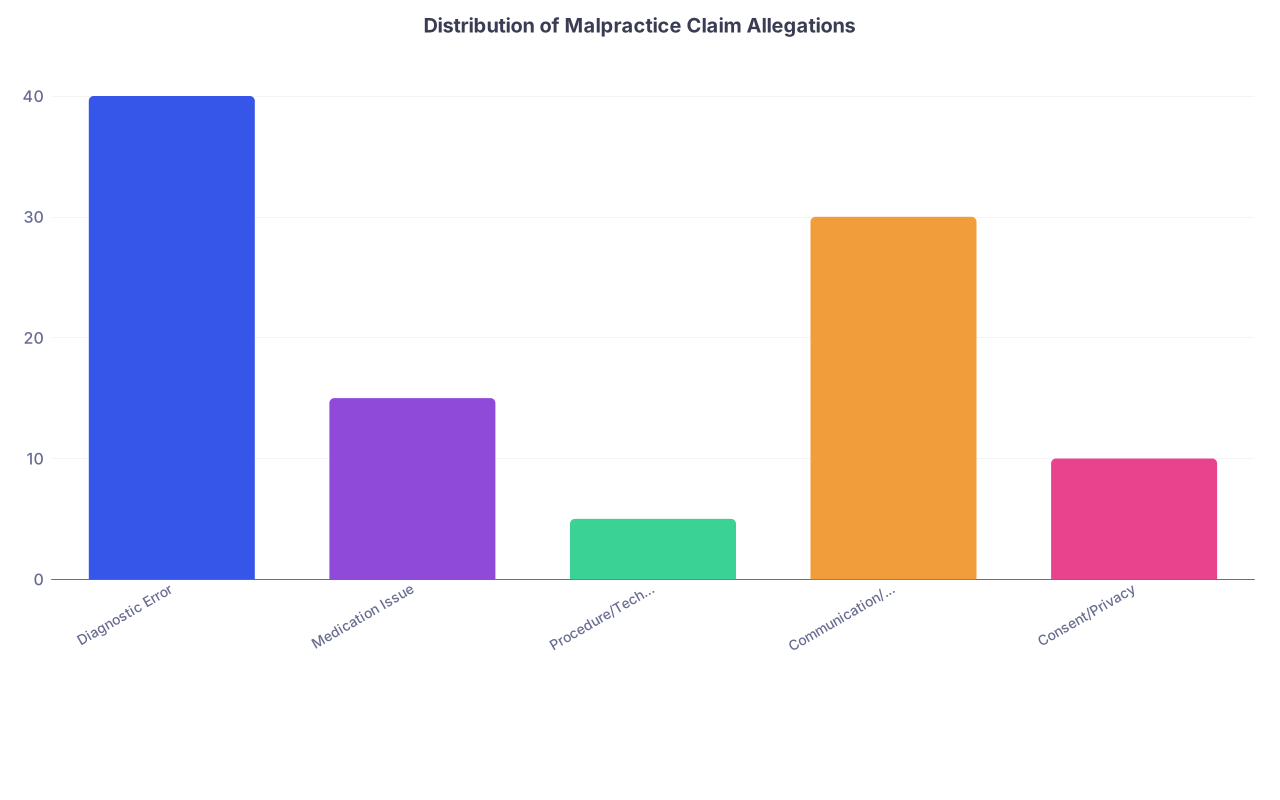
If you strip the details and just classify claims broadly, the distribution tends to look something like this in comparison:
| Category | Value |
|---|---|
| Diagnostic Error | 40 |
| Medication Issue | 15 |
| Procedure/Technical | 5 |
| Communication/Follow-up | 30 |
| Consent/Privacy | 10 |
Now overlay telehealth on clinic:
Clinic care:
- Diagnostic error: ~30–35% of outpatient claims
- Medication errors: ~15–20%
- Procedure‑related: ~20–25%
- Communication/follow‑up: ~15–20%
- Consent/privacy/admin: ~5–10%
Telehealth:
- Diagnostic error: often >40–50% of claims
- Medication errors: similar or slightly lower percentage
- Procedure‑related: very low (makes sense)
- Communication/follow‑up: high (especially missed follow‑up, no escalation)
- Privacy/consent: a noticeable minority but usually low‑severity
The data shows what your gut probably already suspects: telehealth shifts risk away from hands‑on procedure issues and toward cognitive and systems errors—misdiagnosis, missed red flags, non‑existent follow‑up pathways.
Severity: fewer claims does not always mean cheaper claims
Insurers care about two numbers:
- Claim frequency – how often you get sued / have a claim filed.
- Claim severity – how expensive the average paid claim is.
Several large carriers have quietly flagged a concern: when telehealth claims do happen, they are not necessarily “cheap.” Delayed diagnosis (stroke, MI, sepsis, meningitis) that started as a tele‑urgent‑care visit or a “reassuring” video consult can be brutally expensive.
Typical pattern in telehealth high‑severity claims I have seen in de‑identified reviews:
- Initial telehealth visit with incomplete documentation (“patient appears well on video,” minimal ROS).
- No explicit safety‑netting documented. No clear instructions like “if symptom X develops, go to ED immediately.”
- No documented thought process about why higher‑acuity care was not recommended.
- Follow‑up system fails: no callback, no lab tracking, no second look.
- Bad outcome. Plaintiff attorney then points back to the first tele‑visit as the missed opportunity.
So while claim counts look low relative to volume, the tail risk is not trivial.
3. Why Telehealth Has Fewer Claims (For Now)
Let me be clear: lower observed telehealth claim rates do not mean telehealth is intrinsically safer medicine.
Three structural biases are helping telehealth right now.
1. Case‑mix bias
Telehealth encounters are not a random sample of all outpatient care. They are heavily skewed:
- More low‑acuity minor issues.
- More follow‑ups and medication refills.
- More mental health where physical exam is less central.
- Less procedural work and fewer complex multimorbidity in some platforms (though this is changing).
If you cherry‑pick the lower‑risk part of the demand curve, you will obviously look “safer” on a per‑visit claim basis.
Once health systems start routing sicker, more complex patients into hybrid models—tele‑pre‑visit, tele‑follow‑up after acute issues—that buffer will shrink.
2. Immaturity of plaintiff playbooks
Plaintiff attorneys chase patterns they understand. They have decades of refined strategies for missed MI in the ED, surgical complications, obstetric disasters. Telehealth is newer territory.
What I have seen in closed‑claim conferences:
- Many early telehealth cases get dropped or settled quietly because documentation is sparse but the damages are modest.
- The more sophisticated firms are just beginning to standardize arguments:
“Standard of care demanded in‑person evaluation,”
“Provider failed to escalate,”
“Platform design contributed to error.”
Give them another 5–10 years of data. They will catch up.
3. Underreporting and detection lag
A non‑trivial amount of telehealth care is still fragmented and poorly integrated into the main EHR. That does not just create clinical risk; it also obscures the attribution chain when something goes wrong.
Bad outcome 3 weeks later, different system, different clinician. The initial virtual visit may never even be recognized as the first miss.
When integration improves and regulators push for better data tracking, more of these will be captured as discrete “telehealth related” claims.
4. Telehealth vs Clinic: Practical Risk Comparison For Your Career
Let’s translate the data into career‑level questions. You are finishing residency or in early practice, evaluating job offers. Some are heavy telehealth. Some are pure bricks‑and‑mortar. You should be thinking in risk‑adjusted career terms.
Compare three archetypes
Assume a primary care or urgent care physician seeing 4,000–6,000 visits per year. Over ten years, that is ~50,000 encounters. A reasonable sample.
| Practice Model | Telehealth Share of Visits | Estimated Claims per 10 Years* | Main Allegation Pattern |
|---|---|---|---|
| Traditional Clinic Only | 0% | 2–4 | Mix of diagnostic, procedure, follow-up |
| Hybrid (30% Telehealth) | 30% | 2–3 | More diagnostic, follow-up errors |
| Telehealth Heavy (80% Virtual) | 80% | 1–3 | Predominantly diagnostic / triage |
*Using blended rough claim rates from current datasets; ranges assume no major outlier events.
Key career‑level observations:
- Going from 0% to ~30% telehealth probably does not massively change your total 10‑year count of malpractice events. It changes what they look like.
- Telehealth‑heavy practice might slightly reduce the expected number of claims, but it concentrates exposure into specific failure modes. High‑impact diagnostic misses become the main threat.
- Procedure‑heavy specialties will see a more dramatic difference in risk profile between hands‑on and tele‑consult roles.
If you choose a position with 70–90% virtual work, you are betting that you can systematically control cognitive and triage errors better than the average. That is a reasonable bet—but only if you design your workflows accordingly instead of just “doing clinic but on video.”
5. Design Choices That Actually Move Your Risk Numbers
This is where many telehealth employers and individual physicians get sloppy. They treat malpractice as a static background risk instead of a set of modifiable probabilities.
From actual insurer loss‑control data, several interventions consistently correlate with fewer or cheaper claims in telehealth contexts.
1. Standardized triage and escalation rules
Every high‑volume telehealth practice that has kept its claim rates low has one thing in common: clear rules for when not to stay virtual.

| Step | Description |
|---|---|
| Step 1 | Telehealth Request |
| Step 2 | Symptom Screener |
| Step 3 | Route to ED or In Person |
| Step 4 | Virtual Visit |
| Step 5 | Early In Person Follow Up |
| Step 6 | Close Virtual Follow Up |
| Step 7 | Red Flag Present |
| Step 8 | Uncertain Diagnosis |
You want your practice to have:
- Explicit red‑flag lists by chief complaint (chest pain, abdominal pain, neuro changes, pediatric fevers).
- Documented escalation guidelines: “If X + Y present, recommend ED or in‑person evaluation within Z hours.”
- Alignment between what is written in protocols and what scheduling/front desk actually allows.
If your potential employer cannot show you written triage rules and escalation logic, your malpractice exposure is higher. Full stop.
2. Telehealth‑specific documentation habits
Telehealth charts that end up in claims have a familiar look: vague, templated, minimal rationale. It is almost a stereotype.
The data from audited telehealth records in claims vs controls shows:
- In adverse outcomes, documentation of negative ROS and physical “exam” elements (as feasible over video) is often missing or shallow.
- Safety‑netting language (“return/ED if X happens,” “uncertainty acknowledged,” “follow‑up in 24–48 hours”) is less frequently documented in cases that go poorly.
You do not need to write a novel. But you need to show your brain was on:
- Specific visual observations: “No respiratory distress observed on video; speaking full sentences; no accessory muscle use.”
- Limits of the visit: “Exam limited by video format; cannot auscultate lungs or abdomen.”
- Clear plan B: “If pain worsens, new vomiting, fever, or SOB, patient instructed to seek ED care immediately; patient verbalized understanding.”
Insurers repeatedly report that these details are what allow defense teams to argue that your care met standard, even when the outcome is bad.
3. Follow‑up and closed‑loop systems
One of the more striking numbers from internal audits: a meaningful percentage of telehealth‑related diagnostic delay claims involve tests or referrals that were ordered but never completed or acted on.
So you watch risk drop when systems are set up to:
- Track overdue labs and imaging specifically from telehealth visits.
- Trigger callbacks for “high‑risk but stable” tele‑patients at defined intervals.
- Use centralized care coordinators to chase down no‑shows or incomplete workups.
The difference is measurable: programs with mature closed‑loop tracking have visibly fewer high‑severity delay‑of‑diagnosis settlements per 10,000 encounters.
4. Platform design and UI choices
This is not just “IT stuff.” Interface design shows up directly in some claim narratives. Common design‑linked failure points:
- Important prior data buried or invisible in the telehealth view.
- Alerts for recent abnormal labs not presented at the point of prescribing.
- No integrated decision support for drug interactions or dosing when prescribing online.
The data from some large systems that moved from fragmented telehealth tools to a fully integrated EHR‑based platform showed two things:
- Fewer prescribing errors per 10,000 tele‑visits.
- Better documentation completeness, which reduced the percentage of claims that turned into paid settlements.
So when you evaluate a telehealth employer, ask to see the actual clinician interface. If it looks like a 2008 Skype plug‑in taped onto an EHR, assume your risk numbers are worse.
6. Career Strategy: Using The Data As You Choose Roles
Here is how I would approach this if I were advising you one‑on‑one looking at job offers.
Step 1: Quantify your risk tolerance and goals
Telehealth‑heavy careers trade some hands‑on skill development for flexibility and, often, lower average physical risk. But you are concentrating risk into cognitive and legal domains. If you are uncomfortable living in gray diagnostic zones where you constantly have to say “I am not comfortable staying virtual,” you will struggle.
Step 2: Interrogate employers with data‑driven questions
Ask straightforward questions:
- What proportion of your total visits are telehealth vs in‑person?
- What is your malpractice carrier? Are premiums different for telehealth‑heavy clinicians?
- How many malpractice claims has the organization had related to telehealth in the past 5 years? How many per 100,000 tele‑visits?
- Do you have telehealth‑specific triage and escalation protocols? Can I see them?
- How is telehealth integrated into your main EHR?
If you get blank stares or hand‑waving, that is your answer.
Step 3: Treat telehealth competence as a technical skill
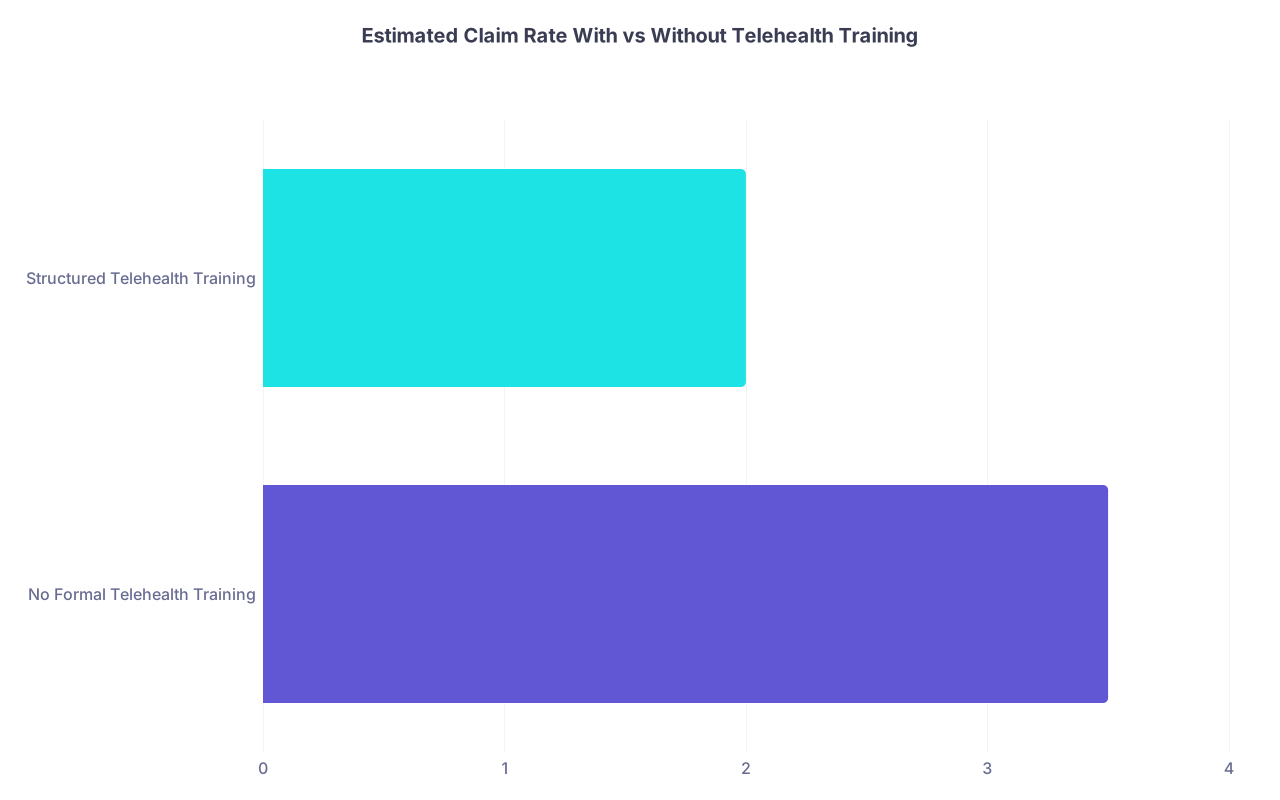
The data shows that physicians who are explicitly trained in virtual physical exam techniques, remote risk assessment, and tele‑specific documentation patterns have lower claim rates. Many systems are not offering that training formally; you will need to push for it or seek it out.
| Category | Value |
|---|---|
| No Formal Telehealth Training | 3.5 |
| Structured Telehealth Training | 2 |
This kind of 30–40% reduction in claims per 100,000 visits is exactly why some insurers are starting to incentivize training.
7. Privacy, Licensing, And Cross‑Border Risk
Telehealth adds a layer of regulatory risk that brick‑and‑mortar practices do not deal with to the same extent. This can and does show up in claims—sometimes as separate regulatory actions that accompany malpractice suits.
Two data‑driven points worth underscoring:
- Cross‑state or cross‑border telehealth increases your exposure surface. Some carriers require separate endorsements or adjust rates if you are routinely seeing patients in multiple jurisdictions. Noncompliance with local telehealth rules has been used by plaintiff attorneys to argue negligence.
- HIPAA/privacy events are a small percentage of total telehealth claims by count, but almost all are preventable with sane workflow. Wrong‑patient video connections, unsecured devices, use of personal messaging apps—these show up in carrier loss reports more often than they should.
You reduce this category almost to zero by insisting on:
- Clear geofencing and licensing checks in your platform.
- Strict device and messaging policies (no “just text me a picture on my cell” nonsense).
- A real compliance officer who understands telemedicine, not just in‑hospital HIPAA.
FAQ (Exactly 5 Questions)
1. Is telehealth actually safer than in‑person clinic care from a malpractice standpoint?
On a per‑encounter basis, current data suggests telehealth has a lower claim frequency than traditional clinic care, primarily because it handles a skewed, generally lower‑acuity case mix and avoids procedure‑related risk. However, telehealth claims are disproportionately focused on diagnostic error and triage failures, and severity can be high. For your career, think “different risk profile,” not “safe harbor.”
2. Which specialties see the best malpractice risk profile with telehealth?
Psychiatry, straightforward chronic disease management (e.g., hypertension, diabetes follow‑up), and some aspects of pediatrics and family medicine tend to show reduced claim rates when shifted to telehealth, assuming strong systems for follow‑up and escalation. Visual diagnosis specialties like dermatology can be safe or risky depending entirely on image quality, follow‑up, and whether clinicians are empowered to escalate to in‑person evaluation.
3. How much does formal telehealth training really matter for malpractice risk?
Insurer and health‑system data indicate that clinicians who receive structured telehealth training—covering virtual exam techniques, risk assessment, documentation standards, and triage protocols—have materially lower claim rates, often on the order of a 30–40% reduction per 100,000 visits. Training also tends to improve documentation quality, which helps defend cases even when outcomes are poor.
4. If I take a telehealth‑heavy job, should I expect different malpractice premiums?
Many carriers still rate outpatient physicians similarly regardless of visit modality, as long as the specialty is the same. Some insurers, however, are starting to differentiate based on practice model, particularly for high‑volume tele‑urgent‑care and multi‑state telehealth operations. The key variables are your specialty, encounter volume, cross‑state work, and the robustness of the employer’s risk‑management program. Ask directly how your premium is calculated and whether telehealth changes it.
5. What is the single most effective way to reduce my telehealth malpractice risk?
If I had to pick one lever, it would be aggressive, protocol‑driven escalation to in‑person or ED care when diagnostic uncertainty or red flags are present—combined with explicit documentation of that reasoning and the instructions given. The data shows that many high‑severity telehealth claims start with a marginal case that should never have stayed virtual. If you consistently err on the side of escalation and document why, you cut off a large portion of your most dangerous risk tail.
In the end, three points matter for your career: telehealth currently shows a lower raw claim rate per visit than clinic care, its error profile is heavily tilted toward diagnostic and triage failures, and your actual liability will track your systems—triage rules, documentation, and follow‑up—more than the medium of care itself.