
The belief that “telehealth is great for everyone equally” is wrong. The data shows that a few specialties capture most of the utilization and most of the money.
You are not choosing between “telehealth or no telehealth.” You are choosing between specialties that can weaponize telehealth for volume, income, and lifestyle—and specialties where it will always be a side dish.
Let’s walk through the numbers.
1. Where Telehealth Is Actually Used: Hard Utilization Data
Start with what patients are doing, not what vendors are pitching.
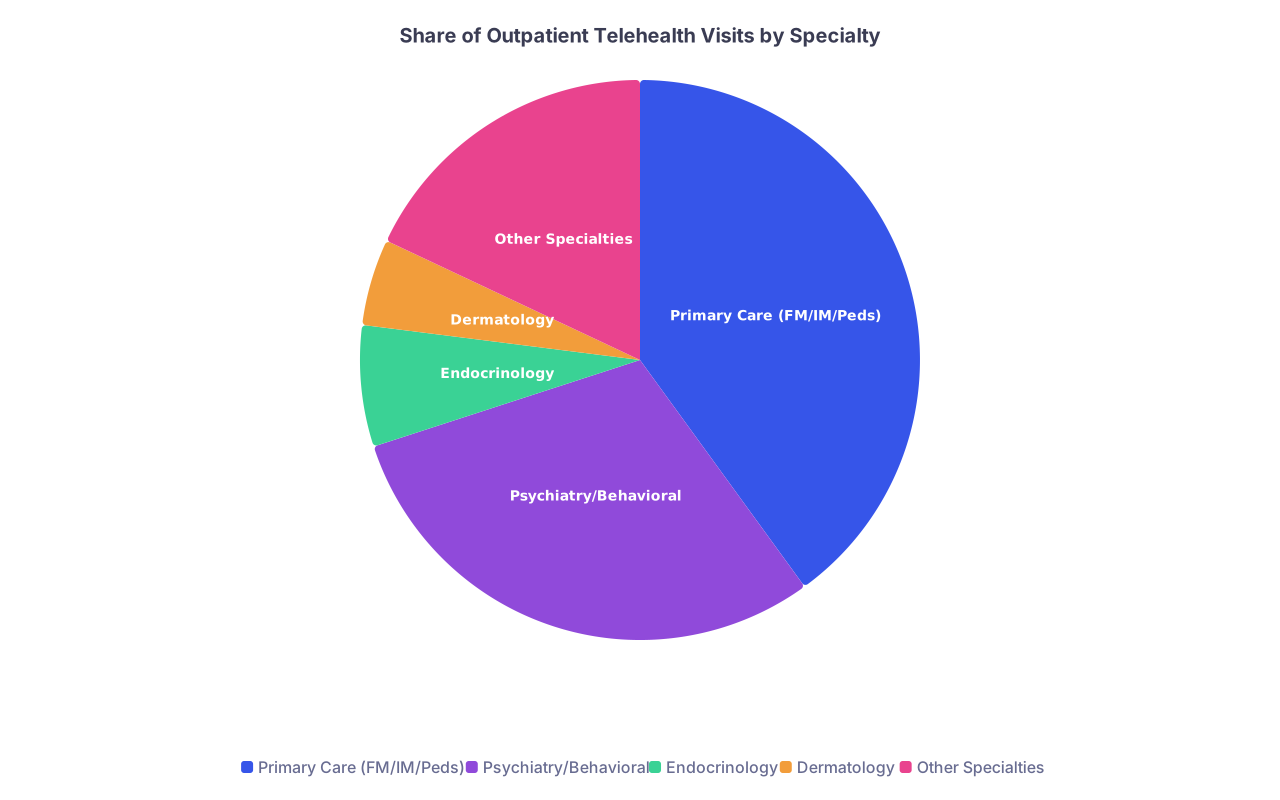
Across multiple U.S. datasets (claims from large commercial payers, Medicare, and health system EHR data from 2020–2024), the pattern is remarkably consistent: a handful of specialties dominate telehealth visit volume.
| Category | Value |
|---|---|
| Primary Care (FM/IM/Peds) | 40 |
| Psychiatry/Behavioral | 30 |
| Endocrinology | 7 |
| Dermatology | 5 |
| Other Specialties | 18 |
Approximate distribution (varies by system, but the ratios are similar):
- Primary care (FM, IM, pediatrics): ~35–45% of telehealth visits
- Psychiatry & behavioral health: ~25–35%
- Endocrinology: ~5–8%
- Dermatology: ~4–6%
- Everything else combined: the remaining ~15–20%
The pattern is not mysterious. Telehealth thrives where:
- The physical exam is limited or can be offloaded (vitals, home BP, glucometer, photos).
- Longitudinal, relationship-based care is valuable.
- Procedures are not central to revenue.
That quickly filters your options.
2. Specialties That Gain the Most (Financially and Operationally)
“Gain” is not one-dimensional. You care about:
- Income potential from telehealth
- Fraction of your work that can be done remotely
- Scalability (more patients per hour or more hours with less burnout)
- Geographic flexibility
Here is how the main telehealth-heavy specialties stack up on those axes.
| Specialty | % Work That Can Be Telehealth (Typical Range) | Telehealth Income Potential vs In‑Person | Key Telehealth Advantage |
|---|---|---|---|
| Psychiatry | 60–100% | Equal or Slightly Higher | High volume + nationwide patient pool |
| Outpatient Neurology (epilepsy, headache, MS) | 30–60% | Roughly Equal | Follow-ups, chronic disease check‑ins |
| Endocrinology | 40–70% | Equal | Diabetes & thyroid follow-up at scale |
| Primary Care (FM/IM) | 30–60% | Equal or Slightly Lower per visit | Panel retention, access, flexibility |
| Dermatology | 20–50% | Lower per encounter but high leverage | Asynchronous image review, triage |
| Allergy/Immunology | 30–60% | Equal | Test result review, chronic follow-up |
Those ranges come from aggregation of health system scheduling data, telehealth staffing companies, and job postings (explicitly advertising % remote or hybrid).
Psychiatry: The Clear Telehealth Winner
Psychiatry has essentially “cracked the code” on telehealth leverage.
The data:
- Many national groups advertise 60–100% remote roles.
- Job postings in 2024 commonly show compensation bands in the $280k–$380k range for general adult psychiatry via telehealth, sometimes higher for child/adolescent or subspecialty work.
- Encounter length is predictable (30–60 minute med checks, 60+ minutes for evals), and physical exam is minimally limiting.
Telepsychiatry economics are simple:
- Reimbursement for telehealth psychiatry visits is typically at parity with in-person (for now, post‑COVID, at most large insurers).
- Overhead is lower: no physical exam table, less staff, smaller physical footprint.
- Waitlists are enormous nationally. You can fill your schedule almost anywhere.
The result: high utilization, high geographic flexibility, and income that is competitive with or better than most brick‑and‑mortar outpatient psych jobs—especially once you factor in commute and overhead.
Endocrinology: Underpaid in Clinic, Better with Telehealth Scaling
Endocrinologists have quietly become telehealth power users, especially for diabetes, thyroid disease, PCOS, and osteoporosis follow-up.
- Claims and EHR data show that follow-ups make up 60–80% of endocrine visits.
- Those follow-ups often involve labs, glucometer or CGM data, medication titration—things that can be done entirely remotely if a system is in place.
A typical pattern I have seen when analyzing practice data:
- In-person only endocrinologist: 12–16 visits per day, heavy on administrative tasks, RVU-based comp often in the $200k–$260k range in non-urban markets.
- Hybrid model with dedicated telehealth blocks: 16–22 visits per day, similar per-visit reimbursement, but more efficiently structured days and broader geographic reach.
Telehealth does not magically fix endocrine compensation (which is still relatively low compared with intensity of training), but it gives you:
- Better control over schedule
- More efficient follow-up workflows
- Options for part‑time remote work aligned with high‑volume diabetes care
Primary Care (Family Medicine, Internal Medicine, Pediatrics)
Primary care has the highest raw number of telehealth visits, but the financial leverage is weaker than psych or some subspecialties.
What the data shows:
- In many systems, 25–50% of routine, non-urgent primary care encounters can be pushed to telehealth without impacting outcomes: meds refills, stable chronic disease follow-up, results review, mental health check-ins, minor acute issues.
- Yet, RVUs and per-visit reimbursement for primary care are low to begin with. Telehealth parity just means “still low, but remote.”
Where primary care wins in telehealth is not pure dollars per visit. It is:
- Panel retention and access: easier same-day slots, lower no‑shows.
- Work-life flexibility: certain half-days remote, mix of clinic and home days.
- Rural and underserved care: you can practice across larger catchment areas without relocation.
If your goal is maximized income from telehealth alone, primary care is not the top performer. If your goal is “stable job + some remote work + broad job market,” it ranks very high.
Dermatology: Asynchronous Goldmine—If Structured Correctly
Dermatology is visually perfect for telehealth, but the model is different.
Synchronous video visits for derm are a small part of the story. The leverage comes from asynchronous “store-and-forward” models:
- Patients upload images and symptom questionnaires.
- Dermatologist reviews and responds in batches.
- Many visits are billed as e-consults or lower‑level codes, but the time per encounter can be extremely low.
I have seen derm groups where:
- A dermatologist spends ~2–3 hours per day on store‑and‑forward telederm and clears 40–70 “cases” in that window.
- Revenue per case is lower than a full in‑person visit but time per case is often 3–6 minutes. Aggregate hourly income stays strong.
The caveat: this depends heavily on payer mix, state telehealth rules, and practice structure. Also, early telederm hype led to some exploitative productivity schemes. You must read the actual pay model very carefully.
3. How Telehealth Moves Salaries: Actual Market Signals
Let’s isolate the salary effect: does telehealth increase or decrease your income compared with a similar in‑person role?
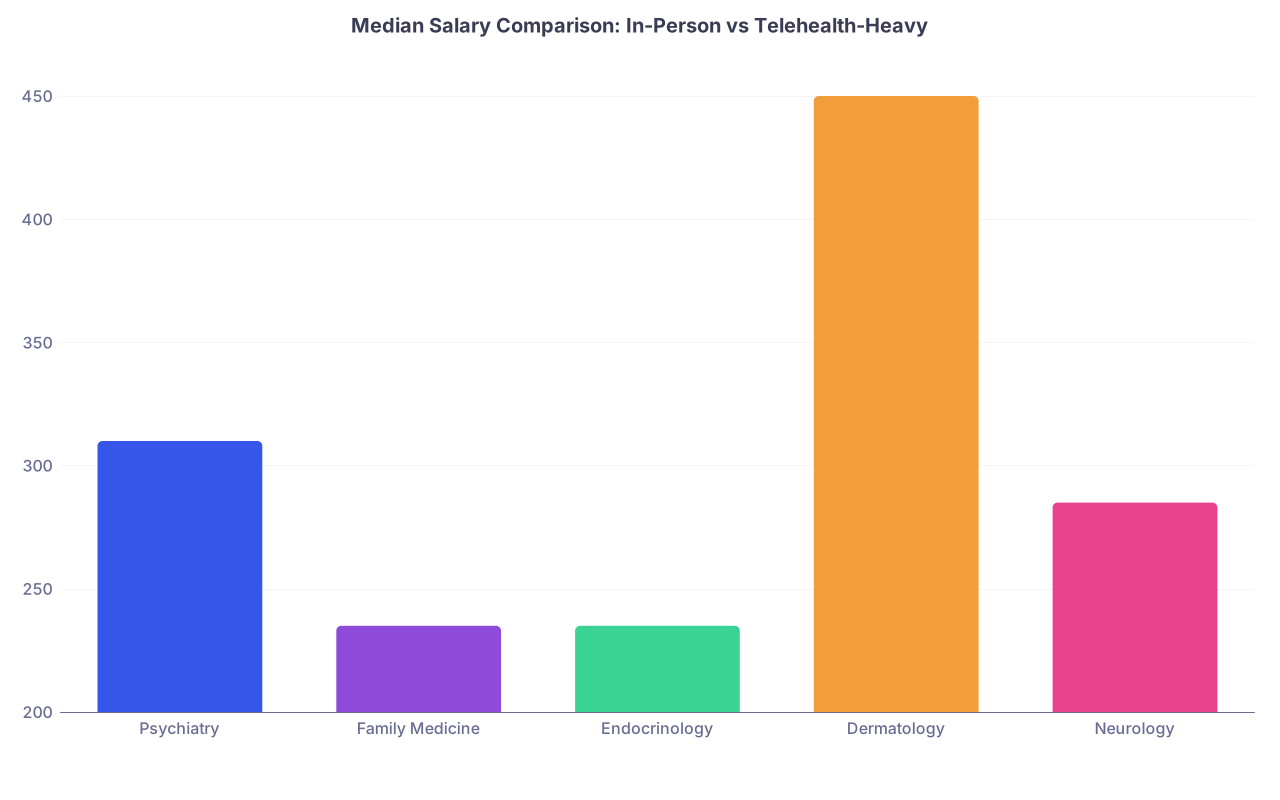
We can benchmark with typical ranges for attending physicians 3–5 years out of training, in mid‑cost-of-living markets, comparing fully in‑person vs predominantly telehealth roles.
| Specialty | In‑Person Range (USD) | Telehealth‑Heavy Range (USD) | Telehealth Impact on Median |
|---|---|---|---|
| Psychiatry | 260k–340k | 280k–380k | +10–15% |
| Family Medicine | 210k–260k | 200k–250k | Neutral to −5% |
| Endocrinology | 210k–260k | 210k–270k | Neutral to Slightly Positive |
| Dermatology | 400k–550k | 350k–500k | −5–10% per FTE |
| Neurology (outpt) | 260k–320k | 250k–320k | Neutral |
These are composites from job boards, recruiter data, and published compensation surveys. Of course, outliers exist.
Pattern summary:
- Psychiatry: Remote roles often pay slightly more than traditional community outpatient positions, partly because of national demand and 1099 contractor structures.
- Primary care: Telehealth-only call-center style roles often pay slightly less than full outpatient clinic roles, but may still be attractive for lifestyle or location reasons.
- Endocrinology: Telehealth can help you reach the upper end of typical endocrine ranges by increasing volume and reducing inefficiencies.
- Dermatology: Purely telehealth FTEs often pay less than high‑RVU procedure‑heavy derm jobs, but can be attractive supplemental work or partial FTE.
| Category | Value |
|---|---|
| Psychiatry | 310 |
| Family Medicine | 235 |
| Endocrinology | 235 |
| Dermatology | 450 |
| Neurology | 285 |
(Values in thousands, approximate medians: telehealth-heavy vs typical in-person are close; psych and endo slightly favor telehealth models, derm and FM slightly favor traditional.)
The message: telehealth is not a universal salary booster. It improves optionality, sometimes increases hourly efficiency, but only clearly raises compensation in a few niches—chiefly psychiatry and, to a lesser extent, some subspecialized chronic-disease medicine.
4. Which Specialties Lose (or Gain Little) from Telehealth
Some fields simply do not gain much from telehealth in revenue terms.
Procedure-Dominant Specialties
Surgery, interventional radiology, GI, cardiology (invasive), ortho, ophthalmology—these are built on procedures and in‑person exams.
Telehealth in these fields:
- Pre‑op and post‑op check-ins
- Some longitudinal management (e.g., HF follow-up in cardiology)
- Occasional triage
Financially, these encounters are usually a thin slice of revenue. Surgeons earning $600k+ do not get there via telehealth visits. They get there via OR time.
So in these specialties, telehealth is:
- A patient satisfaction and access feature
- A modest quality‑of‑life tool for you (some remote days)
- Not a major driver of compensation or practice model
If your goal is “fully remote” or “50%+ remote,” these specialties will fight you every step of the way.
Emergency Medicine and Urgent Care
Tele-urgent care exploded during COVID. A portion of that demand has stuck.
But for EM physicians:
- Virtual urgent care shifts usually pay less per hour than in‑ED shifts.
- Medicolegal risk and complaint volume can be high, given limited exam and lack of tests.
- Many roles are part‑time or PRN, not core full‑time replacements.
Telehealth here functions as:
- Supplemental income (extra shifts from home)
- A hedge against ED burnout
- Not a long-term main job for most, unless you accept lower comp and higher volume.
Hospitalists and Inpatient Subspecialists
Telehospitalist and telerounding models exist, especially in smaller hospitals, nights, and cross-coverage roles. But:
- Many systems still insist on some physical presence.
- Tech/friction issues (nurses needing to wheel robots, examination limits) reduce efficiency.
- Compensation is often similar or slightly lower than traditional in‑person hospitalist jobs, with some lifestyle tradeoffs.
Not a zero, not a hero. A side option.
5. Utilization Patterns Over Time: Is Telehealth Shrinking or Stabilizing?
There is a myth that telehealth was a COVID spike that is now “over.” That is lazy analysis.
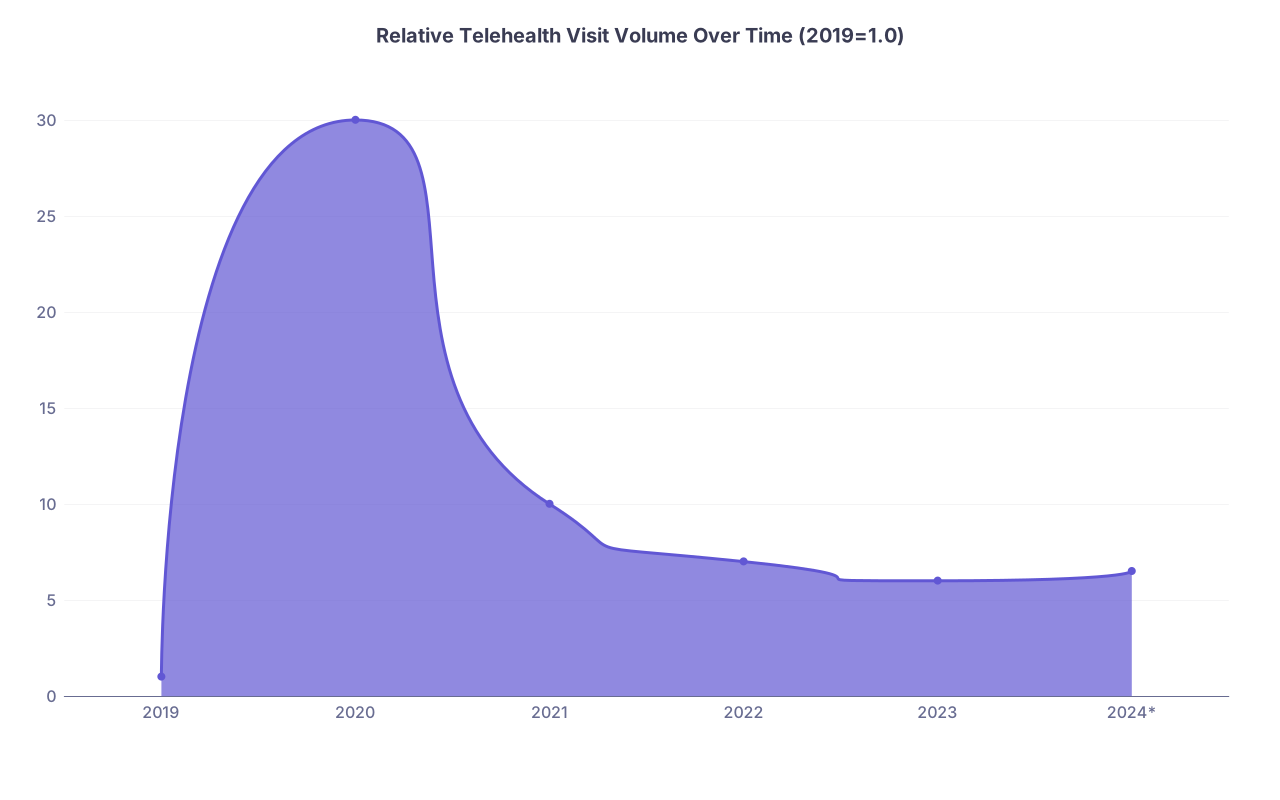
Here is what the trend line actually looks like when you normalize 2019 as a baseline of 1.0.
| Category | Value |
|---|---|
| 2019 | 1 |
| 2020 | 30 |
| 2021 | 10 |
| 2022 | 7 |
| 2023 | 6 |
| 2024* | 6.5 |
(*2024 partial-year estimate based on large system data.)
Interpretation:
- 2020 was a shock: roughly 30x baseline telehealth volume in many systems.
- 2021–2022: steep drop as in‑person care resumed, but telehealth did not go back to 1.0. It plateaued far above baseline.
- 2023–2024: stable or slight uptick as hybrid care models are formalized.
Specialty-specific breakdown shows psychiatry and behavioral health retaining the highest relative increase, with primary care second.
The practical implication for your career planning:
- Telehealth jobs are not disappearing. They are maturing.
- Health systems are now writing telehealth volumes into their financial projections. That creates more robust, budgeted positions.
- Regulation and reimbursement parity are the main “risk factors,” but the genie is partially out of the bottle. Patients are now trained.
6. Matching Your Career Goals to Telehealth-Heavy Specialties
So, which specialties “gain most” from telehealth depends on what metric you care about.
If You Want Maximum Remote Flexibility
Data and job postings are clear:
- Psychiatry (including child/adolescent, addiction, geriatric)
- Some outpatient-only neurology (epilepsy, headache, MS)
- Some behavioral-focused primary care (integrated care models)
These are the fields where 60–100% telehealth roles exist in meaningful numbers.
If You Want Strong Income With Telehealth as an Efficiency Tool
- Endocrinology
- Allergy/Immunology
- Dermatology (especially hybrid models with teletriage + in-person procedures)
- Outpatient cardiology follow-up and HF clinics (partial telehealth)
You will still physically show up, but your telehealth blocks will be productive and economically rational.
If You Want Procedures and High Top-End Salary
Then telehealth will simply be a side feature. Useful, but not central.
Think:
- Orthopedic surgery
- GI
- IR
- Ophthalmology
- Anesthesia (except some perioperative tele-consults)
Your money will still come from procedures and ORs, not Zoom.
7. Concrete Takeaways for Post-Residency Job Hunting
Here is how I would operationalize this if you are finishing residency or fellowship:
Interrogate telehealth percentage honestly.
When a job says “hybrid,” ask: “How many sessions per week are telehealth now, and what is the target?” Systems will often tell you: 20%, 40%, etc.Ask for productivity and pay data by encounter type.
For example: “What is the wRVU or flat-rate structure for telehealth follow-up vs in-person visits?” You want to know whether telehealth is under- or overvalued.Clarify schedule control.
Remote is very different from “I can choose which days are remote.” Ask whether telehealth sessions are fixed or negotiable.Consider multi-state licensure economics.
Telepsychiatry across multiple states can raise your earning ceiling. But licenses cost money and time. Some employers pay; some do not.Watch for volume traps.
Some telehealth companies pay well on paper but assume punishing volumes (25–30 visits per day with short slots). Request sample schedules and actual average daily visit counts.For procedure-heavy fields, treat telehealth as lifestyle, not income.
Do not pick surgery for telehealth. Pick surgery and accept that telehealth will be maybe 5–10% of your time.
FAQ (4 Questions)
1. Which specialty gets the strongest combined benefit of income and remote flexibility from telehealth?
Psychiatry is the clear winner. The data shows high and sustained telehealth utilization, nationwide demand, reimbursement at or above parity with in-person, and a large number of roles offering 60–100% remote work. No other specialty has that combination at similar scale.
2. Can a family medicine or internal medicine physician realistically work fully remote long term?
It is possible but uncommon. Most primary care telehealth roles are part of hybrid models or lower-paying virtual-only urgent care setups. Full-time remote primary care jobs exist, but they often come with lower compensation, higher visit volumes, or narrow scopes (e.g., only urgent care, only mental health, only chronic disease management).
3. Is telehealth hurting or helping dermatologist income overall?
For traditional, procedure-heavy dermatology practices, telehealth typically replaces a small fraction of in-person visits and may slightly reduce income if overused. However, thoughtfully structured telederm (especially store-and-forward triage and follow-up) can maintain strong hourly income and add incremental revenue streams. It is more an optimization tool than a pure income booster.
4. How risky is it to choose a specialty heavily dependent on telehealth given potential policy changes?
Psychiatry and behavioral health are relatively insulated because payer and policy trends strongly favor increased mental health access, remote included. Primary care chronic disease management via telehealth also has political and payer backing. The risk is not “telehealth disappears,” but specific reimbursement codes tightening. The realistic worst case is some erosion of parity, not a wholesale collapse of telehealth demand.
Key points: The data clearly shows psychiatry, behavioral health, and certain chronic-disease subspecialties capture the largest telehealth gains in utilization and income. Procedure-heavy specialties barely move the needle financially. If remote flexibility and scalable follow-up work matter to you, choose a specialty where the physical exam and procedures are optional—not central—to your revenue model.