The emergency department is no longer the only front door for acute care—and if you ignore tele‑urgent care, you are limiting your career options.
Let me be blunt: being a strong in‑person urgent care or EM physician does not automatically make you competent on webcam. The overlap is about 60%. The other 40% is a different job with different muscles.
You want to work in tele‑urgent care post‑residency? You need a deliberately built skillset, not just a Zoom account and a license.
Let’s break this down specifically.
What “Tele‑Urgent Care” Actually Is (And Is Not)
Tele‑urgent care is not “FaceTime with a doctor.” It is a defined clinical product with its own constraints, patient expectations, and operational rules.
At scale, tele‑urgent care usually means:
- Scheduled or on‑demand video visits (5–15 minutes)
- High volume, low acuity by design
- Clear “no‑go” conditions that must be routed to ED or in‑person
- Heavy protocolization and standardization
- Metrics tracked obsessively: throughput, Rx rate, NPS, return visits, escalation rates
Think Teladoc, Amwell, Optum / United’s virtual clinics, Kaiser’s virtual urgent care, or large health systems’ “OnDemand” video programs.
This is not:
- Full‑spectrum primary care
- A replacement for a physical urgent care center
- A place to “be creative” with wild differential diagnoses
It is acute, narrow‑scope medicine under tight guardrails. Your job is to be fast, safe, and consistent—with incomplete data and no physical exam tools beyond your eyes, ears, and brain.
Core Clinical Skillset: Practicing Acute Care Without a Physical Exam
The single biggest shift: you lose the exam and keep the liability.
A lot of residency‑trained physicians underestimate how much this changes your thinking. You can not “push” the edge of outpatient management the way you might when you can lay hands on a patient.
You need to rebuild basic urgent care thinking around:
- Exclusion and escalation thresholds rather than confirmation
- History granularity that compensates for the lack of physical exam
- Risk‑tiered decision making: what you are willing to manage vs what you redirect
History‑Taking 2.0: Ultra‑Structured, Ultra‑Efficient
Tele‑urgent care history has to be:
- More structured than your EM “story‑first” style
- Obsessive about red flags
- Ruthless about time
You do not chit‑chat your way into the HPI. You start with structure.
Example: “sore throat” visit.
In‑person, you glance at the patient, note they look fine, get a rough history, and the physical exam does most of the work.
On webcam, you must get near‑decision‑grade data from history alone:
- Onset, progression, severity (with numbers, not adjectives)
- Fever history with actual temps, not “felt warm”
- Respiratory status: ability to speak in full sentences, sleep lying flat, any stridor or drooling
- Swallowing: solids vs liquids vs saliva
- Associated symptoms: cough, rhinorrhea, exudate sensation, unilateral vs bilateral pain, otalgia, rash
- Exposure history: known strep, mono, COVID, sexual exposure for gonococcal pharyngitis
- Risk factors: immunocompromise, prior rheumatic fever, lack of follow‑up access
You need a near‑script level of patterning in your own head for:
- Chest pain
- Shortness of breath
- Abdominal pain
- Headache
- Fever in children (by age group)
- Rash
- GU complaints
- Eye complaints
If you cannot rattle off your must‑ask questions for those categories without thinking, you are not ready for tele‑urgent care. Fix that first.
The Tele‑Exam: More Than “Can You Show Me That?”
You will not percuss a chest or palpate a spleen on a laptop. But the idea that telemedicine has “no exam” is lazy thinking. You have a modified exam, and you must maximize it.
You can systematically assess:
- General appearance: toxic vs well, work of breathing, ability to sit comfortably, interaction level
- Respiratory: counting RR visually, speaking full sentences, visible retractions, tripod posture, audible wheeze/stridor over mic
- Neuro: orientation, speech clarity, facial symmetry, arm drift (you can literally do a modified NIHSS if needed), gait if space permits
- ENT: mouth opening, visible exudates, tonsil asymmetry, uvula deviation, drooling, trismus, voice quality (“hot potato voice”)
- Skin: rashes, distribution (you direct camera angles), blanching with patient or parent assistance, dermatomal patterns
- MSK: range of motion, ability to bear weight, focal tenderness with guided palpation (“press where I show you and tell me when it hurts most”)
- Peds: level of interaction with caregiver, consolability, playfulness, sucking/drinking behavior, diaper counts, cap refill approximation via parent
The real skill is standardizing your tele‑exam for each complaint type, so it becomes muscle memory.
For example, tele‑exam for suspected UTI? Minimal. You are history‑heavy. Headache in a 40‑year‑old? Now you are doing focused neuro via camera and testing gait if there is space.
Tele‑urgent care error pattern I have seen repeatedly: physician reassured by appearance on screen and under‑weights concerning history. You must separate these in your mind: reassuring appearance helps, but it never overrules a worrisome story.
Risk Management: Knowing When Not to Play Hero
In tele‑urgent care, your three most protective words are “I am uncomfortable.”
You need crystal‑clear internal rules about when you stop trying to manage virtually and send the patient in. And those rules have to be stricter than your in‑person thresholds.
Categories that demand a different, more conservative threshold on video:
- Chest pain / atypical chest pain
- Shortness of breath
- Acute neuro deficits, weird headaches, “worst headache,” altered mental status
- True abdominal pain with systemic symptoms
- Any unstable vitals (even if reported by home BP cuff) when consistent with symptoms
- Late pregnancy complaints (bleeding, decreased fetal movement, preeclampsia concerns)
- Pediatric fevers in the very young or immunocompromised
You are operating in a medico‑legal context where:
- You chose to evaluate without exam tools
- Chart reviewers and plaintiff attorneys will emphasize that you could have, at any point, directed them to in‑person care
So build your escalation rules. For yourself. In writing. Before your first shift.
And then actually document it: “Due to [X concerning factor], I recommended immediate evaluation in ED for in‑person examination and further workup. Patient verbalized understanding and agreed to plan.”
Now you look like a thoughtful clinician, not a tele‑Rx dispenser.
Communication and “Web‑Side” Manner
Bedside manner does not map 1:1 to web‑side manner. The medium strips out a lot of nonverbal context and magnifies small missteps.
Technical Setup Is Not Optional
You are a professional. Your video presence should not look like a late‑night FaceTime from a dorm room.
Minimum standard:
- Quiet, private space with a neutral background
- Decent lighting (soft frontal light, no bright window behind you)
- External webcam if your laptop camera is trash
- Wired or high‑quality wireless headset to avoid echo and missed words
- Reliable broadband; if your video drops, it is not “just annoying,” it is a clinical risk
If you plan to do this as serious income, invest a few hundred dollars in your setup. It pays for itself in one or two shifts.
Verbal Skills: Tight, Direct, Reassuring
Patients on video are:
- Less tolerant of rambling
- More sensitive to perceived disinterest or distraction
- Hyper‑focused on whether you “took them seriously”
So you trim your verbal style:
- Short, clear sentences
- Fewer filler phrases
- More explicit “here is what we are going to do” language
- Clear “this is safe for telemedicine” reassurance when appropriate
A good tele‑urgent care script pattern:
- Very brief opening: “I am Dr X, urgent care physician. I have reviewed what you entered but want to go through it together.”
- Targeted, structured history. You guide, not the patient.
- Quick tele‑exam with clear instructions. You narrate what you are doing: “Now I want to see how you are breathing.”
- Explicit summary: “Here is what I am hearing and why I am thinking about [diagnosis range].”
- Plan stated in plain language, with explicit addressing of “what if you get worse” and “when this is an emergency.”
You cannot rely on chart notes or patient instructions to do the heavy lifting. Your spoken words are the intervention from the patient’s point of view.
Decision‑Making Without Lab / Imaging Crutches
One of the quiet addictions of modern urgent and emergency care is “just get a test.” Tele‑urgent care takes that away.
You have three tools:
- History
- Modified exam
- Your own risk tolerance and familiarity with guidelines
So your skillset has to include deep internalization of outpatient guidelines and thresholds. Off the top of your head, you should know:
- When outpatient pneumonia treatment is reasonable (by risk score, not just vibes)
- Strep pharyngitis rules and when empiric treatment is acceptable with/without testing based on local protocols
- UC‑friendly antibiotic choices by region and typical formularies
- Which rashes are “photo + history” diagnosable and which must be seen
- Outpatient DVT/PE rules (PERC, Wells) and when you simply stop and send in
- Safe outpatient management ranges for BP, HR, RR in various ages
Tele‑urgent care punishes physicians who are vague about these. There is no “just get a CBC and a film and see what it shows.” Either you are comfortable treating empirically, or you are not and you escalate.
Documentation and Medico‑Legal Discipline
Tele‑urgent care charts are often short. They cannot be sloppy.
Your documentation must do several things well:
- Show that you considered and reasonably excluded dangerous diagnoses for that complaint
- Demonstrate that your decision to manage virtually (or to escalate) was reasoned
- Record the patient’s understanding and agreement with the plan
- Capture the specific constraints of the encounter (no vitals, patient refused ED, limited exam view, etc.)
You adjust some habits:
- Always document what you could and could not see on video.
- Be explicit when you rely on patient‑reported home vitals.
- Record tele‑exam findings (“Patient speaking in full sentences, no visible increased work of breathing, no accessory muscle use, no audible wheeze over call.”)
- For any borderline case, document your safety‑netting in concrete terms: “Return to ED immediately for…” not just “Return for worsening.”
I have seen tele‑care charts where the plan was defensible, but the documentation was a three‑line afterthought. On review, it looks like no one thought about risk at all. Do not put yourself in that position.
Technical and Operational Literacy: How Virtual Clinics Actually Run
If you want to be employable in this space long‑term, you need to speak the operational language. Not just “I see patients and chart.”
Common models:
- High‑volume, low‑touch national vendors (Teladoc, MDLive, etc.)
- Health‑system based virtual urgent care (e.g., Kaiser, Cleveland Clinic, Intermountain)
- Integrated primary care + urgent tele‑pods from payers or big groups
- Employer‑based telemedicine (direct‑to‑employer platforms)
Each has different expectations around:
- Visit length (6‑minute vs 15‑minute standard)
- Prescribing patterns (especially for antibiotics and controlled substances)
- Disposition tendencies (how “conservative” they want you to be)
- Follow‑up responsibilities (are you “one and done” or part of a system?)
You should understand basic operational metrics. You will be judged on them.
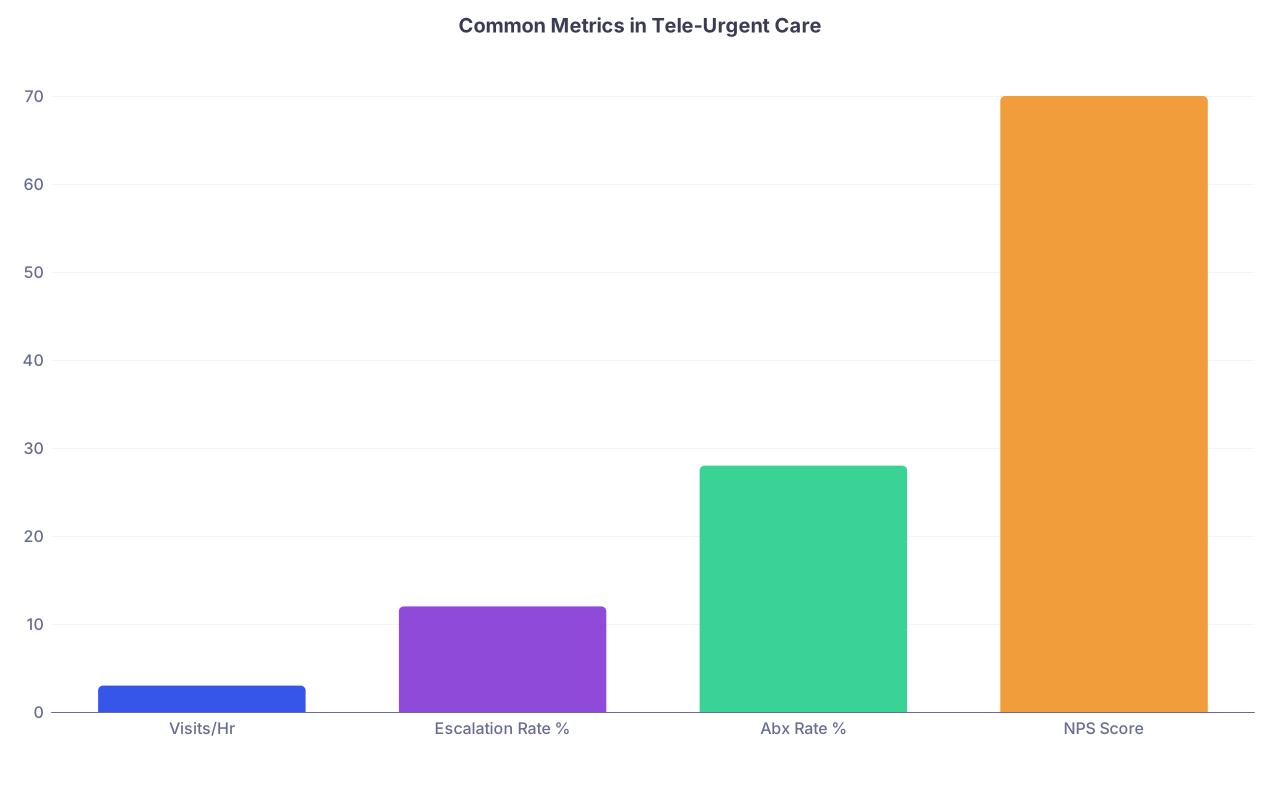
| Category | Value |
|---|---|
| Visits/Hr | 3 |
| Escalation Rate % | 12 |
| Abx Rate % | 28 |
| NPS Score | 70 |
Those numbers are not universal, but the categories are. You want to know:
- What is this group’s target visits per hour?
- What escalation rate do they consider reasonable vs “over‑escalating”?
- How do they track inappropriate prescribing?
- How is patient satisfaction measured and how much does it affect your shifts/pay?
If you can talk about this like an insider, you instantly sound like a physician who understands the business and can be trusted with a tele‑panel.
Non‑Clinical Skillset: Licensure, Workflows, and Lifestyle Reality
Multi‑State Licensure and Compacts
Tele‑urgent care multiplies your paperwork. Many national groups expect:
- 3–5+ active state licenses to start
- Willingness to expand to 10–20+ over time
- Familiarity with IMLC (Interstate Medical Licensure Compact) timelines and requirements where eligible
This matters for you practically:
- More CME tracking
- More state‑specific opioid / PDMP rules
- More malpractice tail considerations if you leave states later
Before you jump into tele‑urgent work heavily, have a clear personal policy: how many state licenses are you realistically willing to maintain? And are you IMLC‑eligible (critical for scaling quickly)?
Workflow Integration With Your Life
People romanticize telemedicine as “work from home in pajamas.” Reality, when done seriously:
- You still commit to scheduled shifts
- You still need uninterrupted focus time
- You still have metrics and QA review
The upside is real:
- No commute
- Easier shift trading
- Ability to stack part‑time contracts from multiple vendors
- Possibility of moving to lower COL states while working for national pay scales
But you must respect the work like any clinical job. If you are planning to combine in‑person EM/UC with tele‑urgent care, be honest about your mental bandwidth. Seeing 18–24 video visits in a 6‑hour block is cognitively tiring in a different way.
How to Deliberately Build Your Tele‑Urgent Care Skillset
If you finished residency and you want to be good at this, not just “logged in,” you build it in layers.
Step 1: Tighten Your Acute Outpatient Medicine
Before the webcam, fix the basics.
- Review IDSA / CDC guidelines for common infections (URI, sinusitis, bronchitis, pneumonia, UTI, skin/soft tissue)
- Revisit outpatient chest pain, syncope, headache, and abdominal pain evaluation—what is truly “safe to discharge” vs “needs workup”
- Streamline your own personal algorithms for peds fever by age, asthma flares, allergic reactions, simple trauma
If you cannot practice crisp, guideline‑aware acute outpatient medicine in person, you will be unsafe online.
Step 2: Create Complaint‑Based Tele‑Checklists
Do not trust your memory under time pressure. Create a one‑page cheat grid of:
- Required history questions
- Critical red flags
- Minimal tele‑exam elements
- Default plan options (treat here / in‑person UC / ED)
Start with:
- Chest pain
- Shortness of breath
- Fever (adult, pediatric separated)
- Abdominal pain
- Headache
- Sore throat
- Cough / suspected pneumonia
- Rash
- UTI and STI complaints
- Eye complaints
- MSK injuries
Keep these by your monitor. Over time, you internalize them.
Step 3: Learn the Legal and Regulatory Basics
You do not need to be a lawyer. But you do need:
- Understanding of your malpractice coverage specifics for telemedicine
- Clear rules from your employer on controlled substance prescribing
- Familiarity with your platform’s policies around minors, consent, and triage to higher care
- Awareness of cross‑state care rules if you are licensed in State A and patient physically in State B (you treat where they are, not where you are)
If a recruiter or medical director cannot answer your malpractice and scope questions clearly, that is a red flag.
Evaluating Tele‑Urgent Care Jobs Post‑Residency
Do not treat tele‑urgent care as a generic commodity job. The culture and expectations vary wildly.
Here is how I would compare offers if I were you:
| Factor | National Vendor | Health System VC | Boutique Startup |
|---|---|---|---|
| Visit Length Expect. | 5–10 min | 10–15 min | Variable |
| Charting Time | Minimal | Moderate | Often high |
| Metrics Pressure | High | Moderate | Unclear |
| Multi-State Required | Yes | Usually No | Sometimes |
| Follow-Up Responsibility | Low | Moderate/High | Variable |
Questions you should ask outright:
- What are your average visits per hour for physicians?
- What happens if I choose to escalate more often for safety?
- Do you track and give individual feedback on antibiotic prescribing? How?
- How is QA done? How often are my charts reviewed and by whom?
- Is there dedicated tech support during shifts for failed connections?
- What does your malpractice coverage look like for multi‑state telemedicine?
An employer that dodges these questions or talks only about “flexible lifestyle” without specifics is not taking the clinical side seriously.
Career Positioning: Making Tele‑Urgent Care Work For You Long‑Term
Tele‑urgent care can be:
- A side‑gig to diversify income
- A bridge during geography changes or family obligations
- A primary role if you value location independence
But if you want more than “gig worker with a stethoscope on mute,” you think strategically.
Niche Yourself
You can stack differentiators:
- EM boarded with multi‑state tele‑urgent experience
- Comfort with adult + pediatric tele‑care
- Strong metrics (visits/hour, low inappropriate escalation, good patient feedback)
- Familiarity with specific major platforms and EHRs
At the next level, you can aim for:
- Tele‑urgent care medical director roles
- QA and guideline development positions
- Educational roles training other physicians on tele‑exam and tele‑triage
Organizations need physicians who understand both the clinical nuance and the operational pressures. You are more valuable if you show you can bridge those.
Be Honest About What Tele‑Urgent Care Will Not Give You
It will not:
- Hone your procedural skills
- Replace the adrenaline or complexity of a busy ED
- Give you the same depth of patient relationships as longitudinal primary care
If you need those, you pair tele‑urgent care with other work. Many EM and FM physicians settle into a hybrid model: 0.5–0.7 FTE in‑person, 0.3–0.5 FTE remote.
Practical Setup: Your “Virtual Exam Room”
Treat your home office like a clinic room.

| Step | Description |
|---|---|
| Step 1 | Patient Request |
| Step 2 | Check Tech and Identity |
| Step 3 | Focused History |
| Step 4 | Targeted Tele Exam |
| Step 5 | Direct to ED or UC |
| Step 6 | Diagnosis and Plan |
| Step 7 | Education and Safety Net |
| Step 8 | Documentation and Close |
| Step 9 | Safe for Tele? |
Your environment should support that flow, not fight it.
You want:
- Second monitor (EHR on one, video on the other)
- Cheat sheets visible but not distracting
- Quick access to local care resources by ZIP (ED, urgent care, imaging centers)—especially for national companies
- A reliable backup device (tablet or second laptop) in case your primary hardware fails mid‑shift
Tele‑urgent care is unforgiving if your tech fails repeatedly. Patients leave bad reviews. Ops gets annoyed. You get fewer shifts.
A Word on Burnout and Boundaries
Tele‑urgent care “feels easier” at first. No standing. No alarms. No family clusters at the door.
Then you realize:
- High visit volumes
- Constant cognitive toggling between complaints
- Limited context for each patient
- Emotional distance combined with legal responsibility
People burn out here too, just differently.
Be strict about:
- Scheduling actual breaks (even 5 minutes every hour)
- Not stacking too many 10–12 hour tele shifts back‑to‑back
- Turning off notifications and closing the “clinical” room when you are done
If you let tele‑work ooze into the rest of your home life without boundaries, you will hate it within a year.
Putting It All Together
You are not just “a doctor on Zoom.” You are an acute‑care clinician operating under constraint, with high throughput, visible metrics, and no physical exam tools.
The physicians who thrive in tele‑urgent care share three traits:
- They re‑engineer their clinical reasoning for a no‑exam environment and adopt strict escalation thresholds instead of winging it.
- They treat communication, documentation, and technical setup as core clinical tools—not optional polish.
- They understand the operational game (metrics, workflows, licensure, risk) and use tele‑urgent care deliberately to build a flexible, sustainable post‑residency career.
If you can do those three things, urgent care by webcam is not just viable. It becomes one of the few levers in modern medicine that actually gives you more control over how—and where—you practice.