
The way most students “handle” shelf exam stress during clerkships is backwards. They try to fix anxiety the week before the test instead of building a month‑by‑month system that makes panic basically unnecessary.
You are in clerkship year. Time is not your friend. The schedule is not your friend. The shelf exam still does not care.
Here is the only approach that works reliably: lock in a year‑long timeline where, at each point in the month and on each rotation, you know exactly what you should be doing for studying, stress control, and damage control when things go off the rails.
Big‑Picture Year Timeline: Before Clerkships Start → Final Shelf
Let’s zoom out first. Then we will go month‑by‑month.
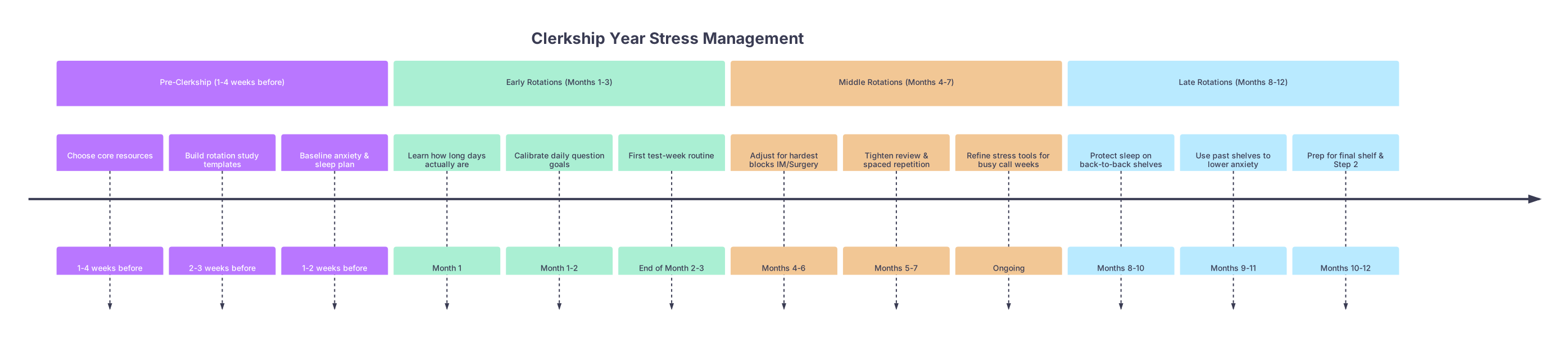
| Period | Event |
|---|---|
| Pre-Clerkship (1-4 weeks before) - Choose core resources | 1-4 weeks before |
| Pre-Clerkship (1-4 weeks before) - Build rotation study templates | 2-3 weeks before |
| Pre-Clerkship (1-4 weeks before) - Baseline anxiety & sleep plan | 1-2 weeks before |
| Early Rotations (Months 1-3) - Learn how long days actually are | Month 1 |
| Early Rotations (Months 1-3) - Calibrate daily question goals | Month 1-2 |
| Early Rotations (Months 1-3) - First test-week routine | End of Month 2-3 |
| Middle Rotations (Months 4-7) - Adjust for hardest blocks IM/Surgery | Months 4-6 |
| Middle Rotations (Months 4-7) - Tighten review & spaced repetition | Months 5-7 |
| Middle Rotations (Months 4-7) - Refine stress tools for busy call weeks | Ongoing |
| Late Rotations (Months 8-12) - Protect sleep on back-to-back shelves | Months 8-10 |
| Late Rotations (Months 8-12) - Use past shelves to lower anxiety | Months 9-11 |
| Late Rotations (Months 8-12) - Prep for final shelf & Step 2 | Months 10-12 |
At this scale, there are three non‑negotiables:
A fixed resource list (per rotation)
No flailing. For example:- Internal Medicine: UWorld IM, OnlineMedEd + one high‑yield book (Step‑Up / MKSAP for Students).
- Surgery: UWorld Surg + Pestana + OnlineMedEd.
- OB/Gyn: UWorld, Case Files, maybe OnlineMedEd.
- Peds, Psych, FM: same pattern.
A question‑first strategy
Content review follows your practice questions, not the other way around.A planned anxiety protocol
What you do when:- you are behind
- you fail a shelf
- your attending destroys your confidence
- your call schedule crushes your study plan
We are going to wire those three into your calendar.
1–4 Weeks Before Clerkships Start: Build the Anti‑Panic Framework
At this point you should stop pretending you will “figure it out during rotations.” You will not. You will be exhausted and reactive.
Week −4 to −3: Resource Lock‑In
At this point you should:
- Decide your primary question bank (usually UWorld) and commit to it for all shelves.
- Choose one main text per rotation. Not three. Not “I will see once I start.”
- Set up Anki or another spaced repetition system with:
- A dedicated “Clerkship Year” profile.
- Tags by rotation (IM, Surg, Peds, etc.).
Make a simple table for yourself like this:
| Rotation | Qbank | Primary Book | Video Resource |
|---|---|---|---|
| Internal Med | UWorld IM | Step-Up to Medicine | OnlineMedEd |
| Surgery | UWorld Surg | Pestana | OnlineMedEd |
| OB/Gyn | UWorld OB | Case Files OB/Gyn | OnlineMedEd |
| Pediatrics | UWorld Peds | BRS Peds or Case Files | OnlineMedEd |
| Psychiatry | UWorld Psych | First Aid Psych or Case Files | OnlineMedEd |
If you are still “comparing options” at this point, you are procrastinating.
Week −3 to −2: Rotation Templates
At this point you should build reusable templates:
Daily Study Template (on a normal ward day)
- 20–30 questions on weekdays (40–60 on lighter rotations).
- 1–2 short video topics while eating or commuting.
- 20–30 minutes of flashcards.
Weekly Plan Skeleton
- 5 days of questions.
- 1 day for catch‑up + review of missed questions.
- 1 lighter day (call / post‑call / true day off).
Test‑Week Template
- Qbank: focus on mixed, timed blocks.
- Content: almost no new material, heavy on review and high‑yield lists.
- Sleep: hard cutoff for studying.
You want these written down in a calendar or app you actually open daily. Not aspirational.
Week −2 to −1: Baseline Stress and Sleep Plan
This is where most people miss the mark. They talk about “self‑care” and then ignore it by week 3.
At this point you should:
- Set a sleep floor: e.g., minimum 6 hours except true call.
- Decide your non‑negotiable stress tools:
- One 5–10 minute breathing routine.
- One quick physical reset (walk around the block, stairs, push‑ups in the call room, whatever you actually do).
- One “I am spiraling” protocol (more on this later).
Month 1: First Rotation – Learning the Game, Not Beating It
You will be overwhelmed. That does not mean you are failing.
Week 1: Reality Check
At this point you should observe and collect data, not chase perfection.
- Track:
- Actual hours in the hospital.
- Commute time.
- Time you realistically have between leaving the hospital and sleep.
- Then shrink your daily study plan to fit reality:
- Many students can manage only:
- 10–20 questions
- 15–20 minutes of review
- 15 minutes of flashcards
- Many students can manage only:
Your goal in Week 1 is not “crush UWorld.” It is “prove I can study a little every day, even tired.”
Week 2: First Adjustment
Now you have data. At this point you should:
Set a realistic daily minimum:
- Heavy rotation? Minimum = 10–15 questions on weekdays, 30–40 on weekends.
- Lighter rotation? Minimum = 20 questions on weekdays, 40–60 on weekends.
Start a simple stress log:
- Rate anxiety 0–10 at the end of each day.
- Note triggers: being pimped, getting behind on questions, feedback from residents.
You are learning what makes you anxious, not just that you are anxious.
Week 3–4: First Test‑Week Simulation
Even if your shelf is not yet, you do a mini test‑week.
At this point you should:
- Pick 1 day off and run:
- 2 blocks of 40 questions, timed.
- Minimal content review.
- Early bedtime.
Notice:
- When your anxiety spikes (before the block? during? between blocks?).
- How your sleep changes if you push late.
This first month is your “pilot study” on yourself. Use it.
Months 2–3: Early Rotations – Building a Stable System
You have one rotation under your belt. At this point you should stop treating every block like a brand‑new experiment.
Rotation Start (Day 1–3)
At the start of each new rotation you should:
Map the calendar:
- Shelf date.
- Call days / nights.
- Clinic vs ward weeks.
- Mandatory sessions (didactics, simulation, OSCE).
Back‑plan your Qbank:
- Total questions for that shelf / number of days until 5–7 days before exam.
- That is your daily target. Example:
- 600 UWorld questions
- 28 days until shelf − 5 days (test‑week) = 23 days
- 600 / 23 ≈ 26 questions per day
- Round to 25–30 on weekdays, more on weekends.
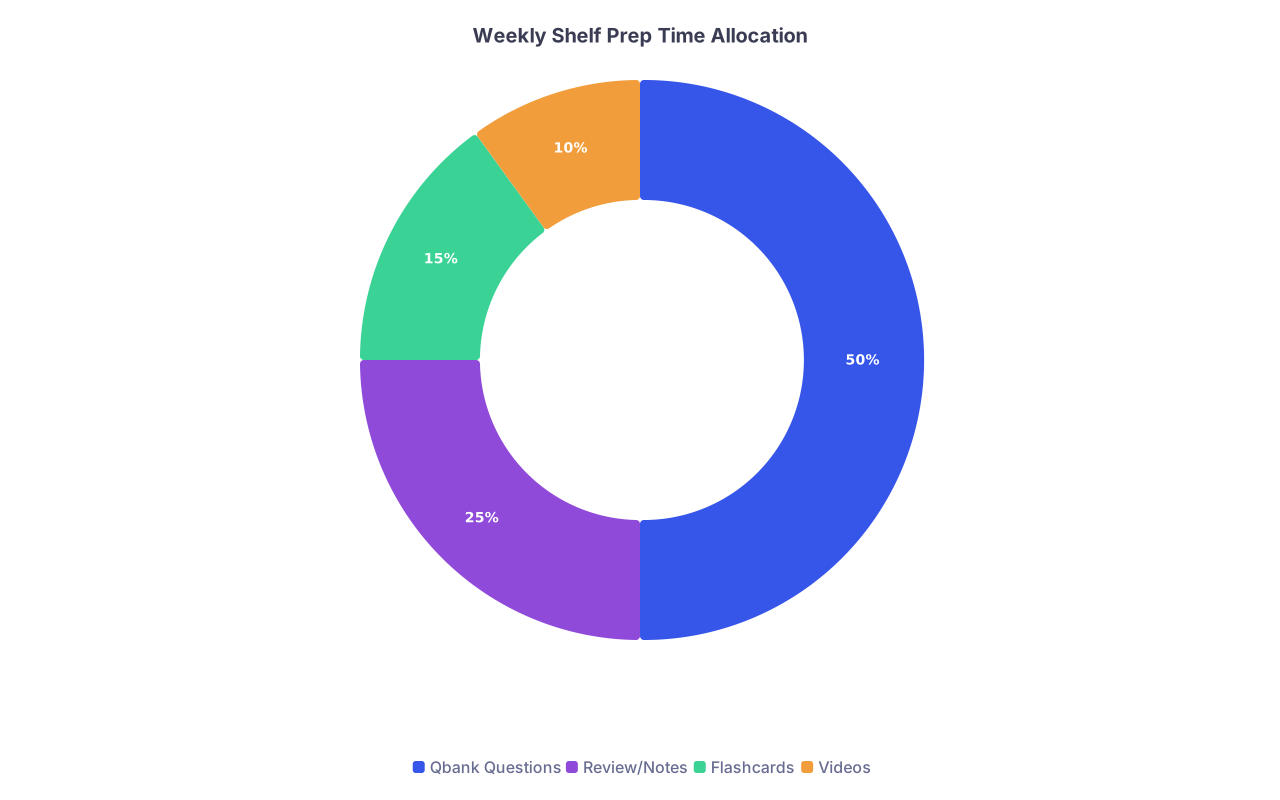
| Category | Value |
|---|---|
| Qbank Questions | 50 |
| Review/Notes | 25 |
| Flashcards | 15 |
| Videos | 10 |
- Pick a single “panic phrase” you recognize in yourself:
- “I am so behind.”
- “I am going to fail this shelf.”
- “Everyone else knows more than I do.”
Whenever you catch that phrase, that is your trigger for the anxiety protocol:
- 2–3 minutes of slow breathing (4–6 breaths per minute).
- Write down: “What is the next specific action?” (e.g., finish 5 questions, review 10 missed flashcards).
- Do that one action. Not your whole plan. Just the next brick.
Mid‑Rotation (Week 3–4 of the Year)
By now you should have:
- A consistent daily question habit.
- Clear knowledge of your worst stress days (e.g., post‑call, trauma days, OR days, long clinic).
At this point you should:
Design “bare minimum days”:
- On those high‑stress days:
- Only 5–10 questions.
- Zero guilt for not hitting your usual target.
- You are protecting the habit, not the number.
- On those high‑stress days:
Start weekly 10‑minute debriefs (solo or with a classmate):
- What pushed anxiety above 7/10 this week?
- What actually helped lower it?
- What will you change for next week?
This is how you stop repeating the same stress pattern for 12 months.
Months 4–7: The Middle – Hard Rotations, Real Fatigue
This is usually Internal Medicine and Surgery for many schools. Shelf stress peaks here. Because these shelves are weighted heavily and the rotations are long and busy.
Start of a Hard Rotation (e.g., IM or Surgery)
At this point you should front‑load structure because your energy later in the block will be worse.
Shrink your resource list even more:
- Qbank + 1 book + 1 quick reference (Pestana, small outlines).
- Everything else is “if time,” which there will not be.
Double‑protect your sleep:
- Decide your maximum study end time (for example, 10:30pm).
- Even if you are “behind,” you stop at that time. Chronic sleep debt explodes anxiety more than being 50 questions behind.
Pre‑negotiate with yourself what happens when you fall behind:
- If you are:
- 50 questions behind: add 10 per weekend day for the next 2–3 weeks.
- 100+ behind: accept you will not finish the entire bank. Prioritize:
- Mixed blocks.
- Highest‑yield topics (CHF, COPD, chest pain, abdominal pain, infections, etc. for IM; pre‑op/post‑op care, trauma, acute abdomen for surgery).
- If you are:
I have seen students panic at −150 questions and then waste three days staring at their dashboard. Do not do this. Cut scope; protect momentum.
Mid‑Rotation Stress Peak (Usually Week 3–4)
You are tired, you have been wrong in front of attendings, and your questions feel harder.
At this point you should prevent the anxiety tailspin:
Do a half‑length practice exam:
- NBME or a 2–3 block UWorld self‑assessment.
- Timed, in one sitting.
Then write down (actually write, not “think about”):
- 3 things you did well (time management, certain topics solid, staying focused).
- 3 specific weak areas (e.g., reading EKGs, OB triage, psych meds).
Your next 7–10 days of studying should be built around those weak areas. Not vague “review everything.”
You are not guessing where you are weak; you are using data.
Managing Call and Night Float
Call destroys routines. You will not fight that with willpower.
At this point you should structure around it:
Night before call:
- Do a bigger question block.
- Prepare flashcards/download offline content for gaps in the night if your hospital allows.
Call day:
- Academic goal = zero. Shelf anxiety will yell at you; ignore it.
Post‑call day:
- Micro‑goal: 5–10 questions.
- If your brain is mush, that is still a win because the habit stayed intact.
You always plan shelf work around call, not through it.
Months 8–10: Late Rotations – Confidence vs Burnout
Now you have several shelves behind you. You might be feeling one of two things:
- “I passed all of them; I am fine” → you risk under‑preparing and getting blindsided.
- “I underperformed early, I am behind” → you risk chronic anxiety and over‑studying.
At this point you should intentionally use your past shelves to shape your stress.
Review Your Shelf Track Record
Take one evening and:
- List each rotation, your shelf outcome, and your emotional state:
- Medicine – 78, felt borderline, lots of test‑day anxiety.
- Surgery – 82, felt okay, pacing was good.
- Peds – 70, felt rushed and under‑reviewed vaccine schedules.
You are looking for patterns:
- Do you always crash on outpatient topics?
- Do you miss management questions more than diagnosis questions?
- Does anxiety spike the night before or the morning of the exam?
Use that to modify your final rotations:
If test‑day anxiety is always high:
- Run at least two full timed practice days prior to each remaining shelf.
If outpatient topics are weak:
- Dedicate one weekly session to purely ambulatory material.
Back‑to‑Back Shelves
Some schools do this. Evil but common.
At this point you should protect transitions:
2–3 days after Shelf A:
- Light review for Shelf B.
- No more than 20–30 questions per day.
- Prioritize sleep and reset.
It is tempting to jump to 60+ questions/day immediately. That looks “hard‑working” and feels terrible. Your exam performance will not thank you.
Final Months (10–12): Integrating Shelf Stress with Step 2 Prep
Late in the year, shelf anxiety blends with Step 2 anxiety. The trick is not to run two separate panic programs.
At this point you should:
- Think of each remaining shelf as:
- Content for that rotation.
- A Step 2 dress rehearsal: timing, stamina, stress control.
4–6 Weeks Before Your Last Shelf
You probably know your weak systems by now.
At this point you should:
Start mixing more “Step‑style” blocks:
- Multi‑system questions (mixed IM, surgery, OB, etc.).
- Maintain rotation‑specific studying but layer broader review on top.
Tighten your pre‑exam routine into a checklist you repeat for every major test:
- 1–2 short review sessions (no marathons).
- Review formula lists / algorithms / must‑know numbers for that shelf.
- Confirm logistics: exam time, location, transport, food.
- Fixed bedtime.
Morning of:
- Light review only (flashcards you know well).
- 2–3 minutes breathing before starting the exam.
- One sentence intention: “My job is to do my best on the question in front of me, not predict my score.”
You want test day to feel familiar, not special.
Test‑Week and Test‑Day: Micro‑Timeline
Let me zoom in here, because this is where anxiety is loudest.
5–7 Days Before Shelf
At this point you should:
- Switch to mostly mixed, timed blocks.
- Cut new resources completely. No new books. No new video series.
- Identify 3–5 must‑know topics for that shelf and hit them daily:
- Example for OB: hypertensive disorders, fetal heart tracings, labor management, postop infections, contraception.
2–3 Days Before Shelf
At this point you should:
- Do one last moderate timed block (40–80 questions).
- Then pivot to:
- Reviewing incorrects.
- Flashcards only for high‑yield.
You are not trying to raise your score dramatically here. You are stabilizing it.
Evening Before Shelf
Non‑negotiable rules:
- No multi‑hour cramming past your set bedtime.
- No new full question blocks.
- Pre‑pack what you need: ID, food, water, earplugs, jacket, etc.
Anxiety will tell you, “Everyone else is studying harder tonight.” Ignore it.
Test Morning
At this point you should:
- Do your breathing routine before you enter the room (standing in the hallway or even bathroom stall if you must).
- Pick one question‑by‑question mantra:
- “What is the most likely next step?”
- “Do not overthink; pick the safest answer.”
- Push back from the screen.
- Take three slow breaths.
- Consciously reset: “New question, fresh start.”
This is not soft, feel‑good advice. This is exactly what students who perform consistently well do without bragging about it.
What To Do When Things Go Wrong
Something will go wrong. A bad shelf. A failed one. A rotation from hell.
At that point you should have a damage‑control script ready, not improvise through tears.
First 24 hours after a bad result:
- No big decisions. No rewriting your entire year plan.
- Tell one trusted person (classmate, mentor, partner). Silence amplifies shame.
After 24–48 hours:
Get actual data:
- How far were you from passing / target?
- Which content areas were weak (most NBME score reports give you this)?
Decide:
- Is this a content issue (did not finish Qbank, misunderstood key topics)?
- A test skills issue (timing, anxiety, careless mistakes)?
- A schedule issue (call wiped out 40% of planned study)?
Next rotation start:
- Make one major change only:
- Example: If timing killed you, do all question blocks timed, from week 1.
- If you never reviewed incorrects, schedule 3 short “review blocks” per week.
- Make one major change only:
Scattershot change is pointless. Targeted change works.
Final Summary: What Actually Lowers Shelf Stress
You manage clerkship shelf anxiety by calendar, not by willpower.
Two things matter most:
Front‑loaded structure
Before and at the start of each rotation, you lock in:- Which resources you are using.
- How many questions you are doing daily.
- What your bare minimum days look like.
- How you protect sleep around call and test week.
Pre‑planned anxiety tools
You decide ahead of time:- Your breathing routine and “I am spiraling” protocol.
- What you do when you fall behind (reduce scope, do not just push later).
- A repeatable pre‑exam week and test‑day routine.
Follow that month‑by‑month, and shelf exams become stressful but predictable. Which is about as good as clerkship year ever gets.