
It’s 10:47 p.m. the night before your first big medical school exam.
Your anatomy notes are a mess of highlights. Your group chat is blowing up with people casually tossing around phrases like “I skimmed First Aid just in case” and “I think I’m good.” Your heart is pounding. You’re reading the same sentence five times and absorbing none of it.
And in the back of your mind there’s this extra, heavy thought:
“If I blow this, I’m not just failing myself. I’m proving everyone right who thought I didn’t belong here.”
That’s test anxiety as a first-gen med student. It’s not just nerves. It’s the fear that one exam will expose you as an impostor in a place where it feels like everyone else has a family manual for this world that you never got.
Let’s deal with that. Directly. Because this is fixable.
What You’re Actually Up Against (It’s Not Just “Stress”)
You’re not just anxious because exams are hard. You’re anxious because:
- You’re carrying family expectations, financial risk, and survivor’s guilt.
- You don’t have a mental archive of “I survived hard exams before” stories from your parents or siblings.
- You’ve probably been the “first” or “only” in a lot of academic spaces already. You’re used to walking into rooms that weren’t built with you in mind.
So when an exam comes, your brain doesn’t go, “Ok, time to recall physiology.”
It goes, “If you fail, you prove you don’t belong. If you fail, the whole thing collapses.”
That flips your nervous system into full fight-or-flight. Palms sweating, heart racing, tunnel vision. Not exactly the ideal conditions for recalling the coagulation cascade.
Let me walk through what to do. Before, during, and after exams. Not theory. Tactics.
Step 1: Before the Exam – Build a System That Chokes Anxiety Out
Test anxiety gets loud when two things are true:
- You don’t trust your prep.
- You’ve tied your entire worth to the score.
We’re going to hit both.
Create a “Good Enough” Study Plan (Not a Fantasy One)
Perfectionist plans spike anxiety. The, “I’ll do 300 Anki, 80 questions, and review lectures every day” nonsense. You miss that for one day, and now you’re “behind” and panicking.
Build a good enough plan you can actually execute on in real life.

| Step | Description |
|---|---|
| Step 1 | Set weekly goals |
| Step 2 | Daily question blocks |
| Step 3 | Targeted review |
| Step 4 | Anki/flashcards |
| Step 5 | Short reflection |
Here’s a sane baseline for a heavy block (e.g., cardio, renal):
- 20–40 practice questions per day (NBME style if possible).
- 1–2 focused review blocks of 60–90 minutes each.
- Anki or flashcard session, but with a cap. Example: max 45–60 minutes, not “until I finish all 600 reviews.”
The rule: If you do this consistently, you get to call yourself “prepared enough.” Anxiety doesn’t get to argue.
Use something simple like:
| Time Block | Task |
|---|---|
| 8:00–9:30 | New content or lecture review |
| 10:00–11:00 | 20–25 practice questions |
| 11:00–11:30 | Review explanations |
| 1:00–2:30 | Systems-based deep dive |
| 4:00–4:45 | Anki/flashcards (capped) |
You adjust specifics, but the structure matters. Questions + review + capped memorization. Not just passive reading.
Build a Pre-Exam “Proof File”
First-gen students often feel like every exam is a verdict on whether they’re a fraud. That’s upstream of anxiety.
You need receipts your brain can’t easily dismiss.
Start a simple running document or note called “Evidence I Can Do This.”
Put in:
- Screenshots of decent question bank performance (even if it’s just 55–65%).
- Passing quiz grades.
- Positive feedback from attendings, TAs, peers.
- Any time you pulled up a grade after struggling.
You read this the night before and the morning of an exam. That sounds corny. It works anyway. Your anxiety is running a story; you need to run the counter-story.
Step 2: The 24 Hours Before – How Not to Wreck Yourself
The day before an exam can destroy you if you let panic take over.
Tighten the Day, Don’t Marathon It
When you’re first-gen, you may feel like you have to outwork everyone just to be average. Dangerous mindset the day before an exam.
Use this structure instead:
Morning:
- 10–20 low-stakes practice questions (not a big block; you’re just staying warm).
- Quick review of your highest-yield weak areas (1–2 topics).
Afternoon:
- Light pass through summary sheets, diagrams, or concept maps.
- Close the books 10–12 hours before the exam. No new content.
Evening:
- Skim your “Proof File” note.
- Pack what you need: ID, snacks, water, layers, earplugs if allowed.
This isn’t you being lazy. This is you trading “I pushed until midnight” for “My brain actually works tomorrow.”
Lock Down the Triggers: Group Chats, Grade Talk, Flexing
There is always that person at 9 p.m.:
“I just redid UWorld for the entire block and took two full-lengths, feeling pretty good.”
Mute. Them. Now.
If a group chat is raising your heart rate, you either mute it for 24–48 hours or leave. You’re not missing anything essential at that point. You’re just marinating in other people’s anxiety and insecurity disguised as over-preparedness.
Also:
No more talking about what you “need to get” on the exam. That is gasoline on test anxiety. Your only job is to show up with the best functioning brain possible. Obsessing over cutoffs will do the opposite.
Step 3: The 60 Minutes Before – Controlling Your Physiology
You know that feeling walking into the exam building. Tight chest. Shaky hands. That’s not a character flaw; that’s a nervous system in threat mode.
We calm it on purpose.
A Simple Pre-Exam Ritual
Do this consistently so your body starts to associate it with “we’re safe enough to perform.”
Arrive 20–30 minutes early. Not an hour. Too much dead time fuels spirals.
Walk for 5 minutes. Literally walk around the building or hallway at a slow, deliberate pace. Feel your feet hitting the ground.
3 rounds of physiological sighs (Google it later, but here’s the quick version):
- Inhale through your nose.
- Take a second, sharper inhale on top of it.
- Long, slow exhale through your mouth.
- Repeat 3–5 times.
Repeat a script that isn’t garbage. Not “I’m going to fail” or “I must crush this.” Something like:
- “I have done enough to take this exam today.”
- “My job is to think one question at a time.”
- “My worth is not on this test.”
You may roll your eyes the first time. Fine. Do it anyway.
Step 4: During the Exam – Handling the Panic Spikes
This is where most people fall apart. They know content. Their anxiety hijacks the execution.
When You Open the Exam and Your Brain Blanks
Happens all the time. You read the first question and your mind is static.
Here’s the move:
- Acknowledge it: “Ok, my brain is in freak-out mode. That’s happening.”
- Take one slow breath.
- Go to question 2 or 3. Don’t force yourself to start with the one that just scared you. Your brain just needs a win or two to get going.
You are not obligated to answer in order. You’re obligated to build momentum.
The “Micro Reset” Technique
Any time you feel that “oh no I’m failing” wave mid-exam:
- Take your hand off the mouse/keyboard.
- Put both feet flat on the floor.
- Take one full, deep breath.
- Tell yourself: “Next question only.”
You will “waste” maybe 10 seconds. That 10 seconds is cheaper than missing 4 questions in a row because you mentally left the room.
Trick for Question Stems That Look Impossible
Your anxiety loves to tell you: “Everyone else knows this; I’m the only one who doesn’t.”
Reality: often, half the room is also staring blankly.
When you see a monster stem:
- Scroll directly to the last line: “What is the most likely X?”
- Identify what they’re actually testing (diagnosis? mechanism? side effect?).
- Then go back up and pull only the data relevant to that category.
This turns an overwhelming wall of text into a targeted search. It also reminds you that this is a pattern-recognition game, not a moral judgment on your intelligence.
Step 5: After the Exam – Stop Feeding the Anxiety Cycle
Your brain will want to do a full post-mortem. Question-by-question debrief in your mind. You already know this makes you sick to your stomach and ruins the next 24 hours.
Hard Rule: No Post-Exam Group Autopsy
You walk out. Everyone starts:
“What did you put for the hyperkalemia question?”
“Wait, you got C? Oh no, I think I messed that up.”
Step away. Literally.
You can say: “I don’t go over answers right after, I’ll see what the score says when it drops.” Then walk.
Going line by line through what you maybe missed doesn’t change the result. It just keeps your nervous system in crisis mode long after the threat is over.
Short, Deliberate Decompress
Do something short and specific to mark the exam as “done”:
- 20–30 minutes walk without your phone.
- One episode of a show you like.
- A call with someone who doesn’t ask about grades.
Then, the next day (not the same afternoon), you evaluate:
- Did your study plan work?
- Did anxiety kill your performance?
- What’s one thing you’ll do differently next block?
Calm post-game review. Not emotional self-destruction.
First-Gen Specific Landmines (And How to Defuse Them)
“If I Fail, I Let My Family Down”
This one is brutal, and it’s common.
When that voice kicks in, respond logically and directly:
- Your family did not fight for you to get here so you could be perfect.
- They fought for you to have a shot at this career, which includes learning, struggling, and sometimes screwing up.
- One score is not the referendum on their sacrifice. The way you persist is.
If you want something more concrete, write a short note to yourself in their voice. What they’d actually say if you failed something. Often it’s a lot kinder than what you’re saying to yourself.
“I Can’t Ask for Help, I Don’t Want to Look Weak”
I’ve watched first-gen students quietly drown while everyone else is openly using resources: tutoring, disability services, counseling, group review sessions.
The truth:
Your classmates with physician parents? Many of them have been getting help and structured guidance for years. You’re not “cheating” by getting formal support. You’re catching up.
Here are real, valid resources you should be using without apology:
| Resource Type | What It’s For |
|---|---|
| Learning specialist | Study plans, test-taking strategies |
| Counseling services | Anxiety, impostor syndrome, burnout |
| Disability services | Extended time, quiet rooms, breaks |
| Peer tutoring/TA hours | Content review, practice questions |
You do not announce this to your whole class. You quietly build an infrastructure around yourself.
How to Shrink Anxiety Over Time (Not Just Survive Each Exam)
You’re not trying to white-knuckle your way through four years. You want anxiety to lose its grip on you exam after exam.
Track Data, Not Feelings
Your anxiety says: “You always bomb big exams.”
Reality might be: you’ve never actually failed one.
Make a simple log:
- Course/block
- Study plan used
- How anxious you felt 0–10
- Grade or percentile
- What helped vs. what tanked you
After a few blocks, show your brain:
“When my anxiety is at 8, I usually still pass or even do fine. The feeling is not the outcome.”
Build an Identity That Isn’t “The One Who Has to Prove Herself”
This one is more subtle, but it’s huge.
If your whole identity is: “I’m the first, I must be exceptional to justify being here,” then every exam is life-or-death.
Shift it slightly:
- “I am the first in my family doing this… and I’m allowed to be a learner here.”
- “I’m not the admissions committee’s mistake. They saw something in me I’m still growing into.”
Cheesy? Maybe. Effective? Yes.
Visual: Anxiety vs. Performance Reality
A lot of first-gen students dramatically overestimate how “at-risk” they are, even when their actual grades are fine. Here’s what this disconnect often looks like:
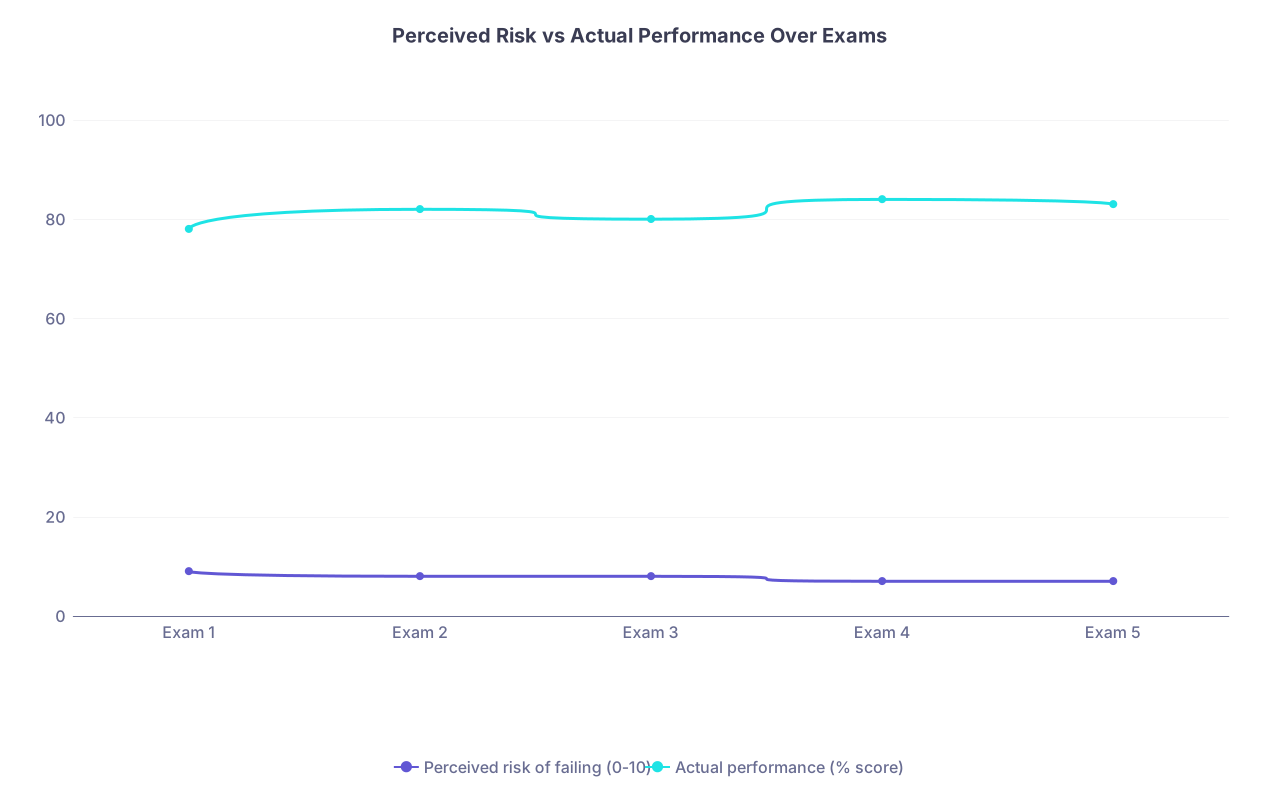
| Category | Perceived risk of failing (0-10) | Actual performance (% score) |
|---|---|---|
| Exam 1 | 9 | 78 |
| Exam 2 | 8 | 82 |
| Exam 3 | 8 | 80 |
| Exam 4 | 7 | 84 |
| Exam 5 | 7 | 83 |
Your internal alarm system is often maxed out even as your performance stays stable or improves. The goal of everything above is to bring those lines closer together — not by tanking your scores, but by taming your alarm.
What to Do If Anxiety Is Already Out of Control
If test anxiety is:
- Making you physically sick before every exam
- Causing panic attacks
- Destroying your sleep for days
- Leading you to freeze so badly you run out of time regularly
Then this is no longer a “just push through it” situation. You need professional support.
Concrete next moves:
Email your school’s counseling center. Say directly:
“I’m a medical student struggling with significant test anxiety that’s affecting my performance. I’d like to meet with someone who has experience with performance/test anxiety.”Reach out to a learning specialist if your school has one. Ask for:
“Help with test-taking strategy and performance under anxiety.”Consider disability services if your anxiety is severe and chronic. Accommodations like extra time or reduced-distraction environments are legitimate tools, not loopholes. If your brain needs a little more space to not short-circuit, use the system that exists for that.
You’re Not Behind; You’re Carrying More
First-gen med students often think: “Everyone else is ahead, I’m behind.”
Different truth:
You’re doing med school while also being your own cultural translator, financial planner, emotional support for home, and often the bridge between two worlds. That weight? It shows up strongest around exams.
You’re not fragile. You’re overloaded.
With the system and habits I laid out — realistic prep, pre-exam rituals, in-exam resets, post-exam boundaries, and real support — you can absolutely lower the volume of test anxiety. It may not disappear. But it will stop running the show.
You’ve gotten this far without a manual. Now you have one for this specific problem.
With these pieces in place, you’re not just surviving individual tests. You’re building a way of operating that will carry you into clerkships, Step exams, and boards with a brain that can actually show what you know. And as you stabilize this part of your life, you’ll free up energy for the next set of challenges — clinical performance, evaluations, and the first time you sign your name as “MD.” But that’s a situation for another day.