
You are in late September. ERAS is open. Programs are already downloading applications. Your WhatsApp groups are full of “II!!” (interview invite) screenshots.
You?
Maybe one observership. Maybe a short online externship. Maybe nothing. And now the panic is setting in:
- “Did I just destroy my match chances?”
- “Is it even worth submitting this year?”
- “What can I still do that will actually move the needle?”
You are not the first IMG here. You will not be the last. I have seen people match from this exact position. But they did not keep doing the same thing and hope. They treated it like a damage-control operation and moved aggressively.
This is your recovery playbook.
1. First, Get Clear: How Bad Is Your USCE Situation Really?
You need an honest assessment, not vibes.
Define “minimal USCE” in real terms
For IMGs, this is roughly how programs view US clinical experience:
| Program Type | USCE Expectation |
|---|---|
| Community IM / FM | 2–3 months preferred |
| Mid-tier university IM | 3+ months ideal |
| Competitive specialties | 3–6+ months common |
| Psych / Neuro | 2–3 months helpful |
You are “minimal USCE” if:
- You have 0–1 months of in-person USCE (observership, externship, sub-I, hands-on rotation).
- Or all your USCE is online / remote.
- Or your USCE is very old (more than 3–4 years ago) and nothing recent.
Quick situation triage
Answer these:
- Do you have any in-person USCE in the last 2 years?
- Do you have any US letters of recommendation from that experience?
- Is your Step 2 score / OET / ECFMG status strong and already done?
- Do you have any ongoing or upcoming USCE (even if unofficial)?
Based on that, you fall into one of three buckets:
- Red Zone – No in-person USCE and no US LORs
- Yellow Zone – Some USCE, weak / generic LORs, or too short
- Green-ish Zone – 2+ months USCE with at least 2 strong US LORs, but still feel behind
If you are Red or Yellow, this article is for you.
2. Decide: Push This Cycle vs. Quietly Pivot to Next
Let me be blunt: not everyone should go all‑in this cycle. The worst outcome is burning money and timing for a 0‑interview season when you had the option to regroup for a much stronger application next year.
Here is the decision framework I use with IMGs.
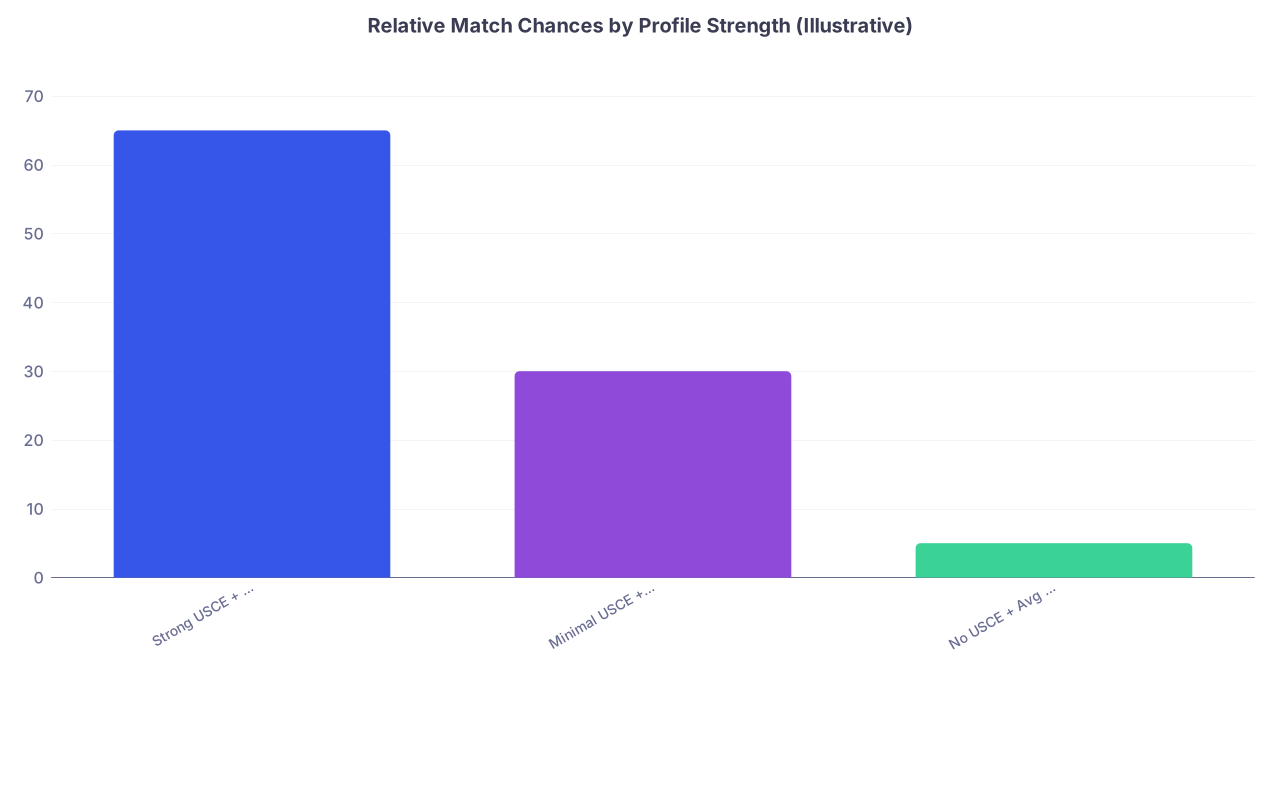
| Category | Value |
|---|---|
| Strong USCE + US LORs | 65 |
| Minimal USCE + Strong Scores | 30 |
| No USCE + Avg Scores | 5 |
Numbers are illustrative, but the pattern is real. Now, your call:
You should still push THIS cycle if:
- You already submitted or are locked into this cycle financially, and
- You have:
- Step 2 ≥ 240 (or equivalent for your cohort) or
- Major home-country clinical experience with leadership / teaching or
- Strong non-US LORs from well‑known institutions or academics
In this case, your goal: salvage and maximize. You will treat USCE as a live problem you are fixing in real time during application season.
You should strongly consider pivoting to NEXT cycle if:
- You have:
- Multiple attempts / low scores and
- No USCE and
- No US LORs
- And you have not yet applied to many programs (or can still cut back heavily).
In that scenario, the smartest move may be:
- Apply this year to very few, strategic programs (to learn the system),
- Work intensely for 6–12 months on:
- USCE
- targeted networking
- research or QI
- Then return next year with an actually competitive portfolio.
If you decide to pivot, skip to Section 6 and read it like it is your project plan.
If you are staying in this cycle, keep reading. You do not have time to feel bad.
3. Immediate Damage Control: What You Can Still Fix Now
You cannot manufacture 4 months of prior USCE in October. But you can change how your current weakness is perceived. Programs do not evaluate you only on what is missing. They evaluate how you explain the gaps and what you are doing about them.
3.1 Reframe minimal USCE in your application materials
Your personal statement and experiences should not scream “I could not get USCE.” They should say:
- “I have deep clinical experience in X context.”
- “I understand US healthcare expectations.”
- “I am already adapting my practice to US standards.”
Action steps:
Personal statement edit – 1 focused paragraph
- Do not write an apology letter.
- Do this instead:
- Briefly acknowledge training context (country, system).
- Highlight what you did to understand US medicine (CME, guidelines, tele-rotations, shadowing, conferences).
- Emphasize transferable skills: working in resource-limited settings, high volume, independent decision-making, strong documentation culture, etc.
- Example framing:
“While my clinical training has been primarily in India, I have focused on aligning my practice with US standards through continuous CME, guideline-based management, and structured tele-observerships with US faculty in internal medicine. These experiences have sharpened my understanding of documentation expectations, multidisciplinary communication, and patient safety priorities in US hospitals.”
CV / ERAS experiences – emphasize clinical depth
- Your home-country internship / residency is not “non-USCE junk.” If described well, it shows you are not a beginner.
- Make your bullets sound like US notes:
- “Managed 15–20 inpatients per day with common conditions such as decompensated heart failure, DKA, sepsis, and COPD exacerbations under attending supervision.”
- “Led daily interdisciplinary rounds with nursing and pharmacy on a 30-bed internal medicine unit.”
Program signaling via supplemental ERAS (where applicable)
- Use free-text sections to:
- Express specific interest in underappreciated programs (especially community ones).
- Mention that you are actively arranging USCE or already started some (see next).
- Use free-text sections to:
3.2 Start any credible US clinical proximity now
Even if interview season has started, if you are on a ward in the US, that changes the tone of your application and your interviews.
You will not magically create a formal 4-week university elective in November. Forget that fantasy. You are playing the practical game now:
Options that can start fast (2–4 weeks):
- Paid observerships with private IM/FM/psych practices
- Observerships set up through:
- community hospitals
- physician groups
- ethnic community networks (e.g., Indian / Pakistani / Egyptian medical associations in major cities)
- Scribe roles with a short onboarding period (ED, outpatient)
- Remote clinical “telescribing” with a US physician (less ideal, but better than nothing)
- Volunteer roles in clinics that allow chart exposure (e.g., free clinics, FQHC-affiliated programs)
Your script when emailing / calling:
- Keep it short.
- Show you are low-maintenance and high-gratitude.
- Include your timeline.
Something like:
Dear Dr. X,
I am an ECFMG-certified physician from [Country], currently applying to internal medicine residency. I will be in [City] from [date] and am seeking an observership opportunity for 2–4 weeks to deepen my understanding of US clinical workflows, EMR documentation, and interdisciplinary communication.
I have [brief highlight: Step score, years of IM practice, specific interest in their field]. I understand observerships are observational only and am happy to complete any necessary paperwork or compliance modules.
I would be grateful for any opportunity to observe your practice, even part-time. I have attached my CV for your reference.
Respectfully,
[Name]
You send 50–100 of these. Not 5. Not 10. 50–100. The response rate is low. That is normal.
3.3 Fix your LOR situation aggressively
If you have no US LORs, your priority during any USCE you secure is:
- Show up early.
- Be prepared.
- Make your interest in US training clear.
- Ask intelligently for feedback before asking for a letter.
Then, 2–3 weeks into working with someone:
“Dr. X, I am applying to [specialty] residency this cycle. Working with you has been very helpful in understanding US practice. If you feel you know my work well enough, would you be comfortable writing a letter of recommendation to support my application?”
Do not force it. If they hesitate, move on. One strong US LOR beats three generic “he observed in my clinic” letters.
If you cannot get US LORs at all this cycle, then:
- Optimize your non-US LORs:
- Get letters from people with titles: department chair, program director, senior consultant, research PI.
- Ask them to comment on:
- clinical judgment
- reliability
- communication
- ability to work in teams
- And explicitly ask them to comment on your potential to succeed in US training if they can.
4. Application Strategy When Your USCE is Weak
You cannot out-compete US grads and strong-portfolio IMGs by playing their game. You have to choose a game where your profile is not immediately disqualified.
4.1 Target the right programs – ruthlessly
You know this in theory. But most IMGs ignore their own filters and blast.
Here is how I would filter in your position:
DO NOT waste time on:
- Top 50 academic hospitals (unless you have absurd scores or strong research).
- Programs explicitly requiring “US clinical experience of 3–6 months.”
- Programs that have not taken IMGs in the last 3 years.
DO focus on:
- Community internal medicine and family medicine programs.
- Smaller university-affiliated community programs.
- Psych programs outside major metro hubs.
- Programs in less popular locations:
- Midwest, South, non-coastal states, less “brand-name” cities.
Use data:
- Check FREIDA.
- Look at program websites.
- Search “current residents”:
- How many IMGs?
- From which countries?
- How old are their graduation years?
If a program has multiple IMGs from your region, from older graduation years, with Step scores similar to yours, that is a high-yield target.
4.2 Play the numbers game realistically
You are not matching with 30 applications and minimal USCE. You probably need:
- 100–150+ programs in IM / FM if your scores are decent.
- Possibly more, depending on gap years, attempts, etc.
Yes, this costs money. Yes, it is ugly. But if you are already in for the cycle, under-applying is the most expensive way to fail.
5. Direct Outreach and Networking – The Only “USCE Substitute” That Sometimes Works
Let me be clear: Nothing truly replaces USCE. But human relationships can reduce how much programs care about the missing box.
You are not going to “network” your way into a top-tier program with no USCE. But you might get:
- A closer read of your application.
- An internal advocate.
- A late interview after cancellations.
5.1 PD / APD emailing – how to do it without being spammy
You send concise, personalized emails to:
- Program Directors (PDs)
- Associate Program Directors (APDs)
- Chiefs (sometimes)
Ideal timing:
- 1–2 weeks after application submission.
- Again, 1–2 weeks before interview season peak (late October / early November) if there is something new to update (USCE started, new LOR, new research, etc.).
Your email should do 4 things:
- Show specific knowledge of their program.
- Acknowledge your weakness without begging.
- Highlight 1–2 strengths that offset it.
- Express genuine interest.
Example skeleton:
Subject: IMG Applicant – [Your Name], ERAS ID [####] – Interest in [Program Name]
Dear Dr. [PD Last Name],
I recently applied to the [Program Name] internal medicine residency and wanted to briefly express my strong interest. I am an ECFMG-certified physician from [Country] with [X years] of clinical experience and a particular interest in [program’s strength – e.g., underserved care, hospitalist training, etc.].
I recognize that my formal US clinical exposure is limited. Over the past year I have focused on aligning my practice with US standards through [tele-observership / CME / guideline-based practice] and am currently starting an observership at [Hospital/Clinic] in [City] this [Month].
I would be grateful if you would consider my application. I believe my experience managing high-acuity patients in resource-limited settings and my commitment to [specific thing] would fit well with your program’s mission.
Respectfully,
[Full Name]
ERAS ID: [####]
You send this to a curated list of programs that:
- Take IMGs.
- Are in the tier you can realistically match at.
Do not send 200 identical emails. That just marks you as noise.
5.2 LinkedIn and hospital websites
Look up:
- Current residents from your country / region.
- Residents who graduated from your med school.
- Residents with similar paths (multiple attempts, old grad year, etc.).
Message them:
- “I saw you matched at [Program]; I am an IMG from [school/country] applying this year. Would you be willing to share any advice about how to make my application more aligned with what your program values?”
You are not asking them to “put in a word” right away. You are building a relationship. If the conversation goes well and they seem helpful, near the end you might say:
“If you feel comfortable, I would appreciate if you could let your PD know I applied, but I completely understand if that is not possible.”
Do not push. They are busy, and some programs have strict rules.
6. If You Decide to Pivot: 6–12 Month “USCE and Credibility” Plan
Let us say you accept that this cycle may not be your real shot. Good. That maturity already puts you ahead of the crowd who keep reapplying with the same CV like it is a lottery ticket.
Your mission: enter the next cycle with:
- 3+ months of meaningful USCE (at least some in-person).
- 2–3 strong US LORs.
- Ongoing or completed research/QI or teaching that shows you are embedded somewhere.
6.1 Build a USCE pipeline, not a one-off
Think in blocks:
- 1–2 months observership at a community hospital or clinic.
- 1–2 months externship / hands-on rotation if you can get it.
- 6–12 months part-time scribing or clinical assistant role.
- Volunteer positions in free clinics / community health centers.
You chain them:
- Start with whatever is easiest to obtain (private clinic observership).
- Use that experience and LOR to get a better rotation or hospital observership.
- Use those to apply for scribe / assistant / research positions.
This is how people “manufacture” a US narrative in one year.
6.2 Layer research or QI strategically
You do not need to be first author in NEJM. You need to show:
- You can work with US teams.
- You understand basic research ethics and IRB processes.
- You can finish projects.
Look for:
- QI projects in community hospitals (reduce readmissions, antibiotic stewardship, diabetes control).
- Case reports / series with US attendings.
- Simple retrospective chart reviews.
Ask supervisors during USCE:
“Are there any ongoing QI or small research projects that I could help with? I am very comfortable with literature review and basic data collection.”
This can yield:
- Abstracts.
- Posters.
- Small publications.
- And, more importantly, another reason for LOR writers to say you are proactive and reliable.
6.3 Treat your future LOR writers as long-term relationships
Do not rotate and disappear. Keep in touch:
- Send an email update every 2–3 months:
- “I have started a new observership at X.”
- “I am preparing for next year’s match and wanted to share my plan.”
- Ask for guidance:
- “If you have any suggestions about programs that might be a good fit for my profile, I would appreciate your input.”
When it comes time for letters next cycle:
- Provide them with:
- Your updated CV.
- A short “brag sheet” of what you did with them (cases, projects, teaching, etc.).
- Your personal statement draft.
Make it easy for them to remember you and write a specific letter.
7. Interview Season: How to Talk About Your Minimal USCE Without Sinking Yourself
Let us assume you fix enough of this to land some interviews. You must be ready for the inevitable questions:
- “Do you have any US clinical experience?”
- “How do you think you will adapt to the US system?”
- “Why so little USCE compared with other IMGs?”
7.1 Wrong answers that I have seen kill interviews
- “I could not find any rotations.”
- “My visa was delayed.”
- “It was difficult financially.”
- “I did online observerships only.”
These might be true. But presented like that, they sound like excuses. Programs hear: “I had obstacles and did not overcome them.”
7.2 Better framework: constraint → action → learning
You acknowledge reality, then show you compensated like a grown professional.
Example:
“I had limited access to formal US clinical electives due to [constraint – graduation timing / visa / financial limits]. Because of that, I focused on maximizing my training where I was, including high-volume inpatient care, teaching responsibilities, and continual CME based on US guidelines.
Over the past year I have also actively sought exposure to US practice through [observership at X / tele-rotation / conferences], which helped me understand documentation standards, team communication, and the expectations for residents. I am very aware there will be a learning curve with EMR and institutional protocols, but I am used to adapting quickly. During my internship I transitioned between three hospitals with different systems and was consistently one of the fastest to meet documentation benchmarks.”
You are telling them:
- Yes, there was a gap.
- I did not sit and complain.
- I built skills that partially bridge the gap.
- When I get here, I will adapt fast.
That is a hireable attitude.
8. Mental Game: How To Not Lose Your Head This Season
Match season with a weak application is psychologically brutal. You will:
- Watch classmates with better USCE and worse scores get 10+ interviews.
- See people on forums counting their “15th invite.”
- Stare at an empty inbox.
You need a protocol, otherwise you spiral and your performance on the rare opportunities you do get will suffer.
Here is the protocol I recommend:
Limit comparison time
- 10–15 minutes per day max on forums / WhatsApp “II” groups.
- Then close it. You already know the landscape.
Daily 3-block system
- Block 1: Applications / outreach (emails, calls, searching programs, networking).
- Block 2: Clinical / academic sharpening (reading guidelines, practice questions, working on cases, research).
- Block 3: Physical reset (walk, gym, anything that gets you out of the chair).
Prepare for success, not just for failure
- Keep an interview notebook ready:
- “Why this program?”
- “Tell me about yourself.”
- “Weaknesses” answer.
- Practice answers before you get invites. People waste early interviews because they are unprepared emotionally and technically.
- Keep an interview notebook ready:
9. Quick Reality Check: What “Success” Looks Like from Here
You want certainty. You will not get it. But you can define realistic wins.
Depending on where you start:
This cycle success:
- You get 3–6 interviews at community or mid-tier programs.
- You rank 8–12 programs.
- You match in IM/FM/psych in a solid but not famous hospital.
If you miss this cycle but play it right:
- You end this year with:
- 3–6 months USCE.
- 2–3 strong US LORs.
- One or two small research/QI items.
- Next cycle, you are a fundamentally different candidate.
- You end this year with:
The most common mistake?
Repeating the same application with a couple of cosmetic changes and hoping for “better luck.”
Do not do that.
FAQ (Exactly 3)
1. Is it even worth applying this year if I have zero USCE?
It can be, but only if you treat this year as both a trial and the start of your improvement plan. If you have strong scores and solid home-country clinical experience, applying to a limited, targeted list of IMG-friendly community programs can teach you the system and might still yield an interview or two. But if you have weak scores, no USCE, and no realistic way to secure any US exposure in the coming months, you are usually better off investing that money and energy into building a strong USCE foundation for the next cycle.
2. Do online observerships or tele-rotations count as USCE?
They are better than nothing, but they are not equal to in-person USCE in most program directors’ eyes. Online observerships can help you understand US guidelines, documentation concepts, and basic EMR workflows. They can also sometimes yield a letter of recommendation. But they do not show that you can function within a US care team physically on the ward. Use them as a supplement, not a substitute, and emphasize what you actually learned and produced (case presentations, QI ideas, literature reviews).
3. How many months of USCE do I really need as an IMG?
For internal medicine and family medicine, 2–3 months of solid USCE with good LORs is often enough to be taken seriously by many community and mid-tier programs. More helps, but quality and recency matter more than raw duration. For more competitive fields (like categorical surgery, dermatology, or certain subspecialties), 3–6+ months, plus research, is common among successful IMGs. If you are far below these ranges, then your short-term focus should be on stacking real, recent USCE and securing strong US-based letters before you burn multiple match cycles.
Key takeaways:
- With minimal USCE, you survive this cycle by being brutally strategic: targeted programs, honest framing, and aggressive outreach.
- You win future cycles by treating USCE and US LORs as a structured, 6–12 month project, not a last-minute patch.
- Stop thinking in “luck” terms. Start acting like someone running a high-stakes, multi-year professional plan. That is how IMGs in your exact situation end up matching.