
You’re not crazy for worrying that one USCE decision might have screwed everything up.
Let me say the blunt version first: picking a “non-ideal” USCE site will not destroy your residency chances. But. How you use (and explain) that experience absolutely can hurt or help you.
So yeah, it matters. Just not in the doomsday way your brain is probably spinning it.
Let’s unpack this like someone who’s also lying awake at 2 a.m. replaying every decision in their head.
What Program Directors Actually Care About (vs What You’re Imagining)
Here’s the fear running in the background:
“I picked the wrong externship/observership. It’s community, not academic. It’s non-teaching. It’s paid. It’s not famous. PDs will think I’m weak, desperate, or scammed. My application is ruined.”
That’s the script, right?
Now here’s the much less dramatic reality. When program directors look at your USCE, they’re not obsessing over the name of the clinic the way you are. They’re asking three basic questions:
- Did you show you can function in the U.S. healthcare system?
- Did someone who knows U.S. residency standards vouch for your clinical ability and behavior?
- Does your experience make you look like an actual future intern, not a tourist in a white coat?
If your “wrong” USCE checks those boxes—even partially—it’s not a death sentence. Seriously.
Where it can sting is when:
- The experience is clearly low quality, and
- You have no strong letters from it, and
- You don’t have anything else that shows you can handle U.S. clinical work.
So it’s not “You chose the wrong site → auto-reject.”
It’s more “You chose a weaker site → you now need to compensate in other areas.”
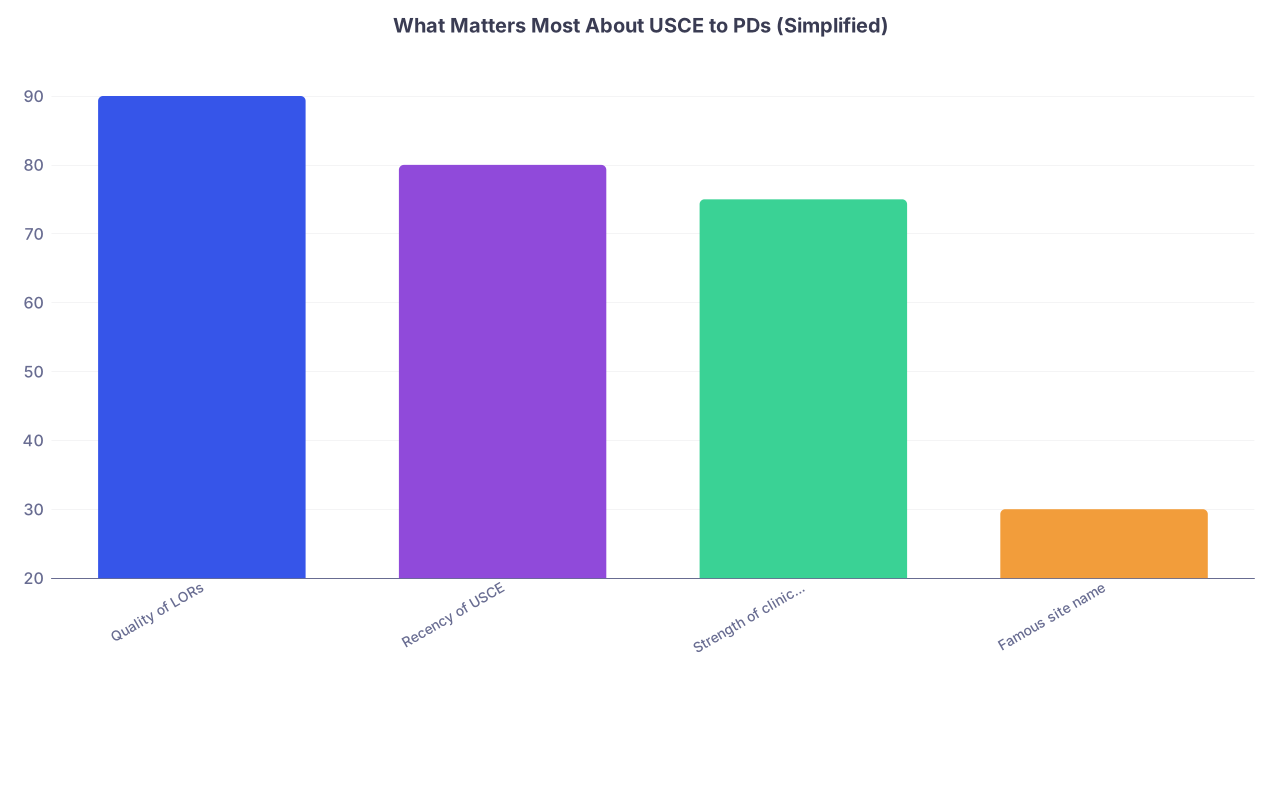
| Category | Value |
|---|---|
| Quality of LORs | 90 |
| Recency of USCE | 80 |
| Strength of clinical role | 75 |
| Famous site name | 30 |
If you’re panicking about the name on the letterhead more than the quality of the letter itself, you’re worrying about the wrong variable.
Signs Your USCE Site Was “Less Than Ideal” (And What That Actually Means)
Let’s be honest: not all USCE is created equal. Some places are basically glorified shadowing mills that know IMGs are desperate and will pay.
You probably already know if something felt off. Things like:
- You weren’t allowed to touch patients, write notes, or present.
- There was no structured teaching, just following random doctors around.
- Attendings barely knew your name, let alone your strengths.
- The program promised “great LORs” before you even started (giant red flag).
- The site isn’t affiliated with any residency or teaching program.
If you’re staring at that list saying “uhhh… that’s my rotation,” I get why you’re worried.
But here’s the twist: program directors have seen this before. You are absolutely not the first IMG who picked a weak externship because:
- You didn’t know better,
- It was all you could afford/find/secure in time,
- Visa and timing issues cornered you.
They’re not sitting there thinking, “Wow, what an idiot, why did they choose this clinic?”
They’re thinking, “Okay, this person did some USCE. Do I see evidence that they actually learned something and can function here? And do I trust the person who wrote their letter?”
That’s it.
Can a Bad USCE Site Actually Hurt You?
Yes—but usually not in the dramatic, cinematic way your brain is imagining.
Here’s when it really can hurt:
Garbage letters of recommendation
The worst damage is a weak, generic, or backhanded LOR from your USCE site.
Stuff like:- “Rotated with us for 4 weeks and was punctual.”
- “Completed observership satisfactorily.”
- No specific examples, no clear endorsement.
That kind of letter is almost worse than no letter. It signals: “I don’t really know this person, and I’m not motivated to advocate for them.”
Misrepresentation or sketchy-looking experience
If your CV suggests:- You were a “resident” in some random clinic that obviously doesn’t have a residency,
- You massively inflated your clinical responsibilities,
- You claimed “research fellow” at a place that never does research,
PDs notice. They compare your ERAS to reality. If anything feels dishonest? That absolutely hurts.
Only doing non-teaching, office-based USCE and nothing else
If all your U.S. experience is private practice, no inpatients, no EMR, no team environment—and you’re applying IM/FM/neurology and claiming you love hospital medicine—there’s a mismatch. It’s not fatal, but it’s a gap.
So yeah, a poorly chosen site can hurt indirectly: by the kind of letter you get, by how it looks in context, or by what it doesn’t provide.
What it usually does not do is:
“IMG did USCE at Non-Famous Internal Medicine Clinic → instant rejection.”
Programs don’t have time for that level of pettiness.
How Much Does the Prestige of the USCE Site Matter?
You already know the fantasy:
Cleveland Clinic, Mayo, Mass General, top university program. Famous name, strong teaching, big brand.
And yeah, if you have those on your CV, it helps. But if you’re reading this, I’m guessing you don’t.
Here’s the less glamorous reality:
| USCE Type | Typical Impact on Applications |
|---|---|
| Big-name academic teaching hospital | Strong boost if LOR is strong |
| Mid-tier university-affiliated | Solid, very acceptable |
| Community teaching hospital | Common, totally fine |
| Private clinic with some teaching | Mild help, depends on LORs |
| Pure observership / shadowing only | Limited impact, mostly filler |
The name mostly amplifies what’s already there.
Great performance at a no-name community hospital with a fantastic, detailed LOR will beat a half-hearted letter from a big-name place any day.
Program directors care more about:
- Does your evaluator compare you to U.S. grads?
- Do they say they’d rank you or work with you again?
- Do they describe you as reliable under pressure, teachable, safe?
They don’t reject you because your clinic was in New Jersey instead of Manhattan.
What If My USCE Was Paid / “Commercial”—Do Programs Judge That?
You’re probably terrified they’ll see the word “paid externship” and roll their eyes.
Reality: They already know a lot of IMGs pay for rotations. It’s not a secret. They don’t love the whole for-profit externship industry, but they also live in the real world.
What matters more than “paid” vs “unpaid” is:
- Were you actually supervised by legitimate physicians?
- Did they see enough of you to write a meaningful letter?
- Did you participate in real patient care (within the limits of an IMG)?
- Does the experience look coherent and honest on your CV?
If it was:
- A random house converted to a “clinic,”
- No EMR,
- No clear supervising physician,
- No structure, no feedback— then yeah, it looks sketchy and unhelpful.
But if it was:
- A real clinic or hospital,
- Real attendings,
- Real charting or presenting,
- Teaching moments,
then whether money was involved is not the centerpiece of the conversation.
How to Recover If You Think You Picked the Wrong Site
This is the part you care about most: “Okay, did I screw up, and if so, what now?”
Here’s what you do next instead of just spiraling.
1. Be brutally honest about what you actually got from that USCE
Write it down somewhere private:
- Did you present patients?
- Did you write notes (even draft notes)?
- Did you get feedback?
- Did anyone see you enough to vouch for you?
- Can you name three specific things you learned about U.S. healthcare?
If all you did was silently follow someone and hold a clipboard—fine. Then don’t try to oversell it. Use it as a secondary experience, not the anchor of your application.
If you did more than you realized, good. You’re probably undervaluing it because you’re fixating on the name.
2. Be very selective about who writes your letters
If your supervising doc:
- Barely knew you,
- Wasn’t interested in teaching,
- Seems likely to write something generic,
you are not obligated to ask them for a letter just because you rotated there.
You’re allowed to prioritize:
- The attending who actually watched you work,
- The one who invited you to present,
- The one who corrected you and then later trusted you.
Strong letter from an average site > weak letter from a “better” site.
3. Add or plan a stronger experience if you still have time
If you haven’t applied yet, or you’re in a gap year, you can absolutely “course-correct”:
Look for community teaching hospitals with residents.
They don’t have to be big-name places. Just somewhere with:- Morning report,
- Sit-down rounds,
- Actual team structure.
Even a 4–6 week rotation at a better-structured site can change the story from:
“I just did whatever I could find”
to
“I kept improving my exposure to U.S. clinical settings.”

| Step | Description |
|---|---|
| Step 1 | Weak First USCE |
| Step 2 | Reflect on Limits |
| Step 3 | Avoid Weak LOR |
| Step 4 | Find Better Teaching Site |
| Step 5 | Gain Strong LOR |
| Step 6 | Explain Growth in ERAS/Interviews |
You’re not locked into your first choice forever. You’re allowed to get smarter and do better.
4. Frame the experience intelligently on your application
Don’t lie. Don’t oversell. Don’t use fake titles.
But you can:
- Emphasize what you actually did and learned: EMR exposure, interprofessional communication, U.S. outpatient workflows, preventative care, managing chronic conditions, whatever is true.
- Use your personal statement or experiences section to show progression:
“My early clinical exposure in X setting helped me understand Y, which motivated me to pursue more rigorous, inpatient experience at Z.” - Show that your understanding of the system deepened over time.
You want them to see: “This person didn’t just randomly buy rotations. They actually grew.”
How to Talk About a “Weak” USCE Site in Interviews
This is the nightmare scenario you’re rehearsing in the shower:
“So, tell me about your U.S. clinical experience. I see you worked at [unknown clinic]. Why there?”
Your goal isn’t to impress them with the site. Your goal is to show:
- You made the most of what you had.
- You weren’t passive.
- You grew from it and sought better afterwards if you could.
A calm, honest answer might sound like:
“My first U.S. experience was at a small community clinic in [city]. At that time, it was the only site I could secure due to [visa/timing/geography]. The setting wasn’t academic, but it gave me a real look at chronic disease management in underserved patients and how primary care functions here. I realized I needed more structured teaching and inpatient exposure, which is why I later pursued [second site / hospital-based rotation], where I could present cases, get feedback, and work with residents.”
That doesn’t sound clueless. It sounds like growth.
You’re not being judged for being born into the wrong passport, budget range, or zip code. You’re being judged on what you did with the cards you had.
You’re Probably Being Way Harsher On Yourself Than Programs Will Be
Let’s be real. You remember:
- The sketchy waiting room,
- The disorganized schedule,
- The way you felt like you were “buying” legitimacy.
Program directors don’t see any of that. They see:
- A line on ERAS,
- A description you wrote,
- Maybe a letter.
You’re giving the site 100x more emotional weight than they are.
What they really care about:
- Your scores,
- Your clinical judgment (as reflected by LORs),
- Your communication skills,
- Your work ethic,
- Your fit for their specialty and program.
USCE is a piece. Not the entire puzzle.
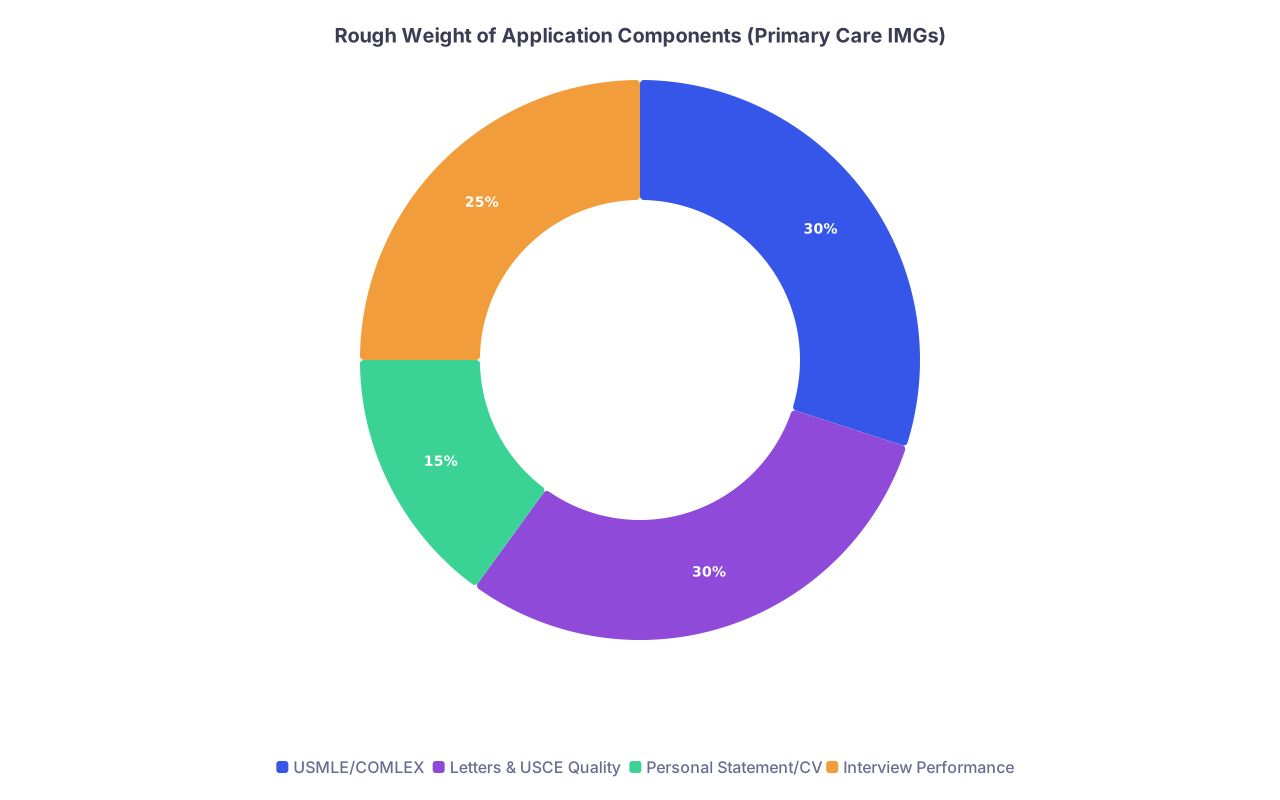
| Category | Value |
|---|---|
| USMLE/COMLEX | 30 |
| Letters & USCE Quality | 30 |
| Personal Statement/CV | 15 |
| Interview Performance | 25 |
Your brain is acting like “USCE site name” is 70%. It’s not.
A Quick Reality Check: Many Matched IMGs Had Imperfect USCE
I’ve seen people match with:
- One random clinic externship + one mid-level hospital observership.
- Only observerships but golden, detailed letters.
- Community hospitals no one outside that state has heard of.
They matched because:
- Their letters were enthusiastic and specific.
- They showed consistency and effort.
- They didn’t hide or fake anything.
So no, choosing a non-ideal USCE site did not doom them. And it doesn’t doom you.

What You Can Still Control (Even If the Rotation Is Over)
You can’t go back and re-pick that site. You can still control:
- Whether you use that site for a letter or not.
- How you describe it on ERAS.
- Whether you add another, stronger, more teaching-focused experience.
- How you frame your growth and learning in your personal statement and interviews.
- How you perform now on every new rotation you do.
So instead of mentally torturing yourself with “wrong site,” shift the question to:
“How do I make this one piece fit into a story that makes sense and shows growth?”
That’s what programs are actually reading for.

FAQs
1. I only have USCE from one small outpatient clinic. Is that enough to apply?
It might be enough to apply, but it may not be enough to be competitive for many programs, especially inpatient-heavy ones. If that’s all you have, lean hard on:
- Strong, specific letters from that clinic,
- Any exposure to EMR, teamwork, and continuity of care,
- A clear explanation in your application of what you learned.
If you can add even one more, better-structured teaching or hospital-based experience before the next cycle, do it. But don’t assume you’re automatically rejected just because your only USCE is outpatient.
2. My USCE was clearly low quality. Should I even list it on ERAS?
If it was legitimate—real patients, real physicians, real clinical setting—you can list it. But if:
- There was no real supervision,
- It feels like something you’d be embarrassed to explain in detail,
- You’re not getting a letter from there,
then keep the description simple and neutral. Don’t try to inflate your role. It may function as minor filler rather than a highlight. That’s okay. Not every experience has to be your showpiece.
3. Will program directors judge me for using a for-profit externship company?
Most of them already know IMGs are pushed into that system. They don’t like the industry, but they don’t automatically dislike you for using it. They judge:
- What you did there,
- How your letters read,
- Whether your experience seems real and coherent.
So no, they’re not sitting there gossiping about which company you used. They just want to know whether, after all of that, you’re someone they’d trust as an intern.
4. I think my attending from that rotation will only write a generic LOR. Should I still ask them?
If you know it’ll be generic and you have other options, don’t use them. A bland, short, vague letter can drag you down. You’re better off:
- Using fewer but stronger letters,
- Asking someone who actually saw your work over someone with a more “impressive” title or site.
If they’re your only U.S. clinical letter, you might still ask—but then work hard to get at least one more, better letter from another experience as soon as possible.
5. I already applied with this “wrong” USCE. Is there anything I can still do this cycle?
Yes. You can:
- Send update letters or emails if you start a new, stronger rotation and get a good letter mid-cycle.
- Be ready in interviews to talk honestly and calmly about what you learned from that first site and how you built on it.
- Emphasize growth in professionalism, communication, and understanding of the U.S. system.
You can’t retroactively change where you went, but you can absolutely change how your story lands with the people reading it.
Years from now, you won’t remember the exact address of that clinic or how sick you felt after realizing it wasn’t what you imagined. You’ll remember whether you let that one imperfect choice define you—or whether you used it as the first, messy step toward something better.