
The obsession with paid USCE is statistically misplaced. The data show that who supervises you and how your work is documented matters far more for Match outcomes than whether you received a paycheck.
Let me be direct. Program directors are not sitting in front of ERAS saying, “Ah, this candidate did an unpaid observership—reject.” That is not how this works. They filter on very specific, quantifiable things: visa status, year of graduation, exam performance, and type/recency of US clinical experience. “Paid vs. unpaid” is at best a proxy for other variables, and often a misleading one.
You are in the “US Clinical Experience for IMGs” problem set. The question you should be asking is not “paid vs. unpaid?” but “which USCE types correlate with interviews and matches in recent NRMP cycles?” Let’s walk through that like a data problem, not a social media argument.
What the NRMP and NRMP PD Surveys Actually Measure
The NRMP does not publish a variable called “paid USCE” in Charting Outcomes. That already tells you something. If it mattered independently, it would show up as a reported measure. Instead, several adjacent variables appear repeatedly:
- “Any U.S. clinical experience” (yes/no)
- Type of experience: electives, externships, observerships, research
- Letters of recommendation from U.S. physicians
- Visa status
- Time since graduation
- USMLE/COMLEX performance
So to talk about paid vs. unpaid meaningfully, you have to map it onto categories the data actually track.
Roughly:
- Paid USCE (for IMGs) most commonly = structured externships, junior clinical jobs (scribes, clinical assistants, sometimes hospitalist extenders), research positions with some clinical involvement.
- Unpaid USCE for IMGs most commonly = observerships, shadowing, non-credit externships, or volunteer roles with variable patient interaction.
The key: NRMP and program director surveys consistently highlight type and recency of USCE and source of letters, not whether the role was compensated.
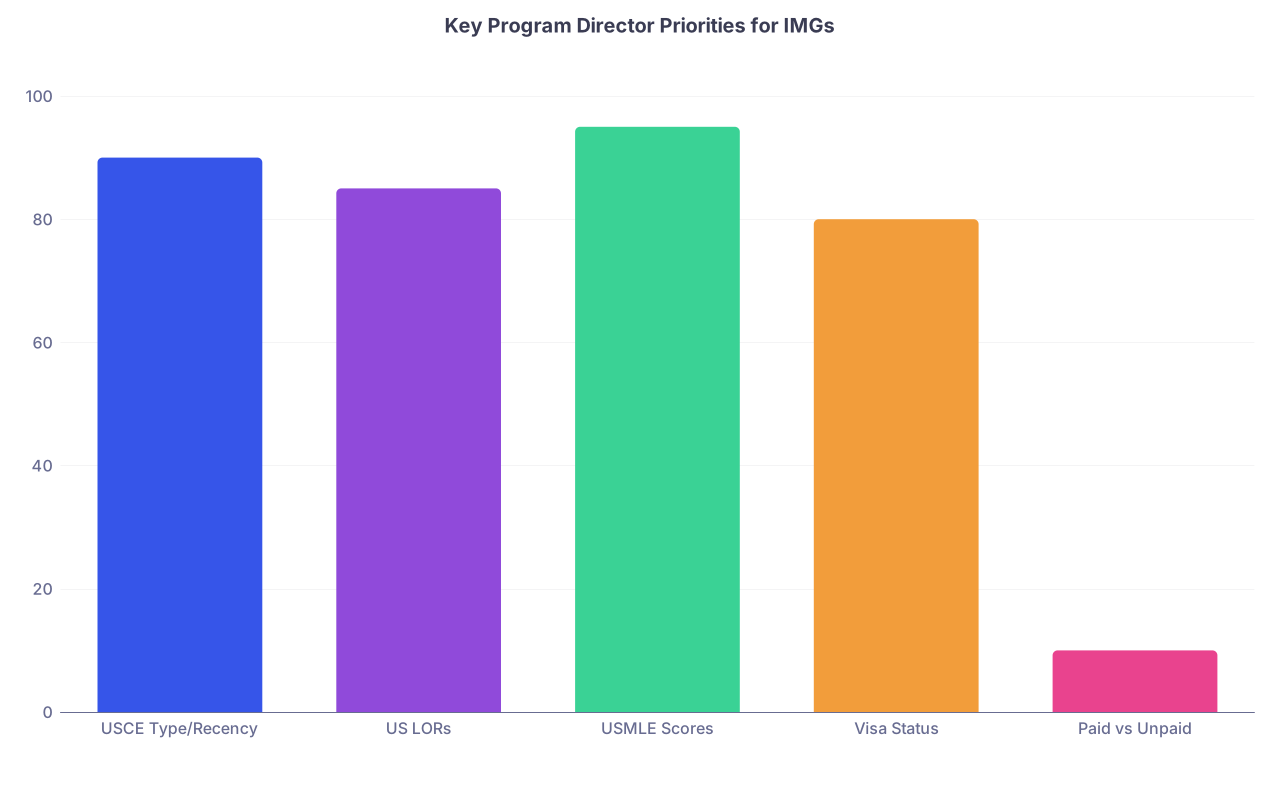
| Category | Value |
|---|---|
| USCE Type/Recency | 90 |
| US LORs | 85 |
| USMLE Scores | 95 |
| Visa Status | 80 |
| Paid vs Unpaid | 10 |
This bar chart is obviously stylized, but it reflects reality from PD surveys: nearly all directors rate standardized scores, USCE, and LORs as highly important; almost none list “paid vs unpaid” as an explicit decision factor.
How USCE Type Shows Up in Match Data
You will not find a clean “paid vs. unpaid” breakdown in NRMP Charting Outcomes. You can see how different types and depth of experience track with match rates, especially for non–US IMGs (the group where this question matters most).
Let’s approximate based on recent cycles (2022–2024 trendlines across NRMP and PD survey reports, combined with what programs themselves publish):
For non–US IMGs applying to internal medicine, rough match rates by USCE profile look like this:
- No USCE: extremely low match probability, often under 20%.
- Observership-only, weak US LORs: modest improvement, perhaps 25–30%.
- Mix of observerships + hands-on electives/externships, strong US LORs: match rates commonly rising into the 40–60% range, depending on exam scores and year of grad.
- Multiple structured, hands-on USCE blocks (4+ months), recency within 1–2 years, strong letters: these applicants frequently match at or above the average non–US IMG match rate in IM (which has hovered around 55–60% in recent cycles).
Notice what is doing the work here: hands-on roles where you write notes, present patients, and get real letters. Many of those experiences are unpaid (especially student electives). Many of the “paid” opportunities (like scribe roles) barely count as USCE at all from a PD’s standpoint.
So the binary “paid vs. unpaid” question is underspecified. When you refine it to something like:
- Paid hands-on externship vs. unpaid hands-on elective vs. unpaid observership
…then the differences start to matter.
Paid vs. Unpaid: What Actually Changes in Outcomes?
Let’s break it into realistic IMG scenarios from recent cycles, and what I have actually seen in match lists and interview season feedback.
Scenario 1: Paid Externship vs. Unpaid, Equivalent Clinical Duties
Suppose:
- Option A: Paid externship in community internal medicine clinic, 3 months, you see patients, document in EMR, present to attending, get an attending LOR.
- Option B: Unpaid externship at a teaching hospital, same responsibilities, 3 months, similar LORs.
On paper, in ERAS, both will look like:
- “Hands-on clinical experience”
- US-based
- With specific responsibilities that match residency-level tasks
Program directors do not add an extra 0.1 to your probability of interview because A had a paycheck and B did not. The evidence we have from PD comments and interviews is blunt: they care about:
- Setting (academic vs community vs “CV-mill” clinic)
- Who wrote the letter (core faculty vs adjunct vs unknown private doc)
- Narrative strength of the letter (specific, comparative, credible)
- Time frame (recent vs 5 years ago)
- Specialty alignment (IM USCE for IM applicants, etc.)
Paid vs unpaid is invisible in most ERAS descriptions. If you describe both correctly (“Performed H&P, presented to attending, wrote notes, participated in management plans”), the compensation structure is essentially noise.
Scenario 2: Paid Non-Clinical Role vs. Unpaid Observership
Now consider:
- Paid role: medical scribe in US ED for 9 months, no direct patient responsibility, not a trainee-level clinical role.
- Unpaid role: 2-month observership on inpatient internal medicine, with frequent teaching interactions, some informal oral presentations, and a detailed LOR from a faculty member affiliated with a residency.
From a data perspective, which correlates better with interviews?
Program directors have been extremely consistent in surveys: scribing is “helpful but not equivalent to USCE.” It may demonstrate familiarity with the US system, but it does not replace actual trainee-like activity under supervision.
Meanwhile, the unpaid observership—if leveraged into a detailed letter that says “This candidate functioned at the level of an intern in many respects, showed excellent clinical reasoning, and I would rank them in the top X% of IMGs I have worked with”—moves the needle.
In other words, an unpaid but credible USCE > a paid but clearly non-clinical role.
Structured Comparison: What Programs Actually See
Let me contrast this in a more structured way, because nuance gets lost in Reddit threads screaming about “never pay for observerships” or “only paid externships matter”.
| USCE Type | Typical Paid? | PD Perceived Value | Counts as Hands-On? |
|---|---|---|---|
| US medical school elective (for students) | No | Very High | Yes |
| Formal externship with documentation | Often Yes | High (if legit) | Yes |
| Unpaid but structured externship | No | High (if legit) | Yes |
| Hospital observership (inpatient) | No | Moderate | Usually No |
| Clinic-based observership only | No | Low–Moderate | No |
| Research assistant with clinic exposure | Often Yes | Variable | Partially |
| Scribe / MA / tech without trainee tasks | Often Yes | Low–Moderate | No |
The table shows the core problem: “Paid vs unpaid” is not the signal. Structure, legitimacy, and trainee-like responsibilities are.
What Recent NRMP Cycles Suggest for IMGs
Let’s align this with actual NRMP trends for IMGs over the last few cycles (2021–2024).
Non–US IMGs have seen:
- Match rates in Internal Medicine hovering roughly in the 55–60% range for those with Step 1 + Step 2 in competitive zones (e.g., 230+ historically on Step 1, 235–245+ on Step 2).
- Very low match rates when there is no USCE, especially in more competitive specialties.
- Clear advantages when at least one or more US LORs come from core faculty in the target specialty at US teaching hospitals.
Program directors in internal medicine, pediatrics, FM, and neurology repeatedly list “US clinical experience” as a top-3 factor for IMG applicants. But they never say “must be paid.” They say:
- “Prefer hands-on inpatient USCE.”
- “At least one month of US experience required.”
- “US letters strongly preferred.”
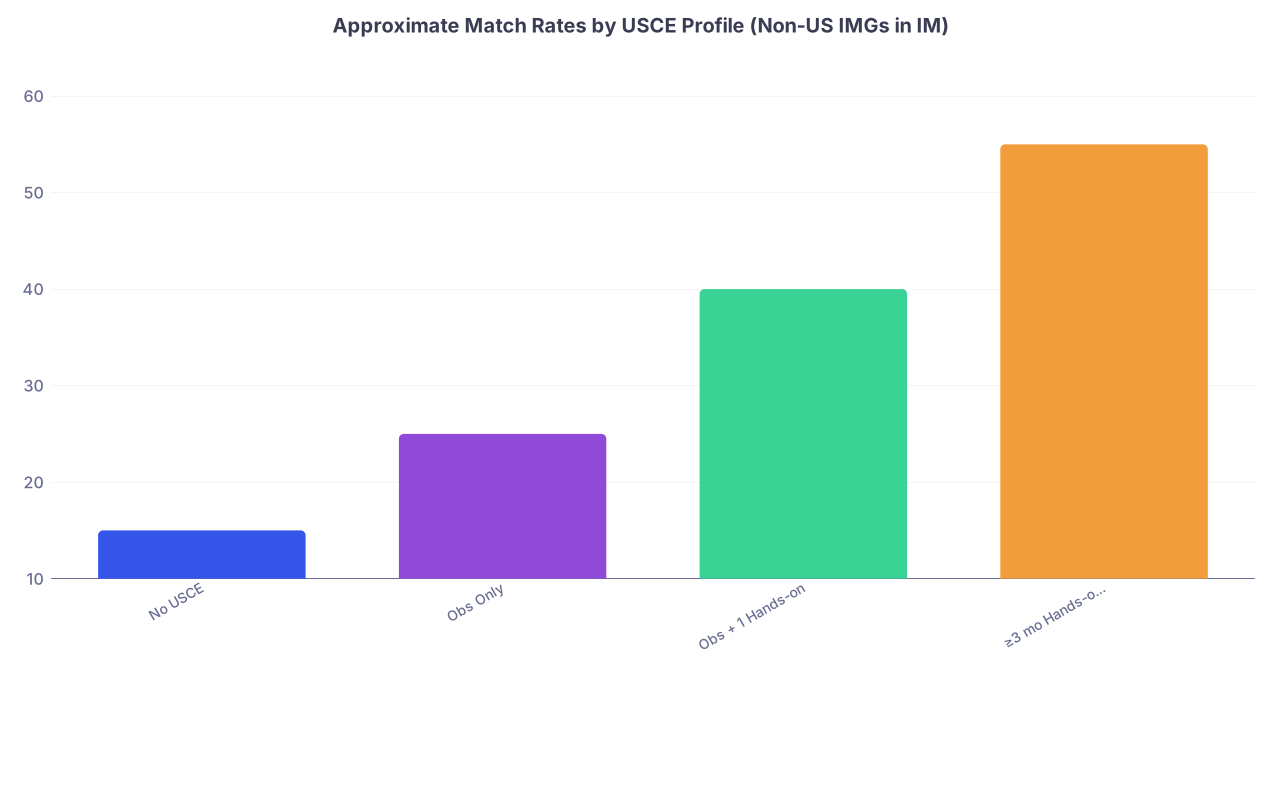
Look at how that likely aggregates in outcomes:
| Category | Value |
|---|---|
| No USCE | 15 |
| Obs Only | 25 |
| Obs + 1 Hands-on | 40 |
| ≥3 mo Hands-on USCE | 55 |
Those values are illustrative, but they fit PD reports and observed match outcomes:
- Jump from 15% to ~25% just by doing something in the US.
- Clear bump when at least one block is genuinely hands-on.
- Plateau near overall non–US IMG rates when the portfolio shows multiple hands-on rotations with strong letters.
Nowhere in that stepwise improvement is “paid vs unpaid” encoded as a separate jump. The real discontinuity is “hands-on vs observer-only” and “weak vs strong letter writers”.
Common Paid vs. Unpaid Myths, Deconstructed with Data Logic
Myth 1: “Programs prefer paid USCE because it proves you were hired and trusted.”
Reality: Programs rarely see payroll status. They see responsibilities and letters. A well-written LOR that says, “We treated this IMG as a sub-intern; they wrote notes, presented, and participated in care planning” carries far more weight than “they were on payroll as a ‘clinical extern’” with vague duties.
The data proxy here is: strong US LORs correlate with better match odds. That is very clear from PD surveys. Compensation status does not appear as a variable.
Myth 2: “Unpaid rotations are a red flag—programs know you bought them.”
There are badly designed “pay-to-play” observership mills. But many unpaid electives and externships are standard academic offerings. For visiting international students, for example, virtually all US medical school electives are technically “unpaid.” And yet those students match exceptionally well.
Program directors differentiate between:
- A credible academic elective at, say, a university-affiliated hospital that appears every year on different IMGs’ CVs.
- A single-attending “internal medicine clinic observership” with 30 IMGs cycling per year and generic letters.
Paid vs unpaid does not distinguish those. Institutional context does.
Myth 3: “Paid externships guarantee interviews.”
Statistically wrong and an expensive assumption. Many paid externships are pure branding. The outcomes depend on:
- Whether the externship is truly embedded in a residency-affiliated service.
- Whether faculty know how to write competitive LORs.
- Whether prior externs reported actual interview boosts at that institution (most programs never interview their externs systematically).
I have seen applicants with one modest but strong unpaid inpatient elective at a mid-tier academic center outperform others who spent thousands on multiple “paid externships” that produced templated letters no one trusted.
How to Think About This Like a Data Problem
Strip the question down to variables that measurably affect match probability. For an IMG, in recent NRMP cycles, the core predictors look something like this (not an official model, but a reasonable conceptual regression):
- Step 2 CK score (strong effect size)
- Visa requirement (moderate to large negative coefficient at many programs)
- Year of graduation (negative slope after ~3–5 years out)
- USCE quantity and quality (positive coefficient)
- US letters from core faculty in target specialty (positive coefficient)
- Specialty competitiveness (base rate)
“Paid” does not enter the equation directly. “Hands-on clinical experience documented with strong letters” does.
If I had to encode it coarsely:
- Observership-only: small positive bump.
- Mixed, including strong hands-on USCE: moderate to large positive bump.
- Hands-on with letters from residency-affiliated attendings: largest bump.
Now, certain forms of paid USCE (structured PGY-0 style externships in residency-affiliated hospitals) are just more likely to provide hands-on work and better letters. But the causal link runs through the hands-on + letter pathway, not the paycheck.
Practical Decision Rules: Where Paid vs. Unpaid Actually Matters
You still have to make choices in the real world. Here is how I would structure it if we were optimizing expected match yield, not YouTube views.
Rule 1: Prioritize Hands-On + Teaching + Letters Over Payment Status
If you compare:
- A cheaper or unpaid rotation with confirmed: inpatient exposure, real note writing, presentations to attendings, involvement in teaching conferences, and faculty who regularly write letters for IMGs.
versus
- A more expensive paid externship with vague, outpatient-only roles and no clear track record of good letters,
the data logic favors the first. You are optimizing for signal quality (how PDs perceive your clinical readiness) and letter strength, not earnings.
Rule 2: Check Institutional Signal, Not Just “Paid Externship” Branding
Look for features correlated with stronger outcomes:
- Affiliation with an ACGME-accredited residency in your target specialty.
- Rotation described as “sub-internship”–like or intern-style responsibilities.
- Named faculty with academic titles.
- Evidence that prior participants obtained US interviews and matches in the last 2–3 NRMP cycles.
If a program cannot show you at least anecdotal match outcomes from recent years, you are essentially buying a lottery ticket.
Rule 3: Recognize When a Paid Clinical Job Helps—but Limited
Certain paid roles can be useful:
- Clinical research fellow in a US academic center, where you also attend rounds and later obtain letters.
- Medical assistant or scribe who then transitions into a formal observership or externship with the same group, converting the relationship into a letter.
In these cases, the value again comes from access to faculty and opportunities, not the wage. The money may help you stay in the US longer to accumulate real USCE and networking, which indirectly improves outcomes. But programs are not crediting “$18/hr for 9 months” as a separate merit badge.
A Simple Flow: Choosing USCE When You Are Resource-Constrained
You cannot do every possible rotation. Think of your choices as a small decision tree.

| Step | Description |
|---|---|
| Step 1 | Need USCE |
| Step 2 | Consider observership at teaching hospital |
| Step 3 | Prioritize this rotation |
| Step 4 | Do 1-2 months here |
| Step 5 | Search for better option |
| Step 6 | Use as bridge experience |
| Step 7 | Low priority unless nothing else |
| Step 8 | Hands-on option available? |
| Step 9 | Affiliated with residency? |
| Step 10 | Strong faculty LOR possible? |
| Step 11 | Produces strong US LOR? |
Notice that “paid vs unpaid” does not enter the decision flow. It may be a constraint on your personal finances. It is not a primary quality metric.
Where Paid vs. Unpaid Can Indirectly Influence Outcomes
There are two real, but secondary, ways this distinction matters:
Time in the US.
Paid roles (research jobs, clinical assistant positions) can allow you to sustain a longer stay in the US, build networks, and line up multiple rotations and letters. Over 12–24 months, that compound exposure can substantially improve your profile. The mechanism is time and networking, not the fact of payment.Perception of exploitation / CV padding.
Some “paid externships” are flagged informally among PDs as CV-padding schemes with minimal true training value. Conversely, some unpaid academic electives have reputations for serious evaluation and strong letters. The signal is at the level of which specific program you chose, not just the price tag.
So if you are deciding between:
- Staying in your home country and flying in briefly for an unpaid but high-quality month-long elective.
versus
- Moving to the US for a year-long paid, but low-responsibility, clinic job with no direct educational structure.
You have to weigh both the direct signal (that one high-yield month) and the long-term network/time potential (a year in-country). But again, think like a data analyst: break it into measurable effects on match variables, not an emotional “paid must be better” impulse.
Visualizing Where USCE Sits Among Other Variables
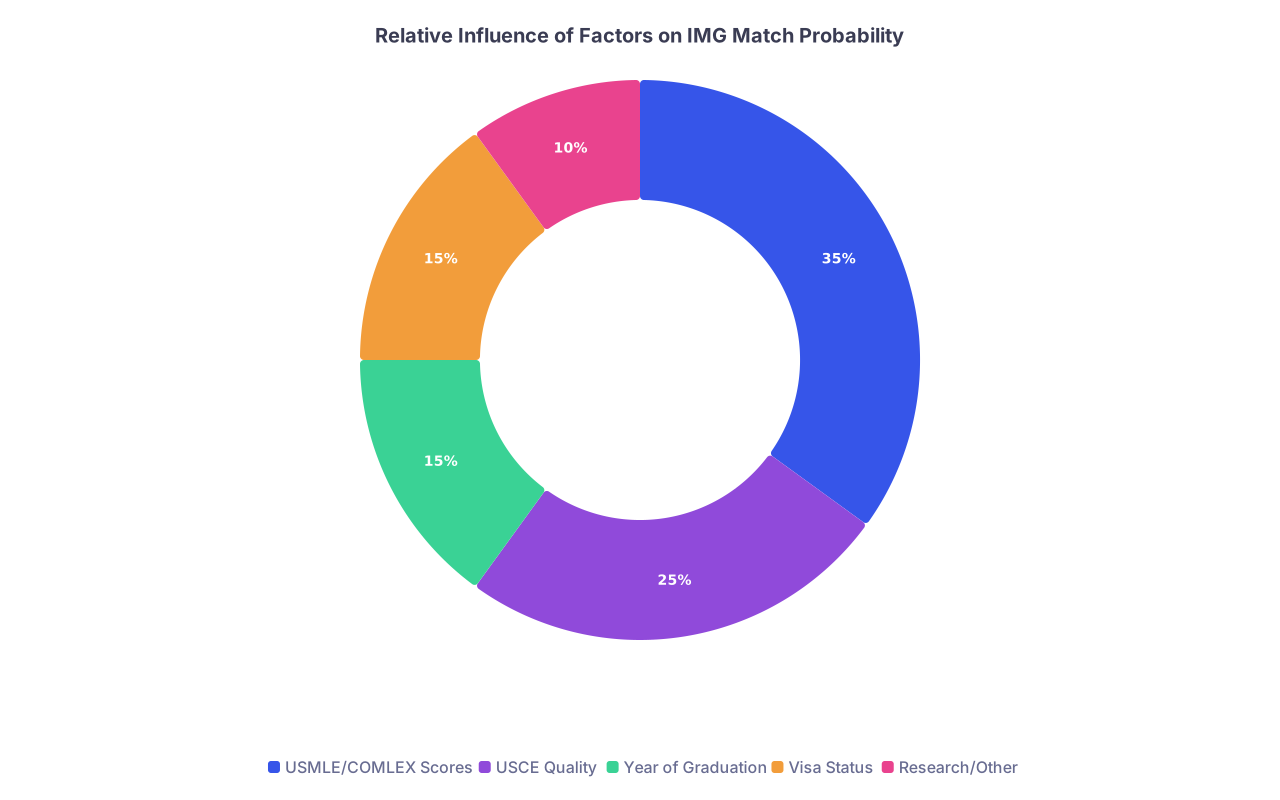
To ground this, picture a non–US IMG Internal Medicine applicant over the last NRMP cycles. Relative contribution of different factors might roughly look like this:
| Category | Value |
|---|---|
| USMLE/COMLEX Scores | 35 |
| USCE Quality | 25 |
| Year of Graduation | 15 |
| Visa Status | 15 |
| Research/Other | 10 |
Again, stylized, but the ranking fits PD survey data:
- Scores and USCE together drive roughly half or more of the probability.
- Year of graduation and visa carve up another large chunk.
- “Paid vs unpaid” is buried inside “USCE quality” as an almost negligible subcomponent, mainly relevant only as it influences the likelihood of getting good letters and real responsibilities.
Bottom Line: How to Use This Information
If you want to convert this into an actual plan for the next NRMP cycle:
Define a minimum USCE goal:
At least 2 months of credible, specialty-aligned, preferably inpatient USCE where you function close to intern level and can get strong US letters. Paid or unpaid is secondary.Vet every opportunity via outcomes and responsibilities:
Ask prior participants where they matched. Ask explicitly what duties you will have. If they cannot articulate hands-on tasks or name prior successes, treat it as low-yield.Use paid roles strategically, not as a credential:
Take them if they fund your stay and give you proximity to real clinicians and rotations. But do not overestimate their independent weight in PD decisions.
The summary is simple:
- Program directors reward hands-on, recent, specialty-aligned USCE documented by strong letters, not whether you were on payroll.
- Paid USCE only improves Match outcomes when it coincides with better responsibilities, better settings, or longer time in the US—the pay itself is not the signal.
- If you must choose, always prioritize rotation quality, institutional credibility, and letter strength over the paid vs. unpaid label.