

It’s 5:45 a.m. You’re on your sub‑I. Your senior just texted “Pre‑round on 3, 5, 7, and new admit. See you at 6:30.”
Your Step 2 CK date is locked in two and a half weeks away because:
- It’s the only slot before ERAS opens
- Your school requires a score by a certain date
- Or you delayed Step 1 and everything downstream got crushed
You’re staring at UWorld with 1,300 questions left, a ward list with 18 patients, and the feeling that something has to give. But nothing actually can.
This is the situation: you have to take Step 2 CK in the middle of a sub‑I. You can’t change it. So the only thing left to change is how you manage time and expectations.
Here’s how to run this gauntlet without destroying your evals or your score.
1. First Reality Check: What You’re Actually Up Against
Step 2 during a sub‑I is not about “ideal prep.” It’s about “salvage a solid score without tanking your rotation.” Those are different games.
You’re dealing with:
- 60–80 hours/week in the hospital
- Variable call / nights / weekend coverage
- Unpredictable pages and late discharges
- A tired brain that’s already reading about medicine all day
- Limited flexibility on days off (if you even have them)
So you have to accept a few truths:
- You will not finish “the perfect” UWorld run. And that’s fine.
- You will sacrifice some “great med student” extras (elaborate notes, over‑the‑top presentations) for efficiency.
- You must protect sleep. If you sacrifice sleep, both Step and the sub‑I will suffer. I’ve watched people try; they crash by week 2.
The move is not to pretend you’re on dedicated. The move is to build a realistic, ruthless micro‑schedule that lives inside your sub‑I.
2. Build a Two‑Layer Plan: Non‑Negotiables vs Flex Slots
You need two layers:
- Non‑negotiable Step 2 blocks (short, protected, daily)
- Flexible opportunistic time (what you do with random 20–40 minute windows)
Think like you’re scheduling around an attending who doesn’t care about your exam. Because they don’t have to.
Step 2 baseline: The “Daily Floor”
For most people on a busy sub‑I, your realistic daily floor is:
- 20–40 UWorld questions per day (timed, random, or by high‑yield system)
- 30–45 minutes of review (not perfection; major learning points only)
So ~1.5 hours/day of actual Step activity. On an insane sub‑I, that’s already ambitious.
If you’re 3 weeks out and behind, you nudge up to:
- 40–60 questions on days without call
- 20–30 questions on brutal days / call days
But you don’t touch those baseline blocks. That’s the discipline.
When exactly do you do this?
Let’s be specific. A typical sub‑I day:
- 5:30–6:00 a.m.: wake / shower
- 6:00–6:30 a.m.: pre-rounds
- 7:00–9:30 a.m.: table rounds
- 9:30 a.m.–5:30 p.m.: wards, notes, discharges, admissions, consults
- 5:30–7:00 p.m.: sign‑out / finish notes / wrap‑up
- 7:00–8:00 p.m.: commute, food, shower
- 8:00–10:30 p.m.: ???
- 10:30–11:30 p.m.: maybe sleep, maybe regret
You’re not going to study 3 hours from 8–11 p.m. daily and also survive this rotation. Let’s stop fantasizing about that.
What works better:
- 25–30 questions: 8:15–9:00 p.m.
- Quick review: 9:00–9:30 p.m.
- Shut it down. Sleep.
Then, maybe:
- Light review (Anki or notes): 10–15 minutes with breakfast or commute (audio or flashcards)
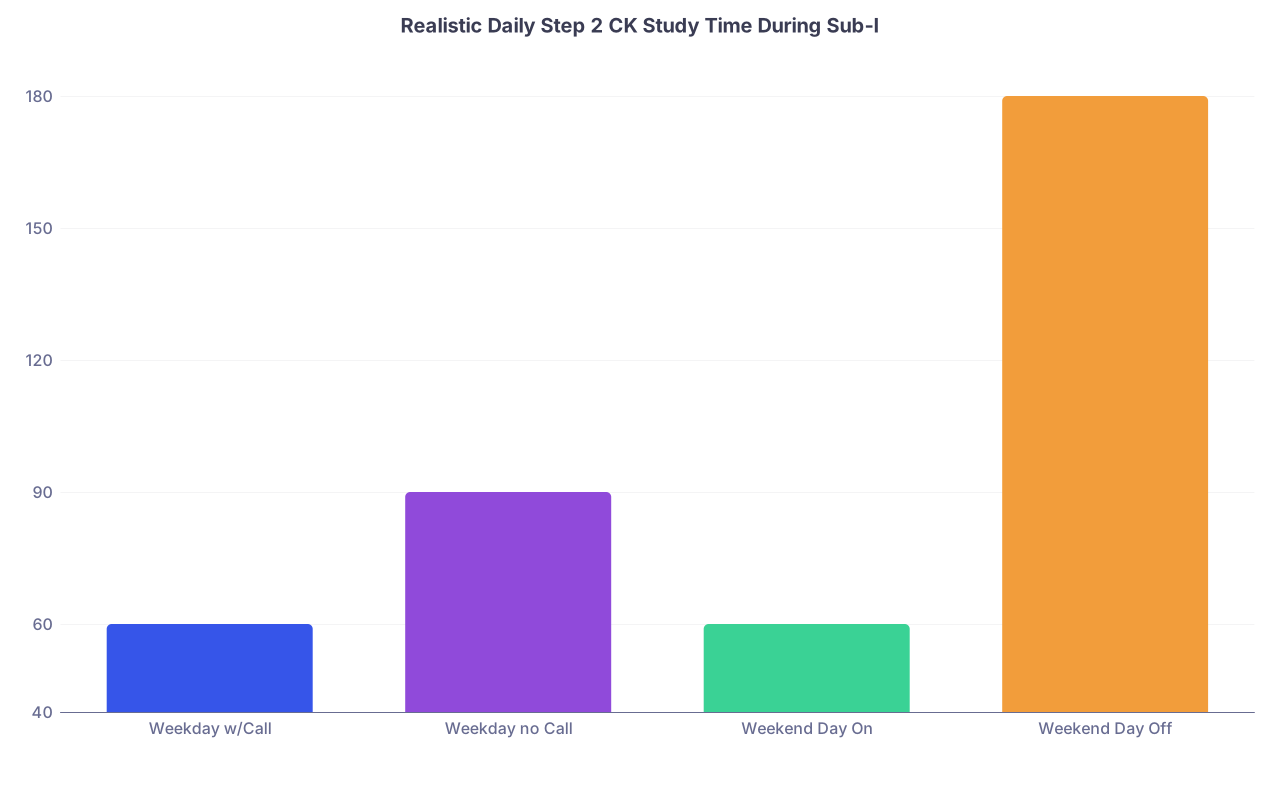
| Category | Value |
|---|---|
| Weekday w/Call | 60 |
| Weekday no Call | 90 |
| Weekend Day On | 60 |
| Weekend Day Off | 180 |
60–90 focused minutes is more powerful than 2–3 half‑awake, multitasked hours. I’ve watched students “do UW for 3 hours” while texting, chart checking, and falling asleep. Their retention: near zero.
3. Set Priorities: What Actually Matters 2–4 Weeks Out
You can’t do everything. So we cut.
If your exam is within 2–4 weeks and you’re on sub‑I, your focus list should look like this:
- UWorld (or equivalent QBank) > everything else
- NBME/CCSSA practice exams only if you can protect the time
- Brief targeted review of weak systems/topics revealed by questions
- Skip: long video series, big new resources, rewriting notes from scratch
If you try to “start AMBOSS fresh,” or binge watch OnlineMedEd from zero, you’ll burn hours you do not have. Keep it to:
- One primary QBank (usually UWorld)
- Your chosen self‑assessments
- One rapid review resource (e.g., UWorld notes, Divine Intervention podcasts, quick review book) for commute / dead time
4. Tactical Scheduling: Week‑by‑Week Model
Let’s say you’re 3 weeks out from Step 2, smack in the middle of your sub‑I.
Week 3 out (21–15 days)
Goal: establish the baseline and survive
- Daily: 30–40 UWorld questions + 30–40 minutes review
- 1 NBME on your “lightest” day (even if that’s just less insane), protected 4–5 hours total including review
- Identify your bottom 2–3 systems from that NBME (e.g., Neuro, Renal, OB)
Strategy: explore your limits without breaking. If 40/day plus work is barely doable, accept that. Don’t chase someone else’s Reddit schedule.
Week 2 out (14–8 days)
Goal: push content, no heroics
- Daily: aim 40–60 questions on non‑call days, 20–30 on call days
- Short, system‑focused review on your weak areas (30 minutes after UW review on 3–4 days this week)
- Optional: another NBME if your energy and schedule allow. If taking one will wreck your rotation or sleep, skip it.
Final week (7–1 days)
Goal: sharpen, not cram new content
- Early in the week: 40–60 questions/day on lighter days, 20–30 on brutal days
- Last 2–3 days: taper down total questions. Maybe 20–40/day. Let your brain breathe.
- Final 24 hours: no more full blocks. Do light review: key lists (murmurs, acid–base, OB triage, psych meds, shock types) and quick question stems if you really want.
The night before, you should feel underprepared. Everyone does. Your metric is: “Have I been consistently doing questions and review every day in spite of this sub‑I?” If yes, you’re in the game.
5. Use the Hospital to Study (Without Being Annoying)
You’re surrounded by live Step 2 questions all day. Use them.
Convert patient care into Step reps
Example: You’re managing a decompensated cirrhotic patient with variceal bleeding.
Ask yourself on the spot:
- What’s the Step 2 algorithm? (2 large‑bore IVs → octreotide → antibiotics → EGD within 12 hours)
- What’s the prophylaxis afterward? (Nonselective beta blocker ± band ligation)
- What similar questions have I seen in UW?
Then: write down 1–2 quick “Step parallels” from that day in a tiny note app or pocket notebook. On your commute home, scan them for 5 minutes. That’s real, high‑yield review.
Exploit downtime correctly
On sub‑I you’ll have fake downtime:
- Waiting for attending to show up for rounds
- Residents finishing sign‑out
- Sitting on a computer with “nothing to do” for 20 minutes
Use this time for:
- Single questions in tutor mode (mobile)
- Reviewing flagged Qs
- Flashcards / short fact lists
Do not start a 40‑question block if you’re going to be interrupted 10 times. That just trains distraction.
6. Conversation With Your Team: How to Handle It Without Looking Soft
You don’t have to announce your exam to everyone. But it helps to have at least one ally (usually your senior resident).
What works:
Day 1–2, once they’ve seen you’re not useless, you say:
“Hey, I just want to give you a heads‑up: I’m scheduled to take Step 2 in about 3 weeks. I’m committed to being fully present here, but if there are any lighter days or chances to get out a bit earlier once work is done, I’d really appreciate it so I can prep. If it’s not possible, I understand.”
This does a few things:
- Signals you care about the rotation first
- Avoids sounding entitled (“I need to leave at 4 every day to study”)
- Opens the door to them cutting you loose some afternoons when the list is calm
Some seniors will respond with, “I took Step 2 during this same sub‑I. I get it. Get your stuff done and I’ll try to get you out when we can.”
Some will say nothing and expect max grind. Fine. You adjust your expectations and lean more on nights/early mornings.
7. Micro‑Time Management: What You Do in 15–30 Minute Chunks
Sub‑I life is built around 15–30 minute unpredictable blocks. If you can’t use those, you lose.
Here’s how to convert them.
10–15 minutes
- Quickly review the explanation of 3–4 previously missed questions
- Listen to a short rapid review audio segment (Divine Intervention, etc.)
- Flash through 15–20 cards of your highest‑yield deck
20–30 minutes
- 10–12 questions in timed or tutor mode, single system or random
- Focused review of a mini‑topic you keep missing (e.g., hyponatremia, prenatal screening, chest pain algorithms)
You do not open social media. You do not check email for the 40th time. You either recover your brain (brief walk, food, bathroom, breathe) or you hit a small, planned study task.

| Step | Description |
|---|---|
| Step 1 | Wake Up |
| Step 2 | Commute/Breakfast |
| Step 3 | Light Review |
| Step 4 | Pre-rounds & Rounds |
| Step 5 | Daytime Clinical Work |
| Step 6 | Mini Study Task |
| Step 7 | Continue Work |
| Step 8 | Sign-out & Leave |
| Step 9 | Dinner/Reset |
| Step 10 | 25-40 UW Questions |
| Step 11 | 30-40 min Review |
| Step 12 | Sleep |
| Step 13 | Free 15-30 min? |
8. Protect Sleep Like It’s Another Exam
If you’re routinely sleeping 4–5 hours/night to squeeze in extra questions, you’re not “grinding.” You’re sabotaging recall and clinical performance.
Target: 6–7 hours minimum most nights. Not ideal, but survivable.
Trade‑offs to get that:
- Shorten question review. Don’t obsess over every explanation line. Capture the key point, move on.
- Accept that you’ll leave some Qs in the bank unfinished. 70–80% of UWorld done well beats 100% skimmed at 2 a.m.
- Stop doing questions 60–90 minutes before bed if you notice you can’t fall asleep. Switch to light reading or an outline.
I’ve seen students drop 10–15 points off what they “should” score because they showed up to the exam already wrecked. Don’t be that person.
9. Adjusting Based on Where You Are Right Now
Not everyone is walking into this with the same base. Align your plan with reality.
| Baseline | Recent Shelf Scores | Core Focus During Sub-I + Step 2 |
|---|---|---|
| Strong | 75th–90th percentile | Maintain question volume, 1–2 NBMEs, avoid burnout |
| Mid | 40th–70th percentile | Question-heavy, targeted review of weak systems, 1–2 NBMEs |
| At-risk | Below 40th percentile | Fewer resources, more repetition, heavy focus on fundamentals (IM, OB, Peds) |
If your shelves have been strong:
- You don’t need miracles. Your goal is not to regress.
- Keep Qs consistent, use your clinical days as applied studying, and don’t over‑cram new material.
If your shelves have been mid:
- UWorld becomes your main teacher.
- Each wrong answer is a mini‑lesson—focus on understanding patterns, not rare zebras.
If your shelves have been weak:
- You must simplify. One QBank. One rapid review method. No new fancy textbooks.
- Use your sub‑I attendings like high‑yield tutors. Ask direct, Step‑type questions (when appropriate), like: “For the boards, would this patient be more likely to get X or Y next?”
10. The Last 72 Hours: Balancing Hospital and Exam
This is where things often get mishandled.
Ideal (if possible): You’re off the day before the exam, or at least post‑call and truly off.
If that’s an option, ask early:
- 2–3 weeks before your test date, mention to your senior or clerkship coordinator:
“My Step 2 is on [date]. Is there any way I can be off or post‑call the day before? If not, I’ll make it work, but I wanted to ask.”
Some programs will accommodate. Some won’t. Ask once, professionally. Do not badger.
If you’re working the day before:
- Do NO more than 20–30 light questions that night
- Stop studying 2–3 hours before bed
- Pack everything for test day (ID, snacks, clothes) before you start any review so you’re not scrambling late at night
Day‑of logistics:
- Don’t try to do questions on the morning commute. You’re not going to suddenly learn hyponatremia on the bus.
- If anything, skim a familiar, reassuring rapid review list or nothing at all. Your job is to show up calm and sleep‑deprived but functional, not wired and frazzled.

11. What to Let Go Of (So You Don’t Break)
You cannot optimize everything. You will drop a few balls. Better to choose which ones, instead of letting chaos choose for you.
Things you are allowed to do:
- Give solid but not Broadway‑level presentations on rounds
- Ask to leave after work is truly done instead of volunteering for extra busywork at 6 p.m.
- Turn down social events during the 10–14 days before your exam
- Use your one true day off as mostly Step + minimal life maintenance, not 12 hours of errands
Things you should not do:
- Skip basic patient care tasks to study. Residents notice. That burns you.
- Brag constantly about your exam. It makes the team less sympathetic when you’re tired.
- Pretend you can “make up” a week of lost questions in one insane 400‑question weekend. That’s not how your brain works.
12. A Sample “Brutal Week” Schedule (To Make This Concrete)
Let’s say:
- 6 days on service
- Call on Tuesday and Friday
- Step in 2.5 weeks
Here’s a realistic version.
Mon (no call):
- 6 a.m.–6 p.m.: Hospital
- 8:15–9:00 p.m.: 25 Qs timed
- 9:00–9:30 p.m.: Review
- Bed by ~10:30 p.m.
Tue (call):
- 6 a.m.–8 p.m.: Hospital (admissions into the night)
- If there’s a true lull: 5–10 Qs in tutor mode at the computer
- After call: go home, shower, crash. No real Step that night. Accept it.
Wed (post‑call, maybe lighter afternoon):
- 6 a.m.–2 p.m.: Hospital
- 4:00–5:00 p.m.: 25–30 Qs
- 5:00–5:30 p.m.: Review
- Evening: light rapid review or nothing, bed early
Thu (regular):
- Same as Monday
Fri (call):
- Same pattern as Tuesday. Maybe a few flashcards if you’re upright.
Sat (post‑call but technically “on”):
- Do as much as your brain allows: maybe 20–30 Qs and review
- Don’t try to treat this as a full “dedicated Saturday” if you’re exhausted from call.
Sun (lighter/half day):
- Protect 2–3 hours total:
- 2 blocks of 20 Qs
- 45–60 minutes cumulative review
- Short targeted brush‑up on weak system
This is not pretty. But it’s realistic—and students in this situation still walk out with strong scores.
FAQ (exactly 5 questions)
1. Should I try to move my Step 2 date off my sub‑I if at all possible?
Yes. If you can move it without messing up graduation, ERAS timing, or school requirements, do it. Dedicated time will almost always produce a better score and a less miserable experience. But if rescheduling means delaying apps, risking missing a score deadline, or losing money you can’t afford, then commit to the “Step during sub‑I” plan and stop second‑guessing it.
2. Is it even worth doing NBMEs if I’m this slammed?
If you can carve out one or two protected half‑days, NBMEs are valuable. They give you a sanity check on where you stand and highlight weak areas. But forcing a full NBME after a 12‑hour shift is pointless; your score will be falsely low and you won’t learn much. Do NBMEs when you’re at least semi‑rested—usually on your lightest day or a true day off.
3. What if I’m so exhausted after work that I can’t focus on UWorld at all?
Back off on question volume temporarily and focus on lighter tasks those nights: reviewing missed Qs, flashcards, short audio. But you have to be honest with yourself—is it true exhaustion or just low motivation? If it’s real fatigue, sleep is higher yield. If it’s inertia, force yourself through a smaller block (10–15 questions) and then stop. Something consistently is better than nothing “until I feel like it,” which never comes.
4. Should I focus questions on internal medicine since I’m on an IM sub‑I?
Partially. Internal medicine overlaps heavily with Step 2 content, so doing IM‑heavy blocks is fine. But you can’t ignore OB, Peds, Psych, and Surgery. A decent split: on weekdays, prioritize IM and your weakest non‑IM system; on your weekend or lighter day, do a fully random block to keep your broad test muscles active.
5. How do I keep my evals decent while still protecting Step time?
Hit the basics hard: show up on time, know your patients cold, write competent notes, follow up on tasks promptly, and be pleasant to work with. You don’t need to be the most talkative or the last one to leave every day. If your work is reliable and you’re not complaining constantly about Step, most residents will see you as solid. That’s enough to get good comments while you quietly guard a bit of time for your exam.
Key Takeaways
- You’re not on dedicated; you’re in survival mode. Anchor your plan around 60–90 focused Step minutes most days and let go of “ideal.”
- Protect sleep and basic clinical reliability first; then ruthlessly pack questions and quick review into realistic micro‑blocks.
- Use your sub‑I to your advantage—every patient is a live Step 2 question—while quietly carving out the minimum structured study you need to walk into test day prepared, not destroyed.


