

The usual Step 2 advice completely falls apart if you know you’re submitting ERAS late.
Most people talk like you’re taking Step 2 in June, submitting ERAS on day one, and riding into early interviews on a wave of “complete” applications. If you’re reading this, that’s not your life. You’re staring at a late ERAS submission, a Step 2 date that’s not ideal, and a clock that’s already behind schedule.
Let me be blunt: you can still put together a competitive cycle. But only if you stop pretending you’re on the standard timeline and start playing the game you’re actually in.
This is the playbook for that situation.
1. First Reality Check: What “Late ERAS” Really Means For Step 2
“Late” is not a feeling. It’s a set of very specific disadvantages you need to work around.
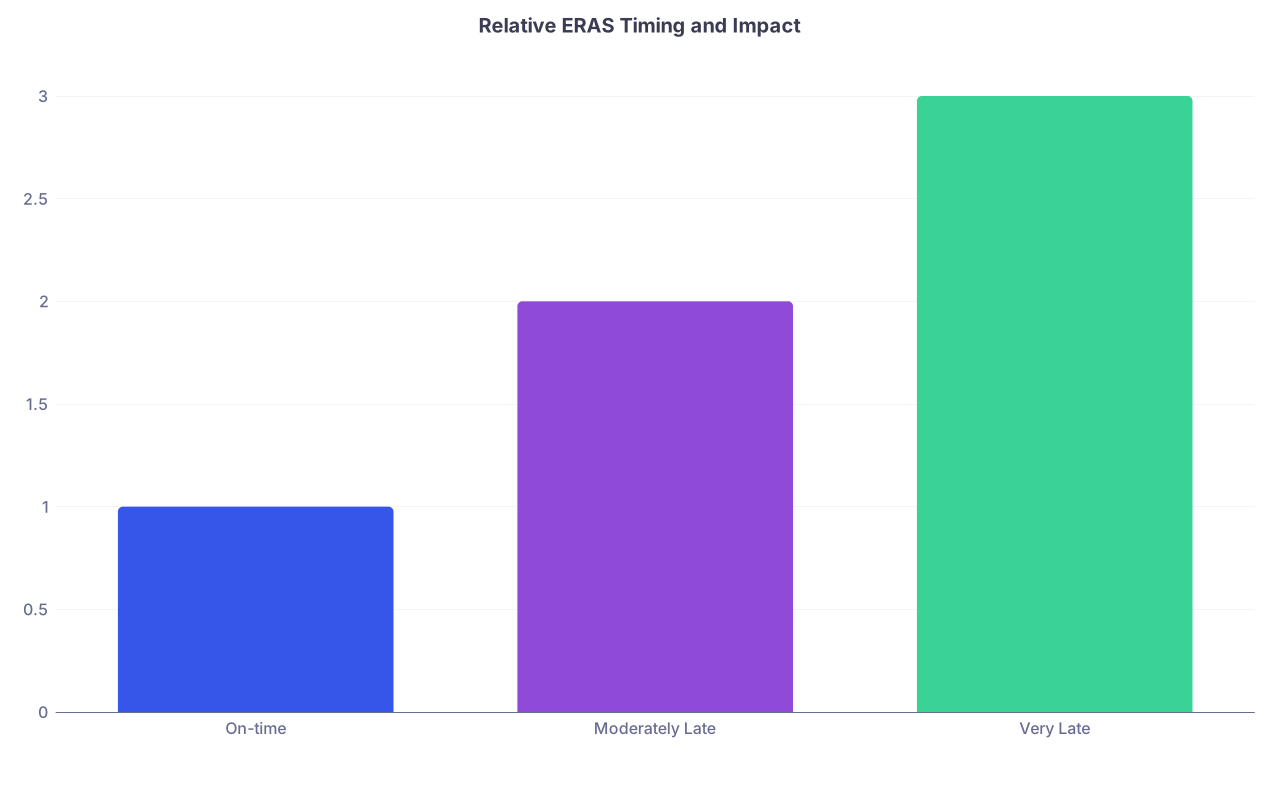
| Category | Value |
|---|---|
| On-time | 1 |
| Moderately Late | 2 |
| Very Late | 3 |
Translated into real life:
- On-time: ERAS submitted around opening week, Step 2 score in by late August
- Moderately late: ERAS submitted 3–4 weeks after opening, Step 2 score hits mid–late September
- Very late: ERAS submitted ≥1 month after opening, or Step 2 score not back until October or later
Where you sit on that spectrum changes your Step 2 strategy.
Here’s what late actually costs you:
- Fewer interview spots left when your app becomes “complete”
- Programs may not even look at you until your Step 2 is in (especially if your Step 1 is weak or Pass)
- You have less time to repair a mediocre Step 1 with a strong Step 2
You don’t fix this by “hoping it works out.”
You fix it by being intentional with:
- When you take Step 2
- When you submit ERAS
- How you sequence studying vs clinicals vs applications
- How you communicate with programs
The rest of this article will assume you’re in one of these three groups:
| Scenario | Step 2 Date | ERAS Submission |
|---|---|---|
| A: Score just in time | Late July–August | Late Sept (after score) |
| B: Submit before score | Sept test date | Submit on opening, score later |
| C: Very late test | Oct test date | Submit whenever ready |
You’ll recognize yourself in one of these. I’ll walk through all three.
2. Decide Your Priority: Score Quality vs Application Timing
You’re balancing two competing forces:
- Strong Step 2 score
- Early-enough “complete” date
You cannot fully maximize both if you’re already late. You have to pick which gets slightly sacrificed.
Here’s the core rule:
- If your Step 1 is weak (low or failed) → Step 2 quality is king
- If your Step 1 is solid and you’re just behind logistically → timing matters more
Let’s make that concrete.
| Step 1 Situation | Priority | Practical Move |
|---|---|---|
| Step 1 Pass-only, unknown strength | Score | Wait to submit until Step 2 back (Scenario A) |
| Step 1 low (e.g., < 220 pre-pass) | Score | Push test to secure higher score |
| Step 1 average, target mid-tier | Mixed | Submit early, test in Sept (Scenario B) |
| Step 1 strong, target competitive | Timing | Submit early regardless, Step 2 later |
If your application needs Step 2 to look acceptable, you do not rush a half-baked exam just to be “less late.” Programs would rather see a later solid score than an early mediocre one that confirms their doubts.
But if your Step 1 is already decent and Step 2 is more of a confirmation than a rescue? You don’t delay ERAS for a slightly nicer number. You get into the review queue asap.
3. Concrete Strategies for Each Scenario
Scenario A: You’re Delaying ERAS to Wait for Your Step 2 Score
This is the “I need this score to save my application” group.
You’re probably:
- Step 1 Pass or low
- Targeting slightly competitive or even moderately competitive specialties
- Planning a July/August Step 2
- Tempted to wait until your score posts in early–mid September before submitting
Here’s the move if you’re in this bucket:
Lock your Step 2 date right now
Not “soon.” Not “when my schedule clears.” Pick the earliest realistic date that still allows 5–6 true study weeks. Then treat that date as non-negotiable.Stop thinking of Step 2 and ERAS as sequential
You don’t: study → take Step 2 → then start ERAS.
You: study for Step 2 as your main job, and build ERAS in the margins.Minimum required ERAS work during Step 2 prep During your Step 2 block, you should still:
- Draft and finish your personal statement
- Finalize your activities descriptions
- Pick your letter writers and make the requests
- Build your school list and spreadsheet of requirements
That way, the moment your score posts, you’re 90–95% ready to hit submit.
Timeboxing rule
Daily during hardcore Step 2 prep:- 0–45 min ERAS work on weekdays (max)
- 1–2 hours on one weekend day
Any more than that and you’re robbing your Step 2 score, which is the whole reason you’re delaying in the first place.
Your score target has to be real, not fantasy You can’t say, “I need a 250” if your NBME/UWorld SA practice is hovering around 220 two weeks out. You’re late. You need achievable, not aspirational.
A useful quick rule:
- Take your last 2 practice scores
- The lower one is your floor, the higher is your ceiling
- Expect to land near the average of the two if test-day conditions are decent
If that average is truly unacceptable, you don’t just cross your fingers—you delay the test by 2–3 weeks early enough that you can still realistically prep, not the day before the exam.
The risk in Scenario A: You get paralyzed trying to make Step 2 perfect and slide your ERAS submission so far back that you miss a huge chunk of interviews. So you choose a realistic score target, push for it hard, then ship the application.
Scenario B: You Submit ERAS On Time But Take Step 2 in September
This is the most salvageable “late” situation if you’re smart.
You’re:
- Submitting ERAS around opening week or within ~7–10 days
- Testing Step 2 in early/mid September
- Hoping programs will start looking at you even without the Step 2 score in
Your main problem: many programs won’t consider your file complete until the Step 2 hits. But some will. And some will at least screen you, then wait for the score to rank or invite.
Here’s your structure:
July–early September is a split-focus block Think in weeks, not vague months.
Example split (8-week window around ERAS + Step 2):
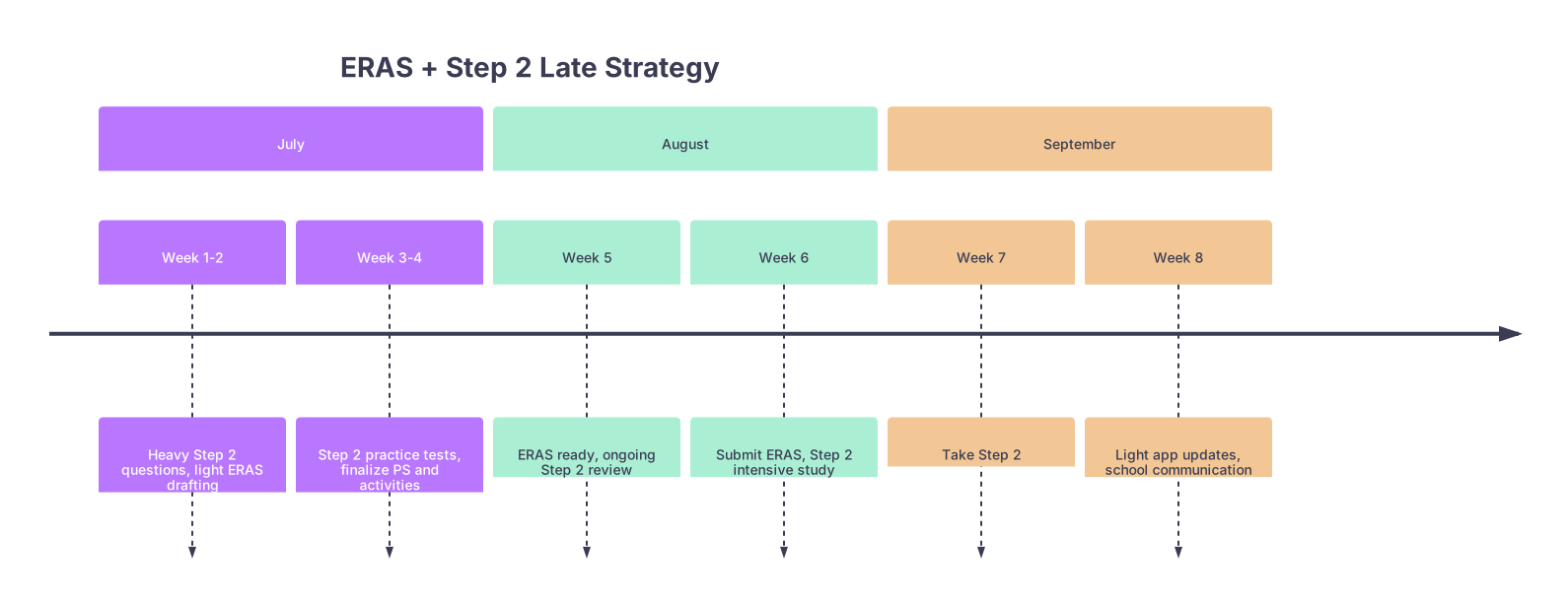
Combined ERAS + Step 2 Timeline Period Event July - Week 1-2 Heavy Step 2 questions, light ERAS drafting July - Week 3-4 Step 2 practice tests, finalize PS and activities August - Week 5 ERAS ready, ongoing Step 2 review August - Week 6 Submit ERAS, Step 2 intensive study September - Week 7 Take Step 2 September - Week 8 Light app updates, school communication The core: ERAS must be essentially complete before the final 2–3 weeks of Step 2 prep. Those last weeks must be question-heavy and distraction-light.
Set a hard cutoff date for application content Example:
“By August 20, my PS, activities, CV, and program list are final. After that, I only tweak small things in 15–20 minute chunks.”You do not want to be wording your meaningful experiences paragraph while trying to reconcile your incorrect UWorld questions. That’s how both end up mediocre.
Expect program behavior realistically This is where people lie to themselves.
Without a Step 2 score, programs may:
- Auto-screen you out (especially if Step 1 is weak)
- Mark your file as incomplete and not review it
- Put you in a “hold until Step 2 posts” pile
- Or, if your Step 1 and rest of app are strong, invite you anyway
You’ll get a sense of the reality 3–4 weeks into the season. If you’re getting zero traction and your Step 2 is pending, you know what’s holding you back.
Your Step 2 prep intensity has to increase after submission A trap I’ve watched students fall into:
They submit ERAS, feel like they “deserve” a break, and their Step 2 studying falls off right when it should ramp up. That’s how “just a few off days” becomes a 10-point drop in score.Once you hit submit, you are not done. You’ve just traded one pressure (ERAS) for another (Step 2 performance that might literally determine if you get interviews).
Scenario C: Very Late Step 2 (October or Later)
This is the most dangerous lane, and you need to be very tactical.
You’re:
- Testing in October (or later)
- Either already delayed or forced by rotations / life
- In danger of not having a score until mid/late November
Let me be honest: For competitive specialties, this is often fatal unless you have something exceptional (home program support, strong research, or already-known quantities).
But if this is your reality, here’s how you stop it from being automatic failure:
Submit ERAS as early as possible regardless
You don’t hold your application for Step 2 if your date is that late. It’s already late. Let programs see something: your LORs, clinical grades, personal statement, Step 1 if it helps you.Email programs strategically about your situation You do not spam 80 programs with a sob story. You:
- Identify:
- Home program
- Nearby / regional programs
- Places where you did aways / sub-Is
- Send a short, tight email:
- One line: who you are
- One line: your test date and reason it’s late (brief, non-dramatic)
- One–two lines: your connection or genuine interest
- One line: offer to send an updated transcript/score as soon as it’s available
- Identify:
You cannot afford a mediocre Step 2 If your score is coming in late and it’s weak, that’s a double hit. Programs will have:
- Already filled many interview slots
- Already formed first impressions from early applicants
- Less incentive to take a chance on a borderline score
So you treat this like a “one shot to get back into the game” exam. That means:
- Protecting 4–6 weeks of real study time as much as humanly possible
- If you’re on a brutal rotation, talking to your attending / coordinator early about 1–2 lighter weeks around the exam (“board study” time). Some will help if you give them time.
Mentally plan for a more regional or less competitive match Not as a defeat. As a contingency.
If you’re very late with Step 2, you should:- Expand your program list
- Include more community and lower-tier academic programs
- Seriously consider your home institution and surrounding geographic area
Late + picky is how people end up scrambling or unmatched.
4. How to Structure Step 2 Studying When You’re Also Doing ERAS
You don’t have the luxury of “just focus on boards for 8 uninterrupted weeks.” You’re in the real world, juggling:
- Rotations (maybe)
- ERAS (definitely)
- Letters
- Life
Here’s the structure that works when you’re late and overloaded.
The Weekly Framework
During the 6–8 weeks before your exam:
5 days per week:
- 40–60 UWorld questions/day, mixed or by system
- 1–1.5 hours targeted review of missed topics
- 20–45 minutes ERAS/administrative (until you’re done)
1 day per week:
- Practice exam (NBME/UWorld SA) every 2 weeks
- No new ERAS writing on full-length days—just small edits at most
1 day per week:
- Light review (Anki, key topics, brief blocks)
- Heavier ERAS work if still pending
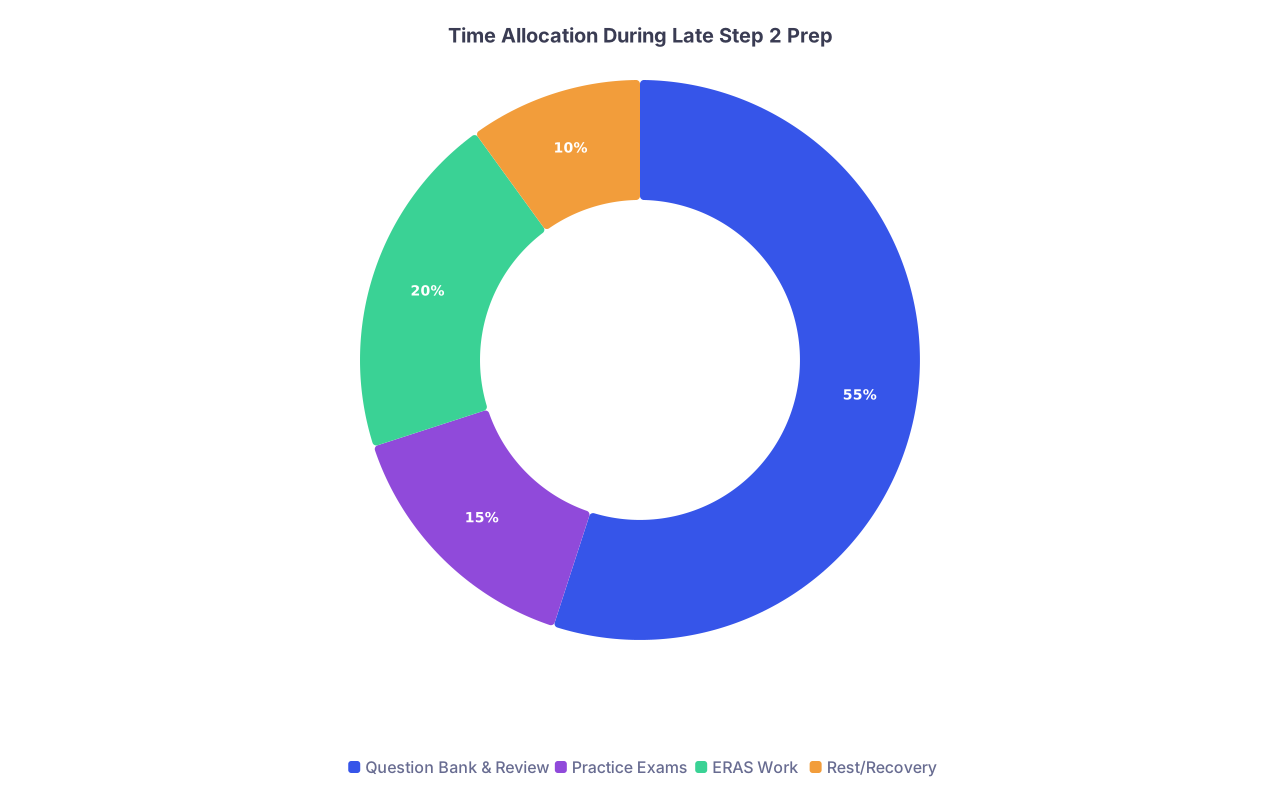
| Category | Value |
|---|---|
| Question Bank & Review | 55 |
| Practice Exams | 15 |
| ERAS Work | 20 |
| Rest/Recovery | 10 |
Non-negotiables
Every 2 weeks → objective data check
- Take an NBME or UWorld SA
- If your predicted score:
- Is within 5–7 points of your target → stay the course
- Is dropping or stagnant while your effort is “maxed” → you have a technique or content gap, not just a time gap
Protect sleep the final 7–10 days You are late. You are stressed. You will be tempted to “solve” that by cutting sleep to squeeze in more questions. It backfires almost every time.
Mild reduction (e.g., 7.5 → 6.5 hours) is tolerable. Chronic 4–5 hour nights before a high-stakes test is academic self-harm.Use your rotations, don’t let them use you On wards during late prep:
- Volunteer for admissions / cross-cover that align with Step 2 bread-and-butter (chest pain, SOB, abdominal pain, sepsis, hyperglycemia, etc.)
- Turn every admission into a Step 2 vignette in your head: “What is the next best step? What labs? What disposition?”
- If a service is destroying your ability to study and your exam matters for your entire future career, talk to your chief/attending early, not two days before your exam.
5. Communicating With Programs About a Late Step 2
This part is uncomfortable, but dodging it hurts you more.
When to say something
You should explicitly communicate your Step 2 timing if:
- Your exam is after mid-September
- Your Step 1 is weak or Pass and programs will likely be waiting on Step 2
- You have a meaningful connection to a given program (home, away, strong fit)
How to say it (template you can adapt)
Subject: Step 2 CK Timing – [Your Name], [Specialty] Applicant
Body (short, tight):
Dear Dr. [PD Last Name] and the [Program Name] team,
My name is [Name], a [MS4, IMG, etc.] applying to your [specialty] residency program this cycle.
I wanted to briefly share that my USMLE Step 2 CK exam is scheduled for [exact date], with an anticipated score report in [approximate week/month]. This timing is due to [brief reason – e.g., required rotations, exam rescheduling, personal circumstance], but I’ve structured my schedule so that I can dedicate focused time to achieve a strong result.
I’m particularly interested in your program because [1–2 specific, real reasons]. I would be happy to forward my updated score report as soon as it is released.
Thank you for your time and consideration.
Sincerely,
[Name, AAMC ID, School]
Do not over-explain. Do not make it dramatic. You’re giving them context and signaling that you’re organized, not asking for special treatment.
6. Specialty-Specific Reality Check (Quick but Brutal)
Different specialties tolerate “late + pending Step 2” very differently.
| Competitiveness Tier | Examples | Sensitivity to Late Step 2 |
|---|---|---|
| Ultra-competitive | Derm, Ortho, ENT, Plastics | Very high |
| Moderately competitive | EM, Anes, OB/GYN, Rad | High–moderate |
| Less competitive | FM, Psych, Peds, IM (community) | Moderate–lower |
Translate that:
- For ultra-competitive: Late Step 2 is often lethal unless your file is already exceptional and you have serious home/mentor support.
- For moderate specialties: Late Step 2 hurts, but a strong score can still open doors, especially regionally.
- For less competitive: You have more leeway, but you still don’t want to be the November-score applicant with no clear reason.
You adjust your program list accordingly. If you’re late, you buy down risk with volume and diversity of programs.
7. Common Mistakes I See (That You Can Still Avoid)
I’ve watched people in your spot blow their chances in very predictable ways:
Waiting to start ERAS until after Step 2 “so I can focus”
No. Wrong order. You will never be less stressed than you are right now. Get the draft work done early.Treating practice scores like optional data
Taking Step 2 when your last 2 practice tests are both below where you’d be comfortable sending the score, “hoping it will be better on test day.” It rarely is.Over-fixating on a magic number
“I need exactly a 245 or my life is over.” No, you need a score that keeps you in range for the types of programs you’re actually applying to. There’s a difference.Ghosting programs instead of updating them
If your score is delayed, say something. A simple one-sentence update via ERAS or email is better than silence.Letting guilt and shame waste time
You’re late. Fine. You don’t fix that by beating yourself up for three weeks and doom-scrolling SDN. You fix it by making the next 6–10 weeks count.
FAQ (Exactly 3 Questions)
1. Should I ever delay Step 2 past the application cycle entirely (take it after I apply)?
If your school and state licensing rules allow it, and you’re applying to a less competitive specialty with a solid Step 1, it can be reasonable to apply with only Step 1 and take Step 2 later. But that’s a very context-specific call. Many programs now expect a Step 2 score during the season, especially post–Step 1 Pass. Talk to your dean’s office and a trusted advisor in your specialty before you commit to that path.
2. How many practice tests do I need if I’m also juggling ERAS?
Minimum three: two NBMEs and either an extra NBME or UWorld SA. Ideally four. If you’re constrained, I’d rather you do three well (with full, ruthless review) than squeeze in five you barely look at. Use them to decide whether to move your test, not as a box-checking exercise.
3. I’m already late, my practice scores are mediocre, and I feel burned out. Should I take a year off and apply next cycle instead?
Maybe. If your current trajectory suggests a clearly weak Step 2 that won’t match your career goals, a planned research year or extra clinical year with a clean, early application the next cycle can be smarter than forcing a half-baked attempt now. But do not decide that alone at 2 a.m. Talk to: your dean, a specialty advisor, and if possible a PD or APD who will be blunt with you. If you stay in this cycle, commit; if you step out, use the year aggressively to fix the underlying problems.
Open your calendar right now and block off your next 8 weeks: exact Step 2 date, ERAS completion deadlines, and your next two practice tests. If those dates aren’t on paper, you’re not running a strategy—you’re just hoping time slows down.


