
What do you do when your phone lights up with “Call me now, it’s urgent” from a family member… and you’re 6 weeks out from Step 2?
This is where the neat color‑coded Anki schedule dies and real life walks in. Illness. Death in the family. Breakup. Parent losing a job. Sibling in crisis. Your own health collapsing. And Step 2 does not care.
I’m going to walk you through what actually works when your life blows up during Step 2 prep. Not the fantasy version where you “push through” with perfect discipline. The real version where your brain is half in a hospital room and half in UWorld.
We’ll hit four big things:
- Whether you should postpone or not (and how to decide fast, not emotionally).
- How to triage your studying when your capacity drops to 40–60%.
- What to say—to your school, your family, and yourself.
- How to survive the 1–2 worst weeks without tanking your long‑term goals.
Step 1: Decide If You Should Postpone — Using a Cold, 3-Variable Check
The first mistake people make: they wait too long to even ask “Should I move my exam?” They just keep trying to grind, doing worse and worse, and then panic three weeks out.
You need a quick decision framework based on three things:
- Your current performance
- The severity/timeline of the crisis
- Your residency goals and application timing
Let’s make it concrete.
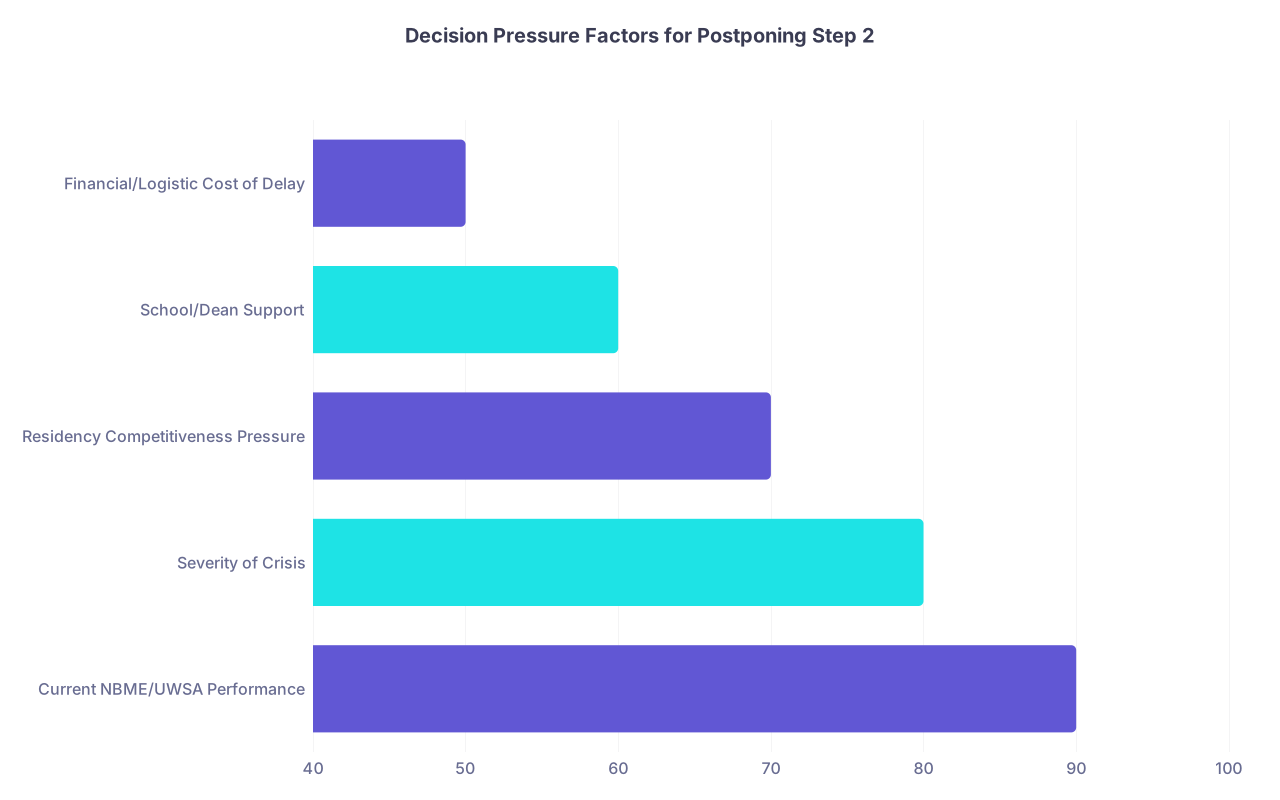
| Category | Value |
|---|---|
| Current NBME/UWSA Performance | 90 |
| Severity of Crisis | 80 |
| Residency Competitiveness Pressure | 70 |
| School/Dean Support | 60 |
| Financial/Logistic Cost of Delay | 50 |
A. Look at your numbers, not your feelings
I don’t care how “behind” you feel. Feelings lie. Your last 2–3 objective data points matter:
- Last NBME/UWSA score
- Last 5–10 UWorld block averages (timed, random)
- How far you are in your question bank
Use this rough guide:
| Current Level (NBME/UWSA) | Crisis Severity | My Usual Recommendation |
|---|---|---|
| ≥ 245 | Moderate/Severe | Probably stay the date |
| 230–244 | Moderate | Case-by-case |
| 230–244 | Severe | Strongly consider delay |
| < 230 | Any Major Crisis | Usually postpone |
“Severe” means: death in family, ICU-level illness (you or close family), active domestic situation, serious mental health crash, or you’re literally handling lawyers/insurance/hospital logistics daily.
B. Ask one blunt question
Here’s the question I ask people when I work with them:
“If your crisis continues at the current level for the next 2–3 weeks, can you realistically complete 2–3 practice tests and at least 50–75 questions most days?”
If the honest answer is no, you’re not “weak.” You’re overextended beyond a human limit. That’s normally a sign to postpone.
If the answer is yes, but at reduced intensity, then you’re in “manage around it” territory.
C. Application timing reality check
You’re probably worrying: “If I delay, my Step 2 score won’t be in time for ERAS. Programs will hate me.”
Let me be direct: a delayed but solid Step 2 is way better than an on-time mediocre one. Especially if Step 1 is pass/fail and Step 2 is your only number.
Rule of thumb:
- If you’re 3+ months before ERAS submission: postponing a few weeks is almost always fine.
- If you’re 6–10 weeks before ERAS and have no Step 2 score yet: you can still delay a couple of weeks and submit your application with “score pending” at many programs. Annoying? Yes. Fatal? Usually no.
- If you already have a strong Step 1 and are not aiming for extremely competitive specialties: you often have more flexibility.
If your school has an advising dean, this is the one moment you actually use them. Email: “I’m dealing with [brief description], considering delaying Step 2 by [X weeks]. Can we talk about how that impacts ERAS?” Then schedule a 15–20 minute call.
Step 2: Build a “Crisis Mode” Study Plan — Not the Fantasy Version
Once you decide whether you’re staying or postponing, you need a crisis-mode plan. Your brain isn’t working at 100%. So don’t design a plan that assumes it is.
Your new priorities:
- Preserve what’s already in your head.
- Do the highest-yield practice with the lowest overhead.
- Accept that your daily capacity will swing.
Forget 10‑hour grind days. You’re trying to average 3–6 real, focused hours, depending on the week.
A. Triage your tools
You cannot do everything. So you pick ruthlessly.
Top tier (must protect if possible):
- UWorld (or main Qbank)
- 2–4 NBMEs/UWSAs before test day
- One core resource for concepts (Online MedEd, Divine, Boards & Beyond, etc.) if you truly need it
Things that often need to shrink or go entirely during the acute phase:
- Massive Anki backlogs
- Second/third question banks
- Long full video series
If you’re deep in family/hospital chaos, for 1–2 weeks, the non-negotiable might just be:
- 40–60 high-quality questions per day
- 30–60 minutes of targeted review
- Sleep at a semi-human level
That’s it. Not pretty. But it keeps your Step 2 brain alive.
B. Use a crisis schedule template (light, medium, heavy days)
Crises are unpredictable. Some days you’re stuck in a hospital waiting room for 8 hours. Others you’re just emotionally drained but logistically free.
Use a 3‑tier structure:
- Heavy day (you’re mostly free, mentally okay-ish)
- Medium day
- Light day (chaos, active crisis)
Rough template:
| Day Type | Qbank Questions | Dedicated Review | Extra Work |
|---|---|---|---|
| Heavy | 60–80 | 2–3 hours | 1–2 hrs vids/notes |
| Medium | 40–60 | 1–2 hours | Optional light review |
| Light | 20–40 | 30–60 min | None |
Each morning, ask: “Today is realistically which type?” Then commit to that plan. No guilt about not doing a “heavy” day when your aunt just died.
Step 3: Studying When You’re Distracted, Grieving, or Half-Broken
Your concentration is not normal. You’re probably:
- Ruminating about your family member between every question.
- Getting triggered by certain vignettes (e.g., cancer, ICU, suicide).
- Feeling guilty whenever you’re not physically present with family.
So you adapt how you study.
A. Switch to shorter, tighter blocks
If 40-question blocks are destroying your focus, drop to:
- 10–20 question blocks, timed
- More frequent, shorter sessions: 15–25 minutes on, 5–10 off
This is not “weak.” It’s how you work when your attention span is shredded.
B. Manage emotionally triggering content
You will absolutely hit vignettes that are too close to home: metastatic cancer, traumatic injuries, sepsis in older adults, psychiatric crises.
You have exactly three acceptable options:
- Skip the question and mark it. Logically bad, but mentally sometimes necessary.
- Read the explanation without forcing yourself to grind through all details.
- Take a 5–10 minute break, then come back when the wave passes.
Do not white-knuckle through a stem that sends you into a panic spiral and then judge yourself for “being weak.” You’re a human being, not a Step robot.
C. Lower your “perfectionism bar” for review
During a stable time, I’d tell you: dig deep into every explanation, take good notes, cross-reference with a video. In a crisis?
You’re allowed to do:
- “Shallow but consistent” review: read the explanation, write 1–2 key lines, move on.
- Focus on patterns: what am I missing over and over? (e.g., CHF meds, diabetes management, psych med side effects).
Step 4: What to Tell Your School, Family, and Program Directors
You’re in the worst mental place when you also have to explain yourself to others. Let’s make that easier.
A. Talking to your school
If the crisis is more than a 48–72 hour blip, email an academic dean or student affairs. Short, professional, not over-sharing.
Sample email:
Subject: Step 2 CK – Personal Circumstances and Scheduling
Dear Dr. [Name],
I’m currently scheduled to take Step 2 CK on [date]. Over the past [time period], I’ve been dealing with a significant family emergency involving [very brief description: e.g., “a parent’s new cancer diagnosis” or “a sudden hospitalization”].
Given the impact on my ability to study consistently, I’m concerned about whether to postpone my exam and how that might affect my fourth-year schedule and ERAS timeline.
Could we schedule a brief meeting or call this week to discuss my options and the school’s recommendations in this situation?
Thank you for your time and guidance,
[Your Name]
[MS3/MS4, Class of XXXX]
You’re not asking for permission to care about your family. You’re asking for logistical help.
B. Talking to family who don’t fully get what Step 2 is
A lot of families hear “exam” and think SAT, not “my entire career competitiveness score.”
You need a 1–2 sentence script:
“This exam affects my ability to get a residency spot. I do want to be here and help, but if I completely stop studying for several weeks, it could hurt my entire career. I’m going to try to split my time: be present, but still keep doing X hours a day of work.”
If someone is not emotionally safe or is minimizing you (“It’s just a test, family is more important”), don’t fight them on it endlessly. Protect your time where you can, even if they don’t fully understand.
C. If this bleeds into your ERAS story (and when it should)
If your crisis wrecks your exam timing or your score, you may later address it very briefly in:
- A personal statement line.
- An ERAS “additional information” section.
- A conversation if a PD directly asks about a lower score or gap.
What you don’t do: write a three-paragraph trauma essay.
You say something like:
“During my Step 2 study period, a close family member developed a serious illness, and I took on a significant caregiving role. I managed to complete the exam while helping at home, but it did impact my preparation. Since then, my performance on [sub-internships/clinical work] has better reflected my usual capability.”
Short. Clear. No pity party.
Step 5: If You Postpone — How to Use the Extra Time Without Burning Out
If you decided to delay, don’t just stretch the same heavy schedule over more weeks and kill your mental health.
You’re not in a normal “5 more weeks of full-time study” situation. You’re balancing recovery and crisis.
Think of things in 2 phases:
- Acute (crisis control, logistics, raw grief) – often 1–3 weeks
- Recovery + Build – when the dust settles a bit and you can ramp back up
A. Acute phase: bare minimum plus survival
During the worst part:
- 20–40 questions per day is completely fine.
- 30–60 minutes of flashcards or rapid review.
- Sleep + food + movement matter more than another 20 questions.
Protect the habit, not the volume.
B. Recovery phase: rebuild like you’re coming back from an injury
When things calm slightly, you ramp:
Week 1 of recovery:
- 40–60 questions most days
- 1–2 hours of review
Week 2:
- 60–80 questions
- Full-length NBME or UWSA on a day you’re reasonably stable
Between now and the new exam date, you want:
- 2–4 total practice tests under your belt.
- Your Qbank at least 70–80% completed with reviewed questions.
- A sense that your last 2–3 exams are at or above your goal range.
Step 6: If You Don’t Postpone — How to Survive and Not Implode
Sometimes you cannot (or strongly should not) move the test:
- Visa issues
- School scheduling constraints
- Very late in ERAS cycle
- Crisis is heavy but time-limited and will likely settle before test day
Then your strategy is: contain the damage and protect your baseline function.
A. Reset your expectations of your score range
Hard truth: yes, your crisis may shave a few points off what you could’ve done in a perfect universe.
But you’re not in a perfect universe. You’re in this one.
Ask a more honest question: “Given my situation, what’s a score that keeps most doors open and doesn’t wreck my mental health further?” That might be 5–10 points lower than your original fantasy goal. Accept that.
B. Protect sleep like it’s part of the exam
Every student in crisis thinks the extra 2 hours from sleeping 4–5 h/night will save them.
It doesn’t. It makes your recall and emotional volatility worse, which destroys your studying and your test day.
Minimum non-negotiable: 6 hours of sleep, aiming for 7+ if you can. If you’re lying in bed ruminating, that still beats doing UWorld at 1:30 am in a half-dissociated state.
C. Plan for the worst day to be before the exam, not the night before
If you can influence logistics, try not to schedule the hardest emotional tasks (viewing, burial, major family meetings) within 24–48 hours of test day.
You sometimes have more control than you think over:
- When you travel.
- How long you stay.
- When you return and lock in your routine before the exam.
You’re allowed to say: “I need to go back 2 days earlier to take this exam that I’ve been preparing for all year.” That isn’t betrayal. That’s adulthood.
Step 7: Mental Health — When To Pull the Emergency Brake
There’s crisis-stressed, and then there’s “I’m not safe” or “I’m non-functional.”
If any of these are true most days:
- You’re not sleeping more than 3–4 hours.
- You’re having recurrent panic attacks.
- You’re having persistent thoughts that life is not worth it, or passive suicidal ideation.
- You can’t get through a 10-question block because your brain is blank / racing.
- You’re dissociating or losing time.
Stop. You’re out of “power through” territory and into “get help now” territory.
What “help now” looks like:
- School counseling / mental health service — yes, they exist for exactly this.
- Your own therapist or psychiatrist if you have one.
- Primary care visit for acute support (sleep, anxiety, depression).
- In truly dark moments: crisis hotlines or ER. That’s not drama, that’s safety.
You will absolutely not tank your career by saying “I needed help.” Quietly failing Step 2 or vanishing from your rotations because you broke down alone? That’s far worse.
A Visual: Reasonable Crisis-Mode Timeline
Here’s a simple mental model of how your study intensity might shift compared to your original plan.
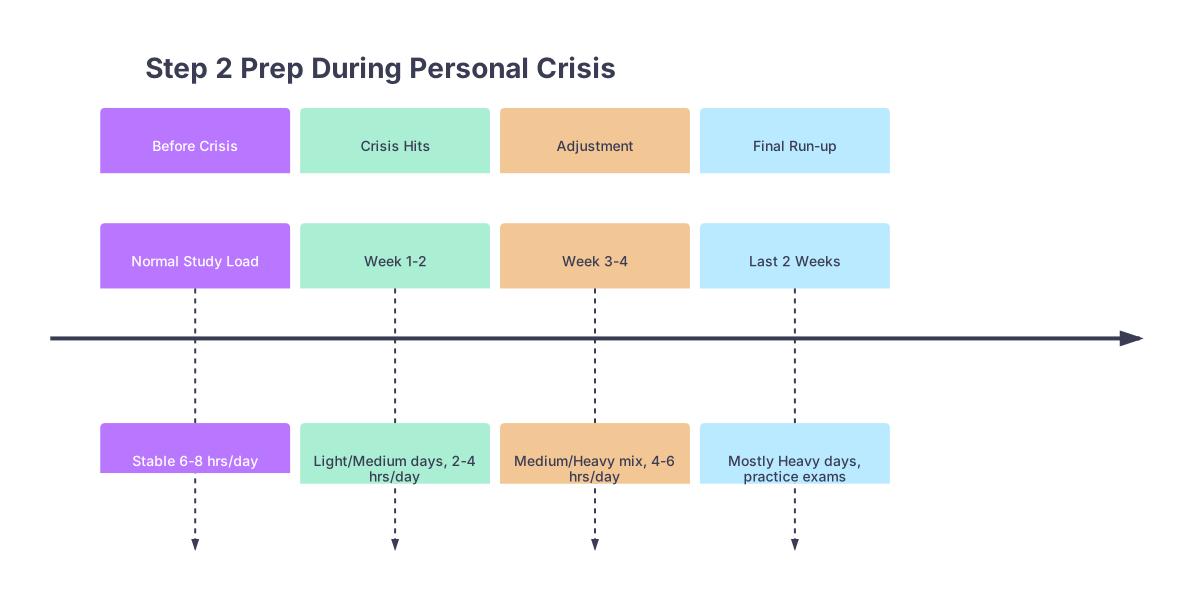
| Period | Event |
|---|---|
| Before Crisis - Normal Study Load | Stable 6-8 hrs/day |
| Crisis Hits - Week 1-2 | Light/Medium days, 2-4 hrs/day |
| Adjustment - Week 3-4 | Medium/Heavy mix, 4-6 hrs/day |
| Final Run-up - Last 2 Weeks | Mostly Heavy days, practice exams |
You’re not “failing” because you had a dip in the middle. You’re adapting.
Small Tactics That Help More Than They Should
A few deceptively simple moves I’ve seen help students in this exact situation:
- Study in a different physical space than where you’re having hard conversations (e.g., go to a quiet corner of the hospital lobby, a library, or even your parked car for 1–2 hour chunks).
- Use noise-canceling headphones or white noise when family chaos is loud.
- Before each block, write on a scrap:
“For the next 40 minutes, my only job is: [finish this block].”
Simple, but it cuts through the mental fog. - At the end of the day, list 3 things you actually did (even if it’s “20 questions, showered, called Mom”). Your brain will always tell you that you “did nothing.”
Quick Data Check: You’re Not Alone
You might feel like you’re the only one whose life fell apart during Step 2. You’re not. I routinely see 20–30% of students hit some serious life event during dedicated prep or late clinical years.
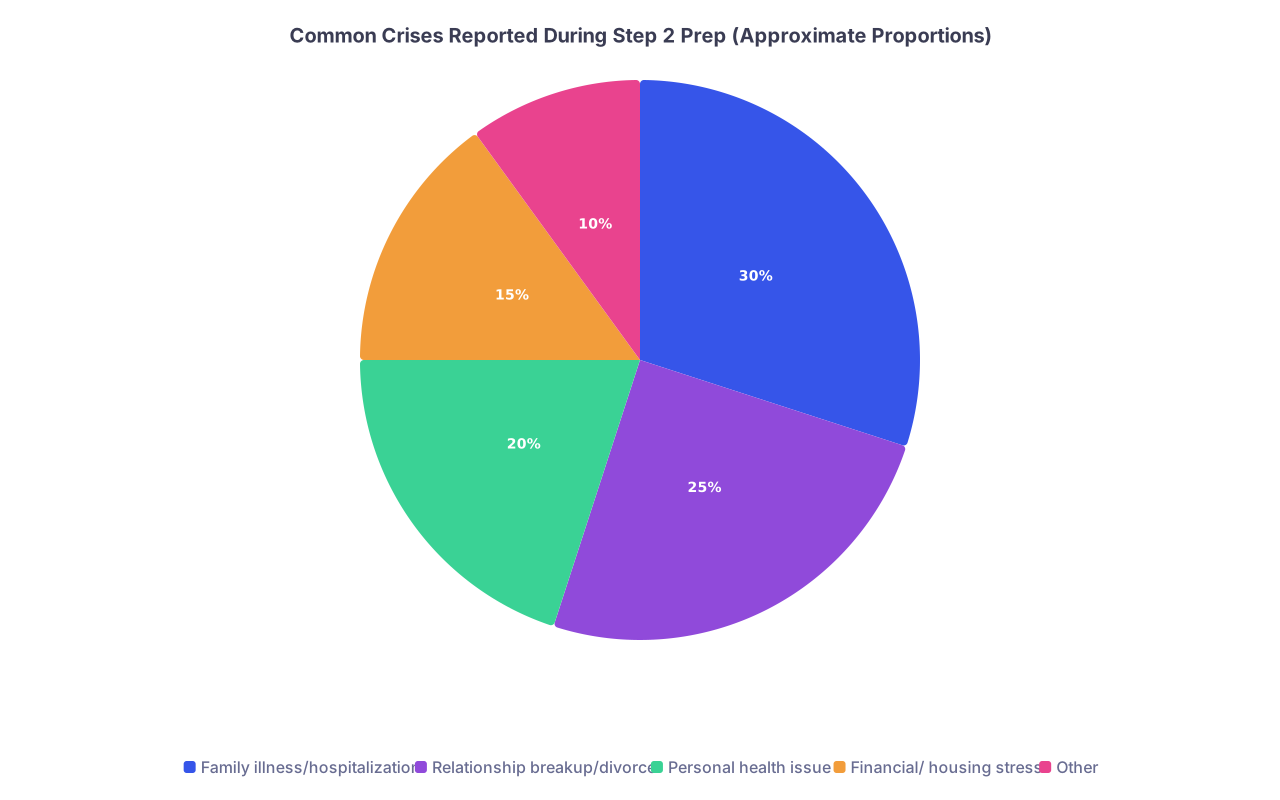
| Category | Value |
|---|---|
| Family illness/hospitalization | 30 |
| Relationship breakup/divorce | 25 |
| Personal health issue | 20 |
| Financial/ housing stress | 15 |
| Other | 10 |
You’re in ugly, very common company.
If You Remember Nothing Else
Two or three big points:
- Make an early, honest decision about postponing based on your actual scores and the reality of your crisis, not on guilt or wishful thinking.
- Switch to a crisis-mode plan: shorter blocks, fewer tools, protect sleep, and aim for consistency over heroics.
- Get institutional and mental health support when your function drops below “barely holding it together.” That’s not weakness; that’s how you keep both your career and your sanity.
You’re not failing because life got messy at the wrong time. You’re being asked to do something brutally hard: care about the people you love while still protecting the future you’ve been building for years. That tension will never feel clean. But you can get through it without burning everything down.
FAQ (Exactly 5 Questions)
1. If I postpone Step 2 because of a crisis, will residency programs hold it against me?
Usually not, especially if your final score is solid. Programs care far more about your actual performance than about whether you moved your date once. If it comes up, a short, straightforward explanation about a serious family or personal issue is perfectly acceptable. What raises more concern is a low score with no context or multiple failures.
2. How close to my exam can I realistically decide to postpone?
You can reschedule pretty late, but fees go up and available dates shrink. More importantly, the later you wait, the more you waste time and mental energy in a half-committed limbo. I tell people: if you’re within 3–4 weeks of your date and your last practice test is significantly below your target, and your crisis is still active, make a decision in that window—not 5 days before.
3. What if my family insists I should stop studying completely during the crisis?
You can respect the seriousness of the crisis while still protecting minimal daily study. Frame it as: “This exam affects my ability to finish training and help patients long-term. I need 2–4 hours a day to keep from falling apart academically, and I’ll be present the rest of the time.” You might still need to set boundaries—go to a different room, leave the house briefly—to make that possible. Their discomfort doesn’t override your entire future.
4. How do I handle seeing exam questions that are exactly like what my family is going through?
Give yourself permission to pause. If a vignette hits too close to home (same cancer, same ICU scenario, same age as a family member), you can skip it, mark it, or read the explanation without forcing full engagement. If it keeps happening and your reactions are intense—panic, flashbacks, tears—this is a sign to get professional support. You’re not broken; you’re having a very normal human reaction in an abnormal situation.
5. Is it ever reasonable to take Step 2 “underprepared” just to get it over with?
Sometimes, but be very strategic. It can make sense if: you already have a solid Step 1; you’re aiming for a less competitive specialty; your practice tests are at least within striking distance of “safe” territory; and logistical constraints make delay much worse. It’s a bad idea if you’re repeatedly scoring at or near failure, your crisis is still at full volume, or you know that a poor Step 2 score would seriously damage your options. In that case, postponing and regrouping is usually the smarter move, even if it feels painful in the short term.