
The usual advice about Step 2 timing is too vague to be useful. “It depends” is not a plan. You need a clear answer: should you take Step 2 CK before or after your sub‑internship?
Here’s the real answer:
If you are aiming at a moderately or highly competitive match, and especially if your Step 1 is pass-only or mediocre, you should almost always take Step 2 before your main sub‑I. But not so early that you’re underprepared or sacrificing your third‑year clerkships.
Let’s walk through this in a way that ends with an actual decision, not hand‑waving.
The Core Question: What Are You Optimizing For?
You are choosing between two things:
- Maximizing your Step 2 score
- Maximizing your sub‑I performance (grade, letters, networking)
You don’t get to fully optimize both at the exact same time. The trick is deciding where you need the bigger win.
Here’s how I rank priorities for most students in 2026:
- A strong Step 2 CK score that’s visible by ERAS opening
- A solid sub‑I (especially in your chosen specialty) with at least one strong letter
- Not burning out so hard that both suffer
If Step 2 is likely to be a strength on your application (i.e., you test well, did fine on shelves, and Step 1 was meh or pass-only), you want that score in early. Program directors are looking at it. A lot.
If Step 2 is likely to be a liability (weak shelves, trouble with timed exams, borderline Step 1), then you need extra prep time, which may mean scheduling it after your sub‑I or after a lighter block.
So timing isn’t abstract. It’s personal.
How Your Step 1 and Career Goals Change the Answer
Let’s be blunt. Different students need different timing. Here’s the high‑yield breakdown.
| Student Profile | Best Step 2 Timing |
|---|---|
| Strong Step 1, non-competitive specialty | Either side of sub-I, flexible |
| Pass-only Step 1, aiming competitive | Before sub-I, score in by ERAS |
| Weak Step 1, needs redemption | Before sub-I, but with sufficient dedicated time |
| Shelf scores consistently high | Earlier is fine, often before sub-I |
| Shelf scores mediocre/low | Later, after extra prep and clinical reps |
If your Step 1 is pass-only or average
You are exactly the person programs will judge on Step 2. It becomes your new “number.”
For you, the exam is not optional decoration. It’s a core signaling tool. That means:
- You want your score in the file before programs seriously review applications (September–October).
- You do not want to cram it between a brutal sub‑I and interview season.
In that situation, taking Step 2 before your big sub‑I is usually smarter, especially if your sub‑I is July–September.
If your Step 1 is excellent and you’re going into a less competitive field
Family med, psych (at many programs), peds, neurology at mid‑tier institutions. Step 2 still matters, but you have more leeway.
You can:
- Use your sub‑I to sharpen your clinical pattern recognition, then
- Take Step 2 after sub‑I with a short dedicated period
For you, a slightly later Step 2 that’s comfortably above average is fine. Programs know you’re safe.
What a Sub‑I Actually Demands from You
A true sub‑internship (medicine, surgery, OB, etc.) is not just “another rotation.” The time and cognitive load are different.
You’re doing things like:
- Pre‑rounding on 4–10 patients
- Writing full notes and orders (co-signed, but still)
- Presenting like an intern on rounds
- Getting called for pages, sometimes staying late, occasionally taking call nights
- Constantly being watched by residents and attendings who might write your letters
Trying to do ~4–5 hours of serious Step 2 studying per day during a real sub‑I? Usually fantasy.
You’ll manage:
- Question blocks some days
- Light review on others
- And on post‑call? Probably nothing
So if you imagine “I’ll just study hard after my sub‑I shifts,” you’re lying to yourself unless your sub‑I is very chill (some places they basically are; many places they are not).
Pros and Cons: Step 2 Before vs After Sub‑I
Let’s actually weigh it.
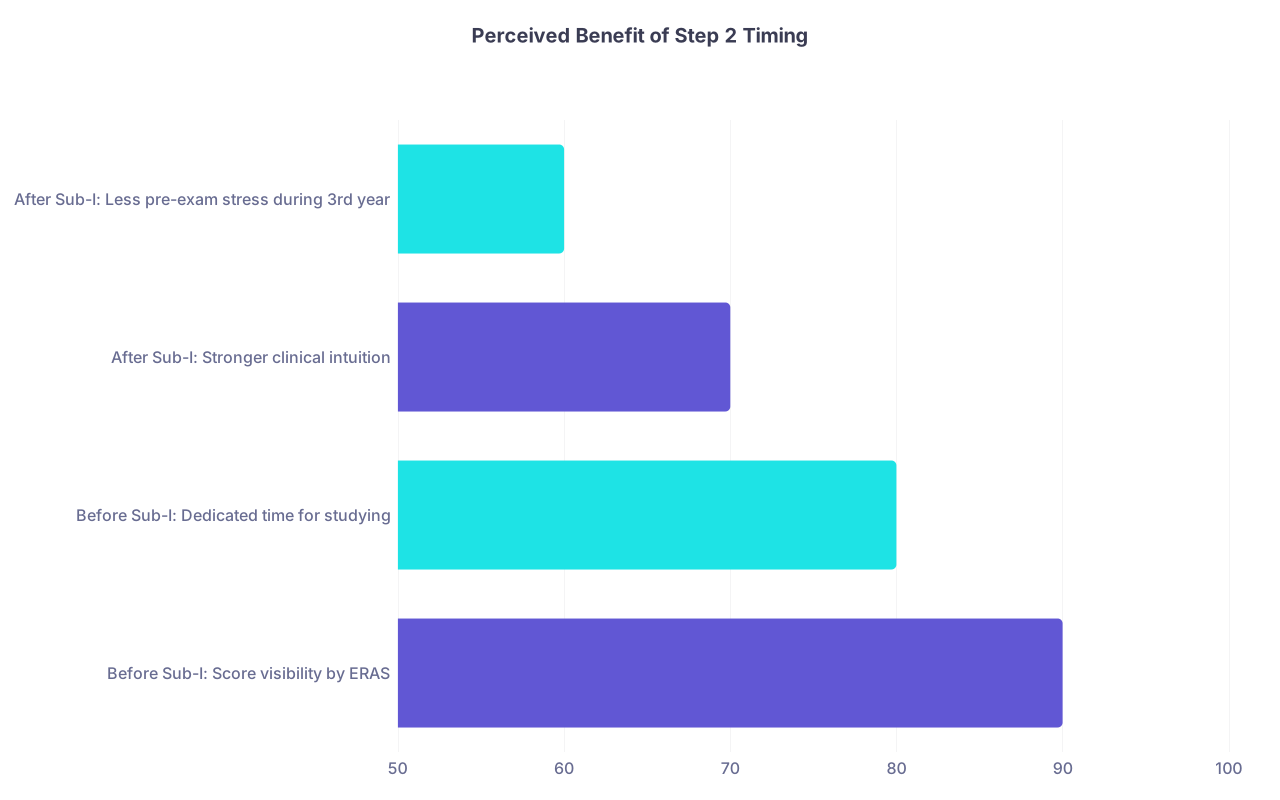
| Category | Value |
|---|---|
| Before Sub-I: Score visibility by ERAS | 90 |
| Before Sub-I: Dedicated time for studying | 80 |
| After Sub-I: Stronger clinical intuition | 70 |
| After Sub-I: Less pre-exam stress during 3rd year | 60 |
Taking Step 2 CK Before Your Sub‑I
Upsides:
- Score is ready by ERAS (huge for competitive fields or weak Step 1).
- You can use a focused dedicated period, often right after third‑year core rotations when shelf knowledge is fresh.
- During sub‑I, you can focus fully on performance, letters, and being a functional intern without exam stress.
- Programs see your “final academic product” before deciding whether to interview you.
Downsides:
- You take the exam with slightly less clinical polish than you’ll have after sub‑I.
- If your third‑year core schedule was chaotic, you might feel underprepared without a clean study block.
- If Step 2 goes badly, it’s locked in early and you’re stuck with that score in your file from day one.
Taking Step 2 CK After Your Sub‑I
Upsides:
- You’re more clinically sharp: better at management questions, triage, what‑next steps.
- Your sub‑I performance might improve because you’re not splitting attention with a looming exam.
- If your sub‑I is in your chosen specialty (e.g., medicine sub‑I before IM Step 2 questions), the clinical reasoning translates nicely.
Downsides:
- Your score might not be in when programs first screen apps. Some will pass; some will wait; some will not.
- You risk being forced into a short, stressed-out prep window squeezed between sub‑I, away rotations, and interviews.
- If you underperform, there’s no time to adjust your application narrative; that is your number.
Practical Scheduling Scenarios That Actually Work
Let’s get concrete. Here are timing patterns I’ve seen work well.

| Step | Description |
|---|---|
| Step 1 | End of 3rd Year Cores |
| Step 2 | Plan 4-6 weeks dedicated |
| Step 3 | Take Step 2 in June-July |
| Step 4 | Do sub-I after exam |
| Step 5 | Do sub-I July-Aug |
| Step 6 | 2-3 weeks dedicated after |
| Step 7 | Take Step 2 in Sept-Oct |
| Step 8 | Fit Step 2 in open month |
| Step 9 | Need strong Step 2 for apps? |
| Step 10 | Sub-I early in 4th year? |
Common winning strategy (for many students)
- Finish third‑year cores in May–June
- 3–5 weeks of dedicated study
- Take Step 2 in late June or July
- Do your main sub‑I in July–September, fully focused on performance
This works well if:
- Your school’s schedule allows that post-core gap
- You need Step 2 to be visible and strong early
- You want to walk into sub‑I with exam stress off your back
Alternative good strategy
- Early 4th year sub‑I (July–August)
- Two lighter rotations or vacation in September
- Dedicated + Step 2 in late September/early October
This can work if:
- You’re not chasing the most competitive specialties
- Your Step 1 is not a liability
- You’re okay with some programs seeing “Step 2 pending” at initial review
Key Red Flags: When “After Sub‑I” Is a Bad Idea
You should be very cautious about planning Step 2 after a sub‑I if:
- You’re applying to competitive specialties: derm, ortho, ENT, plastics, urology, neurosurgery, some EM/ophtho programs.
- Your Step 1 was barely pass or failed first attempt.
- Your shelf exams were mostly average or below, and you haven’t shown a trend of improvement.
- You know your sub‑I will be intense (high patient volume, 6-day weeks, frequent call).
In those cases, punting Step 2 too late is how people end up with:
- A rushed 10–14 day prep
- A mediocre or disappointing score
- No time left to explain or compensate
And then the emails start: “Should I delay graduation? Do I need a research year?” You really want to avoid that.
Study Strategy Differences: Before vs After Sub‑I
Your actual Step 2 studying also looks different depending on timing.
If you take Step 2 before sub‑I
Your approach:
- Treat it like Step 1 light: heavy on questions, compact content review, tight schedule.
- Lean hard on the shelf knowledge you just used.
- Use UWorld, AMBOSS, NBME practice exams; top off weak clerkships (OB, peds, psych) with targeted review.
Your calendar might look like:
| Week | Focus |
|---|---|
| 1 | IM foundations + UWorld medicine blocks daily |
| 2 | Surgery/OB + 1 practice NBME |
| 3 | Peds/Psych/Neuro + 1 practice NBME |
| 4 | Mixed blocks, review wrongs, 1 final NBME/UWSA |
If you take Step 2 after sub‑I
Your sub‑I becomes part of your studying:
- Treat every patient as a test prompt: ask yourself diagnosis, next best test, next best management step.
- When residents pimp you, connect it to how Step 2 would phrase that scenario.
- Keep 10–20 questions most days (even if that means just one block) alive during sub‑I so your test muscles don’t atrophy.
Then, once sub‑I ends:
- Take 2–3 weeks to convert all that clinical reasoning into exam‑style answers.
- Focus your questions and review on areas not emphasized heavily during your sub‑I. For example, if you did a medicine sub‑I, crank through OB and peds questions.
Decision Framework: How To Choose in 5 Minutes
Here’s the straight decision tree I’d use if you were my mentee.
Answer these:
- Are you aiming for a competitive specialty or top programs?
- Yes → You want Step 2 in early, usually before or at latest right around your sub‑I, with score visible by ERAS.
- Was your Step 1 unremarkable, low, or pass-only?
- Yes → Strong bias to before sub‑I, with adequate dedicated prep.
- Are your shelf exam scores mostly at or above your class average?
- Yes → You have flexibility; earlier Step 2 is fine.
- No → You may need more time. Either a later Step 2 after some extra reps or a longer dedicated block.
- Is your sub‑I known to be brutal at your institution?
- Yes → Do not plan to “heavily study” during it. Place Step 2 before or leave a safe dedicated period after.
If you answer:
- Competitive field + weak/average Step 1 + tough sub‑I → Take Step 2 before sub‑I.
- Non-competitive field + strong Step 1 + flexible schedule → Choose the slot that gives you a clean 3–4 week prep, before or after.
- You’re unsure about competitiveness (borderline applicant) → Lean earlier. You want Step 2 to help you, not haunt you.
The Bottom Line
Two clear takeaways:
- For most students in 2026—especially with pass-only or middling Step 1 and any interest in competitive programs—taking Step 2 CK before your main sub‑internship, with a proper dedicated study block, is the safer and smarter move.
- The only good “after sub‑I” plan is one that still gives you a clean, realistic study window and doesn’t delay your score past the point where programs are screening applications.
Everything else is noise.