

It’s February of MS3. Your school just approved your 4–6 week international elective for next fall. You’re thrilled—tropical country, interesting pathology, cheap flights, your classmates are jealous. Then you open your calendar and realize something ugly:
Step 2 CK is looming.
Your core clerkships barely fit.
There’s a shelf exam right before you fly out and another right after you get back.
And you’re suddenly asking yourself: “Am I about to screw my Step 2 CK timeline for a trip I could’ve done after graduation?”
You’re not wrong to be nervous. I’ve watched people do this brilliantly—and I’ve watched others tank their Step 2 momentum so badly that they delayed the exam, then went into ERAS with a weaker application than they needed to.
Here’s how to be in the first group, not the second.
Step 2 CK + International Elective: What You’re Actually Up Against
First, get brutally clear on the constraints. Not vibes. Calendar.
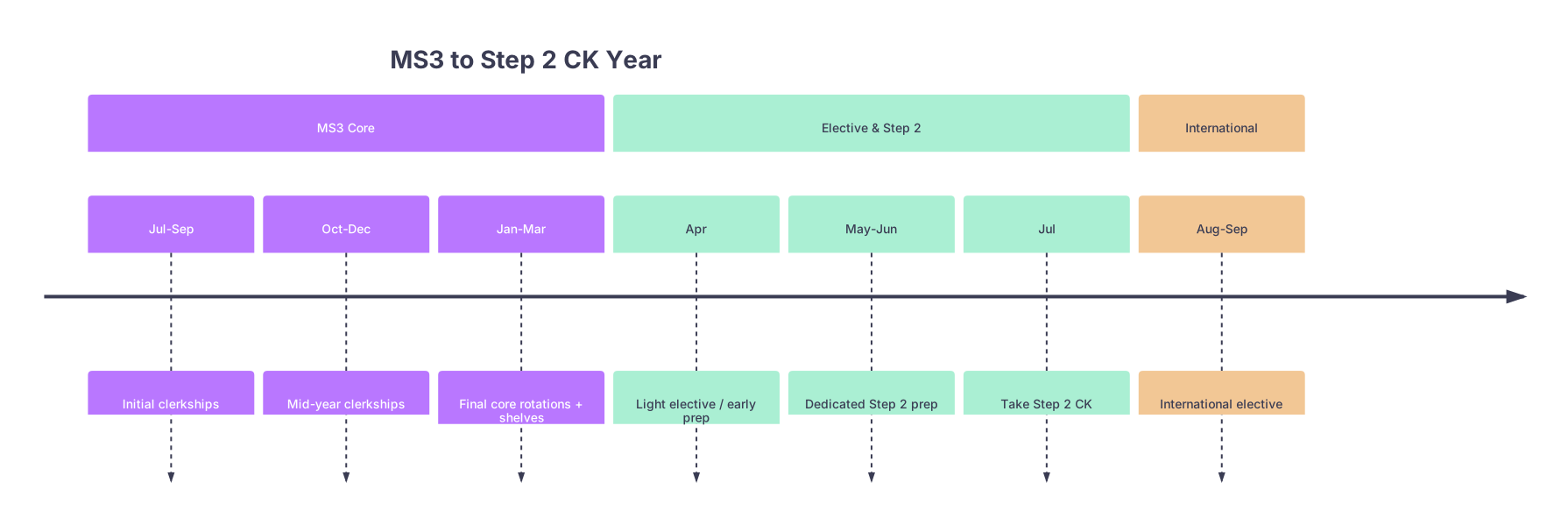
| Period | Event |
|---|---|
| MS3 Core - Jul-Sep | Initial clerkships |
| MS3 Core - Oct-Dec | Mid-year clerkships |
| MS3 Core - Jan-Mar | Final core rotations + shelves |
| Elective & Step 2 - Apr | Light elective / early prep |
| Elective & Step 2 - May-Jun | Dedicated Step 2 prep |
| Elective & Step 2 - Jul | Take Step 2 CK |
| International - Aug-Sep | International elective |
Now imagine you insert your international elective right where that “light elective / early prep” or “post-core buffer” would’ve been. You’re stealing from somewhere. Usually from one of these:
- Post-clerkship consolidation time (when you should be building Step 2-level understanding out of shelf knowledge)
- Dedicated or semi-dedicated Step 2 study time
- Breathing room between final core shelf and exam date
You can absolutely still make this work. But only if you stop pretending time is unlimited.
The big risks I’ve seen:
- You return from abroad mentally checked out and behind—then try to cram Step 2 in 2–3 frantic weeks.
- You underestimate how cognitively draining travel, new systems, and language barriers are—so your plan to “study 4 hours every night” dies in week one.
- You use the rotation as vacation, then panic when your practice NBME scores are flat or dropping.
So your job is simple:
Design the elective so it feeds your Step 2 prep instead of stealing from it.
Step 1: Fix Your Timeline Before You Buy the Plane Ticket
Do this part now. Not “later after things calm down.” They won’t.
You need three dates on paper:
- When you finish your last major core rotation (IM, Surgery, Peds, OB/GYN, Psych, Neuro/FM depending on your school)
- When you’re realistically planning to take Step 2 CK
- Start and end dates of the international elective
If you don’t know how much dedicated time you actually need, use this as a rough guide:
| Baseline Situation | Recommended Dedicated Time |
|---|---|
| Strong Step 1 + mostly Honors on shelves | 2–3 weeks |
| Mixed Step 1 + Pass/High Pass shelves | 3–4 weeks |
| Barely passed Step 1 + weak shelves | 5–6 weeks |
Now the hard rule:
If your international elective removes your minimum dedicated time from the calendar, you either:
- Move the elective
- Move the exam
- Or skip the elective
There’s no magic time-compression hack that turns 6 weeks of needed prep into 2 weeks just because the plane ticket is nonrefundable.
Where the elective can safely fit
Safest positions I’ve seen work:
- After you’ve already taken Step 2 CK (ideal, but not always allowed in MS3)
- Between lighter rotations where you already have a 3–4 week buffer after returning
- Right after a lighter clerkship (FM, Psych for many schools) where shelf prep overlaps heavily with Step 2 material
Worst positions:
- Ending 1–2 weeks before your Step 2 exam date
- Sandwiched between your hardest rotation and another high-stakes clerkship
- During what was previously your only dedicated period
If your plan right now is “I’ll just compress my study later,” you’re already behind.
Step 2: Decide What Step 2 Tasks Must Be Done Before You Leave
Think of your Step 2 prep as three buckets:
- Foundation build – watching/reading core content, organizing notes
- Question engine – UWorld, NBMEs, practice tests
- Refinement – high-yield review, weak areas, test-taking drills
When you add an international elective, you must front-load buckets 1 and chunks of 2 before you fly out. Why? Because abroad you won’t reliably have:
- Consistent internet
- Reliable power
- Time or energy for long learning curves with new resources
What I recommend you commit to finishing before departure:
- One full pass of a primary Step 2 resource (OnlineMedEd, Boards & Beyond, AMBOSS articles, school-specific content—pick one)
- 30–40% of UWorld Step 2 QBank, done carefully (not flash-card speed clicking)
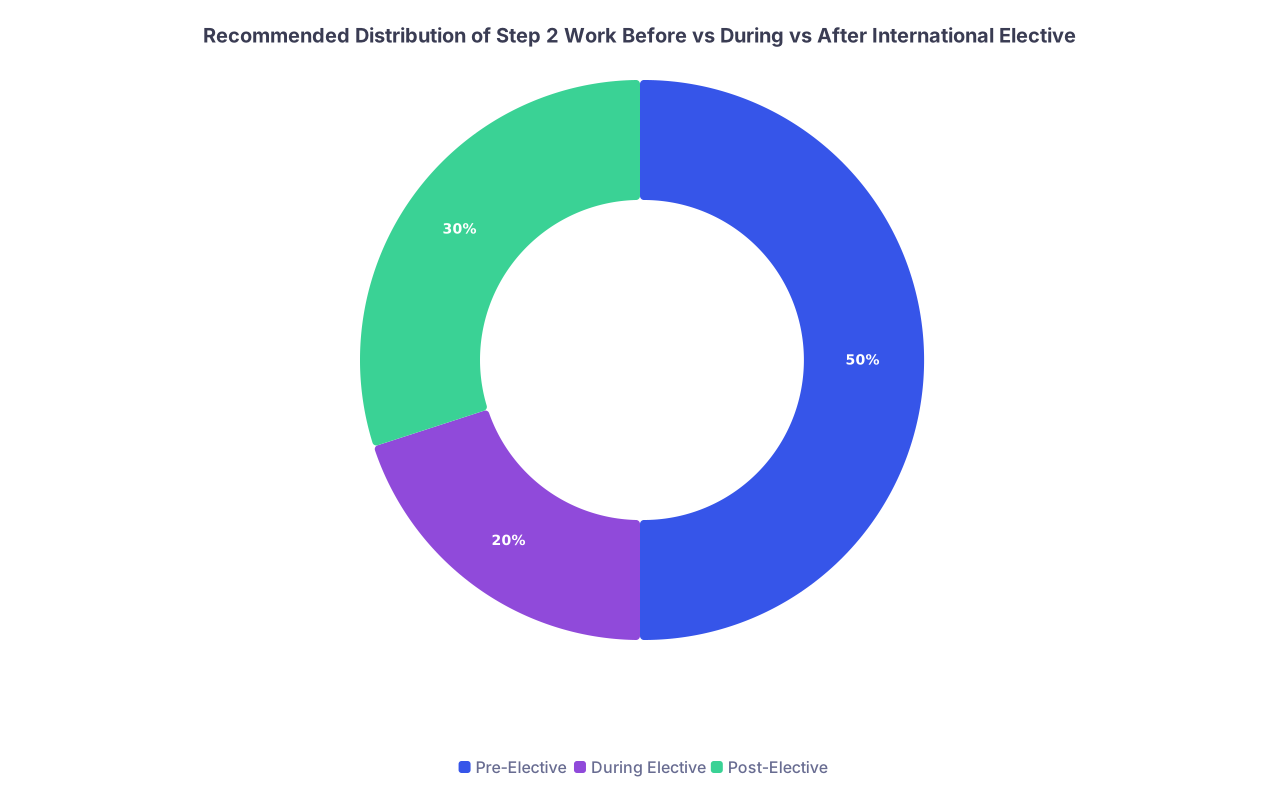
| Category | Value |
|---|---|
| Pre-Elective | 50 |
| During Elective | 20 |
| Post-Elective | 30 |
Rough split that works:
- 50% of your total Step 2 prep before you go
- 20% during the elective (maintenance + targeted review)
- 30% in a real dedicated block after you return
If you’re at 0–5% of UWorld and haven’t touched any Step 2-specific content and you leave in 3 weeks? You need to either move the trip or resign yourself to moving your test date.
Step 3: Pick the Right Kind of International Elective
Not all international electives are equal for Step 2.
Bad scenario: You’re on a “clinical” elective that’s actually shadowing, all in a different language, no opportunity to think through cases, no one bothering to teach, and your days are long and unstructured. Zero overlap with USMLE-style cases. You come home with stories, not skills.
Better scenario: You’re in a busy clinic, you’re allowed to take histories in English, you see bread-and-butter IM, Peds, OB, ID, you’re asked questions, you think through diagnostics and management—even if it’s in a resource-limited setting.
You want:
- Bread-and-butter medicine
- High volume of common problems (fever, cough, diarrhea, prenatal care, hypertension, diabetes, TB/HIV, etc.)
- Some degree of hands-on or at least active thinking
Ask these exact questions before you commit:
- “Will I be expected to take histories, present, or write notes, or mostly observe?”
- “Roughly what hours do students work each day? Are weekends free?”
- “What are the most common conditions I’ll see there?”
- “Is English used in patient care, or will I depend on interpretation?”
If answers are vague (“You’ll see a lot, it will be great exposure”) assume worst case: not Step-2-helpful and time-intensive.
Step 4: Build a Study Plan That Survives Travel Reality
You’re not going to study 4 hours a day every day abroad. You just aren’t. You’ll be tired, you’ll be exploring, call schedules will change, buses will be late, Wi-Fi will randomly die.
So aim for something that’s both useful and bulletproof even on messy days.
Your non-negotiable minimums abroad
Set these before you go and write them down. Something like:
- 10–15 UWorld questions per weekday (or 50–75 per week total)
- 20–30 minutes of daily quick review (Anki, flashcards, or brief notes)
- One half-day (3–4 hours) per week for deeper review (video + question blocks)
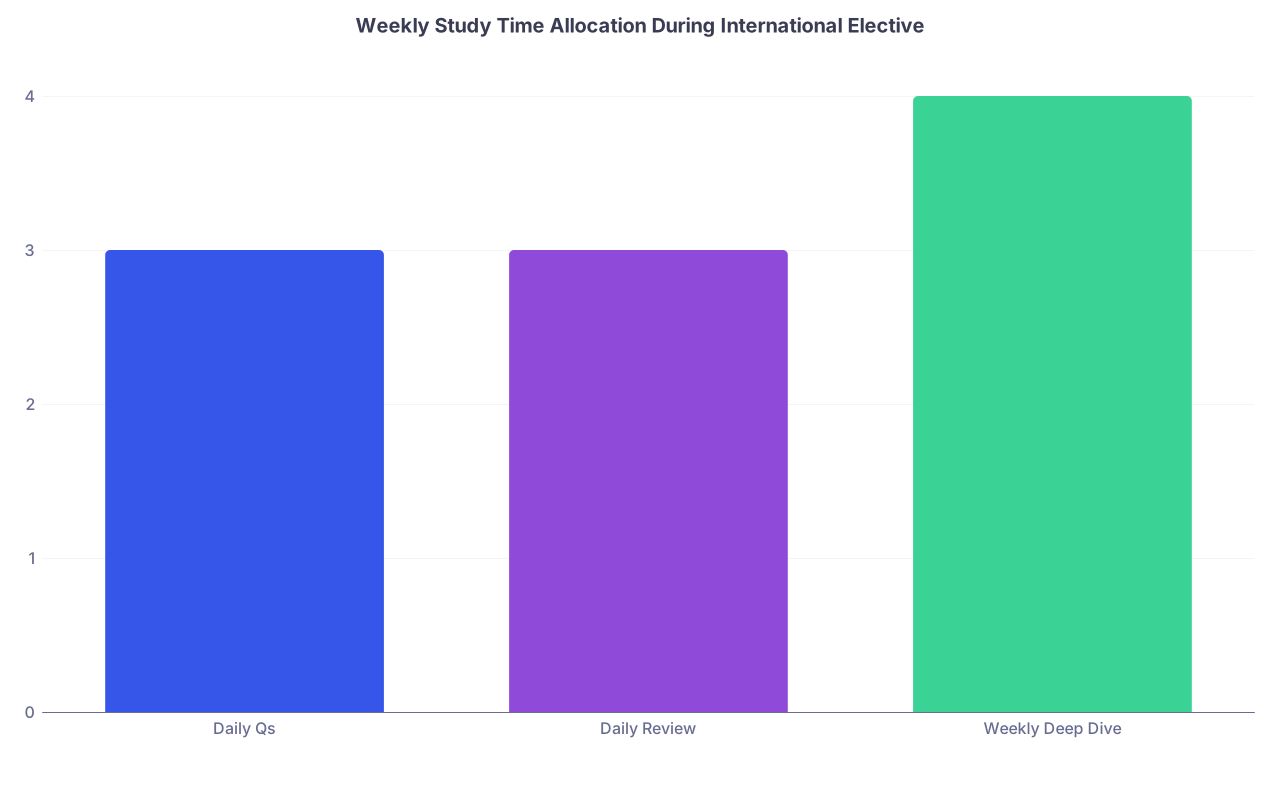
| Category | Value |
|---|---|
| Daily Qs | 3 |
| Daily Review | 3 |
| Weekly Deep Dive | 4 |
Rough total: 6–8 hours per week. Not heavy. But if you actually stick to it, you maintain your Step 2 “brain”.
How to make this feasible
Pre-download everything.
Don’t rely on streaming anything. Download:- Question bank offline if possible (AMBOSS app is better offline than UWorld, which matters)
- PDFs of your main review texts or notes
- Sketchy/Boards & Beyond videos you must see (if terms of use and tools allow offline)
Choose portable resources.
Dragging a 600-page book through three airports? You’ll stop using it after week one. Use:- Laptop + tablet or just tablet
- A compact high-yield book if you’re a paper person (Master the Boards, Step-Up to Medicine, etc.)
Protect early mornings or late nights.
Decide now: Are you a morning study person or night study person? Abroad is not the time to “figure it out.”
Examples:- “I will do 10 UWorld questions every morning before I leave the hostel.”
- “I will do my Anki cards in the evening before I shower.”
Anchor study to fixed routines.
“After dinner, I do 20 minutes of questions.”
“As soon as I get back to housing, I do my flashcards.”
Make it so automatic that it feels wrong not to do it.
If you can’t commit to even 6–8 hours of work per week abroad, you need a longer buffer after returning, or a later test date. Don’t lie to yourself.
Step 5: Choose Your QBank and NBME Strategy Around the Trip
International electives tend to slice your prep in two. Smart people use that second slice as refinement, not panic.
Before you go
Ideal targets before departure:
- 40–60% of UWorld finished
- At least 1 NBME or comprehensive practice exam completed
- A written list of your weakest topics (not just a vague sense of “I’m bad at neuro”)
While abroad
You’re not trying to predict your Step 2 score from another country. You’re trying to keep the muscle active. So:
- Stick with tutor mode or small timed blocks (5–10 questions) if internet or life are unstable.
- Focus questions on your known weak areas or whatever overlaps with what you’re seeing clinically.
Skip the full-length practice exams until you’re home unless you have:
- A full uninterrupted half day
- Stable internet and computer
- Low stress about logistics
After you return
Your first two weeks back should include:
- 1–2 NBME-style practice tests
- A push to finish remaining UWorld questions
- Hard review of mistakes, not just more volume
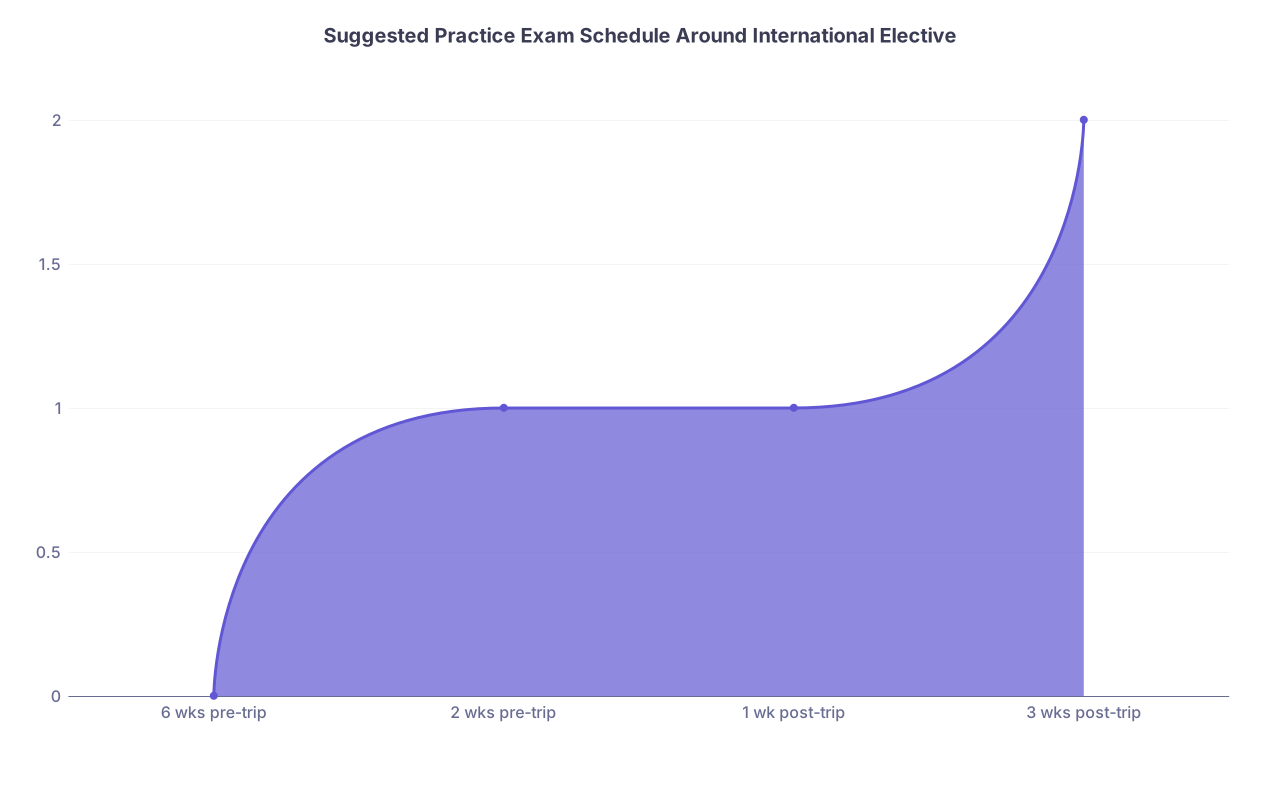
| Category | Value |
|---|---|
| 6 wks pre-trip | 0 |
| 2 wks pre-trip | 1 |
| 1 wk post-trip | 1 |
| 3 wks post-trip | 2 |
If your NBME scores after returning are below your target range by >10–15 points, that’s your signal: you probably need to push the test date if possible.
Step 6: Adjust Your Exam Date Rationally, Not Emotionally
People do something dumb here. They treat the exam date as a sacred fixed point even when all the data says, “You’re not ready.”
Let’s say your goal is a 245 because you’re eyeing IM at a solid academic program.
You come back from the elective, you take an NBME, you’re at 228. The test is in 2 weeks.
Questions you actually need to answer:
- Do you have a real 2–3 week window to focus now? Or are you jumping right into another rotation?
- How much did your score move in 2–3 weeks on Step 1 or shelf prep historically?
- Will delaying the exam meaningfully hurt your ERAS timeline? (Often the answer is no if you’re still pre-MS4 summer.)
If you have:
- Data that you improve quickly with focused work
- Enough time before ERAS or MS4 rotations to delay 2–4 weeks
- A program list that cares a lot about Step 2 (competitive specialties, weaker Step 1, etc.)
Then delaying is usually the right move. Not heroic grinding on a bad trajectory.
If you cannot move the exam—contractual school requirements, scheduled away rotations dependent on a completed Step 2—then you need to cut everything else non-essential and lean hard into final review. That’s the price.
Step 7: Use the Elective to Actually Help Your Step 2 Brain
Here’s the part most people don’t exploit: clinically rich electives can absolutely make Step 2 easier—if you approach them like reps, not tourism.
Tiny habits to add while you’re there:
After each clinic/hospital day, write down 3–5 cases with:
- Chief complaint
- Differentials
- Workup you’d order in the US
- Treatment in US vs resource-limited setting
Once or twice a week, pick one case and:
- Look up an UpToDate/AMBOSS article (downloaded) on that condition
- Do 5–10 related Step 2 questions if available
You’re basically turning your elective into live case-based learning.
A sample:
You saw a 26-year-old woman with fever, RUQ pain, and hypotension post-unsafe abortion. You think through:
- Differential: septic abortion, cholecystitis, cholangitis, appendicitis, PID, liver abscess
- In the US: broad-spectrum IV antibiotics, emergent uterine evacuation, ICU-level monitoring
- If they couldn’t do D&C there—what did they actually do? How does that compare?
That kind of live integration sticks far better than passive video watching.
Step 8: Protect Your Energy So This Doesn’t Break You
One more thing people ignore: exhaustion wrecks Step 2 studying much faster than a slightly shortened timeline.
You’re crossing time zones, eating new food, possibly getting sick, adapting to new systems. If your plan assumes you’ll be physically and mentally at 100% the whole time, it’s fantasy.
Be realistic:
- Week 1 abroad: you’re mostly adapting. Plan for minimal study and be happy if you exceed it.
- Mid-trip: the best time for deeper study blocks—your routine is set.
- Final week: you’re wrapping up, saying goodbyes, maybe doing last trips. Expect capacity for only light review.
Build in slack:
- Give yourself 2–3 days after you get home before you demand peak studying. Jet lag and readjustment are real.
- If you’re going straight from flight to clinical duties? Don’t also schedule an NBME that week. That’s a recipe for a demoralizing score.
Step 9: Red-Flag Scenarios Where You Should Seriously Consider Skipping or Postponing
I’m not going to romanticize this. Sometimes the right move is: do the trip later.
Red flags I’ve seen blow up Step 2 timelines:
- You barely passed Step 1 on the second attempt.
- You’re failing or barely passing shelves now.
- Your school gives you little to no control over your MS4 schedule.
- The elective is long (8+ weeks) and in the middle of your only realistic dedicated window.
- You already have significant non-negotiable time drains (family, job, health).
If you recognize yourself in two or more of those, you’re gambling. You might still choose to gamble. But call it what it is.
There will be other chances to work abroad: post-residency NGOs, short-term trips as an attending, structured global health fellowships. Step 2 is once, and for many programs it matters a lot more than your international elective line item.
What To Do Today
Do not just “think about this.” Actually do the work.
Today:
Open your academic calendar and:
- Write down your last core rotation end date
- Tentatively choose a Step 2 CK date
- Fill in your proposed international elective dates
On a separate page, write:
- “Pre-trip Step 2 goals:” and list:
- X% UWorld completion
- Y practice exams
- Z content resource pass
- “Pre-trip Step 2 goals:” and list:
Then ask a brutally honest question:
“Can I reasonably hit these pre-trip goals with my current schedule?”
If the answer is no, you have decisions to make: move the trip, move the exam, or change your expectations.
Open your calendar now and block 30 minutes to sketch this out. Not later. Not “after rounds calm down.” Put that 30-minute block in the next 48 hours and write “Step 2 + International Plan” on it. That’s how you protect your Step 2 CK timeline without sacrificing the experience you’re excited about.


