
Only 12–15% of Step 2 CK questions involve biostatistics, yet those questions often feel like 40% of what students complain about after the exam.
Let me be blunt: most people are not bad at “stats.” They are bad at recognizing patterns. Step 2 CK biostat is not creative. It is aggressively predictable. Same handful of ideas, wrapped in slightly different white coats.
You want to master this? You do not need a PhD. You need to know exactly what they like to ask, what they never ask, and what they will sneak in under time pressure.
Here is the real map.
The Biostatics “Cluster” on Step 2 CK: How It Actually Shows Up
Step 2 CK does not test biostat in isolation. You almost never see a block of 10 back‑to‑back stats questions. They are usually scattered, often as:
- One clean, standalone stats question (2–3 per exam)
- Several clinical questions with a small embedded table or graph
- A few ethics/patient safety questions that are actually stats/EBM in disguise
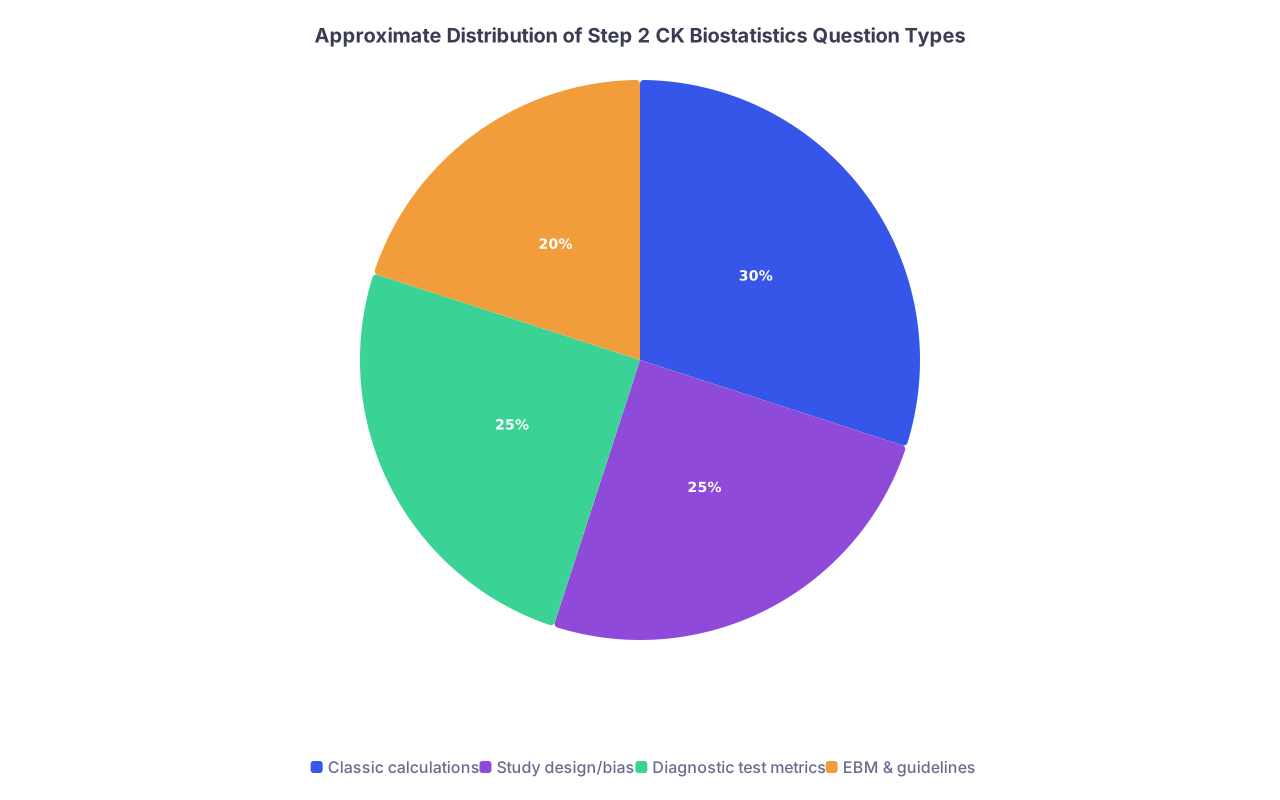
| Category | Value |
|---|---|
| Classic calculations | 30 |
| Study design/bias | 25 |
| Diagnostic test metrics | 25 |
| EBM & guidelines | 20 |
The dominant patterns:
- Classic 2×2 table / test performance questions
- Study design and bias recognition
- Confidence intervals, p‑values, and “is this difference real?”
- Number needed to treat/harm and absolute vs relative risk
- Regression, odds ratio, hazard ratio questions at a very superficial level
- Non‑inferiority trial interpretations
- Screening strategy questions tied to real clinical scenarios
If your “biostat review” does not systematically hit all of these, you are wasting time.
Pattern 1: Diagnostic Test Questions – The 2×2 Table Trap
This is the workhorse pattern. Shows up relentlessly.
What they actually test
Not “derive Bayes’ theorem from first principles.” They ask:
- Which test result rules disease in/out?
- How does changing threshold affect sensitivity/specificity?
- How do PPV/NPV change with disease prevalence?
- What happens when you screen low‑risk vs high‑risk populations?
- Which test should be used first / as a confirmatory test?
The basic 2×2 table:
| Disease + | Disease - | |
|---|---|---|
| Test + | a | b |
| Test - | c | d |
Formulas (you must know cold enough that you never “re-derive”):
- Sensitivity = a / (a + c)
- Specificity = d / (b + d)
- PPV = a / (a + b)
- NPV = d / (c + d)
But Step 2 rarely asks you to calculate all four. It does this instead:
A. “Which population change explains the new PPV?”
Classic stem:
A screening mammogram has 90% sensitivity, 95% specificity. In Clinic A, PPV is 10%. In Clinic B, using the same machine and protocol, PPV is 25%. What explains this?
They want: higher disease prevalence in Clinic B.
If PPV goes up with the same test performance → prevalence increased.
Flip side: If NPV goes up → prevalence decreased.
B. “Better screening test” questions
They give two ROC‑style descriptions without the graph:
Test A: sensitivity 92%, specificity 60%
Test B: sensitivity 75%, specificity 90%
Variations of questions:
- “Which test is better for initial screening?” → High sensitivity: Test A
- “Which test is better to confirm a positive?” → High specificity: Test B
- “Which strategy minimizes false negatives?” → Pick highest sensitivity or lower the threshold.
This is not about memorizing numbers. It is about linking:
- Sensitivity → SnOut (high sensitivity, negative rules out)
- Specificity → SpIn (high specificity, positive rules in)
Yes, these mnemonics are old and cheesy. They still work.
C. Threshold changes
Pattern: They change the cutoff for “positive” test.
Lowering the threshold for a positive troponin test will have what effect?
Correct pattern:
- Lower threshold → more people test positive → sensitivity up, specificity down
- Higher threshold → fewer positives → sensitivity down, specificity up
Do not overthink. It is that mechanistic.
Pattern 2: Risk, Odds, and NNT/NNH – Where Math and Clinical Judgment Meet
This is the second major bundle: incidence, relative risk, odds ratio, and NNT/NNH.
A. Absolute vs relative risk reduction
The board writers love to show how easily people get manipulated by percentages.
Example setup:
- Control event rate (CER) = 10% MI over 5 years
- Treatment event rate (TER) = 7%
Calculations:
- Absolute risk reduction (ARR) = 10% − 7% = 3%
- Relative risk (RR) = 7% / 10% = 0.7
- Relative risk reduction (RRR) = 1 − 0.7 = 0.3 = 30%
What they ask:
- “How many patients need to be treated to prevent one MI?”
NNT = 1 / ARR = 1 / 0.03 ≈ 33.3 → 34 patients
Or twist:
Drug decreases stroke risk from 4% to 3%. A pharmaceutical rep says it reduces risk by 25%. Is that accurate?
Yes, because RRR = (4 − 3) / 4 = 25%. But the clinically meaningful number is ARR = 1%, NNT = 100.
On Step 2, if they offer options like “NNT = 33” or “relative risk reduction = 30%,” they are checking whether you understand absolute vs relative.
B. Odds ratio vs relative risk
You do not need to memorize the formula for odds. You need to know:
- Relative risk → cohort studies (you start with exposure, follow for outcome)
- Odds ratio → case‑control studies (you start with outcome, look back for exposure)
| Study Type | Main Measure | Starting Point |
|---|---|---|
| Cohort | Relative risk | Exposure |
| Case-control | Odds ratio | Outcome |
| RCT | Relative risk | Randomized groups |
Pattern questions:
A study compares smokers to nonsmokers and follows them for development of lung cancer. Which measure of association is most appropriate?
Answer: relative risk.
A study identifies patients with pancreatic cancer and matched controls, then looks back at history of smoking. Which measure?
Answer: odds ratio.
Sometimes they throw numbers:
OR = 4.0, 95% CI 2.0–6.0. Interpret.
You say: Exposure is associated with a fourfold increase in odds of disease, and since CI excludes 1, this is statistically significant.
If the CI crosses 1 → “No statistically significant association detected.”
Pattern 3: Confidence Intervals, P‑values, and “Is It Significant?”
These questions feel more annoying than hard. They test:
- Interpreting CIs around means, differences, or ratios
- Recognizing when an effect is clinically vs statistically significant
- Type I vs Type II errors
A. The CI pattern
Three core uses:
- Single mean (e.g., mean BP 130, 95% CI 128–132)
- Difference between means (e.g., mean BP difference −5, 95% CI −8 to −2)
- Ratios (RR, OR, HR with CI, as above)
Rules:
- For means/differences: CI overlapping 0 → not significant
- For ratios (RR, OR, HR): CI including 1 → not significant
Example:
Treatment A lowers systolic BP by a mean of 6 mm Hg more than placebo (95% CI −9 to −3 mm Hg, p = 0.01). What does this suggest?
Correct interpretation:
- Statistically significant (CI does not cross 0, p < 0.05)
- Consistent BP decrease of about 3–9 mm Hg with treatment A
They occasionally ask “Which study is more precise?” → the one with the narrower CI.
B. Type I vs Type II error
Pattern question:
A trial concludes there is no difference between Drug A and placebo when in reality Drug A is beneficial. What type of error?
This is a Type II error (false negative). Low power.
A trial rejects the null hypothesis when in reality there is no difference. What type of error?
Type I error (false positive). Probability = alpha (usually 0.05).
I see students mix this up because they memorize instead of understanding:
- Type I = “you see an effect that is not there”
- Type II = “you miss an effect that is actually there”
That is all.
Pattern 4: Study Design, Bias, and Confounding – The Vocabulary Section
These questions look soft, but they are easy points if your vocabulary is sharp.
A. Study designs: how they are disguised
Boards almost never say “This is a case‑control study.” They describe it. Quickly classify:
Cohort: Start with exposure status, follow for outcome.
“Researchers follow 1000 smokers and 1000 nonsmokers for 10 years…”Case‑control: Start with outcome, look back for exposure.
“Researchers identify 200 patients with colon cancer and 200 controls, then obtain dietary history…”Cross‑sectional: Exposure and outcome measured at the same time.
“At a single clinic visit, BMI and A1c were measured…”Randomized controlled trial: You see “randomly assigned” to treatment vs placebo.
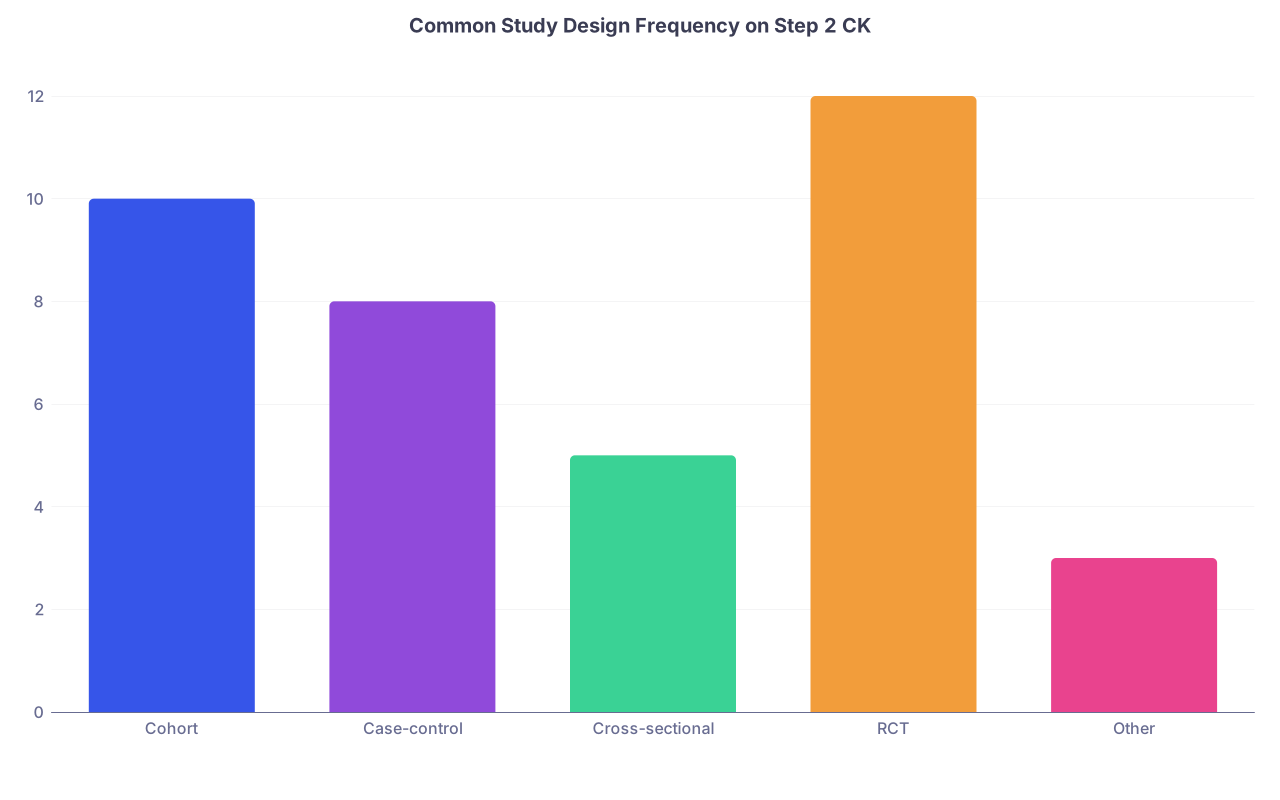
| Category | Value |
|---|---|
| Cohort | 10 |
| Case-control | 8 |
| Cross-sectional | 5 |
| RCT | 12 |
| Other | 3 |
Common question stems:
- “Which study design best answers this question?”
- “What is the major limitation of this study type?”
- “Which bias is most likely?”
B. Bias types you actually need
You do not need an encyclopedia of bias. You need to know the usual suspects:
Selection bias – how participants are chosen distorts the outcome.
Example: Only including patients who come to clinic → not representative of all patients with disease.Information (measurement) bias – inaccurately measured exposure or outcome.
Example: Using inaccurate BP cuff in obese patients.Recall bias – classic in case‑control when people with disease remember past exposures differently.
Example: Mothers of children with birth defects recalling medication use.Confounding – a third variable associated with both exposure and outcome.
Example: Coffee and lung cancer, but smoking is the real confounder.Loss to follow‑up – a form of selection bias in cohort studies.
Healthy patients may be more likely to stay in study.
Pattern questions often say:
The most likely bias threatening the validity of this study is:
and then give scenarios like:
- Researchers only recruit volunteers from a fitness club → selection bias
- Subjects know which treatment they are receiving and modify behavior → Hawthorne effect or performance bias
- Patients lost to follow‑up are sicker than those who remain → attrition bias (subset of selection bias)
C. Handling confounding and effect modification
Step 2 loves this.
Scenario: They show crude (unadjusted) association vs adjusted.
- If the association disappears after controlling for a variable → that variable was a confounder.
- If the association is different in different subgroups (e.g., stronger in smokers vs nonsmokers), that is effect modification, not confounding.
Simplest pattern:
An exposure is associated with disease in men but not women. What does this suggest?
Effect modification by sex.
After adjusting for age, the association between exercise and stroke risk disappears. What was age?
A confounder (older people exercise less and have more strokes).
Pattern 5: Regression, Hazard Ratios, and Non‑Inferiority Trials
This is where students panic for no reason. You are not doing actual regression math. You are reading the output.
A. Regression basics
Two things you must recognize:
- Linear regression – continuous outcome (BP, weight, A1c).
- Logistic regression – binary outcome (MI vs no MI, death vs survival).
They might ask:
Which statistical method is most appropriate to evaluate the relationship between BMI and systolic blood pressure, adjusting for age and sex?
Answer: multiple linear regression.
Which method analyzes presence or absence of disease while adjusting for multiple variables?
Answer: multiple logistic regression.
If they mention time‑to‑event (survival over time), then:
- Use Cox proportional hazards model
- Output gives hazard ratios (HR)
Interpretation same as RR/OR:
- HR = 1.5 → 50% higher hazard
- HR = 0.7 → 30% lower hazard
- CI including 1 → not significant
B. Non‑inferiority trials
These have been showing up more frequently. Step 2 likes the conceptual trap.
Key idea: The goal is not to show new treatment is better. It is to show it is not unacceptably worse than standard within a pre‑specified margin.
Setup:
- Non‑inferiority margin: e.g. −10% (new treatment can be up to 10% worse and still be “non‑inferior”).
- You look at CI of difference (new − standard).
Cases:
- If entire CI is above −10% (e.g., −4% to +3%) → non‑inferior.
- If CI crosses −10% (e.g., −15% to +2%) → cannot claim non‑inferiority.
- If CI above 0 (e.g., +1% to +8%) → non‑inferior and actually superior.
Typical question:
How to interpret a study where the 95% CI for difference in cure rates (new − standard) is −5% to +4%, and non‑inferiority margin is −10%?
Answer: New treatment is non‑inferior (entire CI above −10%). Not necessarily superior (CI includes 0).
Pattern 6: Screening, Prevention, and Guideline Logic
These “biostat” questions look like preventive medicine, but they are really application of test characteristics.
A. When to screen and when to stop
USMLE will not ask you to recall every USPSTF nuance, but they test:
- Screening only when benefit outweighs harm, especially in high prevalence groups
- Avoiding screening in very low‑risk groups where false positives dominate
- Stopping screening when life expectancy is limited or comorbidities are overwhelming
Classic pattern:
A 45‑year‑old woman asks for CT screening for lung cancer. She is a never‑smoker without risk factors.
You say: do not screen. Why? Low pretest probability → low PPV → many false positives and harm.
These are biostat in disguise: they want you implicitly thinking about:
- Pretest probability (linked to prevalence/risk factors)
- How that alters PPV and NPV
B. Parallel vs serial testing
Another classic pattern:
- Parallel testing (multiple tests at once): increases sensitivity, decreases specificity. Good for ruling out disease.
- Serial testing (second test only if first is positive): increases specificity, decreases sensitivity. Good for ruling in disease.
Example:
A hospital wants to minimize missed HIV diagnoses in new admissions. Strategy?
Answer: initial rapid test plus additional screening test in parallel (maximize sensitivity).
A confirmatory algorithm for a new autoimmune disease wants very few false positives.
Answer: serial testing with highly specific test last.
Pattern 7: Interpreting Tables and Graphs Under Time Pressure
A huge chunk of students lose points not because they do not understand stats, but because they panic at an ugly table.
USMLE tables and graphs are standardized. Once you recognize the style, they are fast.
Common visuals:
- Kaplan–Meier survival curves (time‑to‑event)
- Bar graphs comparing means/proportions
- Forest plots with CIs
- Simple correlation plots

| Step | Description |
|---|---|
| Step 1 | See Table or Graph |
| Step 2 | Identify Outcome & Groups |
| Step 3 | Find Units & Time Frame |
| Step 4 | Look for CI or p-values |
| Step 5 | Not statistically significant |
| Step 6 | Statistically significant |
| Step 7 | Direction & Magnitude of Effect |
| Step 8 | Does CI cross 0 or 1? |
If you train yourself to follow this little internal algorithm, you stop getting stuck.
Example Kaplan–Meier pattern:
Two curves showing survival over time. One clearly above the other, with p = 0.03.
They may ask:
- Which group has better survival? → The one with curve highest on y‑axis.
- Is difference significant? → Yes, p < 0.05.
Do not obsess over exact survival percentages unless asked. Most questions target direction and significance, not decimals.
Pattern 8: Sample Size, Power, and “Why Did This Trial Fail?”
These are less frequent but easy if you understand the story.
A. Power and sample size
They will never ask you to compute power numerically. They will ask:
How do you increase power?
Increase sample size, increase effect size, decrease variability, increase alpha.What reduces power?
Smaller sample, high variability, smaller effect size.
Typical question:
A trial with small sample size fails to show a difference when one truly exists. What is the reason?
Correct: low power → Type II error.
Or:
How to reduce the probability of Type II error?
Answer: increase sample size.
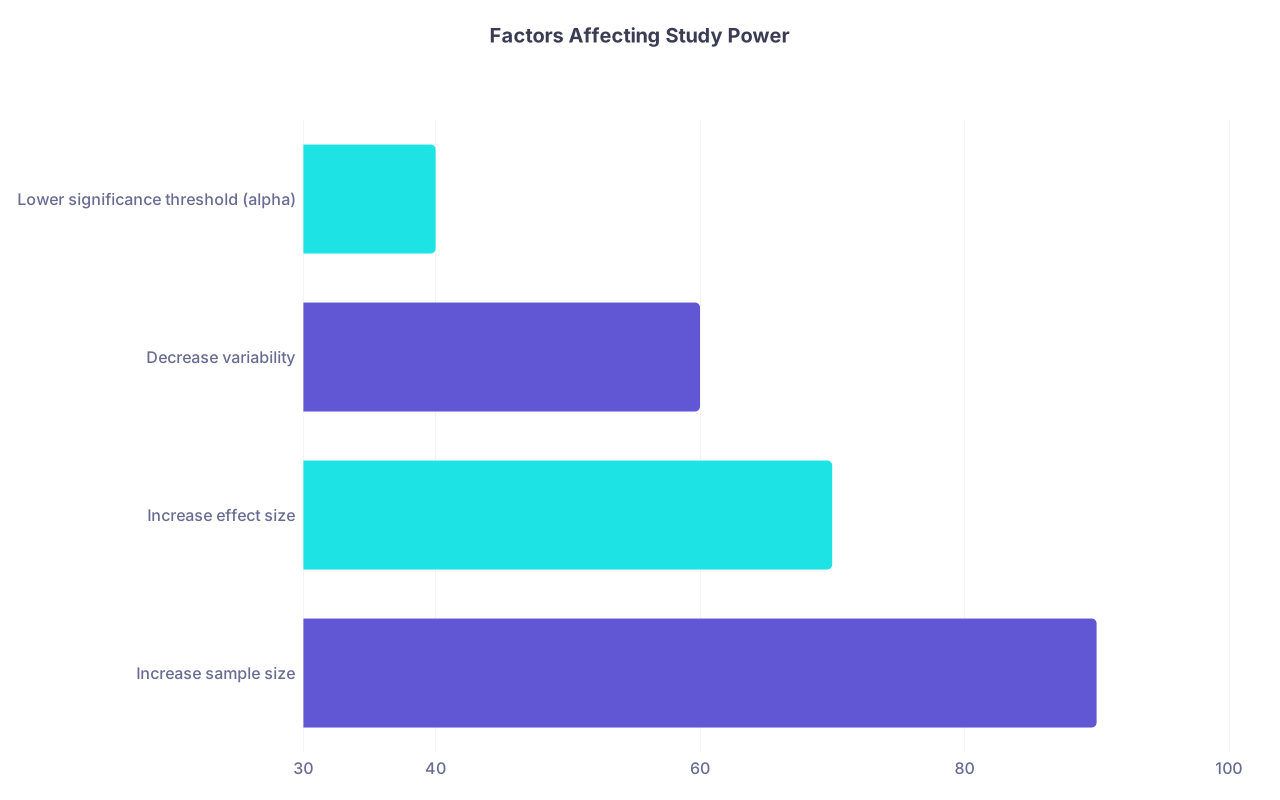
| Category | Value |
|---|---|
| Increase sample size | 90 |
| Increase effect size | 70 |
| Decrease variability | 60 |
| Lower significance threshold (alpha) | 40 |
(The numbers just illustrate relative impact; the pattern is what matters.)
How to Practice These Patterns Efficiently
You do not fix biostat by passively watching videos. You fix it by recognizing question archetypes. Very specifically.
Here is how I have seen students go from “I just guess” to “these are freebies” in 2–3 weeks.
1. Build a tiny formula bank
One side of a single index card. That is it. Include:
- Sensitivity, specificity, PPV, NPV
- ARR, RRR, RR, NNT/NNH
- Type I vs Type II definitions
- Basic CI significance rules
- RR vs OR vs HR thresholds (1 is null)
Review this for 2 minutes before and after your daily question block. You are training reflexes, not theory.
2. Do targeted Qbank passes
Instead of vaguely “reviewing biostatistics,” you do a pattern‑based pass:
Day 1–2: Diagnostic test questions (all 2×2, PPV/NPV, sensitivity/specificity)
Day 3–4: Risk, RR/OR, NNT/NNH
Day 5–6: CI, p‑values, power, error types
Day 7–8: Study design and bias questions
Day 9–10: Regression, hazard ratios, non‑inferiority, screening strategy
On each question, ask yourself:
- What pattern is this?
- Where did I get tripped—concept or arithmetic?
- Could I answer a similar question in 20 seconds next time?
You are not learning a subject. You are learning a finite catalog of question styles.
3. Replicate explanations in your own words
If you stumble on a bias or confounding question, do not just read the explanation and move on. Write one sentence in your own words:
- “This is selection bias because they chose only hospitalized patients, which are sicker than general population.”
- “This association disappeared after adjusting for age, so age is a confounder.”
You will remember your own phrases much better than a Qbank’s generic text.
Quick Reality Check: What Not To Over‑Invest In
I have seen students burn hours on:
- Exact formulas for every exotic test (ANOVA, chi‑square, t‑test variants)
- Derivation of Bayes’ theorem
- Deep theory of regression diagnostics
- Esoteric bias types that show up maybe once every 5 years
Step 2 CK wants functional literacy, not a biostat consulting career.
Recognize these patterns. Be able to read the conclusions of a paper. Calculate a few simple risk metrics. Choose the right test or design.
If you can do that, you are at or above the 90th percentile for biostat performance on this exam.
The 3 Things To Walk Away With
- Step 2 CK biostatistics is pattern‑driven, not creative. You are seeing the same ~8 question archetypes with minor costume changes.
- You must know a tiny core of formulas and definitions so well that you never “re‑derive” them under pressure—2×2 metrics, RR/OR, NNT, CI rules, and error types.
- Most points are lost not on math but on interpretation: CI crossing 1 or 0, recognizing confounding vs effect modification, and understanding how prevalence and thresholds alter test performance. Fix those, and biostat stops being a liability and becomes one of the easiest scoring areas on Step 2 CK.