
The biggest mistake students make with Step 2 CS/PE style prep is starting SP practice way too late—long after bad habits have hardened.
You are being graded on habits. Not last‑minute tricks. So your timeline has to be built around when habits form and when they can still be fixed.
Below is a chronological, practical timeline for Step 2 CS/PE–style clinical skills prep: when to start standardized patient (SP) practice, when to add mock encounters, and how to ramp intensity. I will assume a “typical” U.S. school structure:
- Pre‑clinicals: MS1–MS2
- Core clerkships: MS3
- Dedicated Step 2 CK window: end of MS3 / early MS4
- CS-equivalent / OSCE-style high‑stakes exam: late MS3 or MS4
Adjust dates a bit for your calendar, but keep the sequence. The order matters more than the exact month.
MS2: Foundation Year – Build the Raw Skills, Not CS Tricks
At this point you should stop thinking about Step 2 CS/PE as a separate beast and start thinking in systems:
- Data gathering
- Physical exam targeting
- Communication
- Documentation
You cannot cram those. You wire them.
Months 1–4 of MS2: Script and Structure
Focus: Encounter blueprint, not speed.
At this point you should:
Lock in a universal encounter template
Every patient, every chief complaint should roughly follow the same skeleton. For example:- Opening / introduction
- Chief complaint + one-sentence clarification
- HPI using OLDCARTS or similar
- Targeted ROS
- Past medical / surgical / meds / allergies / family / social
- Focused physical exam
- Brief summary statement
- Assessment: top 2–3 differentials
- Plan: tests + basic management + patient education
Do not improvise a new order for every case. That is how people fall apart in timed encounters.
Start low‑stakes partner practice (no SPs yet)
Once a week, 30–45 minutes:- Pair with a classmate
- One is patient, one is student
- Use a free online case bank or old OSCE cases from your school
- Focus on: flow, transitions, and not forgetting core questions
No timer yet. No white‑coat performance. Just wiring the sequence.
Begin “mental walk‑throughs”
Take 5–10 minutes a few times a week. Run an entire encounter in your head:- “45‑year‑old male with chest pain”
- Picture walking in, greeting, history, exam, assessment, plan
- Mentally say out loud: “My top three diagnoses are…”
This sounds small, but by the time people hit real SPs, the ones who have done this do not freeze at the door.
Months 5–8 of MS2: Early SP Work Inside Your School
Now you should start touching real standardized patients, but in a relaxed, educational context.
At this point you should:
Treat all required SP sessions as Step 2 prep
Most schools run clinical skills labs with SPs during MS2. The mistake: treating them like a checkbox. Instead:- After each session, write a quick debrief:
- What did I forget? (allergies, sexual history, vitals, counseling, etc.)
- What did the SP or preceptor highlight as weak?
- Turn that into a personal checklist.
- After each session, write a quick debrief:
Start a running “CS checklist” document
Literally one page you refine across months:- Opening phrases
- Key questions not to forget
- PE maneuvers by complaint
- Standard counseling snippets: smoking, alcohol, weight, medication adherence, contraception, etc.
By the end of MS2, this becomes your Step 2 CS/OSCE handbook.
Do 1–2 timed encounters per month (10–15 min)
Still using classmates, but now:- Set a 15‑minute timer
- Stop when it rings, even if you are mid‑sentence
- Spend 5 minutes immediately after writing a SOAP-style note
Goal: feel the pressure. It will expose where you waste time. Usually:
- Overlong HPI
- Asking every ROS item you ever learned
- Over‑explaining basic concepts
MS3: Core Clerkship Year – This Is Where You Actually Build CS/PE Performance
MS3 is when you either become “CS‑ready” automatically through clinicals or you drift into unfocused, note-heavy chaos.
You want the former. That does not happen by accident.
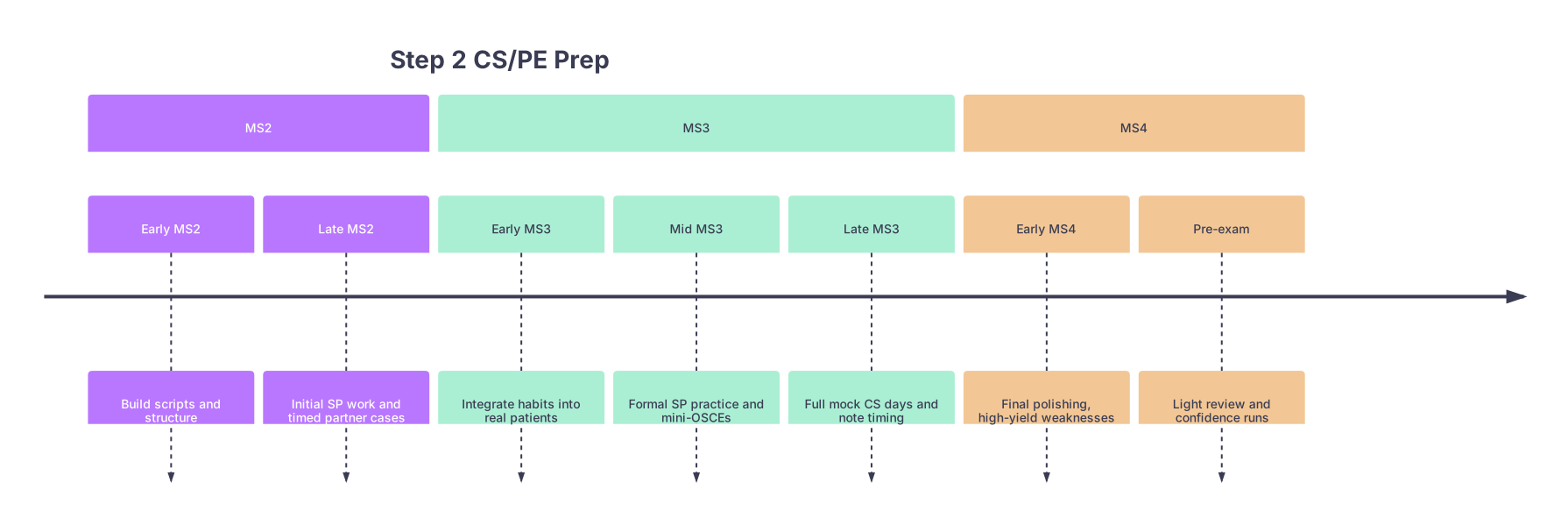
| Period | Event |
|---|---|
| MS2 - Early MS2 | Build scripts and structure |
| MS2 - Late MS2 | Initial SP work and timed partner cases |
| MS3 - Early MS3 | Integrate habits into real patients |
| MS3 - Mid MS3 | Formal SP practice and mini-OSCEs |
| MS3 - Late MS3 | Full mock CS days and note timing |
| MS4 - Early MS4 | Final polishing, high-yield weaknesses |
| MS4 - Pre-exam | Light review and confidence runs |
Early MS3 (First 3 months of clerkships): Convert Theory into Habit
At this point you should force your CS structure onto real patients.
Pick one “CS skill of the week”
Examples:- Week 1: Never forget to ask allergies, meds, PMH, PSH
- Week 2: Always close with a clear summary and “Does that make sense?”
- Week 3: Always wash or foam in/out in a visibly obvious way
Do this with actual patients, not just SPs. Repetition is free in the hospital.
Use SOAP notes as CS/PE practice
Every time you write a SOAP note on the wards, imagine an SP grader reading it:- Is the HPI organized?
- Are the differentials prioritized and plausible?
- Does the plan actually connect to the differential?
If your attending keeps asking, “What is your top diagnosis?” you are not ready for CS‑style grading yet.
Do one dedicated SP–style case per week
On your day off or after clinic:- 15 minutes for the encounter
- 10 minutes for the note
- 5 minutes for feedback with your partner
Keep it short, but keep it weekly. Consistency beats marathons.
Mid MS3 (Months 4–7): This Is When Real SP Practice Must Ramp Up
This is the critical window. If you wait until after you schedule your CS‑style exam to start heavy SP work, you are late.
At this point you should:
Schedule formal SP sessions every 2–3 weeks if your school allows
If your school has:- A simulation center
- Volunteer SP sessions
- A clinical skills elective
You should be booking these now, not 3 weeks before the exam. Use each session to target one cluster:
- Cardio / chest pain / SOB
- Abdominal pain and GI complaints
- Neuro complaints (weakness, headache, dizziness)
- Psych: depression, anxiety, suicidal ideation, substance use
- Women’s health: vaginal bleeding, pregnancy concerns
- Peds: parent‑reported symptoms
Start formal timed note practice
At least once a week, do:- 15 min encounter (partner or SP)
- 9–10 min note maximum
Put a literal countdown in front of you. Students consistently overestimate how much they can write in 9 minutes until they try this five or six times.
Track your performance like data, not vibes
Use a simple tracking table across weeks.
Sample CS/PE Practice Tracking Log Week Cases Done Avg Time (Encounter/Note) Missed Components Top Weakness 1 2 18 / 14 min Allergies, meds Too slow 2 3 16 / 12 min ROS completeness Organization 3 4 15 / 11 min Counseling Closure 4 4 14 / 10 min Focused exam Differential If you are not tracking, you are guessing. And people guess wrong.
Deliberately practice empathy and communication on the wards
You are graded on:- Eye contact
- Non‑verbal cues
- Validating emotions
- Avoiding jargon
You can practice these in every actual patient encounter. Zero extra time required.
Late MS3: 8–12 Weeks Before Your CS/PE‑Style Exam – The Mock Encounter Phase
Now you shift from “general clinical improvement” to exam‑style performance. This is where mock encounters become non‑negotiable.
At this point you should:
8–10 Weeks Out: First Full Mock Mini‑OSCE
Run a 4–6 case mini‑CS day
- 4–6 cases, back‑to‑back
- 15 min per encounter
- 10 min per note
- Short 5 min breaks (like the real thing)
Use friends, residents, or SPs who will not sugarcoat feedback. The goal is to:
- Expose stamina problems
- Reveal repeating blind spots (no counseling, poor closure, missing vitals, etc.)
- See if your note quality collapses by case 4
Do a hard post‑mortem on that mini‑day
Ask:
- Which 2 skills broke most often?
- Was I always running out of time at the end of the history?
- Did my physical exams match my differentials, or were they generic?
- Were my notes readable, prioritized, and logically connected?
From that, choose 2–3 priority weaknesses to fix over the next month.
6–8 Weeks Out: Targeted Fixes + SP Reps
At this point you should:
Run 3–4 cases per week, but highly targeted
Not random. For example:
- Week focused on: chest pain, SOB, palpitations
- Next week: abdominal pain, nausea/vomiting, diarrhea, constipation
- Next: neuro + psych complaints
Each week:
- Do 2–3 live encounters + notes
- Add 1–2 “note only” drills from written scenarios (no live SP, just note writing in 9 minutes)
Fix one systemic error at a time
Common patterns I have seen:
- Student never confirms patient’s understanding of the plan
- Student forgets sexual history in relevant cases
- Student does a full neuro exam on every complaint, wasting 5 minutes
Do not try to fix 10 things in one week. Pick one, overcorrect it, then move on.
Stop reading random tips online and start re‑using a single framework
There are too many “CS hacks” out there. They become noise. Stick to:
- One script for openings and closings
- One structure for HPI
- One structure for your notes
The goal is automaticity, not cleverness.
Early MS4 or Final Months Before the Exam: Polish, Do Not Rebuild
By now, your habits should exist. This phase is about consistency under pressure, not new content.
4–6 Weeks Out: Second Full Mock CS Day
At this point you should:
Do a full simulation as close to the real thing as possible
- 10–12 cases if your school or a prep course allows
- Same timing, same white coat, same tools
- Take it seriously. No phones. No shortcuts.
Ask for structured scoring if possible:
- Data gathering
- Communication/interpersonal
- Documentation
- Clinical reasoning
Compare this to your first mini‑OSCE
Look at:
- Did your time management improve?
- Are your notes tighter and more organized?
- Are your differentials actually better (more likely diagnoses, not just long lists)?
If the answer is “no” in more than one domain, you under‑practiced earlier. You cannot compress all the work into these last weeks. Do not try.
Narrow your focus to 3–4 “must not screw up” areas
Common final‑phase foci:
- Consistently getting sexual, substance, and safety history when appropriate
- Always stating a clear assessment and top 2–3 diagnoses to the patient
- One clean, efficient physical exam per major complaint type
- Notes that always list the most likely diagnosis first
2–3 Weeks Out: Maintenance, Not Panic
At this point you should:
Drop volume, keep frequency
- 2–3 live cases per week
- 2–3 timed notes per week
- Short, focused review of your personal checklist
Do not try to do “20 cases in a day” marathons. That is fatigue, not learning.
Do confidence runs, not demolition runs
Interleave:
- 1–2 cases you find easy
- 1–2 cases from your historically weak area
You want to remind your brain: “I can do this” while still patching holes.
Practice calm openings and closings daily
Literally stand in your room and say:
- Your intro script
- Your summary statement
- Your standard close and teach‑back request
Repetition is what makes your voice sound natural under stress.
Final Week and Last 48 Hours: Protect the Fundamentals
You cannot change your clinical reasoning in 48 hours. You can absolutely ruin your performance by messing with your routine.
5–7 Days Out
At this point you should:
- Do 1–2 light practice cases
- Do 2–3 timed notes
- Review your checklist and most common differentials (chest pain, abdominal pain, headache, cough, SOB, psych complaints, MSK pain, GU issues)
No all‑day sessions. Your brain needs to show up fresh.
48 Hours Out
You should:
- Stop all full encounters
- If you must do something:
- Run through one mental encounter from start to finish
- Skim your standard openings/closings
- Look at your “top mistakes” list and remind yourself of 2–3 key corrections
Then sleep. Hydrate. Eat like a normal human.
When Exactly Should You Start SP Practice and Mock Encounters?
Let me spell it out cleanly.
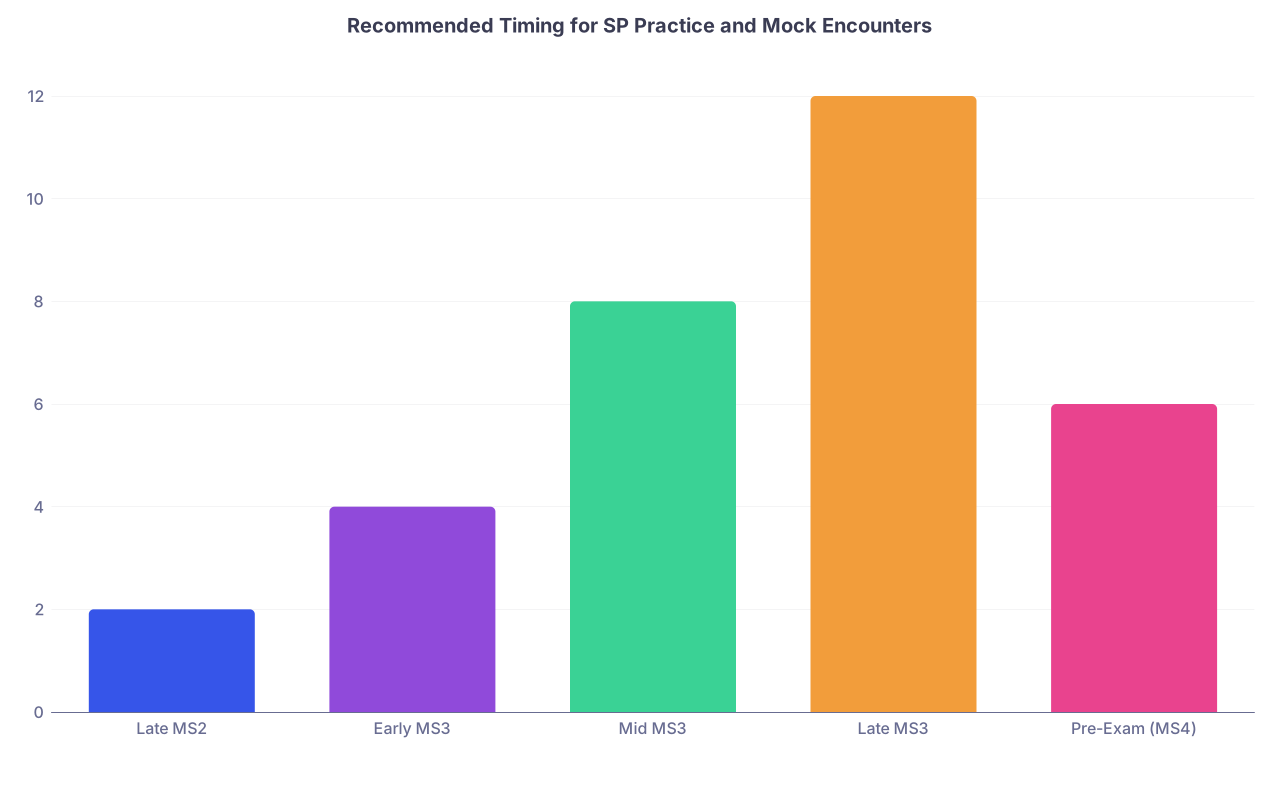
| Category | Value |
|---|---|
| Late MS2 | 2 |
| Early MS3 | 4 |
| Mid MS3 | 8 |
| Late MS3 | 12 |
| Pre-Exam (MS4) | 6 |
Interpretation (approximate cases per month):
- Late MS2: 2 structured SP/partner cases per month
- Early MS3: 4 cases per month
- Mid MS3: 8 cases per month (2 per week)
- Late MS3: 12 cases per month + at least one mini‑OSCE
- Pre‑Exam (MS4): 6 focused cases per month, plus 1 full mock CS day
That pattern works. I have watched students follow it and walk into high‑stakes clinical skills exams without the classic panicked look.
Quick Summary: What Matters Most
If you remember nothing else:
- Start structured partner/SP practice by late MS2; do not wait until after clerkships. You are building habits, not cramming facts.
- Use MS3 to turn every real patient encounter into CS practice. Same structure, same communication skills, same mental discipline.
- Run at least two serious mock OSCE/CS days (one ~8–10 weeks out, one ~4–6 weeks out). Everything else is tuning; those two points tell you if your system actually works.