The standard advice for COMLEX Level 3 assumes you have a strong OMM culture. You do not. So their advice will fail you.
You’re a DO in an ACGME program where nobody cares about OMT, nobody mentions COMLEX, and Step 3 is the only board exam anyone talks about. Yet you still have to pass Level 3 on a timeline, with real consequences if you don’t.
Let me lay out exactly how to handle COMLEX Level 3 when your residency gives you almost zero osteopathic support.
1. Know What You’re Up Against (Reality Check)
COMLEX Level 3 is not just “COMLEX but longer.” It’s different in three key ways:
- It assumes you’re a functioning intern/PGY-2 making management decisions.
- It tests OMM more than your day-to-day life ever will in an ACGME program.
- It uses CCS-style cases (COMSAE/Level 3 clinical decision-making) that feel awkward if you’ve only prepped for USMLE-style multiple choice.
Here’s the real tension in your situation:
- Your residency and attendings care about: clinical performance, Step 3, maybe in-service exams.
- NBOME cares about: osteopathic principles, OMT integration, preventive care, broad primary care knowledge, and safe independent practice.
- Your daily learning: “How to survive wards” and “How my attending does things.”
- What Level 3 wants: “What a generic, safe, guideline-loving physician would do, with osteopathic flavor.”
You have a mismatch between:
- What you practice daily
vs. - What the exam tests.
So your strategy needs to bridge that gap with minimal time and almost no institutional support.
2. Map Out a Realistic Timeline Around Internship
You can’t treat Level 3 like another big dedicated study block. You probably won’t get one.
Think in weeks, not fantasy “months of dedicated.”
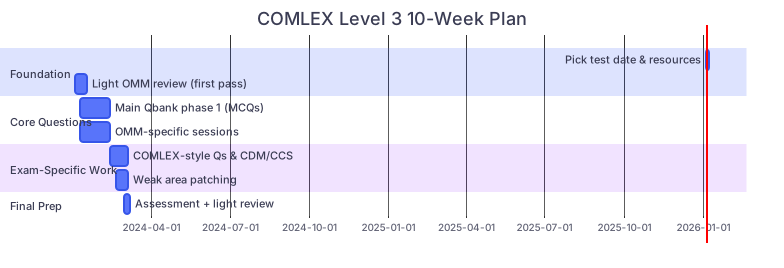
| Task | Details |
|---|---|
| Foundation: Pick test date & resources | a1, 2024-01-01, 3d |
| Foundation: Light OMM review (first pass) | a2, 2024-01-04, 14d |
| Core Questions: Main Qbank phase 1 (MCQs) | a3, 2024-01-10, 35d |
| Core Questions: OMM-specific sessions | a4, 2024-01-10, 35d |
| Exam-Specific Work: COMLEX-style Qs & CDM/CCS | a5, 2024-02-14, 21d |
| Exam-Specific Work: Weak area patching | a6, 2024-02-21, 14d |
| Final Prep: Assessment + light review | a7, 2024-03-01, 7d |
If you’re on wards, nights, ICU, or ED, you’ll average 30–60 minutes a day, not three hours. Stop lying to yourself and build a plan around that.
Target: Book the exam 8–12 weeks out.
Basic structure:
- Weeks 1–2: Light OMM + start main qbank.
- Weeks 3–6: Heavy qbank, daily questions. Layer in more OMM on off days.
- Weeks 7–8: COMLEX-style practice, CDM/CCS cases, shore up weak systems.
- Final 5–7 days: Focused review, not heroics.
If your program demands Step 3 first:
- Study primarily with a USMLE-style qbank (UWorld)
- Then add a short, high-yield COMLEX overlay (OMM + some COMLEX-style questions) before Level 3.
You can pass Level 3 off a Step 3 foundation, but not if you completely ignore OMM.
3. Pick the Right Resources for Your Specific Situation
You don’t have time for six resources. You need a small, tight kit.
Core structure
You want three lanes:
- Main clinical qbank (mostly USMLE/Step 3 focused)
- OMM + osteopathic principles
- COMLEX-specific “translation practice”
Here’s a rough comparison:
| Resource | Main Use | COMLEX-Specific? | OMM Coverage |
|---|---|---|---|
| UWorld Step 3 Qbank | Core clinical knowledge | No | None |
| TrueLearn COMLEX 3 Qbank | COMLEX-style practice | Yes | Moderate/Good |
| COMQUEST COMLEX Level 3 | COMLEX-style practice | Yes | Moderate |
| Savarese OMT Review Book | OMM content | Yes (conceptual) | Strong, concise |
| NBOME practice materials | Format & style familiarity | Yes | Variable |
If you’re in an ACGME program with little OMM support, I’d structure it like this:
- Main qbank: UWorld Step 3 (or another strong Step 3-style bank if you already finished UWorld).
- COMLEX overlay: TrueLearn or COMQUEST for Level 3, but not every question; enough to learn their style.
- OMM source: Savarese OMT Review (the green book) or equivalent, plus any old school notes/videos if you have them.
If you already did a ton of COMLEX-specific prep for Level 2 and feel COMLEX-fluent, you can reduce the COMLEX qbank portion. If not, don’t skip it.
4. Build a Study Plan That Fits a Brutal Schedule
Let’s get concrete. Here’s what an actual DO PGY-1 on wards might manage.
Baseline weekly targets (realistic)
On a tough rotation:
- 4 days/week: 10–20 questions/day (20–40 minutes total with review)
- 1 day/week (lighter): 20–40 questions + 30–45 minutes OMM
- 2 days/week: zero. You’re post-call or destroyed.
On an easier rotation:
- 5–6 days/week of 20–40 questions
- 1–2 OMM sessions per week (30–45 minutes)
- Add 1–2 COMLEX-style practice blocks per week closer to the test
You are not aiming for “finish every single question ever written.” You are aiming for:
- Exposure to common patterns
- Familiarity with COMLEX tone
- Enough OMM that you don’t blank on basic setups
5. How to Study OMM When No One Around You Cares
This is the crux for DOs in ACGME programs.
You don’t need to transform into an OMT guru. You need to:
- Recognize key dysfunction patterns
- Know first-line treatments
- Understand sacrum, innominates, ribs, basic spine, Chapman points in broad strokes
- Know contraindications and when NOT to do OMT
Step-by-step OMM plan
Do one fast pass of Savarese (or similar) in 1–2 weeks
Not memorizing, just orienting. Use 15–20 minutes a day: spine, ribs, sacrum, innominate, autonomics.Pick 3–4 high-yield anatomical zones to truly own:
- Sacrum + innominates
- Ribs (especially rib exhalation/inhalation dysfunction patterns)
- Cervical and lumbar basics
- Autonomics (SNS/PSNS levels per organ)
Use “pattern recognition” instead of obsession: For example:
- Short leg → lumbar sidebend toward, rotate away; sacral base unleveling; pelvic side shift.
- Psoas syndrome → flexed, sidebent/rotated same side; contralateral piriformis tightness.
- Rib 1–2 inhalation/exhalation dysfunctions: scalene vs pump-handle/muscle energy set-ups.
Memorize the “buzzwords” rather than full technique scripts. On COMLEX, you don’t physically treat. You identify:
- Type I vs Type II dysfunction
- Where to place your hand
- Which side is the “buggy” side
- Whether muscle energy vs HVLA vs counterstrain is appropriate
Do micro-reviews on call. I’ve seen residents keep a slim OMM book in their call bag and flip 5 pages while waiting for CT results. That’s the level you’re aiming for: small, repeated exposures.
6. Translating USMLE-Style Thinking to COMLEX-Style Answers
Your daily life and UWorld have trained you to think a certain way:
- Aggressive diagnostics when uncertain
- Cost-effectiveness sometimes secondary
- Fair amount of hospital-based and critical care nuance
COMLEX Level 3 wants:
- Conservative, guideline-based primary care
- Heavy preventative medicine
- “Avoid harm, avoid overordering” unless red flags
The mindset shift you need
On COMLEX, the “best next step” is often:
- A counseling intervention
- A basic lab or imaging, not CT/PET/nuclear
- A lifestyle change before starting serious meds, if safe
- Respect for cost and simplicity
Examples of where DO residents in ACGME programs mess up:
- Ordering an MRI too early when plain X-ray or conservative therapy is more appropriate.
- Jumping straight to a high-cost drug instead of trying a safer/older option first.
- Forgetting osteopathic considerations: posture, somatic dysfunction, biopsychosocial model.
When you do your COMLEX-style qbank (TrueLearn/COMQUEST), don’t just check right/wrong. Ask:
“What’s the NBOME logic here? What type of answer do they like?”
After 50–100 questions, you’ll see the pattern:
- They love preventive care and screening intervals.
- They reward acknowledging patient preference, cost, and minimal harm.
- They expect osteopathic lens: structure-function, somatic dysfunction’s contribution to disease, etc.
7. Handling the CDM / CCS-Style Cases
Level 3 has clinical decision-making (CDM) / case-based questions that feel like stripped-down Step 3 CCS.
The danger if you’re only used to multiple-choice:
- You over-order
- You under-document
- You forget to include basic management that you “just do” in real life
Strategy for CDM-style content
Do a handful of practice cases from:
- NBOME’s sample cases
- Your COMLEX qbank’s case sections if they have them
Focus on structure, not perfection. For each case, quickly ask:
- What’s the immediate safety issue? (Airway, shock, sepsis, ectopic pregnancy, etc.)
- What’s the minimum necessary workup?
- What’s the safe disposition (admit vs discharge) and follow-up?
Pattern your thinking:
- Initial orders: vitals, monitoring, pregnancy test when remotely indicated, glucose, basic labs.
- Stabilization before exotic diagnostics.
- Include commonsense stuff: NPO, IV fluids, analgesia, DVT prophylaxis where indicated.
You don’t need to be a CCS pro. You only need to not panic when you see a slightly different interface and answer style.
8. Integrating Exam Prep With Real-Life Residency
You’re not a full-time student anymore. You’re a worker who studies in the gaps.
Here’s how to make this actually happen:
Use commute time and downtime
- Audio review: short podcasts or your own recorded notes on OMM and high-yield topics.
- 5–10 questions on your phone while:
- Waiting for sign-out
- Sitting in the ED for a bed
- Waiting for CT/US reports
The residents who pass early in PGY-1 usually don’t have big heroic blocks. They have tiny daily habits that compound.
Batch similar tasks
- One day: only OMM. No regular questions. Just crush 30–60 minutes of OMM patterns.
- Other days: only MCQs.
- End of week: 1–2 COMLEX-style blocks.
This keeps your brain out of cognitive whiplash and lets you go deeper on each domain when you touch it.
9. What to Do If Your Program Is Actively Unhelpful About COMLEX
Some programs:
- Don’t reimburse COMLEX fees.
- Don’t give time off.
- Don’t even know your deadlines.
This is common. Here is how to protect yourself.
Know your state and specialty requirements. Some licensing boards and specialties accept either Step 3 or Level 3. Many DOs still choose to take both. Know what you actually need for:
- State license
- Board certification
- Contract renewals
Set your own deadline. Don’t wait for a chief resident or coordinator to nudge you. Decide:
- “I will take Level 3 between month X and Y of PGY-1/PGY-2.”
- Book the exam months ahead, then build backward.
Communicate clearly, not apologetically. When you email or talk to your chief:
- “I’ve scheduled my COMLEX Level 3 on [date]. I’ll need that as one of my elective/education days (or vacation days if that’s the only way).”
- Offer coverage solutions if needed, but don’t frame it like a “maybe if it’s not too much trouble.”
Use other DOs as your support network.
- Text DO friends in other programs to clarify OMM questions.
- Trade screenshots and mnemonics.
- Build a quick group chat just for board questions and rants.
You don’t need your ACGME program to become osteopathic overnight. You need them to not block you. That’s it.
10. Final Week and Test Day Strategy
Final 7 days
- No new resources.
- Focus on:
- Your weakest systems (OB, peds, psych, or neuro are the usual culprits).
- OMM patterns you always forget (sacrum/innominates, ribs).
- Reviewing incorrects you’ve flagged in your qbanks.
A simple daily split:
- 20–40 mixed questions (review carefully).
- 20–30 minutes OMM.
- One or two practice CDM/CCS-style cases total (not every day; just a reminder).
Day before the exam
- Half-day at most of light review.
- Close your qbanks by mid-afternoon.
- Organize logistics: route to test center, ID, snacks, layers for test center temperature.
On test day
Remember COMLEX pacing feels different from Step 3. Some questions are longer but easier than they look; don’t over-think.
When you see OMM:
- Slow down just a bit.
- Visualize the body, not just words.
- Ask: what’s the global pattern? What’s the simplest osteopathic explanation?
When exhausted: default to safe, conservative, guideline-based answers. COMLEX rarely rewards cowboy medicine.
11. If You Fail or Score Lower Than Expected
It happens. Especially for DOs in non-osteopathic environments.
If you don’t pass:
- Do not immediately rebook without a plan.
- Analyze:
- Which content areas were weak on the score report?
- Did you completely neglect OMM?
- Did you run out of time?
Then restructure:
- Heavier COMLEX-specific qbank use.
- More systematic OMM review, not just glancing.
- At least a couple more CDM/CCS practice cases.
- Shift from Step 3-think to COMLEX-think consciously.
And tell at least one trusted attending or program director. Quietly failing boards and suffering alone is how people end up in real trouble later.
The Short Version: How to Survive COMLEX Level 3 in an ACGME World
- Use a strong Step 3-style qbank for core knowledge, but layer in a COMLEX-specific qbank to learn the exam’s tone and expectations.
- Do targeted, repeated OMM review (Savarese or similar) focusing on patterns and first-line treatments; you don’t need to be a technician, just literate.
- Accept your reality: you’re a resident with limited time. Build a plan that fits 30–60 minutes a day, use downtime ruthlessly, and treat Level 3 like a non-negotiable professional requirement even if your program barely mentions it.