
It’s March. You’re an IMG in your PGY‑1 year on a J‑1 visa. Your program director just said, “If you want to moonlight next year, you’ll need Step 3 and a training license by July.” Meanwhile, ECFMG has been emailing you about your J‑1 extension forms, and your state board site looks like it was coded in 1998. You’re staring at Prometric’s Step 3 calendar, trying to connect all the dots before something important explodes.
This is exactly where people quietly wreck their visa status or delay moonlighting by a year. Not because they’re lazy. Because the timelines are ugly, the rules are different in every state, and nobody sits you down and walks you through how Step 3, visas, and licensing actually fit together.
I’ll do that here. Straight, scenario-based, with examples.
Step 3 + Visa + License: How They Actually Interlock
Think of three moving parts:
- Step 3 eligibility and score release
- Visa deadlines (J‑1 vs H‑1B is a very different game)
- State licensing timelines (training vs full license)
If you mess up the order, you get stuck. If you run them in parallel with a plan, you’re fine.
The core logic
You need to answer four questions right now:
- Why do you need Step 3?
- To keep a J‑1? Usually no.
- To switch to H‑1B? Almost always yes.
- To get a training or full license to moonlight? Usually yes.
- By when does that need to be done?
- Visa petitions have hard federal deadlines.
- Licenses have state review times.
- How long does your state board take once they have your Step 3 score?
- How long from exam date to Step 3 score release can you realistically expect?
Once you know those, you backward-plan your test date.
Common Scenarios and What To Do
I’ll go through the situations I actually see:
- J‑1 resident, wants to moonlight PGY‑2
- IMG aiming for H‑1B for residency
- Resident trying to meet a state training license deadline
- Resident needing Step 3 for a full license before fellowship/employment
I’ll also give you a rough comparison table so you can see how some states differ.
| Need Step 3 For | Typical Deadline Anchor | Risk If Late | Who's Affected Most |
|---|---|---|---|
| H‑1B petition | April H‑1B filing | Can’t start on H‑1B | IMGs, some FMGs |
| Moonlighting | Start of PGY‑2 or PGY‑3 | Lose extra income | Most residents |
| Training license | Before residency start | Delay start/conditions | New interns |
| Full license | Before job/fellowship | Delayed start date | Seniors/PGY‑3+ |
Scenario 1: J‑1 Resident, Wants Step 3 for Moonlighting
You’re PGY‑1, on a J‑1. Your J‑1 extension doesn’t care about Step 3. But the hospital credentialing committee does. They say you need:
- Passing Step 3
- A training or full license (varies by state/health system)
- Malpractice coverage etc.
And they want this done before the start of your PGY‑2 (usually July 1).
The reality
Step 3 score reports usually come out:
- About 3–4 weeks after your second exam day
- Sometimes 5–6 weeks during busy seasons or holidays
State boards:
- Training licenses: 2–12 weeks
- Full licenses: 6–16 weeks (some are brutal—California, Texas, New York can be slow)
So if you want to moonlight starting July 1, you do not have the luxury of taking Step 3 in mid‑June. That’s fantasy.
Cleaner timing for J‑1 moonlighting
Assume:
- Program wants your license active by July 1
- Your state board needs 6 weeks
- Step 3 score: 4 weeks after test completion
Work backwards:
- License active by July 1 → board needs file complete by ~mid‑May
- File complete by mid‑May → Step 3 score reported by early May
- Score reported early May → take exam by early April
So for PGY‑2 moonlighting, your Step 3 target is:
Take Step 3 by March–early April of PGY‑1.
You can push a little if your state is fast. You cannot push into June and expect to moonlight July 1. That’s how people get angry and say “our hospital wouldn’t let us moonlight.” No, you just missed the math.
Study load vs intern year
You’re also working 60–80 hours/week. Here’s the compromise that actually works:
- Start light review in January of PGY‑1 (UWorld, CCS cases)
- Schedule exam in late March or early April
- Put it on a lighter rotation month if possible (clinic, elective, ambulatory block)
And talk to your PD early. “I plan to take Step 3 in late March, can we avoid ICU that month?” Some will work with you if you ask in November instead of the week before.
Scenario 2: IMG Wanting H‑1B (Step 3 Is Not Optional)
Different beast.
If your residency or next job will sponsor an H‑1B, USCIS wants all three Steps passed at the time of filing. That includes Step 3.
H‑1B timelines:
- Traditional cap-subject H‑1B:
- Registration in March
- Petitions typically filed April–June
- Start date usually October 1
- Cap-exempt (many hospitals, universities):
- Can file year‑round, but the employer still wants Step 3 done before they file
Most programs are conservative. They want your Step 3 result in hand before they submit the petition.
If you’re an IMG matching to residency on H‑1B
You won’t have a lot of time:
- You match in March.
- They want to file the H‑1B petition soon after match.
- That means passing Step 3 often by January or February of your match year.
So if you’re still in medical school or in a gap year, you target Step 3 before Match Day.
That means scheduling:
- Step 3 no later than January of the match cycle
- Preferably earlier (November/December) so a failure doesn’t destroy the plan
If you already know you’ll only take H‑1B positions, you should be treating Step 3 like Step 2: high urgency, pre‑match exam.
If you’re a J‑1 resident later switching to H‑1B (job or fellowship)
Example: finishing IM residency on J‑1, want H‑1B for a hospitalist job.
Employer will:
- Offer job usually 6–12 months before start
- Tell you: “We need Step 3 passed before we file H‑1B”
So:
- Job starts: July 1
- H‑1B petition filed: often March–April
- Your Step 3 must be passed by February at the latest to avoid stress
You absolutely do not wait until spring of PGY‑3 for this. That’s how you end up on emergency phone calls with HR.
Best play:
- Take Step 3 in PGY‑2 or early PGY‑3 at the latest
- Always give yourself time for a potential retake.
Scenario 3: Training License Before PGY‑1 Start
Some states (not all) require a training license before you start residency:
- You match
- The GME office sends you licensing instructions
- They ask for Step scores, background checks, documents
For these states, sometimes Step 3 is not required for a training license. They just need Step 1 and Step 2 CK. But in a few scenarios, the board or hospital prefers/strongly pushes Step 3 early, especially for IMGs.
You need to confirm:
- Does your state require Step 3 for a training license? (Most: No)
- Does your hospital require Step 3 for any specific privileges in PGY‑1? (Occasionally)
If Step 3 is required for a training license (rare but it exists), then your deadline becomes:
- License must be approved before orientation, usually June
- Board processing: 6–12 weeks
- Step 3 score report: 3–4 weeks
So again, you’re looking at exam no later than March or early April of the year you start residency.
If Step 3 is not required, ignore it for PGY‑1 licensing. Focus on getting your training license with Step 2 CK done, then plan Step 3 around moonlighting or future visa plans.
Scenario 4: Full License Before Fellowship or Attending Job
Full license timelines get people every year.
A typical path:
- IM resident matches into a cardiology fellowship in a different state
- The fellowship program says: “We require a full unrestricted license by start date”
- That full license requires:
- Step 3
- X months of GME completed
- Background checks, transcripts, verification letters
If they require X years of training plus Step 3, you can’t just pass the exam in May and expect a license by July in a slow state.
You have two windows that work:
- Early PGY‑2
- Mid PGY‑2 at the latest
So when you’re applying for fellowship in PGY‑2, Step 3 is already behind you, not hanging over your head.
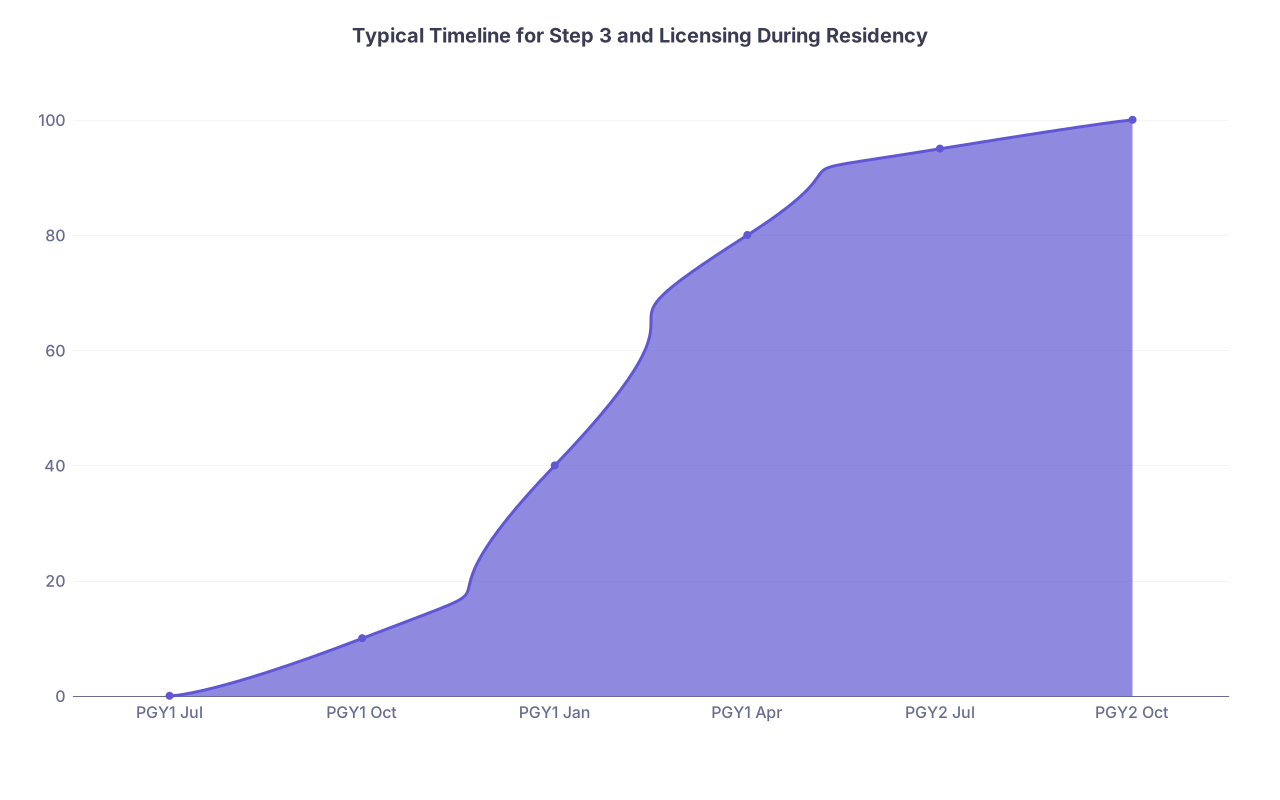
| Category | Value |
|---|---|
| PGY1 Jul | 0 |
| PGY1 Oct | 10 |
| PGY1 Jan | 40 |
| PGY1 Apr | 80 |
| PGY2 Jul | 95 |
| PGY2 Oct | 100 |
(Think of that as your “percent done” with exams and paperwork. You want to be basically at 80–100% by early PGY‑2.)
State Differences: Why You Have To Check Your Board
People treat “the state” as one thing. It’s not. Some boards are fast and sane; others are slow and picky.
Here’s a rough, non-exhaustive sense of variation:
| State | Step 3 Needed for Training License? | Typical Training License Time | Typical Full License Time |
|---|---|---|---|
| New York | No | 8–12 weeks | 12–16+ weeks |
| Texas | Often no*, but varies by scenario | 6–10 weeks | 12–20+ weeks |
| California | No | 8–12 weeks | 16–24+ weeks |
| Illinois | No | 4–8 weeks | 8–12 weeks |
| Florida | Usually no | 4–8 weeks | 10–14 weeks |
(*) Texas is a special animal; IMGs and US grads see different pathways, and hospitals have their own privileges layered on top. I have literally seen residents lose moonlighting for 6 months because they assumed “it’ll be fine, Texas is big, they’re used to this.”
Bottom line:
You must check three things:
- Your specific state board’s website (and call if it’s confusing).
- Your GME office’s internal deadlines.
- Your hospital’s credentialing rules for moonlighting/independent practice.
Do not assume what’s true for your co‑resident in a different state will apply to you.
How To Actually Backward-Plan Your Step 3 Date
Let me lay out the process like a flowchart.

| Step | Description |
|---|---|
| Step 1 | Identify Why You Need Step 3 |
| Step 2 | Find Hard Deadline Date |
| Step 3 | Subtract Board Processing Time |
| Step 4 | Subtract Score Report Time |
| Step 5 | Set Latest Safe Exam Date |
| Step 6 | Add 1-2 Month Buffer for Retake |
| Step 7 | Create Study Plan Matching Work Schedule |
| Step 8 | Visa? License? Moonlighting? |
Concrete example:
- Goal: Start moonlighting July 1 in Illinois
- IL training license: ~6 weeks
- Score report: 4 weeks
- “Admin slop”: Add 2 weeks for missing documents, etc.
Work backwards from July 1:
- July 1 minus 6 weeks ≈ mid‑May (license processing)
- Mid‑May minus 4 weeks ≈ mid‑April (score report ready)
- Mid‑April minus 2 weeks “slop” ≈ early April
So exam by early April. If you’re risk‑averse, aim for March.
Dealing With Visa Edge Cases
J‑1 residents
Step 3 is not required to maintain a J‑1 visa for residency. You renew annually through ECFMG.
You care about Step 3 for:
- Moonlighting
- H‑1B transfer later
- Full license after training
So the priority is more about money (moonlighting) and future flexibility than immediate visa status.
Strategy for J‑1:
- Take Step 3 by late PGY‑1 or mid‑PGY‑2 at the latest
- Tie it to your moonlighting plan: if your hospital lets PGY‑2s moonlight, treat Step 3 like a prerequisite for a $20–$40k annual raise. Because that’s what it often is.
H‑1B residents/fellows
If you’re already on an H‑1B in residency, the Step 3 box is already checked. You’re past that hurdle. Now Step 3 timing relates more to:
- Moving states (new licensing board)
- Upgrading from training to full license
- Moonlighting rules in your new hospital or fellowship
Still important, but the federal immigration part is mostly behind you.
What If You’re Late or You Fail?
This is where people panic and start making bad decisions. Don’t.
If you’re late for a moonlighting deadline
Worst case:
- You start moonlighting a few months later than planned
- You lose some income but not your visa
Talk to:
- Your PD (“I’ll have Step 3 done by August, can I start then?”)
- GME / credentialing (they sometimes have mid‑year start cycles)
If your Step 3 score is delayed
Score reports can get held for “additional review.” It happens randomly.
That’s why you don’t schedule Step 3 three weeks before an H‑1B petition filing or state board deadline. You give margin.
If it happens and the delay threatens an H‑1B filing or licensing date:
- Your program’s GME or HR should contact ECFMG/USMLE and state board
- Sometimes a board will tentatively proceed with other parts of your file so once the score drops, they can approve you quickly
- For H‑1B, your attorney may be able to time filing or upgrade processing, but they can’t file without you meeting the legal requirements
If you fail Step 3
Ugly but survivable.
Consequences:
- H‑1B petition can’t be filed until you pass
- Moonlighting is delayed
- Fellowship/job may get nervous but often will wait if you’re early enough
If you fail:
- Tell your PD. Do not hide it.
- Immediately reschedule for the earliest date you can realistically pass with serious study.
- If this affects an H‑1B timeline, get the program’s immigration lawyer involved quickly to see if there’s any workaround (often there isn’t, but you at least know what’s real and what’s rumor).
Practical Scheduling Moves That Actually Help
A few concrete tactics:
- Pair Step 3 with a light rotation (ambulatory, elective, research month). Don’t attach it to ICU or night float if you can avoid it.
- Register as early as possible so you actually get dates in your chosen window. Prometric centers fill.
- Split the exam days with 1–7 days in between. Most residents feel less destroyed that way.
- Nail CCS practice early. CCS performance is notorious for being underappreciated and can rescue your score.
- Don’t try to “just squeeze it in” during the heaviest block of intern year. That’s how people end up failing and then pushing everything back by 6–12 months.
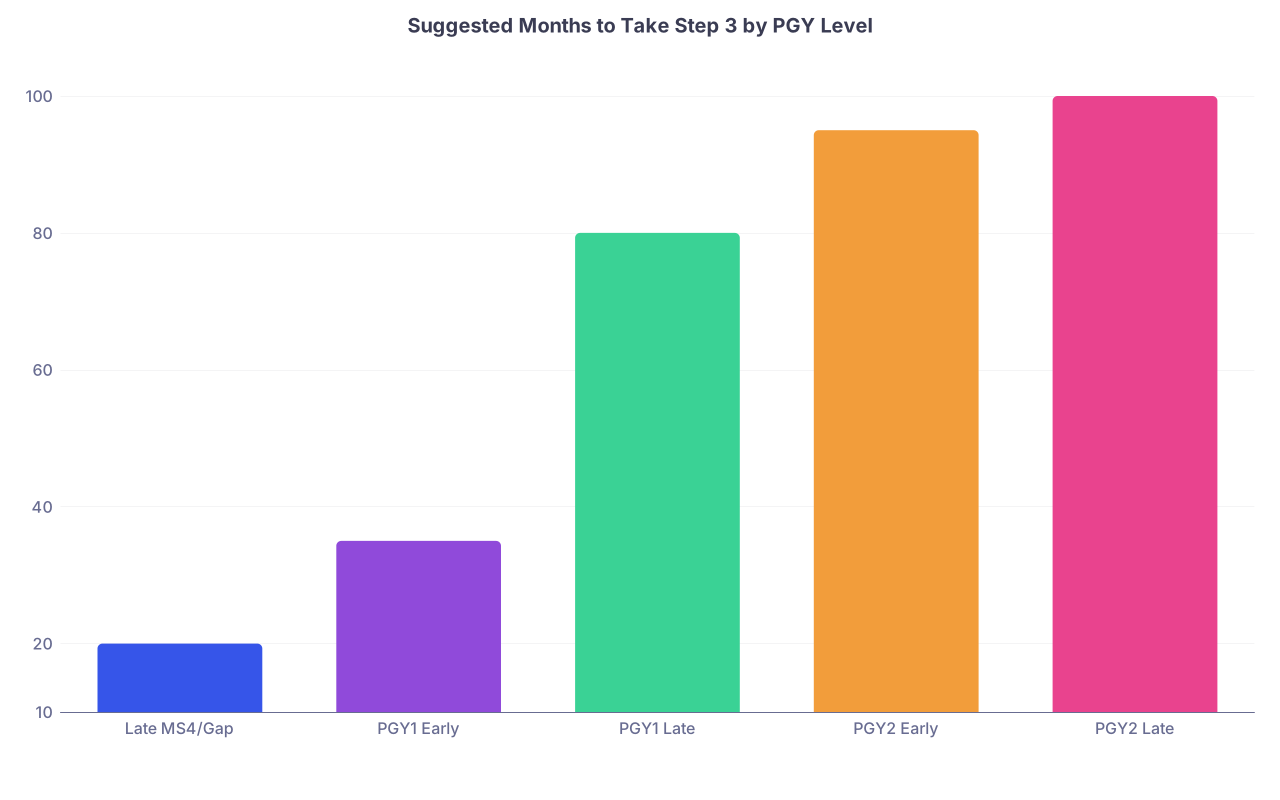
| Category | Value |
|---|---|
| Late MS4/Gap | 20 |
| PGY1 Early | 35 |
| PGY1 Late | 80 |
| PGY2 Early | 95 |
| PGY2 Late | 100 |
Interpretation: by late PGY‑1, you want to be done if visas, moonlighting, or licensing are in play. By early PGY‑2, you need to be done for most scenarios.
How To Get Clarity Fast (Instead of Guessing)
You can stop guessing in about 3 phone calls and 2 emails.
- Email your GME office:
- “For my PGY‑2 year, what are the requirements and timelines for moonlighting and licensing?”
- Call or email your state board:
- “Do you require Step 3 for a training license? What is your current processing time for training/full license?”
- Ask your program coordinator or PD:
- “Do you have any internal deadlines or expectations around Step 3 timing?”
- If H‑1B is involved:
- Ask the program’s immigration lawyer or HR:
- “By what date must my Step 3 result be available for H‑1B filing?”
- Ask the program’s immigration lawyer or HR:
Write those dates down, subtract margins, and schedule the test.
FAQ (Exactly 4 Questions)
1. I’m an international medical graduate on a J‑1 in PGY‑1. When’s the latest I should take Step 3 if I want to moonlight in PGY‑2?
If your state board takes around 6 weeks and Step 3 scores take 4 weeks, you want your score by early May for a July 1 moonlighting start. Working backward, that means taking Step 3 by late March or early April of PGY‑1. If your board is slower or you want a retake buffer, aim for February–March.
2. I matched into residency on an H‑1B offer but haven’t taken Step 3 yet. Am I already in trouble?
Not automatically, but the leash is short. Most programs will only sponsor an H‑1B if you’ve passed Step 3 before they file the petition (often April–June). If it’s still the fall or early winter before you start, you can realistically schedule Step 3 for November–January. If you’re already close to petition filing, you need to talk to GME/HR immediately and see if they’ll switch you to J‑1 or delay your start if you can’t pass in time.
3. My state doesn’t require Step 3 for a training license. Should I still rush to take it in PGY‑1?
If your future plans include moonlighting, H‑1B, or a state that demands Step 3 for full licensure before fellowship/employment, yes—you should still push to get it done by late PGY‑1 or early PGY‑2. If you have none of those pressures and you’re drowning in intern year, you can push it a bit, but procrastinating into PGY‑3 is how people end up with job or fellowship delays.
4. Can I rely on my co‑residents’ experience in other states to plan my own Step 3 and licensing timeline?
No. That’s one of the most common mistakes. State boards differ wildly in processing time and requirements. Hospitals also have their own credentialing rules on top of state rules. Use colleagues’ stories as hints, not rules. For your actual plan, you need information from your specific state board, your own GME office, and—if visas are involved—your program’s immigration lawyer.
Key Takeaways
- Start with your hard deadline: H‑1B filing date, moonlighting start, or license requirement—then work backward through board processing and score release.
- For most residents with visa or moonlighting goals, Step 3 should be done by late PGY‑1 or very early PGY‑2. Later than that and you’re gambling with income and flexibility.
- Stop guessing. Call your state board, talk to GME, and get clear answers, then schedule Step 3 in a window that actually respects those timelines.