
Delaying COMLEX Level 3 does not “fly under the radar.” Chiefs and program directors absolutely notice—and they almost never read it the way you think they will.
Let me walk you through what actually gets said in workrooms, evaluation meetings, and rank-list sessions when someone keeps pushing COMLEX 3 down the road. Because the official line you hear in town halls—“We support you taking it when you’re ready”—is only half the truth.
The First Thing They Look At: Pattern, Not Excuse
The delay itself isn’t what bothers most chiefs and PDs. It’s the story they see behind it.
When your name comes up and someone mentions, “They still haven’t taken COMLEX 3,” nobody in that room starts by asking, “What’s their personal situation?” They start from a very different place:
- “What’s this resident’s pattern been with exams and deadlines?”
- “Is this about judgment or is this about performance?”
- “Are they avoiding it or strategically planning it?”
Programs have been burned. Many times. Residents who “just need a bit more time” fail or barely pass. Then the program is stuck rearranging schedules, making remediation plans, explaining to the DME and GME why someone isn’t licensed.
So PDs stop taking the delay at face value. They categorize you.
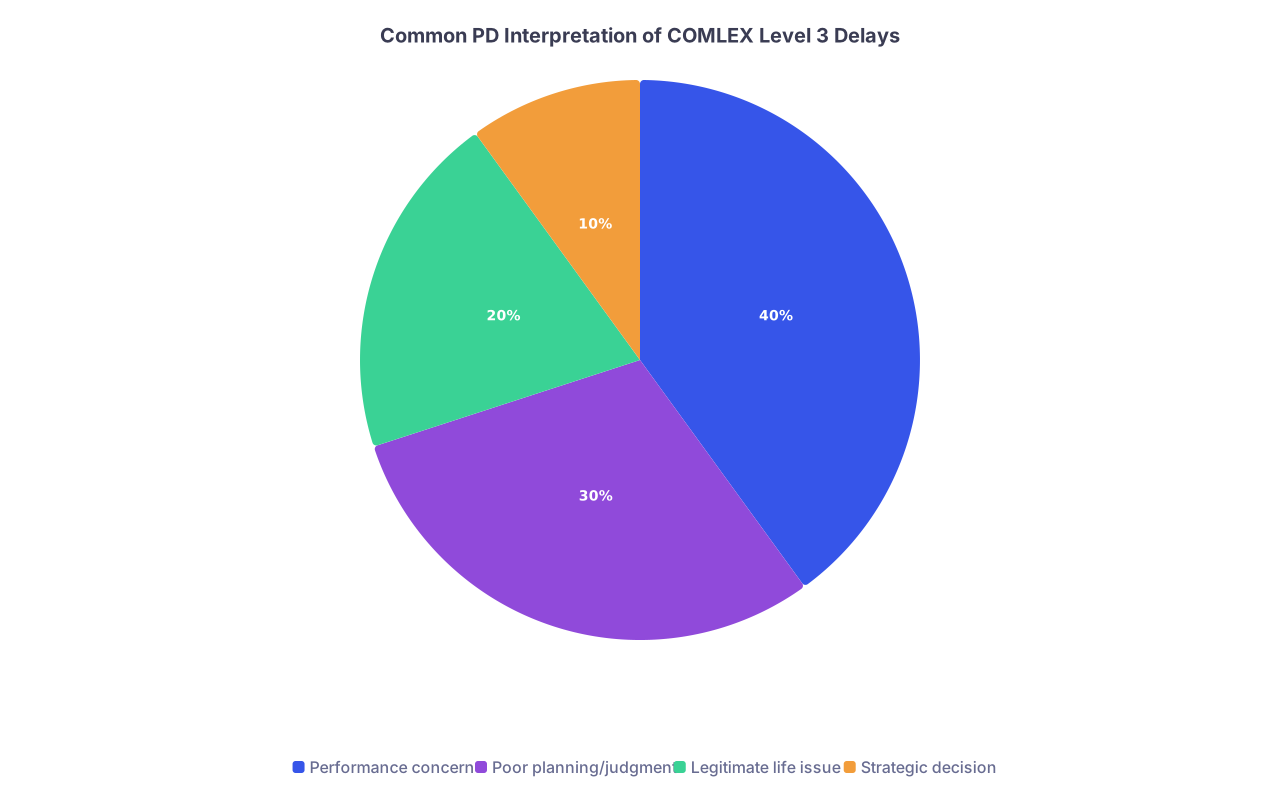
| Category | Value |
|---|---|
| Performance concern | 40 |
| Poor planning/judgment | 30 |
| Legitimate life issue | 20 |
| Strategic decision | 10 |
Notice that? In most chairs’ minds, “strategic decision” is the least common explanation.
If your transcript shows:
- COMLEX 1: multiple attempts or low pass
- COMLEX 2: marginal or delayed
- COMLEX 3: “planning to take later this year”
The conclusion in that room is not subtle: “Performance problem, likely anxiety, possible repeat failure risk.”
If, on the other hand:
- COMLEX 1: first pass, average or better
- COMLEX 2: first pass, solid
- COMLEX 3: delayed a few months, communicated early
Now chiefs will usually say, “They’re probably trying not to tank intern year. Let’s see if they get it done.”
Same delay on paper. Completely different read.
How Chiefs Actually Talk About It
Here’s the kind of conversation I’ve heard behind closed doors more than once:
Faculty A: “Why hasn’t she taken Level 3 yet? We’re in March.”
Chief: “She wants more time to study. Says she’s been overwhelmed on wards.”
Faculty B: “She’s been fine clinically. I’m more worried it’s avoidance.”
PD: “Did she struggle with Level 2?”
Chief: “Bare pass on second attempt.”
PD: “Then we have to push this. I don’t want a failure around contract time.”
No one is yelling. No one hates you. But your delay has triggered a risk flag in their paperwork brain.
What they’re thinking:
- “If they fail, that’s remediation, possible promotion delay, more documentation.”
- “Can we trust their self-assessment and follow-through?”
- “If their classmates are all getting it done, why aren’t they?”
In contrast, here’s a different scenario:
Faculty A: “He’s planning to take COMLEX 3 at the start of PGY-2. Thoughts?”
Chief: “He asked early, said he wanted intern year to settle first. Great on the wards.”
PD: “Has he registered? Scheduled?”
Chief: “Yeah, date is on file.”
PD: “Fine. Just make sure he doesn’t slip. He’s one I want fully licensed by second-year winter.”
Here, the delay doesn’t bother them much. Because they see structure, communication, and a track record of doing what he says he’ll do.
The Hidden Calculus: Licensing, Coverage, and Risk
You think of COMLEX Level 3 as “my exam.” Programs think of it as “our liability.”
They need you licensed by a certain point for:
- Billing in some states
- Independent call coverage
- Promotion to upper-level status
- Meeting ACGME/AOA or hospital requirements
If you’re still “planning to take it” when your peers are getting licenses approved, here’s what happens in the planning meetings:
- “We can’t schedule them as the only overnight upper.”
- “We need to keep them out of certain clinics.”
- “If they fail, this whole plan falls apart.”
So what does a PD think when you push COMLEX 3 from, say, October to March?
They don’t see “self-care and better prep.” They see:
- Compression of risk closer to promotion time
- Less flexibility if you fail
- A resident whose decisions create work and uncertainty for the program
Harsh, but that’s the actual thinking.
How Timing Signals Who You Are (To Them)
Let’s walk through how timing alone creates a narrative—before anyone even hears your spoken reason.
| Timing of COMLEX 3 | Common PD Interpretation | Risk Level |
|---|---|---|
| Early PGY-1 | Eager, maybe overconfident, but proactive | Medium |
| Mid PGY-1 | Ideal timing, planning ahead | Low |
| Late PGY-1 | Acceptable, but watch for slippage | Low–Medium |
| Early PGY-2 | Fine if communicated early, slightly delayed | Medium |
| Mid/Late PGY-2 | Concerning unless strong documented reason | High |
They won’t tell you this in orientation, but most programs have an “internal expectation,” even if it’s not formal policy. Something like: “We want everyone to take it by the end of PGY-1, or early PGY-2 at the latest.”
When you deviate without a clear, proactive, written plan, you’re automatically moved into the “needs monitoring” column.
What Triggers Real Alarm Bells
There are three delay patterns that make chiefs and PDs tense. You do not want to fall into these buckets.
1. The Serial Postponer
This is the resident who keeps pushing the date back:
- “I’m thinking December.”
- Then: “Actually, February.”
- Then: “I had a family situation, maybe April.”
Internally, here’s the translation:
- December delay → “Okay, busy rotation, we get it.”
- February delay → “Problem is bigger than time management.”
- April delay → “We should prepare for a possible fail or meltdown.”
By the third reschedule, trust is basically gone. Doesn’t matter how nice you are on rounds. They will be bracing for bad news.
2. The Silent Avoider
No emails. No discussion. Just “Not yet registered” sitting there in the record when the program coordinator runs a list in February.
Chief brings it up at evaluation:
Chief: “Have you scheduled COMLEX 3 yet?”
Resident: “I’ve been meaning to, just not sure about timing.”
That answer is death. Because what the chief hears is: “I’m not engaged with this at all. I’m hoping you’ll stop asking.”
Silent avoidance, especially with an average or weak exam history, is interpreted as:
- Poor insight
- Poor professionalism
- High likelihood of unpleasant surprises
3. The “I Need a Month Off to Study” Request
This is where people burn goodwill fast.
Asking for:
- A full four-week elective purely to study
- Or worse, trying to carve that out last minute
Programs absolutely hate this. Not because they’re against you passing. But because:
- It blows up the schedule
- It creates resentment among co-residents covering for you
- It signals you can’t integrate exam prep with real life
The whispered comment from faculty is: “If they need a full month off for Level 3, what does that say about their knowledge base?”
Do some residents still get this? Yes. But usually those with clear performance red flags and a PD who’s in full damage-control mode.
When Delaying Is Actually Smart (And How to Do It Right)
Here’s the part no one explains well: A thoughtful, planned delay—communicated clearly—can actually make you look mature.
I’ve seen PDs respect someone who said, before intern year even started:
- “My COMLEX 2 experience was brutal. I passed, but barely. I know I need more clinical context to do well on Level 3. My plan is to:
- Focus entirely on adjusting to intern year
- Start structured studying in January
- Take the exam in May or June
- I’ve already registered and mapped out a study calendar. I just want you to be aware.”
That conversation, early and specific, flips the script.
What chiefs and PDs think then:
- “They understand their weaknesses.”
- “They have a concrete plan.”
- “They came to us before there was a problem.”
They may still push you to move it earlier. But you’ve positioned yourself as someone who thinks, not someone who hides.
How This Affects Letters, Fellowships, and Future Jobs
Here’s the less obvious downstream effect most MS4s and early residents don’t appreciate.
When fellowship directors or employers call your PD for an “off the record” conversation, COMLEX 3 timing and performance often sneak in indirectly.
Sample question: “Any concerns about their reliability or follow-through?”
If you:
- Delayed multiple times
- Needed hand-holding to get it scheduled
- Barely passed after a long, messy process
That entire mess rolls up into one sentence from your PD:
“They got there, but needed a lot of support with exams and deadlines.”
Fellowship director hears: “High maintenance. More work for us.”
On the flip side, if your story is:
- “They chose to take Level 3 a bit later, but communicated early and passed comfortably. No issues with professionalism.”
Then the slight delay barely matters. The narrative becomes: “Thoughtful, self-aware, ultimately reliable.”
What Chiefs Secretly Wish You’d Do Instead
If you want to know what chiefs actually want—what they vent to each other about—this is it:
They want you to:
- Treat COMLEX 3 as a professional obligation, not a personal project
- Schedule it early and build your life around it, not vice versa
- Tell them your plan before they have to ask
- Ask for help well before meltdown mode
I’ve heard chiefs say verbatim:
“I don’t care if they’re anxious about it. Just don’t make it my emergency in March.”
So you ask, “What should I actually do if I’m thinking about delaying?”
Here’s the grown-up way:
- Map your intern year rotations and identify realistic prep windows.
- Decide before July what your likely exam window will be.
- Tell your chief and/or PD your preliminary plan in the first 2–3 months.
- If your plan changes, communicate once—with a real reason and a new, specific date. Not “later this spring.” A date.
You do that, and even a modest delay doesn’t tank how they see you.
The Ugly Truth About “Needing More Time”
This will sound harsh, but it’s what experienced faculty believe:
For most residents, “I need more time” ≈ “I need a different approach,” not “I literally require 3 extra months on the calendar.”
Programs have watched both types for years:
- Resident A: Delays COMLEX 3 “to study more,” but doesn’t change their actual prep method. Scores don’t improve.
- Resident B: Schedules a realistic date, builds a daily 60–90 minute routine, uses days off strategically, asks successful seniors how they studied.
Resident B passes on the first shot more often. Even with less total time.
So PDs are jaded. When you say you want to delay to “have more time,” they’re really thinking:
“Is this about time, or about avoidance and disorganized prep?”
If you must delay, couple it with a concrete, credible prep plan. Spell it out, briefly, like a treatment plan:
- “UWorld blocks 4 days/week”
- “2 COMQUEST blocks weekly”
- “Target completion by [month]”
Show that the delay buys you structure, not just more anxiety hours.
Special Situations: When Delays Are Actually Defensible
There are legitimate reasons where most chiefs and PDs will cut you real slack—if you handle it like an adult.
Major Personal Crisis
Serious illness. Family member critically ill. Divorce chaos. These are real.
The mistake residents make is trying to be stoic and silent, then collapsing near the exam date. Instead:
- Tell your chief early: “This is happening; I’m okay to work, but my bandwidth for exam prep is limited. I may need to move my planned date.”
- Ask them to document that conversation in an email.
Later, if someone questions the delay, there’s a clean paper trail:
“Had significant personal situation, appropriately communicated, still performed well clinically.”
Documented Learning or Test-Taking Issues
If you’ve got formal documentation (testing center eval, neuropsych, etc.) and have historically needed accommodations, your delay is more understandable—if you’re explicit.
“I’ve always needed more prep time and structure for exams. I’ve been evaluated for this. Here’s my plan, and here’s why my timeline is a bit longer.”
Programs prefer that honesty to vague anxiety.
Major Program or Schedule Instability
New program. Chaos on services. Massive coverage gaps. PDs know when their house isn’t exactly in order.
If you say, early on:
“With the current service demands, I’m worried about carving out protected prep time. Can we work together to plan my Level 3 timing?”
You’re aligning with them as a partner, not dropping a bomb later. Big difference.
Visualizing the “Good” Delay vs the “Red Flag” Delay

| Step | Description |
|---|---|
| Step 1 | Realize you may delay COMLEX 3 |
| Step 2 | Share specific plan and new target date |
| Step 3 | Document in email |
| Step 4 | Steady prep, single reschedule |
| Step 5 | Viewed as thoughtful, low-risk |
| Step 6 | Keep quiet, hope no one notices |
| Step 7 | Last-minute reschedule or test panic |
| Step 8 | Multiple delays or failure |
| Step 9 | Viewed as unreliable, high-risk |
| Step 10 | Communicate early? |
You have more control over how the delay looks than you think. But you lose that control the moment you start hiding.
FAQ: What Chiefs and PDs Really Want to Ask You
1. “Will delaying COMLEX Level 3 hurt my standing in the program?”
If it’s a one-time, early-communicated, clearly planned delay? Usually no. You might get some extra questions, maybe a nudge to keep it from creeping later, but your standing basically rests on your clinical work, your professionalism, and whether you ultimately pass.
If you’ve delayed multiple times, gone radio-silent, or pushed it into late PGY-2 with a weak exam history? Yes, it will absolutely color how chiefs and PDs rate you on “reliability” and “preparedness,” and that can leak into promotion decisions and letters.
2. “What’s the latest I can reasonably take COMLEX 3 without raising big red flags?”
Most programs start to get visibly uncomfortable if you’re not at least scheduled by early PGY-2 and not done by mid PGY-2. The exact cutoff varies by specialty and state licensing rules, but if you’re still “planning” in the back half of PGY-2 with no solid date, assume you’re firmly in red-flag territory unless there’s a very clear, documented reason.
3. “Should I wait until I feel fully ‘ready’ before scheduling?”
No. That’s how people end up in endless delay loops. “Ready” is a moving target and anxiety will always tell you you’re not there yet. The mature move is: pick a realistically aggressive date, build a specific study plan backward from it, and only move that date once—and only for a concrete, defensible reason (not just vague nerves).
4. “If I had low COMLEX 1/2 scores, is delaying Level 3 automatically bad?”
Not automatically, but it’s riskier. With a weak track record, every delay looks more like “avoidance” unless you over-communicate and show a structured plan. Some PDs actually prefer you take it earlier so they can deal with any fallout before promotion season. If you’re in this boat, talk to your PD or a trusted faculty member early and make the decision with them, not alone in your head.
If you remember nothing else:
- Programs don’t fear the delay. They fear the pattern behind the delay.
- A single, early-communicated, well-planned delay reads as maturity; serial, silent delays read as risk.
- Do not make your COMLEX 3 timing your chief’s emergency. Own it, plan it, and talk about it before they have to ask.