
It’s 11:47 p.m. You just finished admitting your fifth patient with sepsis, hammered out three discharge summaries, and got chewed out (mildly, but still) for a missed lab. You’re back in the call room, you open your laptop, the UWorld block glares at you. You stare at the screen and think:
“I literally have nothing left. If I try to do Step 3 on top of this rotation, it’s going to break me.”
And then the spiral starts:
If I don’t study, I’ll fail.
If I fail, programs will think I’m incompetent.
If programs think I’m incompetent, I won’t get the fellowship / job / life I want.
All because I couldn’t hack Step 3 and wards at the same time.
Let’s walk through that, because I’ve seen this exact panic play out in real life. More than once.
First: Are You Actually In Danger, Or Just Fried?
Let me be blunt: doing Step 3 during a heavy rotation is a bad combo for almost everyone. Not because you’re weak, but because the setup itself is stupidly hard.
You’re probably dealing with some mix of:
- 60–80 hour weeks
- Call or night float
- Chronic sleep debt
- Emotional overload (codes, bad news, attendings with zero chill)
- A test that expects you to think clearly for 7+ hours, twice
That’s not “I’m not disciplined enough” territory. That’s “this is structurally set up to be brutal” territory.
The key question isn’t:
“Am I strong enough to push through?”
The real question is:
“Is pushing through during this rotation actually a good idea, or am I sabotaging myself?”
Here’s what I’ve seen over and over:
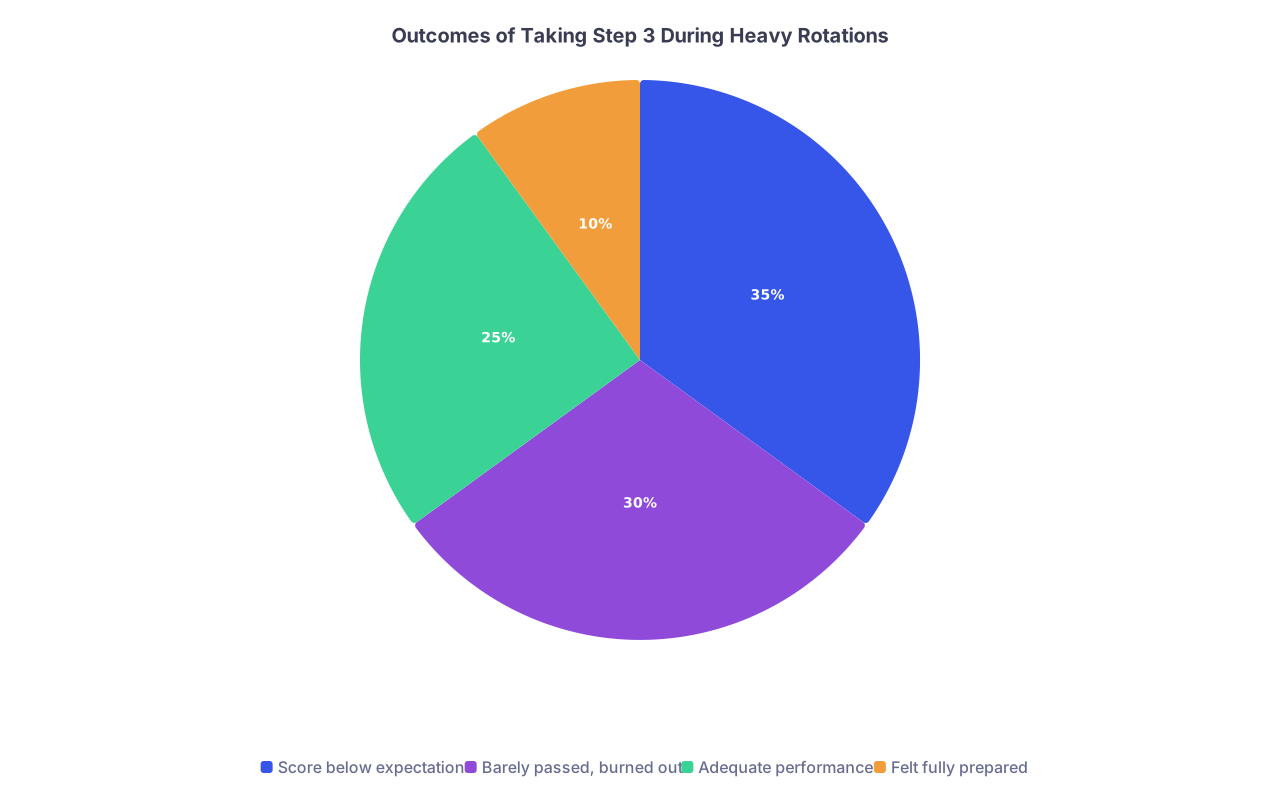
| Category | Value |
|---|---|
| Score below expectation | 35 |
| Barely passed, burned out | 30 |
| Adequate performance | 25 |
| Felt fully prepared | 10 |
Most people can pass drained. But:
- Their score is lower than what they’re capable of
- They burn out and drag that into the next rotation
- Or they fail, not from lack of knowledge, but from pure exhaustion
So if you’re thinking, “What if Step 3 drains me during a demanding rotation?” — I’d flip it:
“What if this demanding rotation is already draining me, and Step 3 is the thing I should move?”
Because yes, you can move it. Usually.
Reality Check: How Bad Is It If You Push Step 3 Back?
This is where the catastrophizing kicks in. The brain says:
“If I don’t take it now, everything collapses.”
Let’s put some structure around that.
| Scenario | Actual Consequence |
|---|---|
| Take Step 3 during brutal rotation and pass with low score | You’re exhausted, but life moves on. Programs mostly don’t care about Step 3 score unless super competitive subspecialty. |
| Take Step 3 during brutal rotation and fail | Annoying, requires explanation, but usually recoverable with a pass on retake and solid clinical performance. |
| Postpone Step 3 to lighter rotation | Mild scheduling stress, but better prep, better score, less burnout. |
| Delay beyond internal program deadline | Needs conversation with PD/Chiefs, can cause tension, rarely career-ending if handled early and honestly. |
Stuff that’s usually not true, even though your brain insists:
- “If I don’t take Step 3 this month, I’ll never get a fellowship.”
- “Everyone else manages this; I’m just weaker.”
- “PDs will think I’m lazy if I ask to move it.”
Program directors care way more about:
- Showing up prepared on rounds
- Not being a walking disaster at sign-out
- Being reliable, teachable, and not constantly on the edge of collapse
Step 3 timing is secondary. Passing is what matters. Not passing “heroically” while dying inside.
If your program has a hard deadline (like “must pass Step 3 by end of PGY-1”), your risk isn’t “I didn’t take it early enough.”
Your real risk is “I bombed it once because I was destroyed and now I’m under pressure to pass fast.”
Signs Step 3 Is Actively Hurting Your Rotation (And You Should Pivot)
If any of these sound like you, I’d seriously consider changing your plan instead of white-knuckling it:
- You’re falling asleep mid-UWorld question repeatedly
- You’re making more errors on the floor: missed orders, incomplete notes, forgetting to follow up critical labs
- You dread both work and studying — not just feel tired, but feel a mix of panic + numbness
- You’re not retaining anything; you read, then instantly forget
- You’re snapping at nurses or co-residents over tiny things because you’re so strung out
That isn’t “normal busy resident life.” That’s your system hitting redline.
And here’s the ugly truth: if Step 3 prep starts making you worse clinically, that’s when attendings and PDs actually start caring. For real.
They don’t see you staying up doing UWorld at 1 a.m. They see:
- The disorganized presentation
- The incomplete A/P
- The missed follow-ups
- The intern who looks glassy-eyed and unsafe
If Step 3 studying is costing you performance on a demanding rotation, something’s got to give — and honestly, it shouldn’t be the rotation.
If You Can’t Move the Exam: How to Survive Without Imploding
Sometimes the exam is scheduled, time off is approved, your PD has signed everything, and moving it will cause explosions.
Fine. Then your goal shifts from “optimal performance” to “minimum necessary prep that doesn’t destroy me.”
Here’s how I’d handle it if I were stuck in that boat:
1. Shrink your definition of “studying”
On a brutal rotation, your realistic bandwidth might be:
- 10–15 high-yield UWorld questions on workdays
- 1–2 hours of more focused review on your lighter weekend day
- Zero on post-call, and that’s non-negotiable
And yes, that’s probably less than what you planned. But “some focused studying you actually do” beats “ambitious plan you abandon in week 2.”
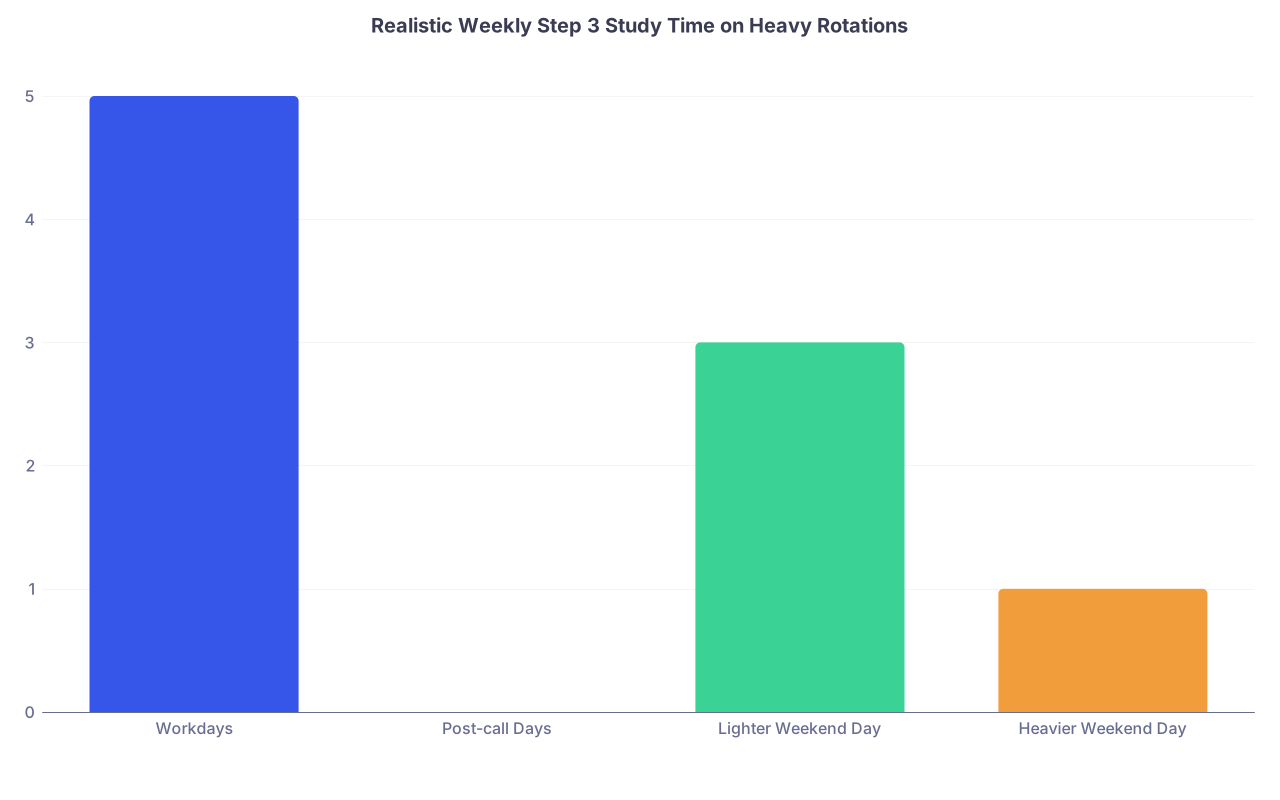
| Category | Value |
|---|---|
| Workdays | 5 |
| Post-call Days | 0 |
| Lighter Weekend Day | 3 |
| Heavier Weekend Day | 1 |
That’s about 9 hours/week. Not pretty. But real.
2. Go laser-focused, not completion-obsessed
You do not need:
- To finish every single UWorld question
- To read an entire review book cover to cover
- To make perfect Anki decks for everything
You do need:
- A decent handle on bread-and-butter IM, peds, OB, surgery, psych
- Familiarity with CCS flow (order sets, timing, when to admit vs discharge)
- Enough stamina to think semi-clearly for 7 hours
So pick:
- A core question bank (usually UWorld)
- A tight resource for CCS (e.g., CCS cases or videos)
- Maybe one concise review source (Online MedEd Step 3 videos, for example)
And stop there. No resource hoarding.
3. Protect sleep like your score depends on it (because it does)
If you’re consistently sub-5 hours/night and trying to do heavy question blocks, your error rate skyrockets. I’ve watched people tank second practice tests simply because they insisted on 40-question blocks post-call.
You’re better off:
- Doing 10–15 questions you can actually think through
- Sleeping 30–60 minutes more
- Walking into test day with a brain that’s at least semi-functional
Sleep is not optional “self-care fluff.” It’s literally neurologic performance maintenance.
If You Can Move the Exam: How to Do It Without Looking Flaky
You’re probably afraid that asking to move Step 3 will make you look weak or disorganized.
I’ve watched the opposite happen: people who proactively shift Step 3 before they start deteriorating usually look mature and self-aware, not lazy.
Here’s what a sane, non-dramatic conversation with your leadership might sound like:
“I’ve been on this rotation for two weeks and I underestimated how intense it would be. I’m concerned that if I take Step 3 on the original date, I’ll underperform because I’m not able to prepare adequately, and it’s starting to bleed into my work. I’d like to move it to [X lighter month], so I can give both the rotation and the exam the attention they deserve. Is that workable, or are there program constraints I should know about?”
Key features of that:
- You’re not whining
- You’re owning the miscalculation
- You’re framing it as wanting to protect both patient care and exam performance
- You’re asking about constraints instead of assuming
Worst-case realistic responses:
- “We really want it done by [date], but you could move it back 4–6 weeks.”
- “You’ll need to rearrange vacation/elective, but we can make it happen.”
- “We can’t push it past [X] for board certification or credentialing reasons.”
The nightmare scenario your brain pushes — “They’ll hate me, I’ll be blacklisted, they’ll think I’m incompetent” — is usually not what happens.
When You’re Already Drained And the Exam Is Soon
If your test is in, say, 1–3 weeks and you’re already toast, here’s the triage plan.
Step 1: Decide honestly — take or postpone?
Ask yourself two things:
- Am I so exhausted that 7 hours of testing sounds physically impossible?
- Are my practice scores vaguely in passing territory, or are they abysmal?
If you’re:
- Physically decimated
- Scoring way below passing on practice tests
- Barely understanding explanations because you’re so wiped
Then postponing is not cowardice. It’s damage control.
If you’re:
- Tired but somewhat functional
- Hovering around or just below passing on practice tests
- Able to get through smaller question chunks coherently
Then you might be okay to proceed, but you need to lower the bar in your head from “crush it” to “solid, safe pass.”
Step 2: Short, brutal prioritization
If you’re proceeding, your mindset becomes:
“What are the most likely points of failure, and how do I shore those up with the time and energy I have?”
Focus on:
- Weakest high-yield sections (e.g., OB you haven’t seen in a year, peds if you’re IM, psych if your program glosses over it)
- CCS basics: orders, timing, must-not-miss diagnostics
Don’t waste time on:
- Deep dives into rare zebras
- Rewatching hours and hours of video content you’ve already seen but feel “meh” about
- Rebuilding your entire knowledge base
You’re not building a palace. You’re patching the roof before the storm.
Step 3: Taper before the test
Two or three days before Step 3, you back down. Not to zero, but closer to:
- 10–15 questions/day, just to stay warm
- CCS case walk-throughs
- Review of your worst topics only
And you sleep. Hard. As much as your rotation schedule allows.
Mental Side: The Shame, The Comparisons, The “Everyone Else Is Handling It”
Let me say the quiet part out loud: a lot of people lie or omit details.
You’ll hear:
- “Yeah I just did UWorld casually on nights and passed fine.”
- “I took it during ICU, it was fine.”
You usually won’t hear:
- “I cried after my first block.”
- “My score was trash and I pretended I was okay with it.”
- “I missed something big on the floor because I tried to study post-call and my brain was gone.”
Stop idealizing other people’s filtered stories.
You are not weak because a 70-hour week + life-or-death responsibility + 2-day marathon exam is frying your circuits.
You are normal.
If anything, recognizing “this is too much, I’m not okay” is stronger than numbing out, pushing through, and then imploding later — academically or emotionally.
A Saner Framework To Keep in Your Head
When Step 3 and a demanding rotation collide, ask yourself:
- Is my clinical performance starting to slip because of Step 3 studying?
- Are my practice scores and energy levels in a zone where passing is realistic?
- If I push this exam back, do I have a lighter block I can move it to, even if it’s not perfect?
If:
- Clinical work is solid
- You’re tired but practice scores are close to passing
- No better rotation exists
→ Keep it, shrink your study plan, and protect your sleep.
If:
- Clinical work is fraying
- You’re barely functioning
- There is a lighter month later, even if it means rearranging vacation/electives
→ Move it. Before the situation forces your hand.
And remember, Step 3 is not Step 1. It’s not the centerpiece of your value as a doctor. Programs mostly care that you pass and that you’re safe, teachable, and not a disaster on the floor.
FAQ (Exactly 4 Questions)
1. What if I fail Step 3 because this rotation completely drained me? Am I ruined?
Annoying? Yes. Ruined? No. A Step 3 fail is a headache, not an obituary. You’ll need a clean pass on the retake and maybe a brief, honest explanation later (“I underestimated rotation demands and didn’t adjust my timing; I learned from it and passed comfortably on the second attempt.”). Strong clinical evaluations and growth after that matter far more than the one fail.
2. Programs say “take Step 3 early.” Won’t postponing make me look bad?
Programs say a lot of general things that don’t apply perfectly to every human. They like early completion because it de-risks scheduling, not because it proves you’re superior. Taking Step 3 slightly later, with a pass and competent clinical work, looks better than taking it early, doing poorly, and dragging burnout into every rotation.
3. How many hours per week should I actually study on a demanding rotation?
If you’re on a legit brutal block (ICU, busy wards, night float), 7–10 focused hours/week is often the upper realistic limit. That might be 15–20 questions on workdays and a few longer sessions on weekends. More than that, and you start robbing from sleep and recovery, which hits your exam performance anyway.
4. What if my co-residents are all taking Step 3 now and I’m the only one delaying?
Then you’re the only one behaving like an adult about your own limits. Their timeline isn’t automatically the right one for you. You don’t get bonus points from ABIM or ABFM or anyone else for matching your friends’ schedule. You get points for passing, staying functional, and not crumbling halfway through the year.
Key points, stripped down:
You’re not weak because Step 3 plus a demanding rotation feels like too much; it is too much for many people.
Protect your clinical performance and your sleep first; shrink or shift Step 3 rather than wreck yourself.
Passing matters. Perfect timing and perfect scores don’t.