

Twenty-eight percent of residency interviews in 2021 were scheduled in the first week of the season—yet programs still filled with applicants interviewed across the entire calendar.
So no, the data does not show some magical “early Zoom advantage” where program directors rank whoever they see before lunch higher just because they’re exhausted later.
But the myth is persistent: “If I don’t get a morning slot, I’m dead.” Or its cousin: “Late in the day they’re too tired to evaluate me fairly.” I’ve heard applicants trading interview slots like baseball cards based on this nonsense.
Let’s separate three things that get conflated:
- Does interview timing within the day (morning vs afternoon, early vs late Zoom block) change how PDs score you?
- Does Zoom fatigue actually exist and impair judgment?
- Does any of this translate into a meaningful change in your rank position?
Short version: Zoom fatigue is real; humans are biased; but there’s zero solid evidence that being seen earlier on Zoom systematically boosts your rank. The story is more boring—and more fixable—than the myth.
What The Existing Evidence Actually Shows
First, the thing nobody telling you scary stories ever mentions: there’s almost no specialty-specific, large-sample, peer-reviewed data showing time-of-day bias in virtual residency interviews that meaningfully changes match outcomes.
What we do have is a mix of:
- Pre-Zoom era data on time-of-day effects in in-person interviews and clinical exams.
- Small-sample studies and surveys from the COVID-virtual-interview transition.
- A lot of cognitive psychology work on decision fatigue and “order effects.”
Let’s hit those one by one.
Time-of-day bias: mostly overhyped, sometimes detectable, rarely huge
In medical education research, there’s scattered work on OSCEs, oral exams, and in-person interviews. The consistent pattern: small differences by time of day that usually disappear once you control for examiner, candidate quality, and structure.
In undergraduate admissions and hiring, some studies show slightly lower ratings later in the day or for later applicants in a queue. But the effect sizes are tiny compared to differences in applicant quality.
Now, in residency:
- Program directors have been surveyed (NRMP, AAMC, specialty organizations). Their reported top factors are Step scores, clerkship grades, SLOEs, letters, and interview performance. Not “they showed up at 9:00 a.m.”
- When programs do internal audits of interview scoring (and some do), the patterns that jump out are usually interviewer variability, not “morning vs afternoon.”
One faculty member at a large IM program showed me their internal 2021–2022 spreadsheet. Scores plotted by interview time. What you saw was noise: one harsh rater at 8 a.m., one soft-touch rater after lunch. No clean downward slide over the day.
So yes, you can find anecdotes. “Our PD told us they’re fried by 3 p.m.” does not equal “your 3 p.m. slot tanks your rank.”
Zoom Fatigue: Real Phenomenon, Messy Impact
Let’s not pretend Zoom fatigue is fake. It’s been studied to death since 2020.
You get:
- Higher self-reported exhaustion after multiple consecutive video meetings
- Increased cognitive load from constant eye contact, lack of microbreaks, unnatural social cues
- Slight drops in attention and working memory with prolonged screen time
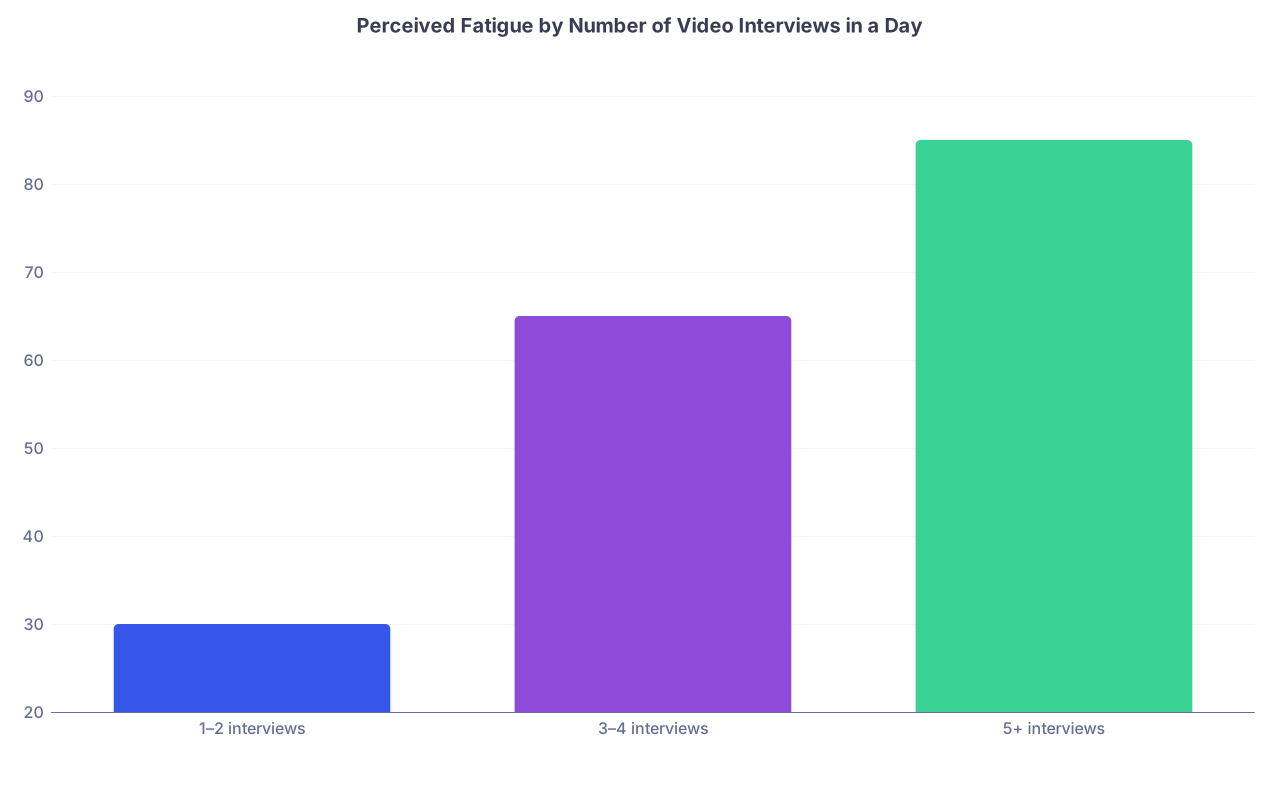
| Category | Value |
|---|---|
| 1–2 interviews | 30 |
| 3–4 interviews | 65 |
| 5+ interviews | 85 |
This is a stylized view of survey patterns I’ve seen: once you hit four or five interviews in a day, both applicants and interviewers feel cooked.
So the logic jump people make is:
Zoom fatigue → worse attention → sloppier evaluation → early applicants get higher scores.
That’s the myth.
Reality is more complicated.
How programs actually compensate (yes, they do)
Most decent programs noticed Zoom fatigue in 2020 by, oh, about 11:30 a.m. on day one. So they started changing:
- Shorter interview days
- Fewer interviews per interviewer
- Longer breaks between blocks
- Standardized scoring rubrics so “tired” doesn’t equal “I’ll just go with my gut”
Are all programs perfect? No. Some ran 8–10 back-to-back 20-minute interviews like maniacs. I’ve seen those schedules. But most adjusted.
And here’s the part applicants underestimate: a lot of faculty are terrified of being unfair. They overcorrect. They slow down later in the day, ask fewer random questions, lean more on structured prompts and rubrics precisely because they know they’re tired.
So Zoom fatigue is real, but its effect on scores is not a simple monotonic slide from 9 a.m. brilliance to 4 p.m. chaos.
Order Effects: The Real Cognitive Trap (But Not The One You Think)
The stronger cognitive phenomenon in selection is primacy and recency—who you remember most clearly—rather than “they were at 10:00 vs 3:00.”
Two separate levels to think about:
- Within-day order: first vs last interview of that day
- Across the entire season: applicants interviewed in October vs January
People love to obsess over #1. #2 is quietly more relevant.
Within a single day: memory vs scoring
Inside a day, there’s some risk that the very first and very last applicant are more memorable. But programs aren’t ranking you based on one day.
They usually:
- Score every interviewee independently on the day itself
- Enter those scores into some system (Excel, ERAS, proprietary)
- Build the rank list weeks later, staring at a spreadsheet, not their memory

| Step | Description |
|---|---|
| Step 1 | Interview Day |
| Step 2 | Immediate Scoring |
| Step 3 | Data Entry |
| Step 4 | Committee Review Meeting |
| Step 5 | Draft Rank List |
| Step 6 | Adjust Based on Discussion |
| Step 7 | Final Rank List Submission |
So you might be more vivid if you’re first or last in a day, but that memory pop hits a wall when the committee is literally sorting columns and filtering for “flagged for concern” and “must rank.”
By the time they’re arguing over who to move from #45 to #38, your exact Zoom time stamp is nowhere on screen.
Across the whole season: early vs late interview dates
Different question: Are applicants interviewed earlier in the season ranked higher because the committee is “fresh” or because opportunities shrink?
Here, the effect is again more administrative than cognitive.
Programs vary, but patterns I’ve seen:
- Some front-load “high priority” applicants they already like on paper into earlier dates.
- Some reserve later dates for people who come in off waitlists.
- Some truly randomize because of scheduling chaos.
So if anything, early-season applicants may be slightly stronger on paper on average. That’s selection bias, not Zoom fatigue.
I’ve seen rank lists where October and January interviewees are completely interleaved. The person who becomes rank #3 interviewed in the second-to-last week. Another in the first week. It tracks more with application strength + interview quality than date.
What Actually Moves Your Rank: Structure, Not Slot Time
The main determinant of whether time-of-day matters is how structured the evaluation process is.
If a program is:
- Using clear scoring rubrics
- Training interviewers
- Anchoring grades to defined behaviors (“Outstanding communication” vs “seems nice”)
- Combining multiple independent evaluations per applicant
…then little things like Zoom fatigue and time-of-day wash out.
If a program is:
- Letting interviewers freehand narrative impressions
- Not calibrating scoring
- Letting one loud faculty member hijack the committee meeting
…then you’re at the mercy of a lot of noise—time of day included.
But notice: that noise doesn’t systematically favor “early Zoom slots.” It introduces randomness, not a clear bias. Being the 10 a.m. slot with a grumpy, undercaffeinated surgeon can be worse than 3 p.m. with someone who’s warmed up and relaxed into the routine.
Data vs Stories: Why This Myth Won’t Die
The myth persists for two reasons.
First, applicants are understandably desperate for control. You cannot change your MSPE. You can’t rewrite your clerkship grades. But you can swap interview slots. That illusion of control is seductive.
Second, people misinterpret local, tiny-sample anecdotes as universal truth.
Yes, a PD might half-joke that they “hate late afternoon interviews.” Yes, a resident might say “morning people always seem sharper.” That’s vibes. Not data.
If there were a powerful, consistent “early Zoom advantage,” you’d see:
- Programs noticing that morning cohorts had higher composite scores over several years
- Specialty organizations putting out guidance on limiting interviews-per-day
- NRMP or AAMC publishing warnings or recommendations
Instead, what you’ve gotten are broad recommendations about:
- Spacing interviews
- Standardizing scoring
- Avoiding marathon days
Notice the difference. They’re trying to reduce fatigue for fairness and logistics, not because someone proved the 1 p.m. slot is death.
Where Zoom Fatigue Can Hurt You (And What To Actually Do)
There is one real risk zone: when interviewers are both tired and given too much unstructured time.
In that scenario, what suffers isn’t usually your numeric score. It’s the depth of engagement.
I’ve watched this happen:
- First interview of the morning: interviewer reads your personal statement, knows your projects, asks smart follow-ups. You shine.
- Fourth interview of the afternoon: same interviewer now on autopilot, asks generic “tell me about yourself,” barely glances at your CV.
Your problem there isn’t that they score you low. It’s that you never get the chance to stand out. You blend into the “seems fine” middle. Which, on a 200-person rank list, is death by mediocrity.
What you can actually control:
- Bring your own energy consistently. Do not mirror their fatigue. If they’re flat, you steady the ship.
- Lead with concrete, memorable stories early in the conversation. Fatigued people remember specific images better than generic adjectives.
- Have 2–3 anchor points you always hit: a clinical moment, a challenge you handled, a specific reason you like that program. Reps matter when your interviewer is cognitively tired.
You’re not fighting their time-of-day bias. You’re fighting the entropy in their attention.
The One “Timing” Thing That Matters More Than Zoom Fatigue
There is one timing-related factor that quietly matters more than your morning vs afternoon slot: whether your interview is early enough in the season for there still to be internal debate about you.
By late January or February in some programs, the top and bottom bands of the rank list are effectively settled. The middle is fluid. If you’re interviewing late and you’re “fine but not special,” the committee has less motivation to reshuffle people. They’ve already got a long list of “fine but not special.”
That’s calendar timing, not Zoom fatigue.
And even then, strong applicants interviewed late still end up high on lists. I’ve seen late-December interviewees land in the top 5 because they were obviously excellent.
So if you want to worry about “timing,” worry about:
- Not delaying your ERAS submission so much that you only get late-season offers
- How you perform in the interview you actually have
Not whether you’re 9:40 a.m. or 2:20 p.m.
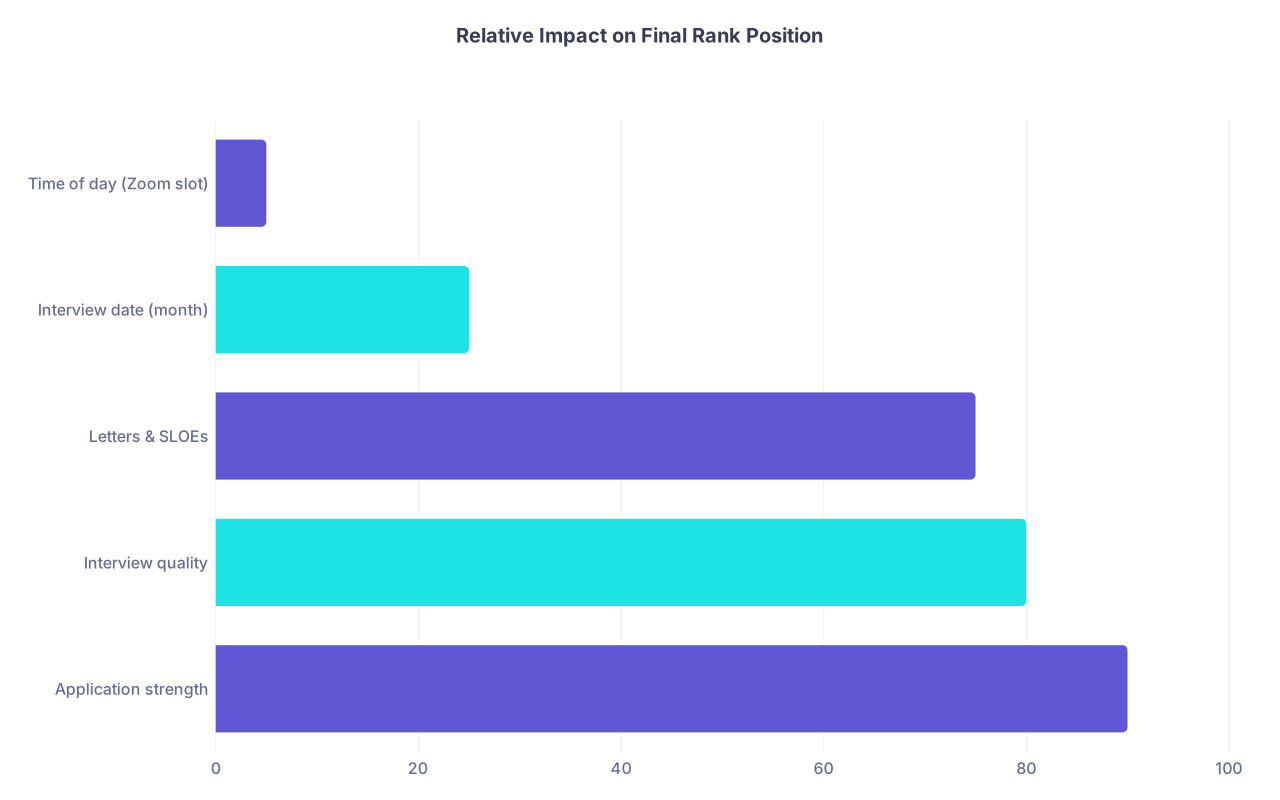
| Category | Value |
|---|---|
| Application strength | 90 |
| Interview quality | 80 |
| Letters & SLOEs | 75 |
| Interview date (month) | 25 |
| Time of day (Zoom slot) | 5 |
Call the numbers above illustrative, but that’s the reality pattern. Time-of-day is background noise.
A Quick Reality Check: How PDs Actually Think
Behind closed doors, rank list meetings don’t sound like:
- “She was a 9 a.m., so I like her more.”
They sound like:
- “Her SLOEs are unusually strong for our program.”
- “He interviewed a little stiff but has ridiculous research for our niche.”
- “She has clear red flags in professionalism—where do we place her if at all?”
- “I don’t remember this one—does anyone feel strongly?”
Notice that last line. The danger zone is being forgettable, not being at 3:15 p.m.
The fix is not to game the schedule. It’s to make sure that when someone pulls your name up on the spreadsheet, at least one person in the room says, “Oh, that’s the one who…”
If you achieve that, your Zoom time stamp becomes irrelevant.
So, Does Zoom Fatigue Make PDs Rank Earlier Applicants Higher?
No. Not in any consistent, evidence-backed, program-independent way.
Zoom fatigue is real. Decision fatigue is real. Order effects and memory biases are real. But translating that into “earlier Zoom slot = higher rank” is storytelling, not science.
If you’ve read this far, remember these points:
- Zoom fatigue exists, but structured scoring and multi-step rank processes dilute any time-of-day effect to near-zero.
- Your bigger risk isn’t being in a “bad slot”; it’s being unmemorable in a noisy, fatigued system—solve that with clear stories and consistent energy.
- Focus on what actually moves rank lists: strong applications, strong interviews, and clear, specific impressions—not whether your Zoom starts before or after lunch.


