
You’ve just closed Zoom. Last interviewer waved, the window disappeared, and now it’s quiet.
You’re replaying every answer in your head, stalking your inbox like something will magically pop up in the next 10 minutes, and wondering: “Do I email them now? Wait? What do I say? Should I tell them they’re my top choice even though I said that last week to another program?”
This is where a surprising number of otherwise strong applicants torch their chances.
Not on interview day.
After it.
Follow‑up etiquette after virtual interviews is one of the most under-taught, over-screwed-up parts of the residency application process. I’ve seen stellar candidates sink themselves with one impulsive “update” email or a badly timed “you’re my #1” message sent to five programs at once.
Let’s walk through the traps so you don’t become one of those cautionary stories people whisper about on SOAP week.
1. The “Immediate Gratification” Mistake: Following Up Too Fast
You end the call at 11:02 AM and by 11:07 AM you’ve fired off a three-paragraph thank-you email to every single interviewer.
That’s not enthusiastic. That’s desperate.
Programs know you just finished interviewing. They also know:
- You’re probably interviewing at multiple places.
- You’re emotional, anxious, and not thinking clearly.
- Immediate follow-ups are often copy‑paste jobs that feel robotic.
A better rhythm for standard thank-you notes:
- Same day is fine if the interview was morning and you write something thoughtful later.
- Within 24 hours is ideal.
- Within 48 hours is still acceptable.
Sending something 5 minutes after you disconnect? It screams “template” and “I’m doing this because I was told I have to.”
Avoid this mistake:
- Give yourself a few hours to decompress.
- Jot down specific details from each conversation so your email can be real, not generic.
- Then send.
If you feel like you have to send it immediately “before you forget,” that’s not professional urgency. That’s poor planning.
2. The Template Trap: Generic, Copy‑Paste Thank‑You Emails
You’d be shocked how many PDs and faculty forward emails around the office with a subject line like: “Got this exact email from 5 applicants today.”
They can tell when your email is a template with name-swaps.
Red flags in your message:
- “Dear Interviewer,” because you forgot to change the salutation.
- “I really enjoyed speaking with you about your program” but you never mention anything specific.
- Calling it the wrong specialty. Yes, people actually send “Internal Medicine” to a Pediatrics PD.
- The exact same wording sent to everyone on the same faculty.

What not to do in your follow‑up:
- Don’t use a single generic three-sentence email for 12 people.
- Don’t mention a “great discussion about research” if that interviewer only asked behavioral questions.
- Don’t send thank-you notes that are so vague they could apply to any program in any city.
Here’s the correct bar:
If you printed your email and covered the program name and interviewer name, could it apply to absolutely anyone at any institution? If yes, it’s weak.
You do not need an essay. You need:
- A specific detail from your conversation.
- A short tie‑in to your interests or goals.
- One sentence expressing genuine appreciation.
If you cannot come up with one real detail from your time with them, that’s already a problem.
3. Over‑Thanking: Too Many Emails, Too Much Contact
Another common screw-up: overcompensating.
- Thank-you to each interviewer.
- Thank-you to the coordinator.
- Follow‑up “just to reiterate my interest.”
- Another email a week later: “Just checking in.”
- Another after rank list certification: “I ranked you highly!”
You become noise. Or worse: a cautionary tale.
There’s a line between professional and clingy. Too many applicants don’t see it.
Here’s a reasonable structure most programs are comfortable with:
- One thank-you email per interviewer (or one consolidated email to the PD + one to the coordinator).
- Maybe one update/interest email later in the season if you have a significant, real update or if it’s clearly allowed.
Beyond that, every extra message has to earn its existence. If you’re emailing just because your anxiety wants reassurance, stop.
Signs you’ve crossed into “problem applicant” territory:
- You have to scroll to read your full email thread with the program.
- You’ve sent more than 3 messages to the same person without them starting the next email.
- You’re inventing “updates” (e.g., “I shadowed one more shift at the same clinic”) just to have an excuse to reach out.
Programs talk. Coordinators remember names. Do not become the applicant they roll their eyes about in the workroom.
4. The Big One: Match Violation & Dishonest “Love Letters”
This is the mistake that is not just cringe, it can be a match violation.
Telling multiple programs, in writing, that you are ranking them “#1” or “very highly” when that’s not true.
Programs are allowed certain communications. You are allowed certain communications. The NRMP is very clear: no one is allowed to solicit or require your rank list information, and you should not misrepresent it.
What I’ve seen blow up:
- Applicants sending “You’re my #1” emails to 4–5 programs.
- PDs emailing each other and realizing they all received those claims.
- Those applicants sliding fast down rank lists when that comes out.
| Message Type | Risk Level |
|---|---|
| Simple thank-you | Low |
| Brief, honest interest statement | Low |
| “You are my top choice” (to ONE program) | Medium |
| “You are my #1” (to MULTIPLE programs) | Very High |
| Asking how you will be ranked | Extreme |
Don’t make these mistakes:
- Don’t lie about your rank list. You have zero obligation to disclose it at all.
- Don’t imply a ranking you’re not prepared to follow through on.
- Don’t ask them how they’re ranking you. That’s not just tacky; it’s a problem.
If you truly do have a genuine #1 program and you choose to tell them (which is allowed in most cases and can be helpful), fine. But:
- Only tell one program.
- Use straightforward, honest language.
- Do it late in the season, once you’re actually sure.
And keep records. If someone asks you later, you want to be confident you didn’t play games.
5. Boundary-Blurring: Overly Personal, Emotional, or Casual Messages
You are not texting a friend. You are not trauma-dumping. You are not writing a diary entry.
I’ve seen emails like:
- “This program means so much to me, I cried after our interview because I just know it’s my home.”
- “I feel like we really vibed. I would love to grab coffee and talk more about your career path.”
- “I’ve been so anxious during this season, and honestly I’m depressed about how competitive things are.”
This is not appropriate for follow-up messages. Virtual format makes some applicants forget there’s still a professional line.
Watch for:
- Emojis in emails.
- Multiple exclamation points everywhere.
- Oversharing about your mental health in ways that make them worry about your ability to function as a resident rather than eliciting empathy.
- Flirty or overly familiar tone. (Yes, this happens. No, it never helps.)
Exceptions exist. If you discussed your mental health or a significant hardship in a thoughtful, relevant way during your interview, it’s fine to briefly reference it in the same tone. But don’t escalate.
Use this rule: if your email were printed and read aloud in a room of 20 faculty, would you want to be remembered for it?
If the answer is “absolutely not,” do not send it.
6. The Ghosting Problem: No Follow-Up At All
Let me be clear: not sending thank-you notes will not automatically kill your chances if your interview was strong. Some PDs barely read them.
But here’s the mistake:
Using “some PDs don’t care” as an excuse to be the one applicant who looks completely disengaged.
Programs are evaluating:
- Professionalism.
- Communication style.
- Basic courtesy.
Thank-you emails are not about sucking up. They’re a low-bar demonstration that you know how to interact in a professional environment.
| Category | Value |
|---|---|
| Nice but not important | 50 |
| Neutral | 30 |
| Negative if obviously missing | 20 |
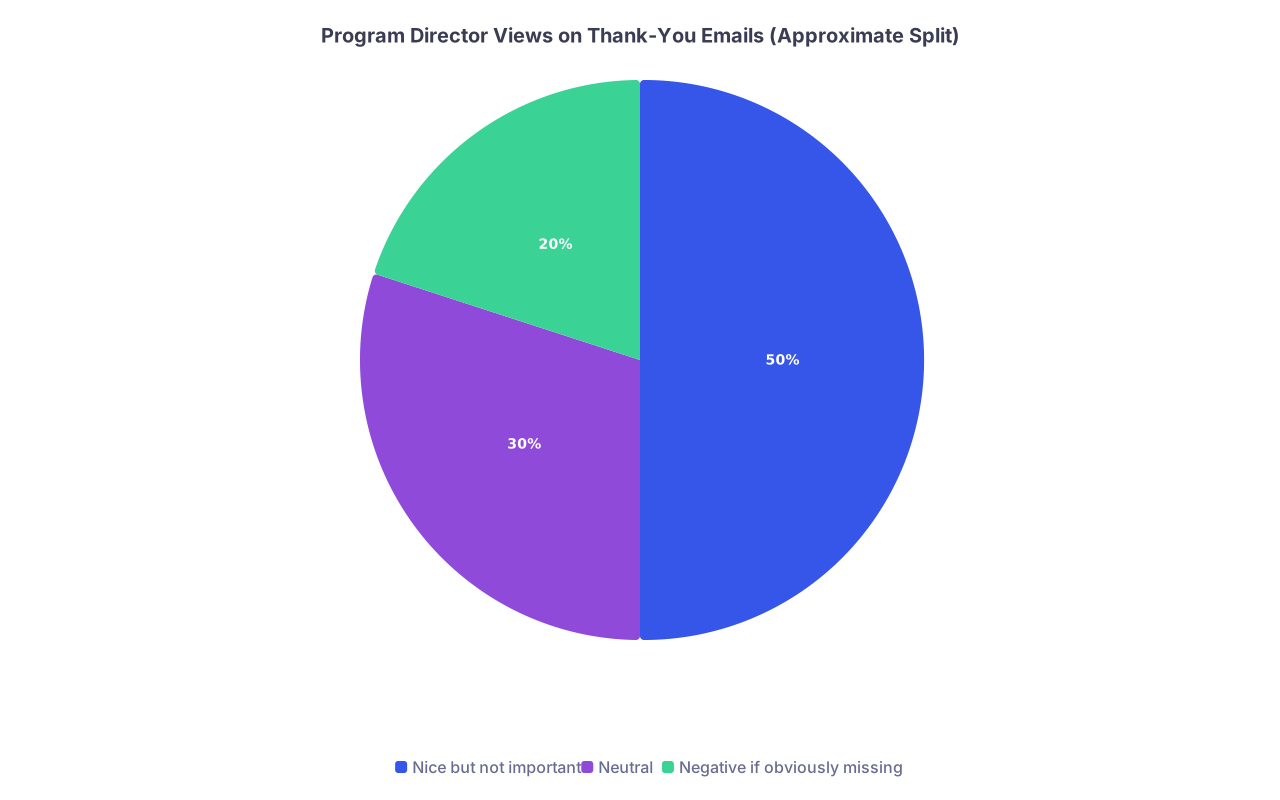
Rough pattern from talking to faculty:
- About half think they’re “nice but not a deciding factor.”
- A minority do notice if you obviously don’t bother when most of your peers do.
- Some coordinators specifically appreciate applicants who acknowledge the logistics they handled.
So no, you’re not doomed if you didn’t send one. But ask yourself why you’re choosing not to. Lazy? Overwhelmed? Bitter about how the interview went?
If you’re not sending follow-ups because you feel the program was a bad fit or unprofessional, fine. But be honest with yourself: if it’s a place you’d actually be okay matching at, a short, respectful email is the bare minimum.
7. Sloppy, Rushed, Error-Filled Emails
You’d never submit your ERAS personal statement with the wrong program name in the first line.
Yet people send this in post‑interview emails:
- “I really enjoyed interviewing with the Internal Medicine program at [Other Hospital Name].”
- “Dear Dr. Smith,” when they interviewed with Dr. Jones.
- Copy‑pasted content referring to faculty or tracks the program does not have.
Virtual season fatigue is real. You’re tired, Zoom‑burned, juggling multiple time zones and programs. But PDs see your follow-ups as a window into your attention to detail under stress.
Common careless mistakes:
- Wrong specialty (EM vs IM, FM vs Peds).
- Misspelling the PD’s name.
- Using the wrong pronouns for the recipient.
- Accidentally forwarding your own notes instead of a polished message.
Slow down.
Build a simple system:
- One folder per program.
- Paste your email drafts there.
- Confirm the correct names, titles, and program before sending.
If your follow-up shows you’re sloppy with basic reading and editing, they’ll assume you’ll be sloppy with orders and notes too. Not the association you want.
8. Unnecessary Updates & Forced Communication
Updates can be appropriate:
- New publication or major acceptance.
- Significant award.
- Step 2 score if it meaningfully strengthens your application.
- Meaningful change in your CV that’s relevant to their program.
But many applicants feel compelled to invent updates. That’s where they blow it.
Examples of weak, try‑hard “updates”:
- “I completed my Sub‑I, and my evaluation was positive.” (No documentation, no specifics.)
- “I continue to be involved in my student interest group.” (So does everyone.)
- “I did another volunteer shift at the same place I already listed in ERAS.”

Every message you send takes mental bandwidth from the program side. Many PDs deal with hundreds of emails per season. If your communication has no real content, you become part of the noise.
Before sending any “update” email, ask:
- Would this change how someone ranks me?
- Is this objectively substantial? (Publication, award, major grade, exam, leadership role.)
- Is this consistent with communications the program said were okay?
If you can’t answer yes to at least one of those, save it in your drafts. Do not hit send.
9. Disrespecting Program-Specific Communication Policies
Some programs are explicit:
- “We do not respond to thank-you emails.”
- “Post‑interview communication will not affect ranking.”
- “Please direct all communication to the coordinator, not individual faculty.”
And yet applicants:
- Bombard individual faculty anyhow.
- Demand confirmation or reassurance that their email was seen.
- Assume “they didn’t respond, so I should follow up again.”
Read the instructions. Then actually respect them.

| Step | Description |
|---|---|
| Step 1 | Want to Email Program |
| Step 2 | Follow policy exactly |
| Step 3 | Do not send |
| Step 4 | Send brief, professional note |
| Step 5 | Program has clear policy? |
| Step 6 | Email has real purpose? |
If a program specifically says “no post‑interview communication will be considered,” your 500‑word love letter isn’t just ignored. It signals that you don’t listen.
This is the quiet killer: ignoring simple stated preferences.
Get used to reading instructions carefully now; it’s half of surviving residency.
10. Tone-Deaf Timing: Rank List & Match Week Messages
Applicants get weird toward the end of the season.
Common timing mistakes:
- Emailing PDs after you submit your own rank list trying to “clarify” your interest.
- Sending “where do I stand?” emails the week rank lists are due or already certified.
- Writing agonized, paragraph-heavy messages during Match Week trying to fish for reassurance.
Harsh truth: by late February, most rank decisions are already made or nearly made. Your last-minute email will not save you. It might just annoy them.
Also problematic: emailing immediately after match results, especially if you did not match there.
Bad examples:
- “I’m disappointed I didn’t match at your program. Was there something wrong with my application?”
- “I was surprised not to match at your institution given our communications.”
- “Can you share any feedback on why I didn’t match with you?”
Programs are not going to unpack their ranking decisions for every unmatched applicant in their inbox.
Accept that:
- You will not get closure from every place.
- Rank lists are complex: group discussions, institutional priorities, diversity goals, couples matches, etc.
- Your follow-up etiquette matters most before lists are locked.
Focus on what you control: consistent professionalism from first contact to last.
Summary: The Short Version You Should Actually Remember
If you skimmed everything else, remember these:
Be honest and measured.
No fake “you’re my #1” to multiple programs. No emotional oversharing. No spammy updates.Be specific and professional.
Thank-you notes should reference something real. No generic templates, no sloppy mistakes, no ignoring program communication policies.Less is more, but zero is risky.
One thoughtful thank-you + one meaningful update (if you have one) is plenty. Ghosting everyone or bombarding them both make you look bad—just in different ways.
Protect your candidacy from the avoidable stuff. The interview is where you show who you are.
The follow-up is where you prove you’re not a problem.
FAQ (Exactly 3 Questions)
1. Do thank-you emails actually affect how programs rank me?
Often, not directly. Many PDs will tell you they don’t change the rank list based on thank-you notes alone. But they do use them to confirm impressions of professionalism, communication style, and genuine interest. A thoughtful, specific note can subtly reinforce a positive interview. A sloppy or inappropriate one can absolutely hurt.
2. Is it okay to tell a program they’re my top choice?
Yes—if and only if it’s true and you’re telling exactly one program. Use clear, direct, honest language and don’t play games. Never send that message to multiple places. That’s dishonest, and if programs compare notes (and they sometimes do), it can severely damage your reputation.
3. What if I already made one of these mistakes—am I screwed?
Usually not, unless you committed blatant dishonesty or serious unprofessionalism. One awkward or overly generic thank-you email won’t ruin you. At this point, stop digging. Don’t send follow-up apologies unless you made a major, obvious error (like misgendering someone or addressing the wrong person). Learn from it, tighten up your process, and handle all future communications with more care.