

Extroverts do not automatically win virtual residency interviews. In fact, the shift to video has quietly taken away several of their biggest built‑in advantages.
The Myth: “Virtual = Performance = Extrovert Wins”
You’ve heard the hallway talk.
“Virtual interviews are like being on TV. You have to be ‘on’ the whole time.”
“Programs love big personalities on Zoom.”
“Quiet people just don’t stand out on video.”
This kind of advice gets repeated so often that anxious applicants start to believe it’s a law of nature: extroverts dominate virtual interviews; introverts survive on paper only.
Let me be very clear: that’s wrong.
Programs did not move to virtual because they wanted a charisma contest. They moved because of cost, logistics, equity pressure, and—frankly—because it made their lives easier. And the actual data on what PDs care about in interviews is embarrassingly boring compared with the social-media mythology of “who has the best vibe on Zoom.”
Here’s the core problem: people are confusing “high energy on camera” with “being a strong residency candidate.” They’re not the same thing. Not even close.
What Programs Actually Look For (Not What Reddit Says)
If you read the NRMP Program Director Survey instead of just vibes scrolling, a pattern shows up fast. Across specialties, when directors are asked what matters in deciding whom to rank, you see the same top items over and over: rotation performance, letters, USMLE, professionalism, communication skills, “interaction with faculty during interview,” and “perceived fit.”
Not: “Most outgoing.”
Not: “Loudest voice on Zoom.”
Not: “Someone I’d want to have a beer with on camera.”
Before we go deeper, look at how “communication” and “personality” actually stack against everything else.
| Factor | Typical Importance Tier* |
|---|---|
| Clerkship/rotation performance | Very High |
| Letters of recommendation | Very High |
| USMLE/COMLEX scores | High |
| Professionalism/ethics | High |
| Communication skills (interview) | Moderate–High |
| “Fit” with program culture | Moderate–High |
*Based on patterns from multiple NRMP Program Director Surveys across specialties.
See the difference? Communication matters. But “communication” in PD language does not mean “talks fast and smiles a lot.” It means: can this person listen, answer questions clearly, not be weirdly defensive, and function in a team.
Those are learnable micro-skills. Not personality types.
And virtual formats actually narrow the bandwidth. PDs get:
- Your facial expressions in a tiny rectangle
- Your voice, compressed by Zoom/Teams/Webex
- Your answers, usually in a structured 15–25 minutes slot
- A brief social or Q&A with residents where they’re mostly watching, not auditioning you
That’s it. No walking down halls. No reading your body language when you present a patient. No seeing you deal with a chaotic clinic morning.
Virtual interviews cut out many of the spaces where extroverts used to shine naturally—hallway chats, pre‑interview dinners, casual banter on the tour. The arena shrank. For everyone.
What Actually Predicts Success on Virtual Interviews
Here’s the part no one wants to hear because it’s not sexy: the traits that predict doing well in virtual residency interviews are boring, trainable behaviors, not who dominated group projects in college.
From watching applicants across two application eras—pre‑virtual and post‑virtual—and talking to faculty who actually sit in those debrief meetings, the same things keep coming up:
- Clarity of thought and narrative
- Concrete examples, not generic answers
- Conversational pacing (not speed, not volume—pacing)
- Emotional self‑regulation under pressure
- Evidence you understand the specialty and that specific program
That’s it. None of these require you to be extroverted. They do require prep. But they’re not personality‑locked.
To see why the “extroverts win” story falls apart, look at how virtual interviews change the playing field.
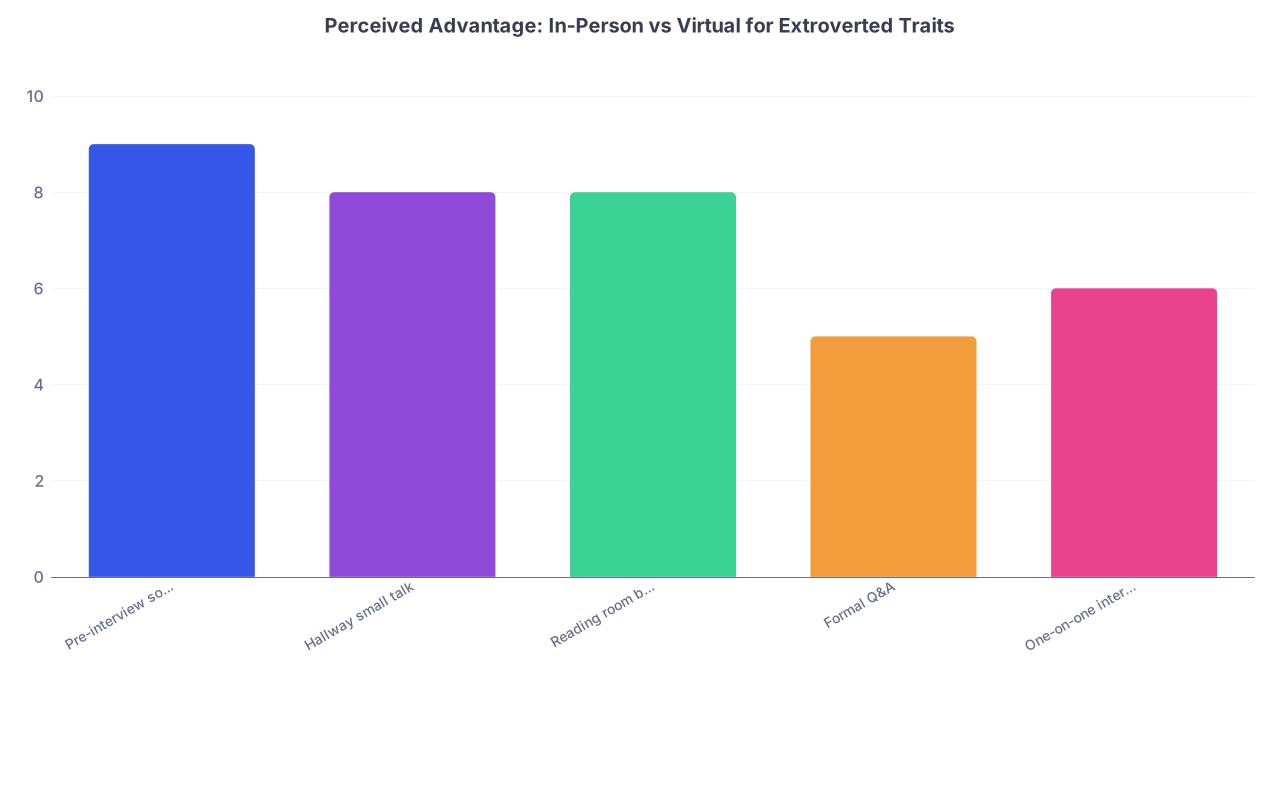
| Category | Value |
|---|---|
| Pre-interview social | 9 |
| Hallway small talk | 8 |
| Reading room banter | 8 |
| Formal Q&A | 5 |
| One-on-one interviews | 6 |
In‑person, extroverted traits like rapid small talk and dominating group space have way more places to show up. On virtual? Those spaces shrink or disappear.
The structure becomes:
- 1–2 formal faculty interviews
- Maybe one brief “meet the PD” type session
- A resident panel where most applicants are muted and typing in chat
If your “strength” is working the room, guess what—there is no room. Just a grid of faces and a mute button.
Meanwhile, people who think carefully before speaking? Perfect for a situation where you answer one question at a time, in turn, with no need to fight for airtime.
The Real Extrovert Traps on Zoom
Let’s flip the myth around.
There are at least four specific ways I’ve watched extroverted applicants shoot themselves in the foot on virtual interviews—mistakes an introvert is actually less likely to make.
1. Talking Over People Because of Lag
In person, you can read breathing cues, shifting posture, eye contact. On video, there’s a half‑second delay and a grid layout. The extrovert who thrives on quick verbal ping‑pong suddenly looks like they keep interrupting the PD.
Faculty description I’ve heard more than once: “Nice, but a little aggressive on Zoom.”
That’s code for: they talked too much, too fast, and didn’t fully answer the question asked.
2. Mistaking “High Energy” for “Good Fit”
A big on‑screen presence can look fine for EM or surgery socials. But in internal medicine, pathology, radiology, anesthesiology, psychiatry? The PDs are often actively allergic to over‑the‑top enthusiasm that feels performative.
Resident debrief quote from one program: “He felt like a salesman. I’m exhausted just imagining rounding with him at 5 a.m.”
Introverts rarely trigger that reaction. Their risk profile is different (too short, too flat), but that’s fixable with practice: add one sentence, raise vocal inflection a notch. Much easier than teaching someone to tone down ingrained over‑talking in 20 minutes.
3. Performing Instead of Connecting
A very extroverted applicant can turn the interview into a stage. Loud, funny, polished—but strangely generic. Programs pick up on that.
Virtual amplifies this because everything already feels less human. If you layer obvious “performance” on top, it rings hollow fast. People remember how you made them feel, not how many jokes you cracked.
4. Fatigue and Inconsistency
Extroverts often assume they’ll just “be themselves” across 12–18 Zoom interview days. No script, no structure. Then halfway through the season they’re fried, their answers drift, and their energy yo‑yos between “overcaffeinated” and “checked out.”
Introverts, ironically, are more likely to script, rehearse, and pace their bandwidth. Which means their virtual presence is often more consistent from program #1 to program #15.
Why Virtual Interviews Quietly Favor Prepared Introverts
Let’s spell this out, because this is where the myth really cracks.
Virtual formats mute several traditional extrovert advantages:
- No travel lobby small talk
- No big group dinners where they dominate conversations
- No long unstructured walking tours
- Less chance to show physical charisma, ease with groups, or quick comedic timing
And virtual amplifies several introvert‑friendly conditions:
- You’re on home turf: same desk, same chair, same setup
- You can rehearse your talking points in the exact environment you’ll use
- You see your own face on screen, which gives immediate feedback for micro‑adjustments
- There are clearer turn‑taking rules. When it’s your question, it’s your floor. Period.
Also, virtual interviews make silence cheaper. A half‑second pause on Zoom while you think doesn’t feel nearly as heavy as dead air in a conference room. Which is exactly what a more reflective person needs: a beat to organize the answer, then deliver something coherent.
I’ve watched “shy” applicants rank extremely well simply because, on Zoom, they came across as:
- Thoughtful
- Calm
- Well‑prepared
- Genuinely interested in the program
No one in the ranking meeting said, “But were they extroverted enough for our call schedule?” That sentence does not exist in real life.
The Skills That Actually Move the Needle (Trainable, Not Hard‑Wired)
Let’s talk about what you can actually control.
The core virtual interview skills are not personality traits. They are behaviors you can practice:
Framing your story – Why this specialty, why now, why you’re not going to implode as an intern. Introvert or extrovert, you need 2–3 anchor stories that demonstrate resilience, teamwork, and growth. Short, specific, not TED‑Talk length.
Answer length control – Most virtual answers should be 45–90 seconds. Extroverts tend to overshoot. Introverts tend to undershoot. Both can use a timer in practice to hit the range reliably.
Facial expressiveness – This is not “be extra animated.” It’s: show that your face responds to what’s being said. Look like you’re actually in the conversation. This is often easier for someone who’s used to expressing themselves in 1:1 situations instead of crowds.
Vocal clarity – You don’t need to be booming. You need to be audible, with some modulation so you don’t sound robotic. That’s mic placement, speaking slightly slower than normal, and varying tone at key points.
Listening discipline – Answer the question asked. Not the one you wish they’d asked. Over‑talkers routinely fail at this on Zoom. Deliberate listeners crush this.
This is all rehearsal. Not personality surgery.
To make the point clearer, look at how these behaviors play out across personality styles.
| Interview Skill | Extrovert Risk | Introvert Risk | Fixable with Practice? |
|---|---|---|---|
| Answer length | Too long, rambling | Too brief, vague | Yes |
| Facial expressiveness | Too intense, performative | Too flat, disengaged | Yes |
| Listening | Interrupting, talking over | Over‑deferential, passive | Yes |
| Storytelling | Entertaining, off‑topic | Overly factual, dry | Yes |
Notice the last column. None of this is inherent.
The Real Determinants of Who “Wins” the Match
Here’s another misconception that feeds the extrovert myth: the idea that the interview itself is where the match is won or lost.
It’s not.
The interview can sink you. It can slightly boost you. But if your application is weak, there’s no amount of charisma that’s going to move you from “borderline” to “top 5” at a competitive program. Faculty know this. They see years of evaluations, not just 20 minutes of banter.
I’ve sat in ranking meetings where someone says, “I really liked her on Zoom,” and another faculty quietly says, “Her sub‑I comments were rough, and the letter from our own attending was lukewarm.” Guess which carries more weight.
On the flip side, I’ve seen very quiet but solid candidates get a program’s respect precisely because their application screams “already reliable,” even if their interview was a bit stiff. The ranking conversation often goes:
- “He was a little reserved.”
- “Yeah, but his evaluations are stellar and the letter from Dr. X is glowing.”
- “True. Let’s keep him high.”
Personality colorizes the picture. It doesn’t draw the outline.
How to Stop Playing the Wrong Game
If you’re more introverted, stop trying to cosplay as an extrovert because you think Zoom demands it. It shows. And it usually looks awkward.
Instead:
- Decide on 3–4 key things you want every interviewer to know about you by the end of the day.
- Build stories and responses around those, then practice until they sound like you on a good day—not you doing a YouTube persona.
- Fix your tech, framing, and audio so they are invisible. You want zero points deducted for environment.
- Practice with someone who will tell you the truth: “You’re mumbling,” “You never smile,” or “You’re monologuing.”
If you’re more extroverted, you have a different assignment: rein yourself in.
- Practice shorter answers.
- Leave explicit space in your responses for the interviewer to jump in.
- Watch recordings of yourself and see if you’d actually want to be on night float with that person for a month. If not, tone it down.

| Step | Description |
|---|---|
| Step 1 | Self-review traits |
| Step 2 | Expand answer length |
| Step 3 | Shorten answer length |
| Step 4 | Practice 60-90 sec responses |
| Step 5 | Check facial and vocal tone on video |
| Step 6 | Mock interviews with feedback |
| Step 7 | Final tech setup and environment check |
| Step 8 | Introvert or Extrovert leaning |
Your goal is not to become someone else. It’s to become the most legible version of yourself within this cramped, weird format.
The Data Story vs. The Anxiety Story
One more thing.
Programs that have actually looked at their own outcomes—who performed well as interns, who had professionalism issues, who stayed vs left—do not find “extrovert on Zoom” as a predictive category. They find the boring stuff: conscientiousness, reliability, humility, ability to learn from feedback.
The NRMP surveys, the AAMC reports, the internal GME reviews—none of them say “high-energy virtual presence” is a key competency. That narrative is coming from stressed applicants projecting their own fears and from social media that rewards flashy advice over dull truth.
If you insist on believing the myth that extroverts automatically win, you will do two dumb things:
- Waste energy performing instead of preparing.
- Ignore the actual levers you can pull: practice, feedback, clarity, and environment.
That’s a bad trade.
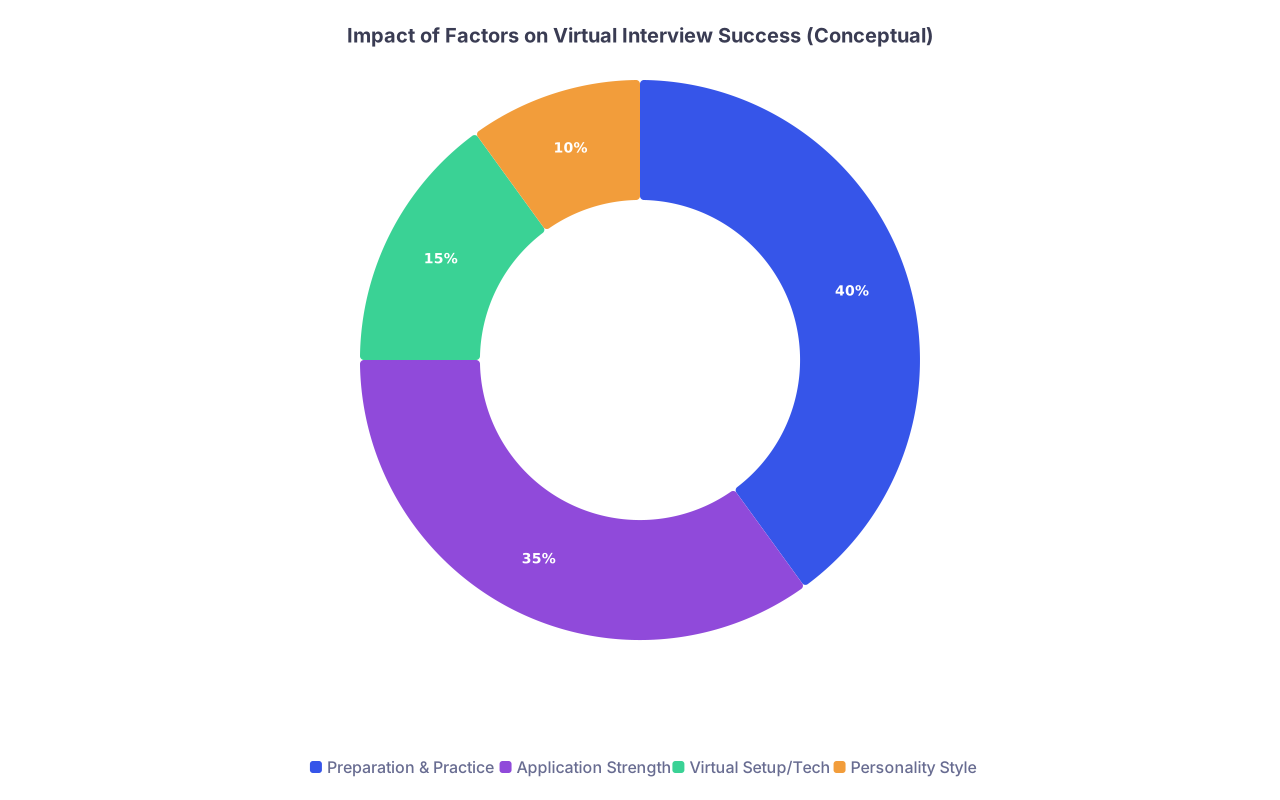
| Category | Value |
|---|---|
| Preparation & Practice | 40 |
| Application Strength | 35 |
| Virtual Setup/Tech | 15 |
| Personality Style | 10 |
Even conservatively, personality style is a small slice. Preparation, prior performance, and application strength dominate.
The Bottom Line
Extroverts do not “always win” virtual residency interviews. They don’t even start with a guaranteed edge.
Three key truths to walk away with:
- Virtual interviews compress the interaction and strip away many natural extrovert advantages; they reward preparation, clarity, and steadiness more than raw charisma.
- The skills that matter—answer structure, pacing, expressiveness, and listening—are behaviors anyone can train, regardless of where they sit on the introvert–extrovert spectrum.
- Your long‑term record (evaluations, letters, work ethic) still carries more weight than your on‑screen personality; the interview can refine that picture, not rewrite it.
Stop trying to win a charisma contest that programs are not actually running. Learn the real game—and play that one well.


