
The way women physicians are constantly mistaken for nurses or “the help” is not a minor annoyance. It is a professionalism problem—and you need a toolkit, not a thick skin.
This happens because of bias, not because you “look too young” or “act too friendly.” You are not the problem. But you do need a system for responding—one that protects your authority, preserves relationships, and does not burn you out.
Here is that system.
1. Understand the Pattern So You Stop Internalizing It
Bias feels personal. It almost never is.
Why this keeps happening
You get mistaken for a nurse, tech, or “sweetie from the front desk” for a few predictable reasons:
- Gender bias: “Doctor” is still coded as male in many people’s heads.
- Racial bias: Women of color get this 10x worse. If you are Black, Latina, Asian, Indigenous, or from a minority group, you already know.
- Age bias: Young = trainee. Young woman = not physician.
- Context: You are outnumbered by men in white coats; patients assume.
You cannot fix the bias in other people’s heads during a 10‑minute encounter. What you can control is:
- Your language.
- Your body positioning.
- Your team scripts.
- Your documentation and escalation when needed.
That is the toolkit.
2. Default Script: Correct Quickly, Calmly, and Once
You need a reflex response. No overthinking. No apologizing for existing.
Your baseline script should be short, neutral, and authoritative.
Examples:
Patient: “Nurse, can you get the doctor for me?”
You: “I am your doctor. I am Dr. Patel. How can I help you?”
Family: “Can we talk to the real doctor?”
You: “I am the physician in charge of your care. I am Dr. Nguyen. What questions do you have?”
Notice the structure:
- Correct the role: “I am your doctor / I am the physician.”
- State your name and position: “I am Dr. X, the [resident / attending / surgeon].”
- Immediately move to the task: “Here is what we are going to do” or “What questions do you have?”
No jokes about “promotion from nurse to doctor.” No self-deprecation. No apology.
You are not obligated to soften the correction with “Actually…” or “Oh, I’m just the doctor.” Cut that.
3. Proactive Moves: Reduce How Often It Happens
You will not eliminate it. But you can decrease the frequency by changing how you show up in the room.
A. Introduce yourself like you mean it
Most physicians mumble their introduction while half-looking at the computer. Then they are surprised patients forget.
Do this instead:
- Walk in, stand where the patient can see your full body.
- Eye contact, firm voice:
- “Good morning. I am Dr. Lopez, one of the internal medicine physicians taking care of you today.”
- Pause. Let it land.
- Only then sit or turn to the computer.
Avoid:
- “Hi, I’m Sarah, one of the doctors.”
Use “Dr. Lastname.” Every time. Especially early in training.
B. Use your badge and coat strategically
I do not care if you hate white coats. I care if you are constantly undermined and you need tools.
Checklist:
- Badge at chest level, facing front.
- Badge that clearly reads “Physician” / “Resident Physician” / “Attending Physician” in large font if possible. Many hospitals will reprint if you ask.
- If your institution color-codes roles (white for MD, blue for RN, etc.), make sure you are compliant so staff can back you up.
Does this fix bias? No. Does it give you an easy visual to point to when correcting someone? Yes.
C. Script your team to introduce you correctly
This one is underused and powerful.
Tell your team directly:
- To nurses: “When you introduce me in the room, would you mind saying, ‘This is Dr. Smith, the internal medicine resident’ so the patient is clear on roles?”
- To attendings: “Patients often mistake me for nursing staff. When we round, could you introduce me as ‘Dr. Jones, the resident working with me’ so they understand my role?”
Most decent people will adjust instantly once you say this out loud.

| Step | Description |
|---|---|
| Step 1 | Enter Room |
| Step 2 | Clear Introduction |
| Step 3 | Proceed with visit |
| Step 4 | Patient mislabels you |
| Step 5 | Use correction script |
| Step 6 | Boundary or escalation |
| Step 7 | Patient understands role |
| Step 8 | Repeated issue |
4. Script Variations for Common Situations
You need different tools for different levels of disrespect. Here are the big four.
4.1 The benign wrong label
This is the person who genuinely does not know.
- Patient: “Nurse, can I get more pain meds?”
- You: “I am your doctor, Dr. Shah. I will review your pain plan and adjust if needed.”
No emotion, no lecture. Correct and move on.
If they do it again later:
- “Just a reminder, I am your doctor, not your nurse. I know it can be confusing with so many people coming in and out.”
4.2 The repeated offender who “forgets”
Here you set a slightly firmer boundary.
- Patient: “Sweetheart, can you bring the doctor?”
- You: “I am Dr. Alvarez, your physician. You have called me ‘nurse’ a few times now. It is important that you know I am the doctor managing your care.”
If they still persist, you make it about clarity of care, not ego:
- “If you are unsure who your doctor is, that can make your care confusing. Let us be clear: I am the doctor in charge of your care today.”
4.3 The undermining family member
This is the “We want the real doctor” or “We want the man in charge” scenario.
You do not dance around this.
Option A – clear and firm:
- “I am the attending physician on your mother’s case. I am the doctor in charge of her care. If you have questions, I am the correct person to answer them.”
Option B – boundary plus offer:
- “I understand this is stressful. To be clear, I am the physician responsible for your father’s care. I can explain the plan now. If you would still like another physician involved after that, we can discuss it.”
If they explicitly request a male doctor out of bias:
- “We do not assign physicians based on gender. I am the physician responsible for your care. If you are not comfortable with that, we can arrange a different doctor if the schedule allows, but it will not be based on gender.”
And you document that conversation. Word for word if needed.
4.4 When a colleague undermines you
Sometimes it is not the patient. It is the senior resident who says “the girls will update the family” about two women interns. Or the attending who calls you “nurse” in front of a patient.
You address it. Briefly. Directly.
In the moment, in front of the patient if necessary:
- “Just to clarify, I am Dr. Chen, the resident physician. I will be updating you about the plan.”
Later, in private with the colleague:
- “When you referred to us as ‘the girls’ in front of the patient, it undermined my role as a physician. Please use ‘doctors’ or ‘residents’ instead.”
If it is your attending and you feel safe, you can still say:
- “When you called me ‘nurse’ in front of the patient, it made it hard for me to maintain authority in the room. I need to be introduced and referred to as ‘Dr. [Lastname]’ to do my job effectively.”
If you do not feel safe, you bring this to a trusted chief or program leadership with specific examples.
5. Decide Your Red Lines in Advance
You will burn out if you treat every incident as a battle. You will also erode your authority if you ignore everything.
You need tiers.
| Situation Type | Example Phrase | Recommended Response Level |
|---|---|---|
| Benign, first-time mistake | "Nurse, can you..." | Quick, neutral correction |
| Repeated but not hostile | Same patient mislabels you multiple times | Firmer correction, clarify |
| Explicitly biased | "We want a male doctor" | Clear boundary + document |
| Colleague undermining | "The girls will update you" | Direct feedback + escalate if needed |
Make some decisions now:
- You will always correct mislabeling at least once.
- You will escalate (to attending, chief, or risk) when:
- Bias undermines care or communication.
- There is verbal abuse or harassment.
- You will let some things go when:
- Patient has delirium, dementia, or clear cognitive impairment.
- Correcting will not improve anything and will only increase distress.
That is not weakness. That is triage.
6. Use the System: Document, Escalate, Protect Yourself
This is not only about your feelings. It is also about patient safety and workplace ethics.
A. Document biased or undermining incidents
Short, factual, unemotional:
- “During family meeting, daughter requested ‘a male doctor instead of her’ to discuss plan. Explained I am attending physician and we do not assign by gender. Offered second opinion; family declined. Care plan unchanged.”
This creates a record. If there is a complaint later, you have contemporaneous notes.
B. Use your chain of command
Escalate when:
- A patient or family’s bias is obstructing care.
- A colleague repeatedly undermines you after feedback.
- There is sexual harassment, racist comments, or threats.
Pathways:
- Talk to your chief resident or program director with specific quotes and dates.
- Use your institution’s professionalism or mistreatment reporting systems.
- For egregious behavior, involve risk management or patient relations.
Do not underestimate how often “small” bias incidents snowball into formal complaints when not addressed.
C. Get witnesses when things escalate
If a family or patient is getting aggressive or highly biased:
- Ask a nurse, chief, or another physician to join you.
- State the roles again clearly in front of them:
“This is Dr. Amin, the resident physician working with me. I am Dr. Blake, the attending.”
You are not being dramatic. You are covering yourself and stabilizing the encounter.
7. Emotional Fallout: How Not to Let This Erode You
You are not a robot. Being misidentified over and over chips away at you if you let it.
Here is how you avoid that slow erosion.
A. Name the pattern, not your deficiency
Stop translating “they thought I was a nurse” into:
- “I do not look like a doctor.”
- “I must not be acting confident enough.”
- “I should be more assertive / less friendly / more serious.”
The correct translation is:
- “Bias is present in this environment. I need my toolkit today.”
B. Debrief strategically, not constantly
You do not need to rant in the workroom after every microaggression. It drains you and everyone around you.
But you should have 1–2 people you talk to when it gets heavy:
- A co-resident who “gets it.”
- A women-in-medicine or URiM faculty mentor.
- A therapist if it is stacking with other stressors.
When you debrief, ask: “What, if anything, do I want to do differently next time?” Then move on.
C. Protect your identity as a physician
If your core story about yourself becomes “I am the doctor no one believes is a doctor,” you will start to shrink.
Instead, build explicit counterweight:
- Keep an email folder of positive patient comments, evals, and compliments.
- Remind yourself: “I finished med school. I passed these boards. I sign these orders. I carry this pager. I am the physician. Full stop.”
This is not toxic positivity. It is reality, documented.
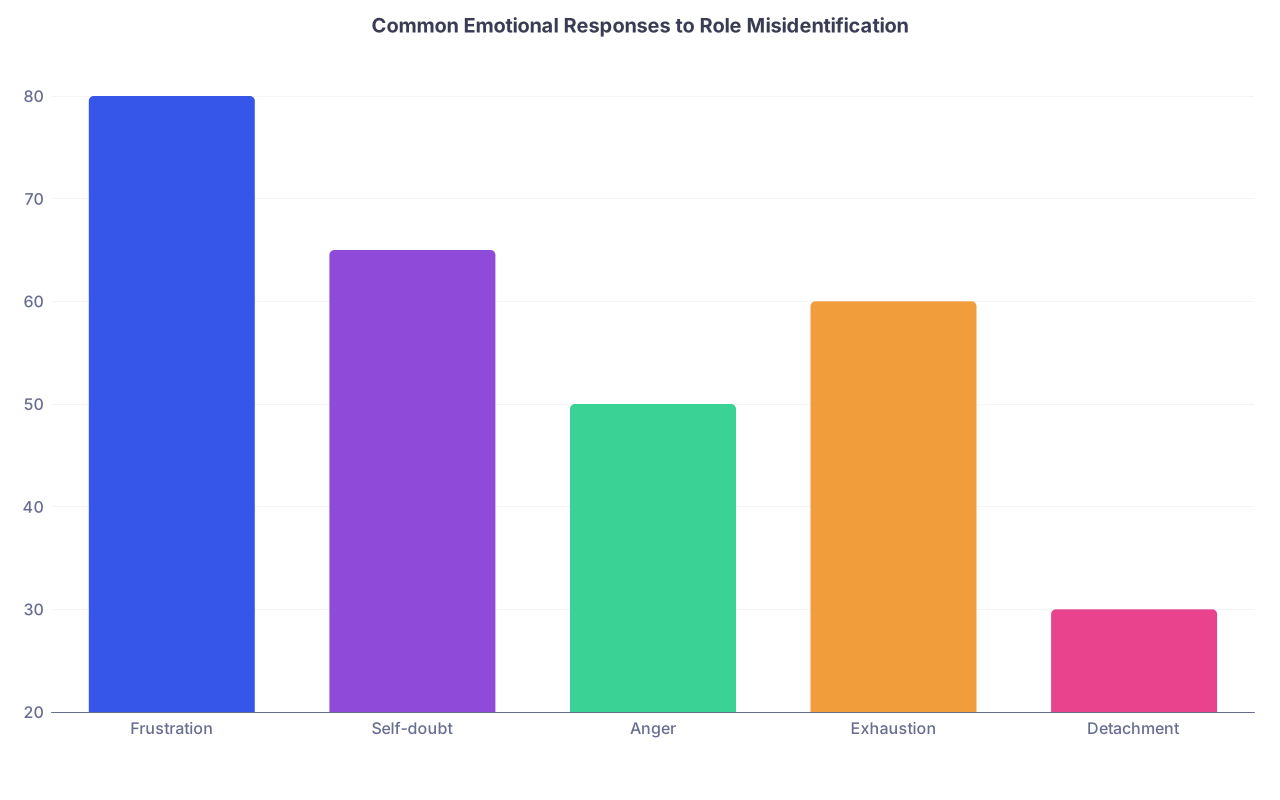
| Category | Value |
|---|---|
| Frustration | 80 |
| Self-doubt | 65 |
| Anger | 50 |
| Exhaustion | 60 |
| Detachment | 30 |
8. Ethical Layer: Balancing Respect for Patients with Self-Respect
You work in a system that tells you to center the patient, always. Fine. But “patient-centered” does not mean “physician-erasing.”
A few ethical anchors:
- Respect is mutual in a professional relationship. You are not a punching bag.
- Clarifying your role is not ego, it is part of informed consent and safe care.
- Calling out bias is aligned with professional ethics. Biased assumptions can lead to poor communication, missed information, and worse care.
A practical ethical question I use:
“If a male colleague were in my position, what level of disrespect would we consider unacceptable for him? That is my bar too.”
Use that test before you minimize something.
9. Build a Micro-Toolkit You Can Carry into Every Shift
Too much theory is useless when you are on hour 26. Here is a micro-checklist you can actually use.
Before a shift
- Wear visible ID that clearly says “Physician.”
- Decide your default correction script and say it out loud once.
- Mentally rehearse one firm boundary line for family requests for “real” or “male” doctors.
During the shift
- Introduce yourself clearly as “Dr. Lastname, [level] physician” to every new patient and family.
- Correct mislabeling once, quickly each time it happens.
- If it repeats with the same person, upgrade to your firmer script.
- If bias or undermining obstructs care or becomes abusive, bring in backup and escalate.
After the shift
- Jot down any serious incidents with exact phrases and names.
- Decide if anything needs to be documented formally or reported.
- Give yourself 2–3 minutes to process emotionally. Then switch tasks.
Small routines prevent big burnout.
FAQ (exactly 4 questions)
1. Should I ever just ignore being called “nurse” or “young lady” to keep the peace?
Yes, selectively. If the patient is delirious, severely demented, or clearly cognitively impaired, your energy is better spent on clinical care than on role correction. Also, if you have corrected once or twice and further correction will only escalate distress without improving anything, you can let it go. The key is that you are choosing to let it go for clinical reasons, not because you think you do not deserve the title.
2. How do I handle this as a medical student who technically is not “doctor” yet?
You still deserve role clarity. Use: “I am [First Last], the medical student working with Dr. Smith on your care.” When misidentified as nurse or staff: “I am actually a medical student on the team, working with your doctors.” Ask residents and attendings to introduce you clearly so patients do not think you are ancillary staff. You are setting patterns now for how you expect to be treated later.
3. What if my attending or senior resident brushes it off and tells me to ‘stop being so sensitive’?
That is a leadership failure on their part, not oversensitivity on yours. You can respond calmly: “I understand it may not bother you, but it impacts how patients respond to me and my ability to function as their physician.” If they still dismiss you, document key incidents yourself and bring them to a trusted chief, program director, or faculty mentor. Patterned minimization of bias concerns is itself a professionalism issue.
4. Is it unprofessional to tell a biased family I will step out and have another provider see them?
You must prioritize patient care, but you are not obligated to endure ongoing harassment. A reasonable approach: “I want to ensure you receive the best possible care. Given the tension here, I am going to step out and speak with my team about whether another physician can assume care. This may not be immediate or even possible, but I will explore options.” Then involve your attending, chief, or risk management. The final decision is usually made at the team or institutional level, not by you alone.
Key takeaways:
- Stop absorbing this as a personal failing; treat it as a predictable bias problem that requires a standard response.
- Use clear introductions, consistent correction scripts, and firm boundaries as your core toolkit.
- Document serious or repeated issues, involve your team when needed, and protect your identity as a physician as fiercely as you protect your patients.