The myth that one bad board score permanently kills your shot at a competitive fellowship is exaggerated and lazy thinking—but the anxiety it causes is very, very real.
I know exactly where your brain is going right now.
“Derm is gone.” “Cards is gone.” “I’ll never match GI.”
You’re replaying one number. One PDF. One stupid exam day where something felt off. And now you’re trying to predict the next ten years of your life from it.
Let’s walk through this like grown‑ups who are freaking out on the inside.
First: How Bad Is “Bad” Really?
This is where people lose perspective.
Programs don’t think in terms of “good/bad.” They think in distributions and cutoffs. You’re thinking, “My 225 on Step 2 is awful.” But compared to what? To your friends? To your specialty? To your dream program? Those are different questions.
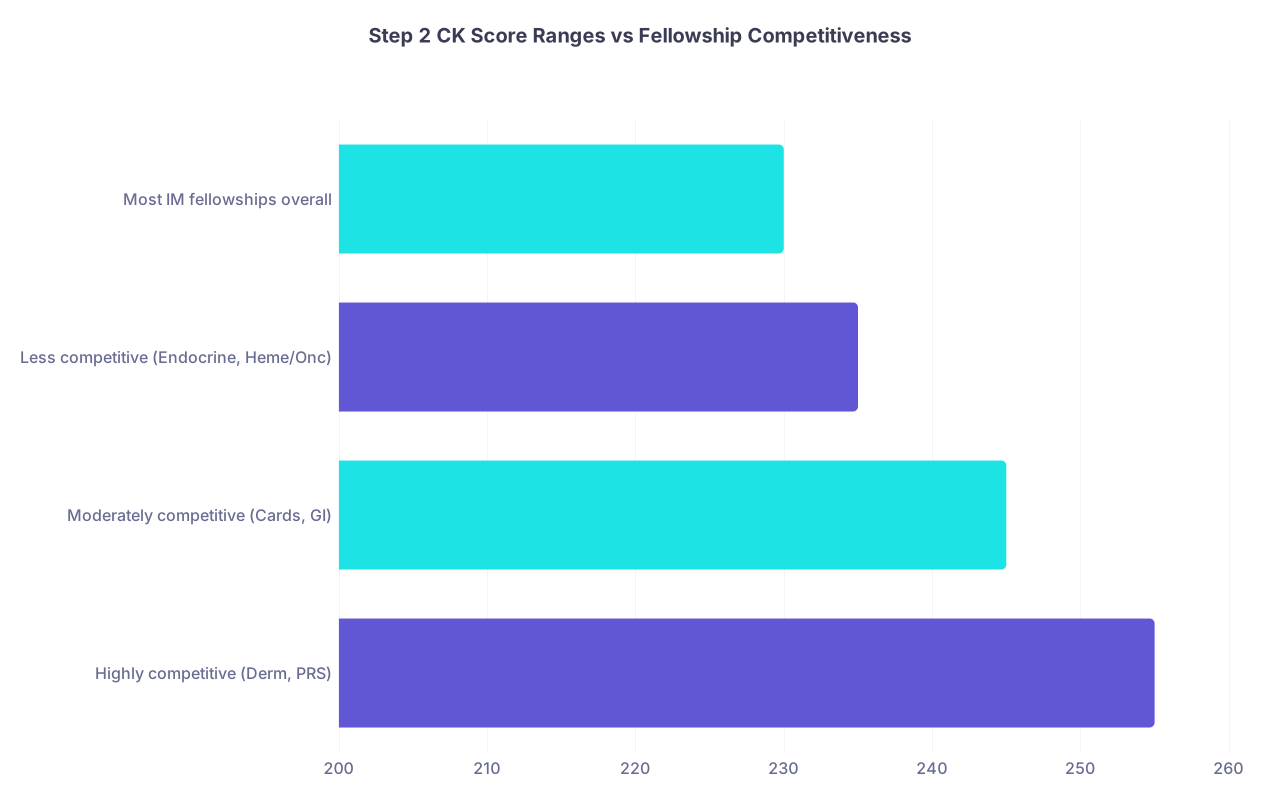
| Category | Value |
|---|---|
| Highly competitive (Derm, PRS) | 255 |
| Moderately competitive (Cards, GI) | 245 |
| Less competitive (Endocrine, Heme/Onc) | 235 |
| Most IM fellowships overall | 230 |
That chart isn’t exact for every specialty, but it captures the idea: expectations shift with competitiveness.
What feels catastrophic to you might register to a PD as: “Okay, slightly below our usual, let’s see the rest of the app.”
There are a few different flavors of “bad”:
- You bombed Step 1 (back when it had a score), but Step 2 is decent or strong.
- You did fine on Step 1/pass, but Step 2 is weaker than your peers.
- One in‑training exam (ITE) is low.
- A board failure or near-failure.
They’re not equal sins in the eyes of fellowship directors.
From what I’ve seen and heard bluntly in conferences and behind closed doors:
- A single mediocre score: annoying, not fatal.
- A single low score with later improvement: concerning but often redeemable.
- A failure with no upward trend: major red flag.
- A failure with strong comeback and clear explanation: still viable, but you’ll have to work harder.
So before we catastrophize, you need to be surgically honest with yourself:
Do you have “not perfect”? Or do you have “outlier low” or “fail”?
Because those are different problems with different solutions.
How Fellowship Directors Actually Look at Scores
Most residents imagine PDs sitting in a dark room, sorting applicants by score like an Excel filter. That’s not totally wrong… for the first pass.
Plenty of competitive fellowships have informal score screens. They’ll never admit exact cutoffs publicly, but they exist. Something like: “We rarely interview under ___ unless there’s something exceptional.”
But here’s the part you don’t see: once you’re past that initial filter, the conversation shifts from “score” to “story.”
I’ve literally heard PDs say during selection meetings:
- “Yeah, the Step is lower, but look at the research.”
- “He failed Step 1, but look at this improvement and the letters.”
- “Her scores are okay, but this letter from our alum is glowing.”
- “The ITE is low, but she’s basically running the unit and everyone loves working with her.”
The ugly truth:
If your score is far below their usual, they may never get to the stage where they say your name out loud. But if you’re within striking distance, a strong narrative can absolutely push you into the “interview” pile.

Here’s what they actually care about more than one number, especially in medicine subspecialties like Cards, GI, Heme/Onc, Pulm/CC:
- Letters from people they know and trust
- Whether you’re perceived as safe and reliable on the wards
- Research output in that field
- How clearly you’re committed to their specialty (not just “I like the heart”)
- Whether you’re going to be a problem (personality, professionalism, laziness)
The dirty secret is this: once scores clear a baseline, the rest has way more weight.
So the real question isn’t:
“Is my bad score fatal?”
It’s:
“Am I doing enough everywhere else to make them say, ‘We want them anyway’?”
The Worst-Case Scenario You’re Probably Imagining
Let me guess. In your head, it goes like this:
You apply to a competitive fellowship.
They see your one bad score.
They all silently scoff in a conference room.
You get zero interviews.
You never do the specialty you love.
You wake up 10 years from now still angry at that one exam.
Your brain is writing fan fiction.
Here’s a more realistic “worst case” with one bad score:
- You get fewer interviews than your peers for that specialty.
- The very top‑tier, extremely score-obsessed programs might not invite you.
- You have to cast a wider net, be strategic, and lean harder on mentors.
- You might end up matching at a solid but not “flashy name” fellowship.
Is that still painful? Yes.
Is it the apocalyptic career death you’re imagining? No.
There are people in top academic jobs who did not have perfect scores. People in high-powered private practice who failed something once. You just don’t hear from them on r/medicalschool because they’re too busy living real lives.
What Actually Redeems a Bad Board Score
You can’t change the number. So stop refreshing the result portal like it’s going to morph. Your leverage now is how aggressively and intelligently you build the rest of the story.
There are a few levers that reliably move fellowship PDs, even when a score is weaker.
1. A Clear Upward Trend
Programs love a comeback story. They just don’t love repeated concern.
If you:
- Struggled on Step 1 or Step 2
- Then nailed later exams (Step 3, ITEs, boards)
…that’s evidence you identified a weakness and fixed it. Some PDs view that more favorably than a flat line of “above average but boring.”
If your low score is the most recent one (like a bad ITE)? Then your job is to absolutely crush the next one and let your PD see you took it seriously.
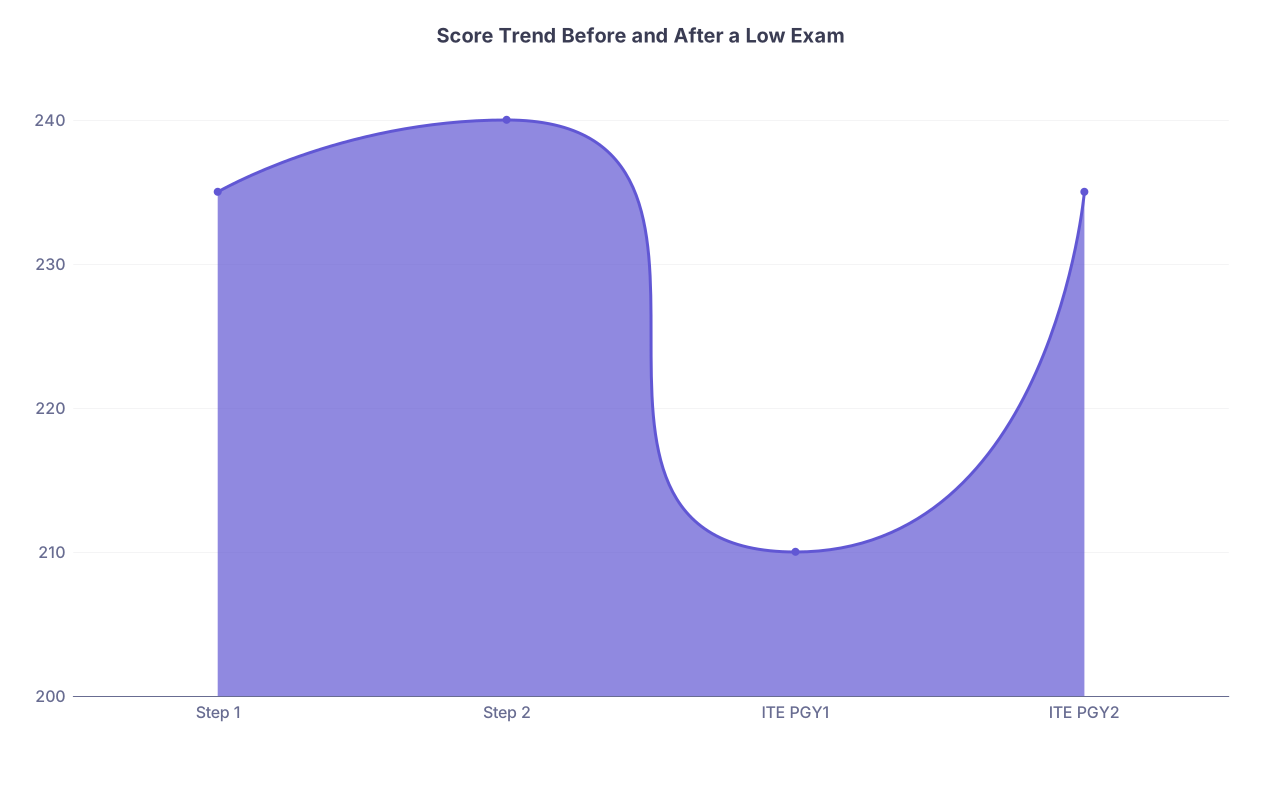
| Category | Value |
|---|---|
| Step 1 | 235 |
| Step 2 | 240 |
| ITE PGY1 | 210 |
| ITE PGY2 | 235 |
A graph like that is the kind of “comeback” narrative your PD can comfortably defend in a fellowship letter.
2. Heavy, Targeted Research in Your Desired Field
For competitive fellowships, especially Cards, GI, Heme/Onc, Pulm/CC, Derm, research is currency.
You don’t need a Nature paper. But you do need specific, consistent involvement:
- Abstracts at relevant conferences
- A couple of decent publications or at least submitted manuscripts
- Ongoing projects with faculty in that specialty
This does two things:
- It proves you’re not just “kind of interested”; you’ve put real skin in the game.
- It gives you powerful letter writers who can say, “This applicant is a worker, understands the field, and will succeed in fellowship.”
I’ve literally watched PDs flip from “score is concerning” to “ok, but their research and letters are excellent, let’s bring them in.”
3. Convincing, Specific Letters
Generic praise does almost nothing now. Everyone is “hardworking” and “a team player.”
What saves people with weaker scores is detailed, anchored praise from respected faculty:
- “He independently managed the sickest patients on our MICU and I trusted his judgment completely.”
- “She is in the top 5% of residents I’ve worked with in the last decade in terms of clinical reasoning.”
- “He led our cardiology QI project and the intervention is now standard at our institution.”
Those kinds of lines flatten anxiety about a single bad exam performance.
4. Being the Resident Everyone Actually Likes Working With
This sounds soft, but it’s brutal truth. Your on-the-ground reputation matters more than you think.
If your name, when mentioned, causes people to say:
- “Oh yeah, they’re awesome, I’d totally take call with them.”
- “They’re solid. No drama.”
…that social capital turns into advocacy.
If your scores are iffy but your name triggers eye rolls? Now it’s not “one bad board score.” It’s “concerns in multiple domains.” That’s a recipe for being quietly filtered out.
Specialty-Specific Reality Check
Some fields are more score-obsessed, at least early in the filter. Here’s a rough sanity check.
| Fellowship Type | Score Sensitivity (Realistically) |
|---|---|
| Derm, Plastics, ENT | Very High |
| Cards, GI, Pulm/CC, Heme/Onc | High |
| Endocrine, Rheum, Nephro | Moderate |
| Geri, Palliative, ID | Moderate to Low |
| Hospitalist (no fellowship) | Low (beyond passing) |
If you’re going for Derm or Plastics fellowship and you completely bombed boards, yeah, your road is steeper. Not impossible, but you’re in “edge case” territory and will need huge research and mentorship.
For Cards/GI/Pulm/Onc: one bad but passing score with otherwise solid performance is annoying, not fatal. Failures are harder, but not automatically disqualifying if followed by strong performance.
For the more “moderate” fields: they care, but they have more flexibility. They’ll look harder at fit and interest.
How to Talk About a Bad Score Without Torching Yourself
The worst thing you can do is pretend it didn’t happen… when it’s obviously a big outlier or a failure. The second worst thing is to turn your personal statement into a 2‑page apology letter.
You want a short, clean, own it and move on approach.
Something like:
“Early in my training, I underperformed on Step 2 CK. At the time, I struggled with balancing clinical duties and an ineffective study strategy. Since then, I’ve significantly improved my approach, as reflected in my stronger performance on subsequent in-training exams and boards. More importantly, this experience pushed me to become more deliberate and disciplined in my learning, which has translated into more thoughtful, reliable patient care.”
No excuses. No blaming the test. No five-paragraph sob story.
Acknowledge → briefly explain → show growth → pivot to strengths.
If you failed an exam, you mention it. But you emphasize what changed:
- New study strategy
- Getting help early
- Different resources
- Documented improvement afterward
A PD should come away thinking, “Okay, they got hit, they adjusted, they’re stable now.”
The One Thing You Can’t Do: Freeze
The biggest danger isn’t the score itself. It’s what it does to you.
I’ve watched residents do this:
- They get a bad ITE or board result.
- They feel ashamed.
- They quietly withdraw from research and teaching because “I’m not competitive anyway.”
- They stop talking about their dream fellowship because it hurts.
- Then, 18 months later, their application really is weak—because they let the exam define every decision.
That’s how one bad score becomes self‑fulfilling.
Here’s the mindset shift you need:
“This is a liability I have to out‑work and out‑build, not a verdict.”
You don’t get to control what PDs thought when they first saw your number.
You do control:
- How much research you do in that field
- Who’s writing your letters
- Whether you crush your next rotation
- Whether you seek out feedback or hide
If you’re sitting there thinking, “I screwed it, so why bother,” that’s the real career threat. Not the number.
Quick Reality Check: What If It Really Does Block Certain Doors?
I’m not going to lie to you: extremely low scores or multiple failures can close some of the ultra-elite doors. The “top 3 name-brand program in the country with 500 applicants for 2 spots” type places.
If that happens, it sucks. You get to grieve that.
But then you have to ask a better question:
“Do I want the specialty more, or do I want the prestige more?”
Because these are not the same.
If you care more about actually doing Cards than being in The One Famous Cards Program, then your goal shifts from “perfect score” to “credible, strong, well-supported application.” That’s achievable for a lot more people, even with a dent in the board record.
And if the damage is truly severe—like multiple failures, plus no improvement, plus weak support—then yes, maybe you pivot. Maybe you recalibrate to a great career that doesn’t rely on the most competitive fellowship on earth.
That’s not failure. That’s triage.
FAQs
1. I failed one board exam. Is a competitive fellowship still realistic?
It can be, but you don’t get to be average anywhere else. You need a hard rebound: pass on the next try by a comfortable margin, show strong in-training and later exam performance, and build a very robust profile in your target specialty—research, letters, clinical reputation. You also need a program director and at least one subspecialist champion who are willing to explicitly address and contextualize the failure in their letters. You’ll have fewer “elite” options, but plenty of solid programs will still consider you if everything else is strong.
2. My score is low but not failing. Should I still bother applying to a competitive fellowship?
If you’re reasonably close to the typical range, yes. Don’t self-reject. You’ll probably need to apply more broadly, lean hard on research and letters, and avoid putting all your hopes on the absolute top‑tier name programs. Talk to your PD and mentors honestly—they’ve seen applicants like you match before and can tell you which tier of programs makes sense. The only time I say “don’t apply” is when there’s a pattern of poor performance plus no compensating strengths and you’d be burning time and emotional energy with near-zero chance.
3. Will programs ask me about my bad score during interviews?
Often, yes—especially if it’s a failure or a stark outlier. They’re usually not trying to humiliate you; they’re gauging insight and growth. Prepare a concise, honest explanation (no drama, no blaming others) and emphasize what you changed and how you’ve done since. If you sound defensive or vague, it raises more questions. If you’re straightforward and can point to objective improvement, most interviewers mentally check the box and move on.
4. What’s the single most effective thing I can do now to offset a bad score?
Assuming you can’t retake that specific exam, the highest-yield move is to build a strong, specialty-specific mentorship and research track. That means: pick a subspecialty, find 1–2 attendings who are active in it, get involved in their projects, show up consistently, and become a known, reliable person in that micro‑community. From that tends to follow: better letters, conference abstracts, maybe papers, and an advocate who will actually pick up the phone for you. That kind of real-world endorsement can outweigh one ugly number on a score report.
Key points:
One bad board score doesn’t automatically kill a competitive fellowship dream, but it does raise the bar for everything else. Programs care a lot more about trends, letters, research, and your real-world reputation than you think. The real danger isn’t the score itself—it’s letting that anxiety paralyze you instead of pushing you to build the rest of your application aggressively and intelligently.