
Is a 4‑Year IM Program Actually a Disadvantage?
You are staring at two offers: a solid 3‑year internal medicine residency and a 4‑year track that promises “extra training” and “leadership development.” The question in your head is blunt: am I shooting myself in the foot if I pick the 4‑year program?
Here’s the short, honest answer:
Most of the time, a generic 4‑year categorical internal medicine program is a net disadvantage unless that extra year directly buys you something you truly need: a guaranteed fellowship, a formal degree, or focused time that clearly advances your specific goals.
Let’s unpack that like an adult, not like a brochure.
First: What Does a 4‑Year IM Program Actually Mean?
We’re not talking about medicine‑pediatrics or combined programs here. Those are 4 years for a reason (Med‑Peds is 4; some EM/IM or IM/Psych are 5). You know what you’re signing up for.
We’re talking about:
- Standard internal medicine residencies that are 4 years instead of 3
- “Enhanced” or “primary care plus” tracks that stretch IM to 4 years
- Programs that sell the 4th year as extra research, QI, teaching, or “professional development”
Examples you might see:
- A 4‑year IM program that bakes in a Master’s in Clinical Research or Public Health
- A “4‑year primary care track” with extra outpatient time, community clinics, maybe an MPH
- A 4‑year clinician‑educator track with built‑in teaching and curriculum design time
Or, less attractively:
A 4‑year program where, in reality, year 4 is “more of the same” with a few electives slapped on.
The details matter. A lot.
The Three Big Trade‑Offs: Time, Money, and Trajectory
Here’s what you are really trading when you go from 3 to 4 years.
1. Time: One More Year of Residency vs. One Year as an Attending or Fellow
One extra year is not just “12 more months.” It’s 12 months at resident pay instead of fellow or attending pay, and 12 months of delayed autonomy.
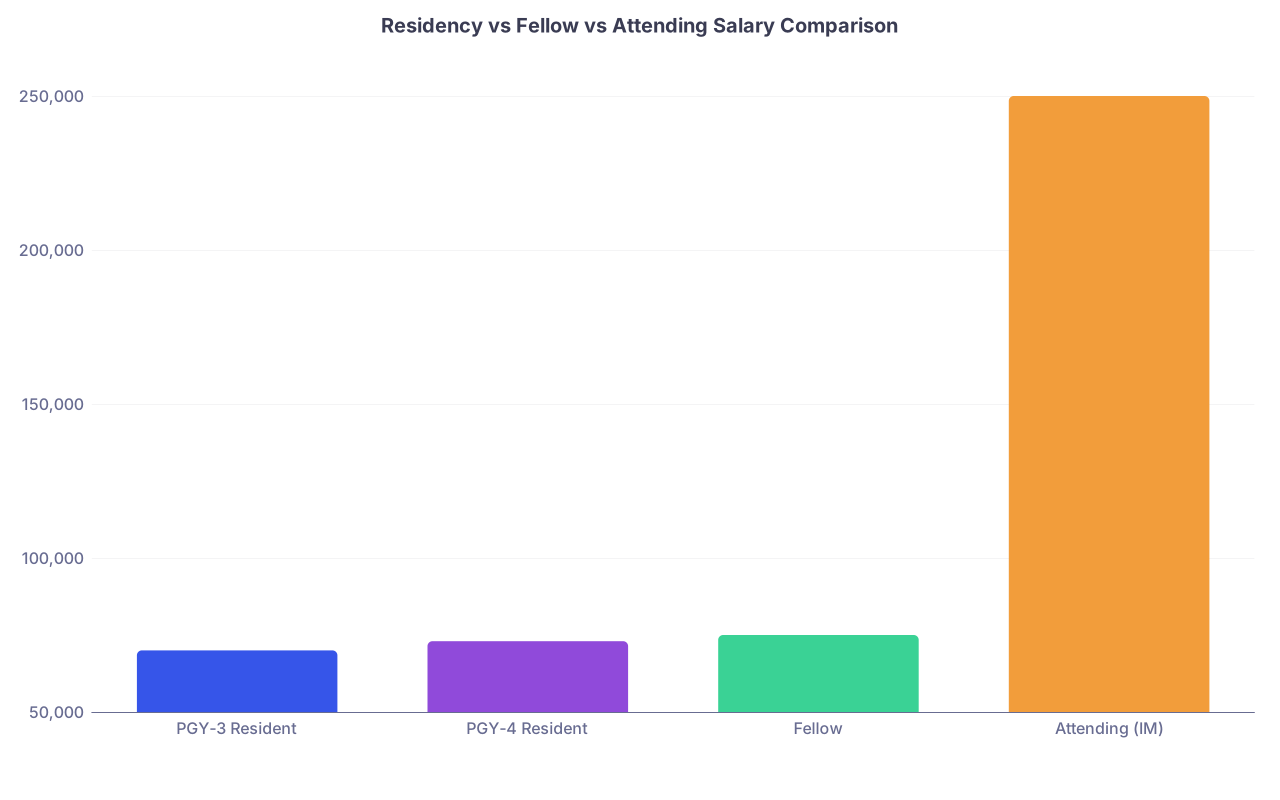
| Category | Value |
|---|---|
| PGY-3 Resident | 70000 |
| PGY-4 Resident | 73000 |
| Fellow | 75000 |
| Attending (IM) | 250000 |
That extra year means:
- One fewer year of attending income over your career
- One extra year of call, odd shifts, and limited control over your schedule
- One more year before you can fully shape your own practice or academic niche
If the 4th year gives you something concrete—like a fully funded MPH or a truly protected research year that realistically boosts your chances at a competitive fellowship—that might be worth it.
But “more rotations, more electives, more growth” as vague selling points? That’s fluff.
2. Money: The Hard Numbers (People Underestimate This)
No one in residency talks about money honestly enough. You should.
Let’s be conservative and say:
- PGY‑4 salary: ~$70–75k
- General IM attending salary: ~$220–260k (varies by region; I’ll use $250k as a round number)
If you do a 3‑year program:
- Year 4 of training life = Attending year 1
If you do a 4‑year program:
- Year 4 = PGY‑4
- Attending year 1 is delayed to year 5
That’s roughly a ~$175–180k difference that year, before you consider retirement contributions, loan payoff acceleration, etc. Over a career, that matters.
Choosing a 4‑year program is essentially choosing to buy something with that lost year of attending income. The question is: what are you actually buying?
3. Trajectory: Does Year 4 Change Your Career Arc?
This is the most important piece. That extra year can be:
- A strategic boost that propels you into academic medicine, a competitive fellowship, funded research, or a hybrid clinician‑educator role
- Or a “victory lap” where you do more of the same and gain almost nothing your future self would actually notice
Ask this very specific question:
“If I removed that 4th year from my CV, what concrete opportunities would disappear?”
If the honest answer is “not much,” it’s a problem.
When a 4‑Year IM Program Is Worth It
Let me be clear: a 4‑year program is not automatically bad. It’s just often mislabeled. There are situations where that extra year is absolutely worth it.
Here are the scenarios where the 4th year can be a real asset.
1. Guaranteed or Strongly Favored Fellowship Pathway
For certain fields, especially competitive ones, a built‑in 4‑year sequence can help—if it’s real and not just marketing.
Look for programs where:
- The 4th year is essentially a fellowship year (for example, at some places: an integrated chief year with subspecialty focus, or a quasi‑hospitalist/academic year with a guaranteed transition to their cardiology or GI fellowship)
- There’s a formal “research pathway” tracked over 4 years that leads into subspecialty training with high success rates
If a program says:
- “Our 4th year residents almost always match into our own cards/GI/onc fellowships, and here’s our match list from the last 5 years”
That’s meaningful.
If instead you hear:
- “Our residents do great! Many go into competitive fellowships,”
but there’s no data, no structure, and year 4 is mostly generic electives? That’s not a strong reason to stay the extra year.

2. A Fully Funded Advanced Degree You Actually Want
Some 4‑year tracks tie in:
- MPH
- MS in Clinical Research
- MBA
- MEd in Health Professions Education
If:
- Tuition is covered (or heavily subsidized)
- The schedule genuinely protects time for coursework (not “do it on nights and weekends, good luck”)
- The degree aligns tightly with how you actually want to practice
Then yes, that extra year can be an investment.
Example: You truly want to do academic general medicine with health services research. A 4‑year program with a funded MPH and 12–18 months of research time, plus strong mentorship, can set you up far better than a random 3‑year community program.
But if the degree is optional, unfunded, or only vaguely supported? You can always do a degree after residency as an attending—with more control and money.
3. Heavy, Structured, Protected Research Time Aimed at a Specific Goal
If you’re gunning for:
- Cardiology at a top academic center
- GI, heme/onc, PCCM at highly competitive programs
- A K‑award/physician‑scientist career
Then a 4‑year “research pathway” might be justified if:
- You get at least 12–18 months of real, protected research time
- You have named mentors, established projects, and realistic output goals: first‑author papers, abstracts, grant exposure
- Alumni from that track actually go where you want to go
Compare that to a 3‑year program that gives you six scattered research electives and no focused track record. For someone dead‑set on research, the 4th year can be a real strategic advantage.
When a 4‑Year Program Is a Disadvantage
Now the flip side. These are the red flags I’ve seen over and over.
1. “We’re 4 Years Because… Tradition”
If the explanation is basically:
- “We’ve always been a 4‑year program”
- Or, “We think an extra year makes better internists”
That’s not compelling. That’s inertia.
Unless they can show you outcomes—fellowship placement, academic positions, leadership roles—that clearly justify the extra year, you’re likely just working one extra year for no meaningful career gain.
2. The 4th Year Is Mostly Service with Minimal Added Value
If year 4 looks like:
- Acting like a cheap junior hospitalist
- Covering more nights and cross‑cover
- Doing extra ward months and a smattering of electives
…that’s you doing another year of resident‑level work when you could be doing the exact same clinical work as an attending with triple the pay and full autonomy.
The test:
Ask: “Can I see the last 2–3 years’ block schedules for PGY‑3 and PGY‑4, side by side?”
If PGY‑4 looks almost identical to PGY‑3 plus some vague “administrative” or “QI” time that no one can explain clearly, that’s a red flag.
3. You Don’t Need What They’re Selling
If you want:
- Outpatient primary care
- Hospitalist life
- A standard subspecialty fellowship in a field that is not ultra‑competitive and your application is solid
You do not need 4 years of IM training at most places. You’ll be fully board‑eligible and employable from a solid 3‑year program.
For straightforward career paths, the extra year is often just… extra.
How Fellowship Directors Actually View 4‑Year IM Programs
This is where applicants often overthink.
Do fellowship directors think:
“Ah, this applicant did 4 years of IM. They must be stronger than 3‑year grads”?
No. Not automatically.
Fellowship directors care about:
- Letters (especially from people they know and trust)
- Concrete productivity: research, teaching, leadership, quality projects
- Reputation of your home program and subspecialty divisions
- How strongly your PD and mentors advocate for you
- Your interview and fit
A 4‑year program can help if it produces those things. The year itself is not impressive. The output is.
| Factor | 3-Year IM Program | 4-Year IM Program (Good) |
|---|---|---|
| Protected research time | 2–6 months typical | 12–18 months possible |
| Degree options | Usually separate/after | Integrated, sometimes funded |
| Fellowship match value | Dependent on output | Higher if output is real |
| Time to attending pay | Sooner | Delayed by 1 year |
If a PD at a big name place sees you did a 4‑year track and you have strong publications, a well‑defined niche, and big‑name mentors—they’ll like that. They’re responding to the work, not the extra year count.
How to Decide: A Simple Framework
Let me give you a clean decision process so you’re not stuck looping in your own head.

| Step | Description |
|---|---|
| Step 1 | Have clear academic or fellowship goal? |
| Step 2 | Prefer straightforward path |
| Step 3 | Choose strong 3-year IM |
| Step 4 | Does 4-year program give funded degree or real protected research? |
| Step 5 | Does program have proven outcomes you want? |
| Step 6 | 4-year IM may be worth it |
Ask yourself these five blunt questions:
What exactly will I do with the extra year, month by month?
If the answer is fuzzy, that’s bad.What outcomes has this 4‑year track produced in the last 5 years?
Get numbers. Where did they match? What jobs did they get?Is there a funded, structured, and protected component (degree, research, leadership) that I cannot reasonably get in 3 years somewhere else?
Does this extra year directly serve my career goals, not just look nice on paper?
If I imagine myself as an attending at age 45, do I honestly care that I trained 3 vs 4 years? Or would I be happier having that extra year of attending income, experience, and flexibility back?
If you’re mostly outpatient‑focused, or aiming for hospitalist work, or planning a standard fellowship in a non‑ultracompetitive field: 90% of the time, pick the stronger 3‑year program.
If you’re dead‑set on a research career, health policy, serious leadership, or a competitive fellowship and the 4‑year track has documented outcomes that line up exactly with your goals—that’s when you seriously consider the longer route.

One More Reality Check: Reputation vs Length
Here’s something applicants often miss:
The name and quality of the program usually matter more than the length.
A top‑tier 3‑year academic IM program with a strong subspecialty presence almost always beats a mediocre 4‑year program “with extras” when it comes to long‑term opportunities.
Given:
- 3‑year big‑name academic program with great mentorship
vs - 4‑year mid‑tier program with vague promises of research and leadership
I would tell almost any student with normal goals: take the 3‑year spot and do great work there.
Your Next Step
Do this today:
Pick one 3‑year program and one 4‑year program you’re seriously considering. For each, write down:
- What exactly you’d gain in the next 5–10 years by choosing it
- What you’d lose (time, money, flexibility)
Then email the 4‑year program’s chief resident or a recent graduate and ask for something specific:
“Can you walk me through what you actually did during your 4th year, month by month, and how it changed your career options compared with your 3rd‑year classmates who graduated earlier?”
Pay close attention to how concrete their answer is. That will tell you more than any brochure.