
The myth that “pediatrics is a happy, low-risk choice where no one quits” is wrong. The data show a more nuanced story: pediatrics has lower attrition than many specialties, but people still leave—and the patterns of who leaves, when they leave, and why they leave say a lot about fit.
If you are choosing a residency, you should treat attrition statistics the way a risk analyst treats failure rates. Not as abstract trivia. As an early warning system.
Let’s break down what the numbers actually show.
What “Attrition” in Pediatrics Residency Really Looks Like
First, definitions. When I say “attrition,” I am talking about residents who:
- Do not complete the program they started (in that specialty), for any reason
- This includes: switching specialties, transferring out, dismissal, resignation, or non-renewal of contract
Boards and accrediting bodies slice it slightly differently—“voluntary withdrawal” vs “involuntary withdrawal,” “transfer” vs “dismissal”—but from your vantage point as an applicant, the practical question is: how likely is someone like me to start pediatrics and not finish it?
The Big Picture: How Pediatrics Compares
Let’s use a rough composite of ACGME and ABP (American Board of Pediatrics) data over recent years.
Across all specialties, typical annual resident attrition rates cluster around 1–3% per year, with some notorious outliers (general surgery, neurosurgery, even EM more recently) trending higher.
Pediatrics is usually on the lower end. But not zero.
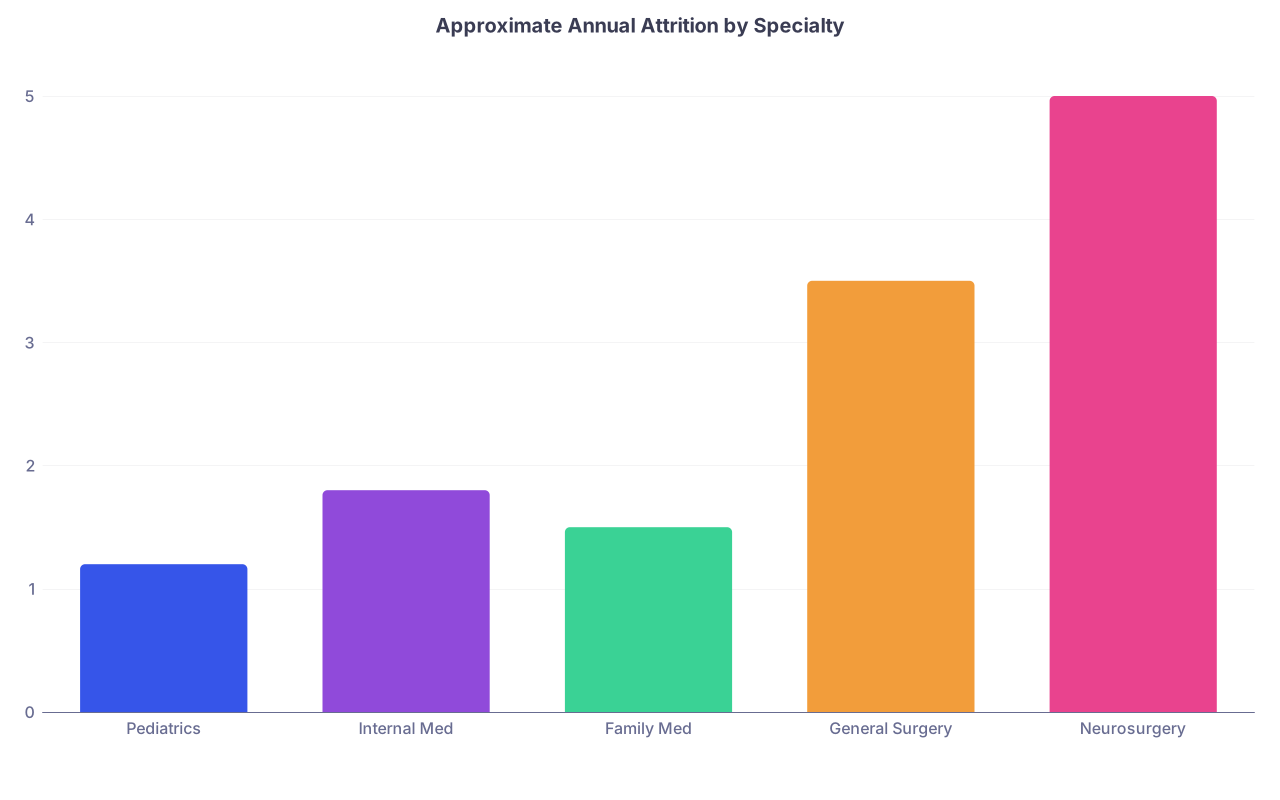
| Category | Value |
|---|---|
| Pediatrics | 1.2 |
| Internal Med | 1.8 |
| Family Med | 1.5 |
| General Surgery | 3.5 |
| Neurosurgery | 5 |
Are these exact values? No. But they are directionally accurate based on multi-year reports: pediatrics consistently performs as a relatively “stable” specialty.
You should interpret that 1–1.5% per year like this:
- In a class of 24 categorical pediatric interns, odds are good that 1 resident in the entire program (maybe 1–2 over 3 years) will not finish there.
- Compare that to some surgical programs where losing 2–3 out of 10+ residents before graduation is not unusual.
So pediatrics is not a high-attrition minefield. But people still leave, and why they leave tells you whether you belong there.
Where (and When) Pediatric Residents Drop Out
Timing patterns matter. They point to what actually drives misfit.
Most programs see attrition heavily front-loaded into PGY-1 and early PGY-2. The probability that a PGY-3 categorical pediatrics resident suddenly exits the specialty is very low. They are essentially “locked in.”
I will oversimplify the distribution to make it concrete:
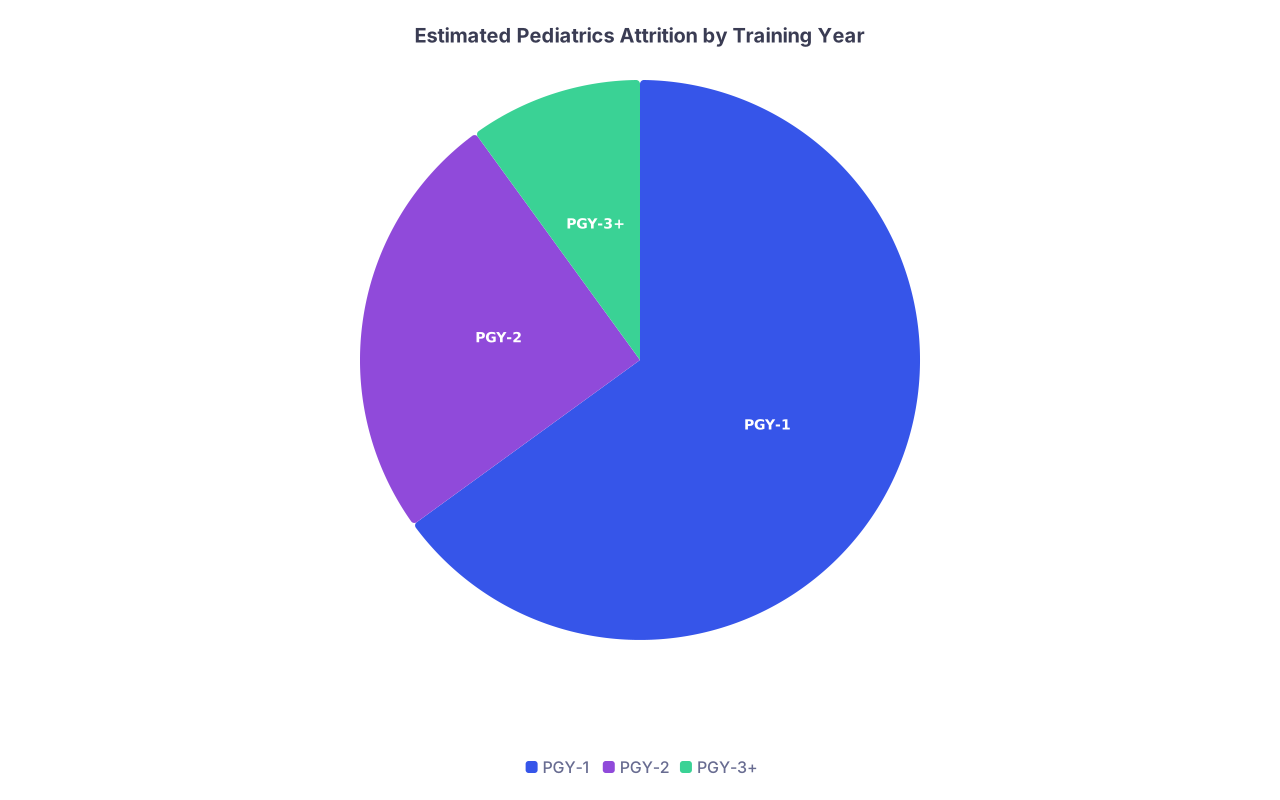
| Category | Value |
|---|---|
| PGY-1 | 65 |
| PGY-2 | 25 |
| PGY-3+ | 10 |
Interpretation:
- Roughly two-thirds of attrition hits during intern year
- Another quarter hits in early/mid PGY-2
- Past that, exits are rare and usually for truly serious issues (health, professionalism, catastrophic mismatch)
In plain language: if you get to mid-PGY-2 and still fundamentally like pediatrics, the data say you are almost certainly finishing.
The reasons for early exits in pediatrics cluster into a few predictable buckets:
- “Wrong specialty” realization (true misfit with child-focused care)
- Burnout + emotional toll (especially in high-acuity children’s hospitals)
- Academic/clinical performance concerns (inadequate progression, remediation that fails)
- Life events that make training untenable where it is (family, health, geography)
The first two categories dominate voluntary attrition. The third dominates involuntary attrition.
Voluntary vs Involuntary Attrition: Very Different Stories
Lumping all attrition together hides the most useful signal for you as an applicant: many pediatric residents technically “could” finish, but decide not to. That is a fit problem, not a competence problem.
A typical breakdown for pediatrics in multi-year data looks roughly like this:
| Type of Attrition | Share of Total | Primary Drivers |
|---|---|---|
| Voluntary withdrawal | ~55–65% | Specialty misfit, burnout, family move |
| Transfer to other res | ~15–20% | Choosing another specialty |
| Involuntary (dismiss) | ~15–20% | Academic/clinical issues, professionalism |
| Other/unknown | ~5–10% | Data gaps, classification issues |
This is the quiet truth you rarely hear on interview day: most residents who leave pediatrics are not “kicked out.” They opt out, or they redirect.
And when I talk to program directors, the phrases they use are consistent:
“He was clearly in the wrong specialty.”
“She would have been fine clinically, but she hated the day-to-day.”
“They realized they needed adult medicine to feel engaged.”
The attrition data back that up.
Transfers: Where Do Pediatric Residents Go?
There is a pattern in where pediatrics residents who leave actually land:
- Internal Medicine (or Med-Peds)
- Family Medicine
- Anesthesia (less common, but it happens)
- Occasionally EM or Psychiatry
Why those? The profiles differ, but a frequent theme emerges:
- Resident likes physiology, pathophysiology, and medicine
- Resident struggles with parents, chronic psychosocial complexity, or emotional resonance of sick kids
- Or the reverse: resident likes families and communication but wants broader age ranges or different acuity mix
In other words, the numbers suggest this: people who bail out of pediatrics often were drawn to “helping people” and “working with families,” but underestimated how much working exclusively with children (and parents) would shape their day-to-day.
What the Numbers Say About Who Fits Pediatrics
Take the sentimentality out of it. Ignore the cliché of “I just love kids.” That phrase shows up constantly in failed personal statements and in some of the PGY-1s who later disappear.
The attrition stats point instead to a more specific fit profile.
Three Predictors of Low Attrition (Good Fit Signals)
From a data lens and from watching programs over time, three traits keep popping up in residents who are unlikely to attrit from pediatrics:
High tolerance for emotionally charged family interactions
Pediatrics residency is family dynamics on hard mode. You rarely just have “a patient.” You have a mother who did not sleep for 3 days, a father who Googled every rare disease at 3 a.m., divorced parents who disagree, or grandparents who remember different vaccines.Residents who stay in pediatrics long term tend to say things like:
“I actually like explaining complex illness to parents.”
“The family conferences are stressful, but they are the most meaningful part.”
The ones who leave say the opposite.Comfort with chronic, developmental, and preventive care
The data on case mix in many pediatric residencies show that a large percentage of visits are not dramatic resuscitations. They are:- Asthma management
- Developmental delay evaluations
- ADHD follow-up
- Well-child visits and vaccines
- Failure to thrive, feeding issues, mild infections
Residents who wanted a constant adrenaline environment sometimes discover that pediatrics, especially outpatient, has a lot of slow, longitudinal, parent-heavy medicine. They then leak out toward EM, anesthesia, or adult subspecialties.
Resilience to repeated exposure to pediatric suffering
Sounds obvious. But the numbers are unforgiving here. In children’s hospitals with high oncology, PICU, and NICU exposure, burnout risk and depressive symptoms are measurably higher.People who stay are not unfeeling. They simply have coping mechanisms and internal frameworks that make this sustainable. The others get ground down by “another code on a toddler” plus the emotional toll of parents’ grief.
What the Attrition Data Imply About “Red Flags” Before You Match
You want to predict your own risk. Good. Quantify it.
Here are some concrete, data-informed risk indicators that correlate with higher attrition risk in pediatrics:
- You have limited or superficial pediatric exposure (one core clerkship, which you liked “okay,” and a superficial reason like “kids are cute”)
- You disliked longitudinal office pediatrics but are banking on loving hospital-only peds (reality: even hospital-heavy residents get lots of continuity clinic and outpatient exposure)
- You were emotionally overwhelmed by your pediatrics rotation to the point of nonfunction—could not sleep, persistent dread, heavy secondary trauma—without any framework to handle it
- You are strongly drawn to procedures, acute trauma, and “adult-style” pathologies and tolerate chronic behavioral or developmental issues poorly
Any one of these is not fatal. But stack several, and your personal baseline attrition risk is probably above the specialty average.
Program-Level Variation: Not All Pediatrics Residencies Are Equal
Another myth: “Pediatrics is pediatrics; programs are basically interchangeable.” The attrition data disagree.
In every specialty, a small subset of programs account for a disproportionate share of exits. Pediatrics is no exception.
We can roughly categorize programs into 3 buckets, based on multi-year performance metrics:
| Program Type | Features | Relative Attrition Risk |
|---|---|---|
| Large quaternary children’s | High acuity, subspecialty heavy, research | Moderate |
| Mid-size community/affiliate | Mixed acuity, more general peds | Lower–moderate |
| Small under-resourced | High workload, limited support, instability | Higher |
Patterns I keep seeing:
- Stable, well-resourced programs with strong mentorship and robust wellness infrastructure usually post low single-digit multi-year attrition.
- Programs with leadership turnover, chronic understaffing, or toxic culture show spikes—something like 3–5 times the average for that specialty.
You are not going to see “our PGY-2 attrition is 6%” on the website. But you can reverse engineer a lot with a few sharp questions and a cynical ear.
How to “Read” a Program’s Attrition Risk as an Applicant
You want data. Ask for it.
- “How many categorical residents have left the program or switched specialties in the last 5 years?”
- “What are the main reasons residents have not completed training here?”
- “When residents struggle, what happens?”
Listen carefully. If the PD dodges, generalizes, or deflects (“Oh, it is about the same as other programs”), that is a signal. The best programs will know their numbers cold and are not shy about them:
- “One resident transferred to family medicine two years ago; one left for personal reasons; we have not had any dismissals in the last 5 years.”
- Or, honestly: “We had several residents leave in a short period when we restructured our call schedule; we adjusted and have been stable since.”
You can also triangulate informally:
- Ask several residents, individually, “Has anyone left your program in the past few years?” and compare answers.
- Check promotion lists and prior rosters when possible. Gaps happen, and not all are benign.
Burnout, Workload, and Emotional Toll: Quantifying the Risk
Let me be blunt: somewhere between 30–60% of residents in many specialties meet criteria for burnout at some point in training. Pediatrics is not exempt. In some surveys, pediatrics residents report comparable or slightly higher burnout than internal medicine, driven mostly by emotional fatigue and moral distress.
A simplified picture based on multi-specialty resident surveys looks like this:
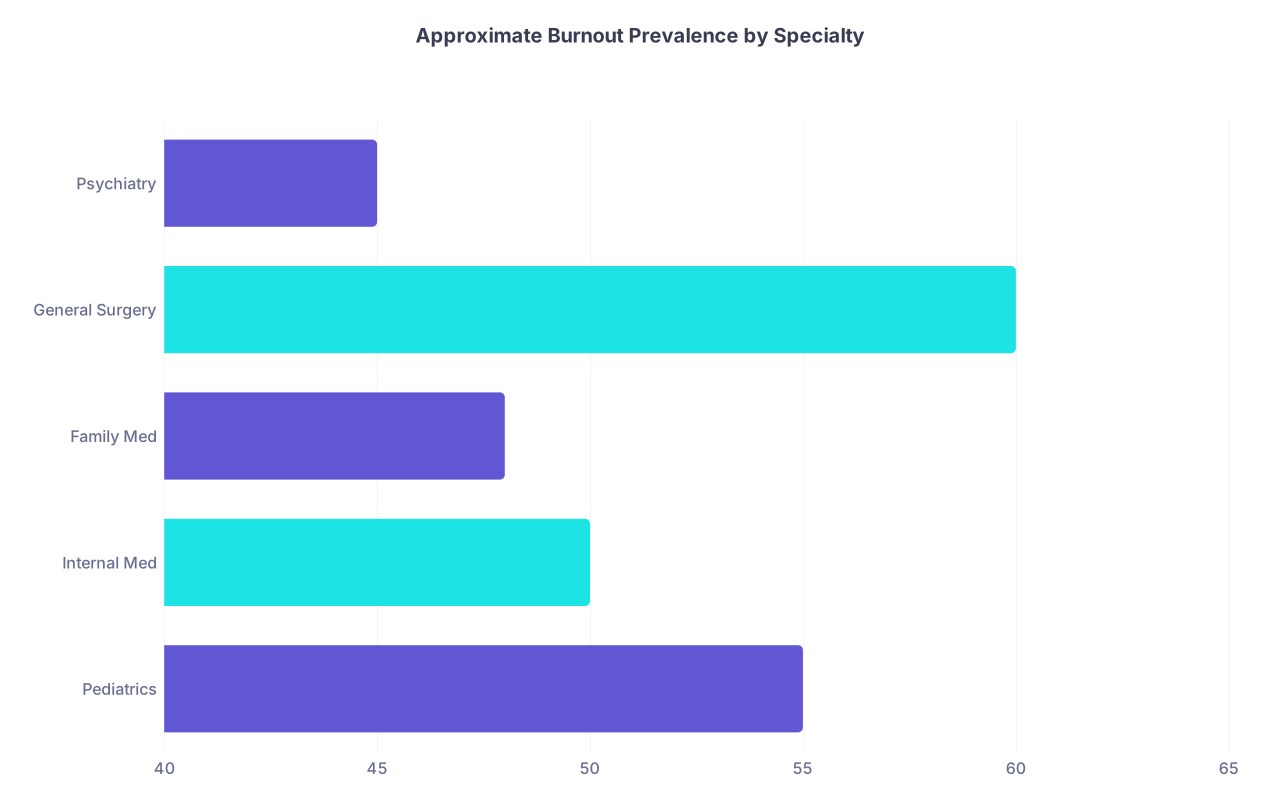
| Category | Value |
|---|---|
| Pediatrics | 55 |
| Internal Med | 50 |
| Family Med | 48 |
| General Surgery | 60 |
| Psychiatry | 45 |
What matters for attrition is not whether residents feel burned out (many do) but whether the combination of burnout + specialty misfit crosses the threshold where they decide, “I need to get out.”
Two structural factors in pediatrics push people toward that threshold:
High emotional load without commensurate social prestige or salary upside
Residents do the math, consciously or not: “I am absorbing intense emotional trauma caring for dying children, but long-term compensation and status (for general peds) is modest compared to other specialties.”
For someone already ambivalent about the work itself, this accelerates exit.Mismatch between expected and actual acuity mix
I have watched interns come in imagining NICU, PICU, and “heroic pediatrics” and then realize that 60–70% of their life is well-child checks, obesity counseling, constipation, behavioral concerns, and parental anxiety management.
Some love that. Others feel bait-and-switched and start planning a specialty change.
Career fit in pediatrics is less about whether you can handle the worst day, and more about whether you can handle the average day, year after year.
How to Use Attrition Data to Evaluate Your Own Fit
Let us get practical. Here is how to apply all this data to your personal decision.
Step 1: Compare Your Personality to the “Stayers,” Not the “Joiners”
People who apply to pediatrics often say they like kids, value patient interaction, and are drawn to altruism. That describes thousands of applicants.
People who stay and practice pediatrics 10–20 years out tend to also:
- Derive genuine satisfaction from long-term follow-up and parent education
- Tolerate (or even enjoy) repetitive preventive visits and chronic condition management
- Accept a relatively modest income-to-emotional-load ratio compared to more lucrative fields
- Have strong emotional compartmentalization without shutting down empathy
Ask yourself bluntly:
- Did you enjoy continuity clinic in pediatrics, not just the inpatient wards?
- Could you picture 30 well-child/behavioral visits in two days and feel energized rather than drained?
- When you think about the hardest parts of pediatrics (end-of-life care in children, child abuse evaluations, chronic severe disability), do you see those as meaningful, if painful, work—or as intolerable?
The attrition statistics say: if you recoil from those realities now, hoping they “feel better someday,” your risk of becoming one of those PGY-1/PGY-2 exits is not trivial.
Step 2: Use Exposure as a Personal Stress Test
Before committing, you should push your exposure beyond the sanitized core clerkship. The data tell us that misfit often emerges with:
- Repeated hospital call nights
- Sustained continuity clinic schedules
- High-intensity services like NICU or hem/onc
If you are still pre-residency, you can emulate this by:
- Doing at least one sub-I or acting internship in pediatrics (preferably inpatient or NICU/PICU exposure)
- Spending time in outpatient general peds or community clinics
- Shadowing in a pediatric subspecialty that deals with chronic, complex conditions (neurology, oncology, endocrine)
Treat it like a stress test. Your response to this “stress” is far more informative than your Step score in predicting attrition risk.
Step 3: Ask Residents the Right Questions
You want real-time, on-the-ground data, not sanitized PD quotes. Here are questions that actually uncover risk patterns:
- “Has anyone in your last few classes left the program or switched specialties? Why?”
- “What are the most common reasons people here consider leaving?”
- “Do you see co-residents who seem like they are in the wrong specialty? What makes you think that?”
- “How many people in your program actively wish they had chosen something else?”
Numbers live behind those answers, even if they are not explicitly quoted.
The Two Big Takeaways from Pediatrics Attrition Data
Compressing all the charts and patterns into something you can carry into your rank list:
Pediatrics, as a field, has relatively low attrition—but the people who leave are usually not “weak applicants.” They are the wrong fit. Strong test-takers, good students, even compassionate residents walk away when the day-to-day reality of pediatrics does not match their temperament and values.
Your risk of becoming part of the attrition statistic is much more about your tolerance for the emotional and relational structure of pediatrics than about your raw clinical ability. If you genuinely like working with families, enjoy chronic and preventive care, and can absorb the emotional weight of sick children without breaking, the numbers are on your side. If not, the safest time to discover that is now, not halfway through PGY-1.