
Most students misread board pass rate charts and draw the wrong conclusions about specialties.
Let me be blunt: the way people throw around “Derm has a 99% board pass rate” or “Neurosurgery is brutal; the pass rate is only 80%” is usually lazy and often misleading. Those numbers do mean something. But not what most MS2s think they mean.
If you are using board pass rate graphs to decide between IM, EM, Ortho, or Derm, you are already a little off track. The smart move is to understand what those numbers actually signal about:
- The competitiveness of entry
- The training environment and exam culture
- How much of your success will depend on you vs your program
- Your real risk of failure once you are in
I will walk you through how to interpret specialty-specific board pass rates the way residency leadership, program directors, and senior residents actually think about them—so you stop being spooked by the wrong numbers and start paying attention to the right ones.
1. What “Board Pass Rate” Actually Represents
First, definitions. People throw “pass rate” around like it is one clean, universal metric. It is not.
Most specialties have at least two (sometimes three) relevant numbers:
- Written qualifying exam pass rate
- Oral or practical certifying exam pass rate (for those specialties that have them)
- First-time pass rate vs eventual pass rate
When you see a glossy chart from ABIM, ABEM, ABS, ABR, etc., they are usually talking about first-time takers. That is a very specific slice:
- They passed residency.
- They were allowed to sit for the exam.
- They are almost always U.S. or Canadian graduates in ACGME-accredited programs.
You are not looking at:
- People who never ended up sitting for the exam (delayed graduation, remediation, personal issues)
- People taking the exam for the 2nd or 3rd time
- Non-standard pathways, foreign equivalency routes, etc.
So “Dermatology: 99% pass rate” means this: of the already highly filtered group of residents who made it through a residency that is hard to get into, 99% of them, taking the exam for the first time, passed.
That is a totally different statement than “Dermatology is easier.”
2. Why High Pass Rate ≠ Easy Specialty
I have heard MS3s say this exact line on rotation:
“Look, Anesthesia has a great board pass rate. Seems like a safer choice.”
That reasoning is upside down.
High pass rates often signal front-loaded selection and strong program-level filtering, not an easy exam or an easy field.
Here is what usually drives very high pass rates (95–99%) in some specialties:
Extremely selective entry.
Dermatology, plastics, radiation oncology, neurosurgery. The average USMLE/COMLEX scores, research volume, and applicant profiles are already heavily filtered. You are seeing the tail end of a very strong cohort.Program-level gatekeeping.
Some specialties are ruthless about not letting someone sit for boards unless they are clearly ready. That can mean:- Delaying graduation
- Extra chief year
- Strong remediation / internal exams This keeps pass rates artificially high, because marginal candidates never count as first-time test takers.
Shape of the exam.
Some boards, like ABEM (Emergency Medicine), have very clinically aligned exams and a training culture that pounds those topics for years (weekly conference, in-training exams, constant board-review style questions). Programs know the blueprint cold and teach hard to it.
So that 99% pass rate is often more about who is allowed into the race and who is allowed to start than how easy the finish line is.
3. What Low or Moderate Pass Rates Usually Signal
Now flip it.
If you see a specialty with, say, 80–90% first-time pass rate, your med school WhatsApp group will immediately label it: “Boards are killer in that field.”
Usually not the full story.
Common drivers of “lower” pass rates:
Broad range of incoming residents.
Family Medicine, Internal Medicine, Pediatrics, Psychiatry, and sometimes Surgery residencies have:- Wider ranges of Step scores
- More IMGs
- More variability in medical school quality and baseline preparation
That is not an insult. It is reality. A wider distribution of preparation → wider distribution of outcomes.
Huge variability in program quality.
In IM or FM, you have:- Elite academic programs that treat the boards like sport
- Smaller community programs that barely run structured board review That spread shows up in pass rates.
Curricular mismatch or exam drift.
Some specialties complain that the boards test rare or outdated material, or emphasize minutiae that daily practice does not reinforce. When a board’s blueprint drifts away from real-world clinic or hospital life, pass rates drop—especially in programs that are service-heavy and education-light.Burnout and exam timing.
If a written exam is scheduled at high‑stress points (e.g., right at the end of grueling chief year in surgery or IM), prep suffers. Pass rates follow.
Do not read a 85–90% pass rate as, “This specialty is unsafe for me.” Read it as, “There is more variability in training, support, and baseline cohort. I need to care more about which program I join and how I prepare.”
4. The Hidden Variable: Who Counts in These Statistics
One thing almost no MS2 looks at: who is included in the denominators of these studies and board reports.
Many board organizations publicly separate pass rates for:
- U.S. allopathic grads
- U.S. osteopathic grads
- International medical graduates (IMGs)
- ACGME-accredited vs other paths
If you skim carefully, you will often see:
- US MD: very high pass rates
- US DO: slightly lower
- IMGs: substantially lower
This is not mystical. It is often explained by:
- Differences in exam training culture (NBME vs COMLEX vs local exams)
- Variable access to high-yield board prep materials
- Language and test-taking style differences
- Systemic inequities in training environments
Now, imagine a specialty where 40–50% of residents nationally are IMGs or non-US grads. The overall pass rate may drop, but that is averaged across groups with very different baselines.
You care about: “What is the pass rate for someone like me, in a decent program?”
Not: “What is the national blended number including everyone.”
5. How Specialty Pass Rates Reflect Competitiveness and Culture
Let me give you a more structured way to interpret these numbers.
| Signal | High Pass Rate (95–99%) | Moderate Pass Rate (80–90%) |
|---|---|---|
| Entry competitiveness | Very high; strong applicant filtering | Moderate to high; broader applicant range |
| Program gatekeeping | Aggressive; few allowed to sit unprepared | Variable; some programs weak on filtering |
| Training culture | Strong exam alignment, structured teaching | Highly variable between programs |
| Your main risk | Not matching / not getting in | Matching at a weak program / poor prep |
You should be asking:
- Does this specialty have a culture of “everyone passes, we take boards seriously”?
- Or is it more “we trust residents to study when they can”, with some doing great and some failing?
I have sat in meetings where program directors explicitly discuss their board pass rate as a key metric. Some will bend over backwards to protect it—by delaying marginal residents or quietly discouraging people from taking boards on time. Others do not track it that closely and only react when there is a cluster of failures.
The specialty’s overall pass rate often reflects whether the national culture punishes poor performance. Some boards publicly report program-level pass rates; that alone changes behavior.
6. Specialty-Specific Patterns: What They Usually Mean
I will generalize a bit. Details shift over years, but the patterns are consistent.
Internal Medicine / Pediatrics / Family Medicine
You will often see:
- Pass rates in the mid 80s to low 90s for first-time takers.
- Big spread in program-level performance.
Signals:
- Wide range of residents, from top-tier academic to barely-accredited.
- Some programs build ABIM/ABP/ABFM board prep into weekly curriculum with question blocks, mock exams, and protected study time.
- Others leave you to sort it out between 60-hour weeks and clinic paperwork.
Interpretation: Your individual outcome is heavily dependent on program choice and your own exam discipline. But if you are a strong test-taker with a history of doing well on USMLE/COMLEX, these pass rates should not scare you.
Emergency Medicine
Historically:
- Very high first-time ABEM written pass rates (mid to high 90s).
- Strong culture of in‑training exams and weekly didactics.
Signals:
- Programs track ITE scores and intervene aggressively for low performers.
- Exam content is tightly aligned with what you see in ED: chest pain, sepsis, trauma, airway, etc.
- EM residents live and breathe board-style cases for years.
Interpretation: High pass rates mostly signal strong culture and exam alignment, not “easy.” The boards are hard, but the system is built to help you pass.
Surgical Specialties (General, Ortho, Neurosurgery, etc.)
Here the story gets more nuanced:
- Written (qualifying) exam pass rates often moderately high.
- Oral (certifying) exam pass rates can be lower and more variable.
Signals:
- Very heavy service demands; studying for a content-heavy exam while being on trauma call is not trivial.
- Oral boards test judgment, decision chains, and pattern recognition under pressure. Very different skillset from pure knowledge recall.
- Some surgical specialties have very high expectations for operative competence and board success; failing one can damage your job prospects.
Interpretation: Board pass rates here mix academic and non-academic skills. The written may not be your bottleneck. The oral may be. Look hard at how a specialty and a specific program prepare you for the oral component.
Highly Competitive Small Specialties (Derm, Rad Onc, Plastics, etc.)
Common:
- Written exam pass rates in the very high 90s.
- Sometimes oral or case-based exams also high.
Signals:
- Strong resident selection at entry.
- Heavy research and academic emphasis; people are used to absorbing large volumes of detailed information.
- Small program sizes: outliers stand out; underperformers get early intervention.
Interpretation: The risk is not “I will fail boards.” The risk is “I will not match at all” or “I will end up in a program that is not a strong fit and be miserable.”
7. Using Board Pass Rates To Compare Programs (Not Just Specialties)
The more useful way to use these numbers is at the program level.
Many boards publish 3–5 year rolling pass rates by program. This is where the serious signals live.
Red flags for a program:
- Multi-year pass rates significantly below the national average.
- Single classes with multiple failures in a small program.
- No structured board review, no in-training exam remediation, no culture of exam preparation.
Green flags:
- Program leadership that can tell you, concretely, how they support residents below the 30th percentile on in‑training exams.
- Protected time for board prep in PGY3–PGY4.
- Graduates who casually tell you, “The exam felt like an easier version of our weekly conferences.”
Here is how I would mentally structure this in your head:
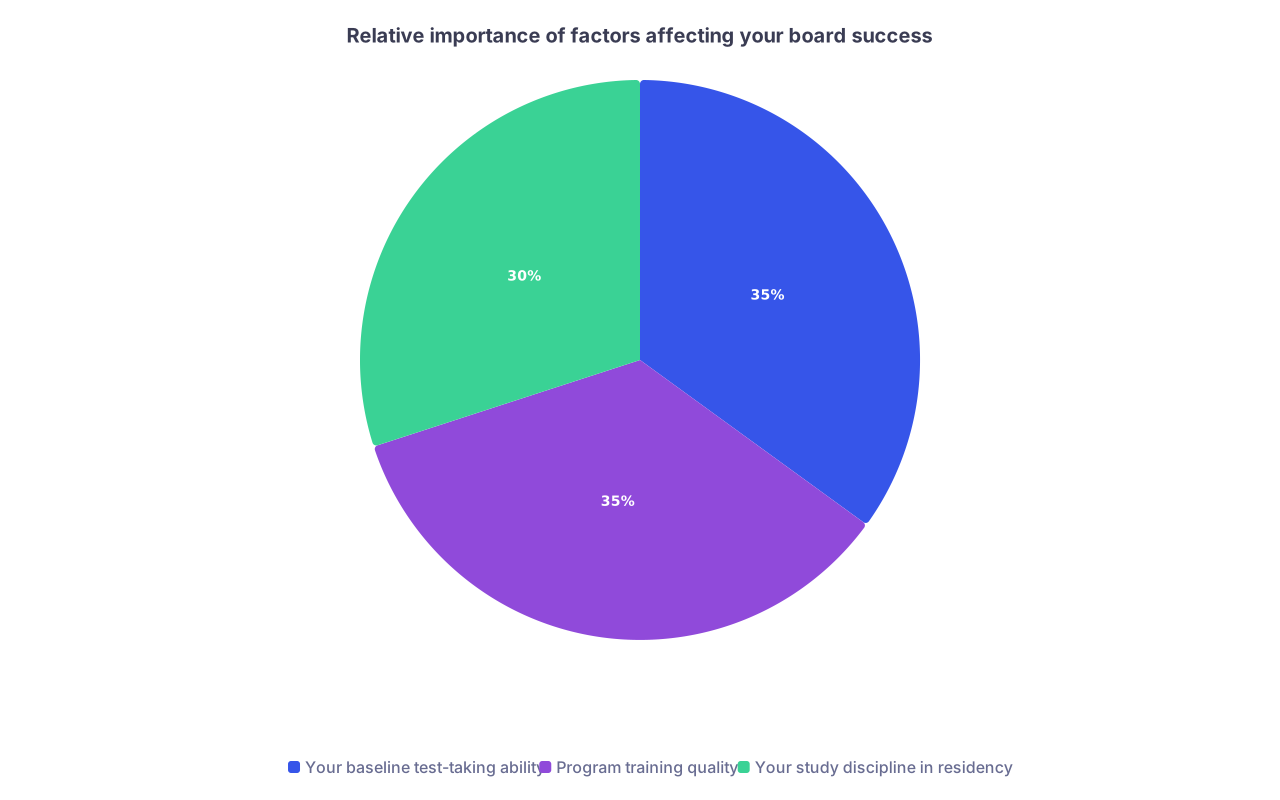
| Category | Value |
|---|---|
| Your baseline test-taking ability | 35 |
| Program training quality | 35 |
| Your study discipline in residency | 30 |
That is not exact, but it is closer to reality than “national pass rate decides everything.”
8. What These Numbers Signal For You When Choosing a Specialty
Let me bring this back to your actual decision process.
1. Do not choose a specialty because of its board pass rate.
If you love Psychiatry but feel spooked because some years had <90% pass rate, you are over-weighting the wrong metric. You are going to live this specialty for decades; the incremental risk difference in board failure between specialties—assuming you match a decent program and study—is small.
2. Use pass rates as a proxy for: “How careful do I need to be about program selection?”
If a specialty has:
- Very high pass rates AND relatively uniform program performance
→ You can worry a bit less about program-level exam culture (though never ignore it entirely).
If a specialty has:
- Broad scatter in program pass rates
→ You should ask every interviewer: “How do you support residents who struggle with the in-training exam?” and “What have your board pass rates been over the last 5–10 years?”
3. Look inward: your own test-taking track record matters more than the specialty.
Be honest about your pattern:
- Step/Level exams: barely passing vs comfortably above average?
- How much structure do you need to study effectively?
- Did you only do well when your school built intensive board prep into the curriculum?
If you are a historically borderline test taker, going into a specialty with a weak exam-prep culture and widely variable program quality (and then matching at a weaker program) does carry real risk. Not because “that field is harder,” but because the system will not save you.
9. The Illusion of Safety: “I Want a High Pass Rate Specialty So I Do Not Fail”
You will hear classmates say this outright:
“I want a specialty where basically no one fails boards. I cannot handle that risk.”
The harsh truth: there is no zero-risk specialty.
Here is what actually changes your “risk”:
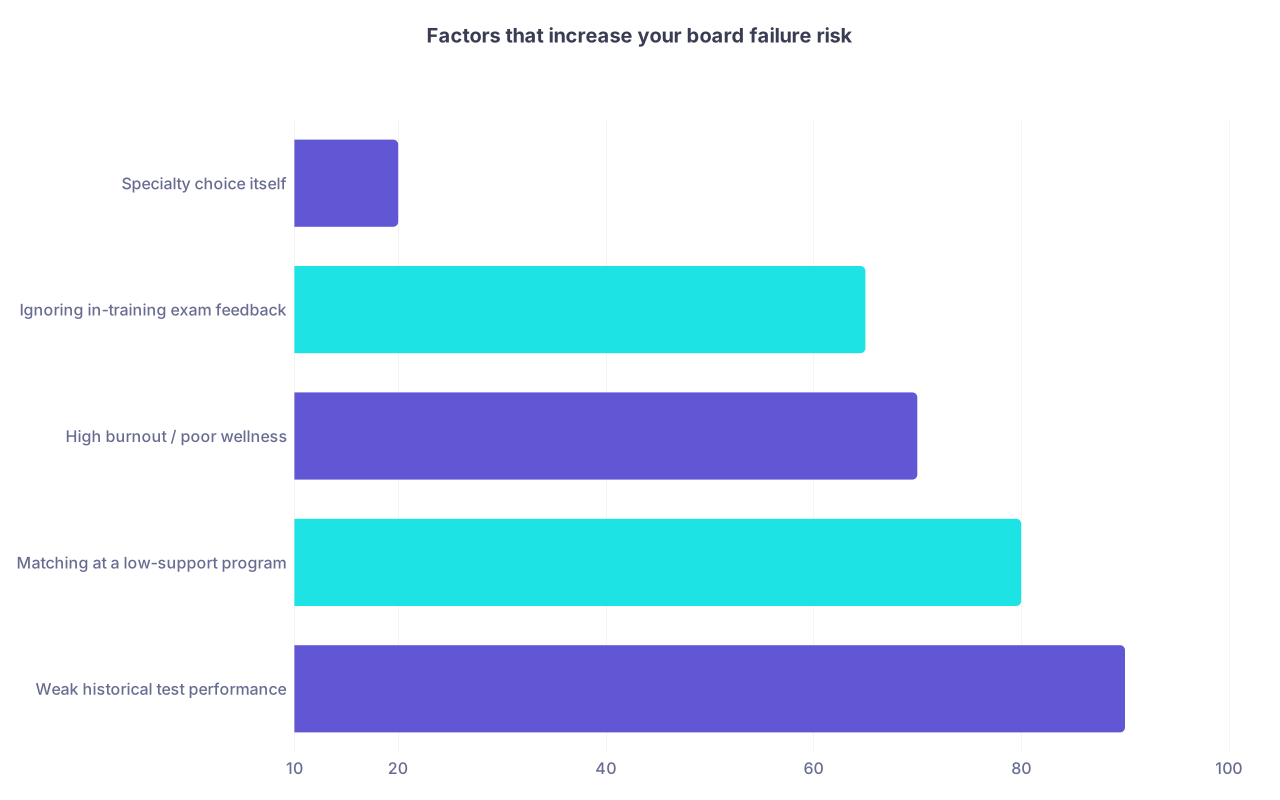
| Category | Value |
|---|---|
| Weak historical test performance | 90 |
| Matching at a low-support program | 80 |
| High burnout / poor wellness | 70 |
| Ignoring in-training exam feedback | 65 |
| Specialty choice itself | 20 |
Specialty choice is at the bottom for a reason. You can be in a “safe” specialty and still fail because:
- You are chronically exhausted and never get uninterrupted study time.
- Your program does not track or care about the in-training exam.
- You misjudge how much content there actually is and start studying far too late.
Conversely, you can be in a demanding surgical field with moderate pass rates and sail through if:
- You have always tested well.
- Your program culture is hard-core about exam prep.
- You set up a realistic, early study plan.
10. Reading Board Pass Rate Reports Like an Adult, Not a Pre-med
Let me spell out a practical checklist for when you see a shocking graph—say, “Specialty X: 82% first-time pass rate last year.”
Ask these questions in order:
Who is in that denominator?
- U.S. MD only, or all takers?
- Residents only, or all pathways?
What is the typical range of applicant competitiveness into that specialty?
- Is this field pulling mostly high-Scorers at entry, or a broad mix?
How wide is the spread across programs?
- Are there many near-100% programs and some awful outliers, or is everyone clustered together?
How does the board exam align with day-to-day training?
- EM and IM: usually high alignment.
- Some surgical / niche specialties: more mismatch.
What is the long-term eventual pass rate?
- Many residents who fail on the first try pass on the second once they have time and reduced clinical load.
That last point is underappreciated. A scary-sounding 85% first-time pass rate may mask a 95–98% eventual certification rate. Very different psychological and career impact.
11. Where in Training This Actually Hits You
Concrete timeline, so you picture where this lands in your life:
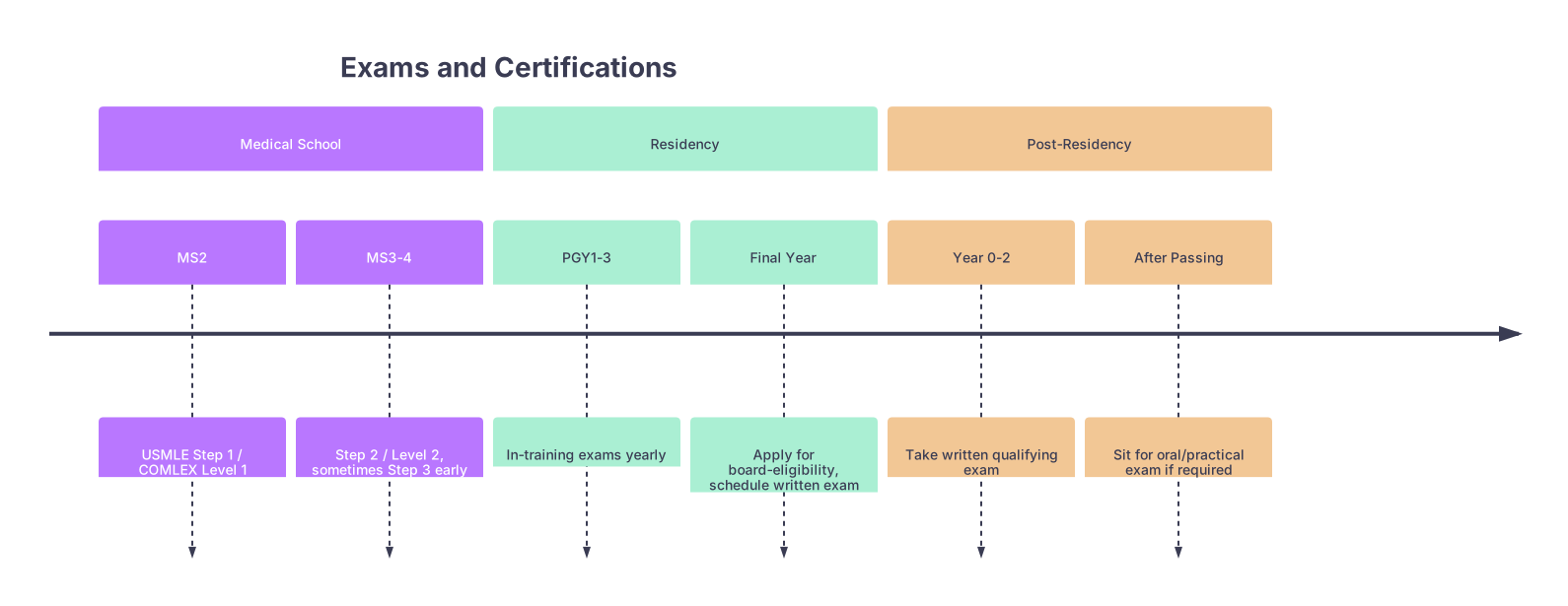
| Period | Event |
|---|---|
| Medical School - MS2 | USMLE Step 1 / COMLEX Level 1 |
| Medical School - MS3-4 | Step 2 / Level 2, sometimes Step 3 early |
| Residency - PGY1-3 | In-training exams yearly |
| Residency - Final Year | Apply for board-eligibility, schedule written exam |
| Post-Residency - Year 0-2 | Take written qualifying exam |
| Post-Residency - After Passing | Sit for oral/practical exam if required |
You care about specialty-specific pass rates mainly in the late residency / early attending slice. By that point:
- You are deep into a field.
- Your identity, skills, and lifestyle are wrapped up in it.
- Failing an exam is painful but usually not fatal to your career if eventually corrected.
This is why using board pass rate charts as a primary deciding factor in MS2 is so backwards. You are over-optimizing a risk 6–10 years down the line and under-weighting: “Do I want to practice this kind of medicine every day?”
12. How To Actually Use This Information When You Are Still in Med School
So what should you do with all this?
Use pass rates to ask better questions on away rotations and interviews, not to choose the field.
- “What are your in-training exam expectations?”
- “Can you walk me through how the program supports residents at risk of failing boards?”
- “What have your last few years of board results looked like?”
Calibrate your own study strategy based on the specialty culture.
- In a field where exam prep is built in (EM, some IM/FM programs), you can lean more on program structure.
- In fields with huge service demands and weaker formal prep, you need to guard your study time ruthlessly.
If you are a weak standardized test taker, factor in program support more heavily than specialty choice.
- You want a place that tracks data, intervenes early, and takes your success personally.
Stop saying, “I want an easy board specialty.” Replace it with, “I want a specialty I like, in a program that will not abandon me academically.”

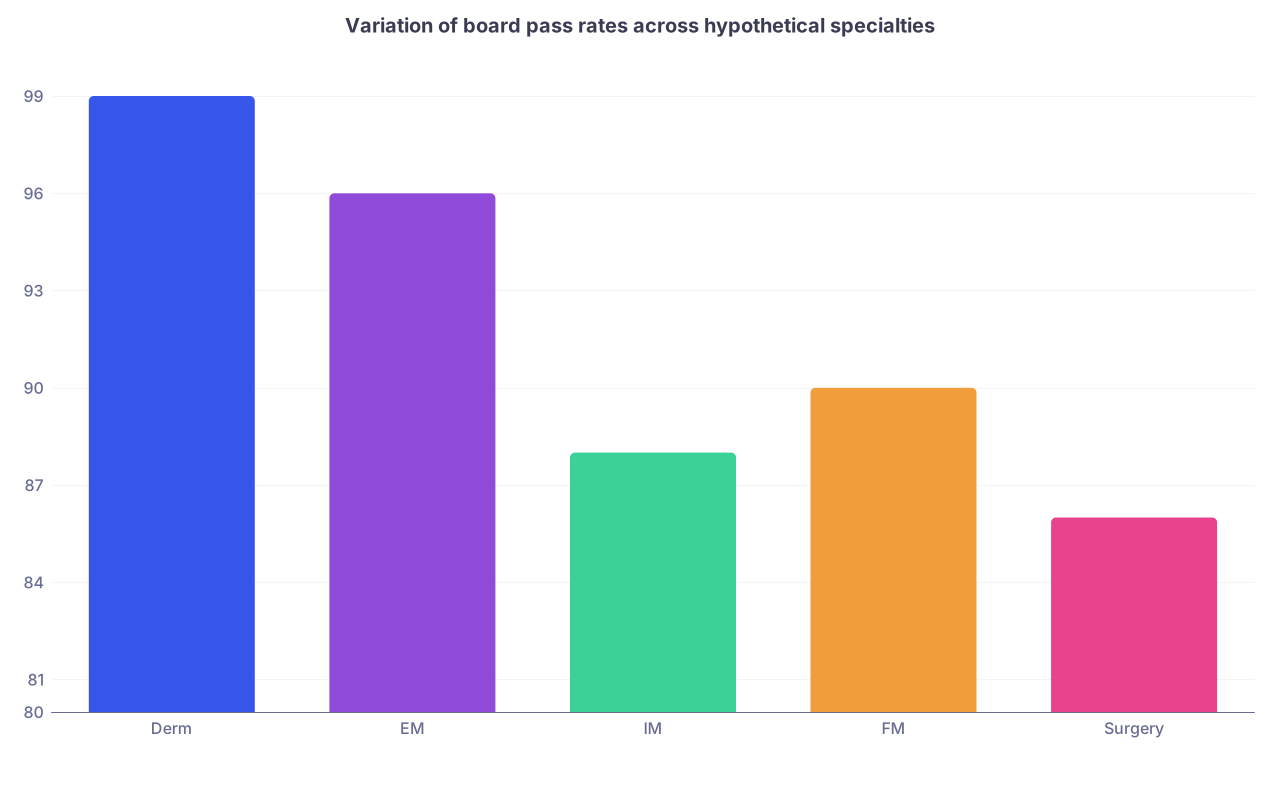
| Category | Value |
|---|---|
| Derm | 99 |
| EM | 96 |
| IM | 88 |
| FM | 90 |
| Surgery | 86 |


| Step | Description |
|---|---|
| Step 1 | See specialty pass rate |
| Step 2 | Check who is included in data |
| Step 3 | Assess selection and culture |
| Step 4 | Look at program-level variation |
| Step 5 | Ask programs about support and ITE use |
| Step 6 | Decide focus: specialty fit first, program quality second |
| Step 7 | Is rate <90%? |

FAQs
1. Should I avoid a specialty if its board pass rate is below 90%?
No. A sub‑90% first-time pass rate is not a “danger specialty.” It usually reflects a wider range of resident backgrounds and program quality. If you are a solid test taker and choose a program with a strong exam-prep culture, your personal risk may still be quite low. Use the lower pass rate as a nudge to scrutinize programs more aggressively, not as a reason to walk away from a field you like.
2. Are oral boards more “dangerous” than written boards when choosing a specialty?
Oral boards add a different kind of stress and failure risk because they test judgment, communication, and real-time reasoning. That said, if you are well trained and your program runs mock orals, the majority of residents still pass. You should not avoid an entire specialty solely because it has oral boards. But you should ask explicitly how each program prepares residents for them and how often their graduates pass on the first attempt.
3. Does failing boards ruin your career in that specialty?
One failure rarely ruins a career, but it does slow you down. You may have:
- Difficulty landing certain jobs until you are certified
- Temporary limitations on hospital privileges or insurance panels Most residents who fail once can pass on a subsequent attempt with focused study and less clinical load. Chronic failure or never attaining certification is more damaging, but that is uncommon if you and your program take remediation seriously.
4. How much should board pass rates matter compared to lifestyle or salary when choosing a specialty?
Board pass rates should rank far below clinical interest, day-to-day work, and lifestyle fit. They matter mainly in two ways: they reflect the training culture of a specialty and they help you judge how much attention you must pay to program-level academic support. You will live the clinical reality and lifestyle of a specialty every day; you will face the specialty boards a few times across your career. Choose the field you can tolerate—and ideally enjoy—daily, then use pass rates to fine-tune which programs you trust to get you across the certification finish line.
Key takeaways:
- Specialty-wide board pass rates mostly signal who gets in and how programs gatekeep, not how “easy” the field is.
- Your real focus should be on program-level pass rates and support systems, especially if you are not a naturally strong test taker.
- Choose the specialty for its clinical work and life fit; use board statistics as a secondary tool to interrogate program quality—not as your primary compass.