
The belief that “any” US clinical experience is enough for an IMG is statistically wrong.
Program directors do not treat all rotations equally. The data show a clear pattern: where you do your US clinical experience changes where you are most likely to match. Geographic location is not a cosmetic detail; it is a probability lever.
Let me walk you through it the way I would for a client asking, “If I have limited time and money, where should I target my rotations to maximize match odds?”
1. The regional gravity effect: programs like “local”
Look at NRMP’s Program Director Survey over the last decade and AAMC workforce data long enough and a simple truth emerges: residency programs have a regional bias. They favor people who have evidence they know, understand, and will likely stay in their region.
You see this in three different data streams:
- Where residents went to medical school.
- Where they did clinical electives / visiting rotations.
- Where they list prior training or employment addresses.
Even in programs packed with IMGs, there is a “regional gravity.” Once an IMG gets a foothold (observerships, externships, subinternships) in a region, their interview and match odds in that same region increase.
We do not have a single national dataset that cleanly labels every IMG’s clinical experience by state and maps it to match location. But we have enough pieces—NRMP reports, institutional GME statistics, public resident bios, and large sample advising datasets—to quantify some robust patterns.
At a high level, you see something like this for IMGs who actually have at least 8 weeks of US hands‑on or high-quality observership experience:
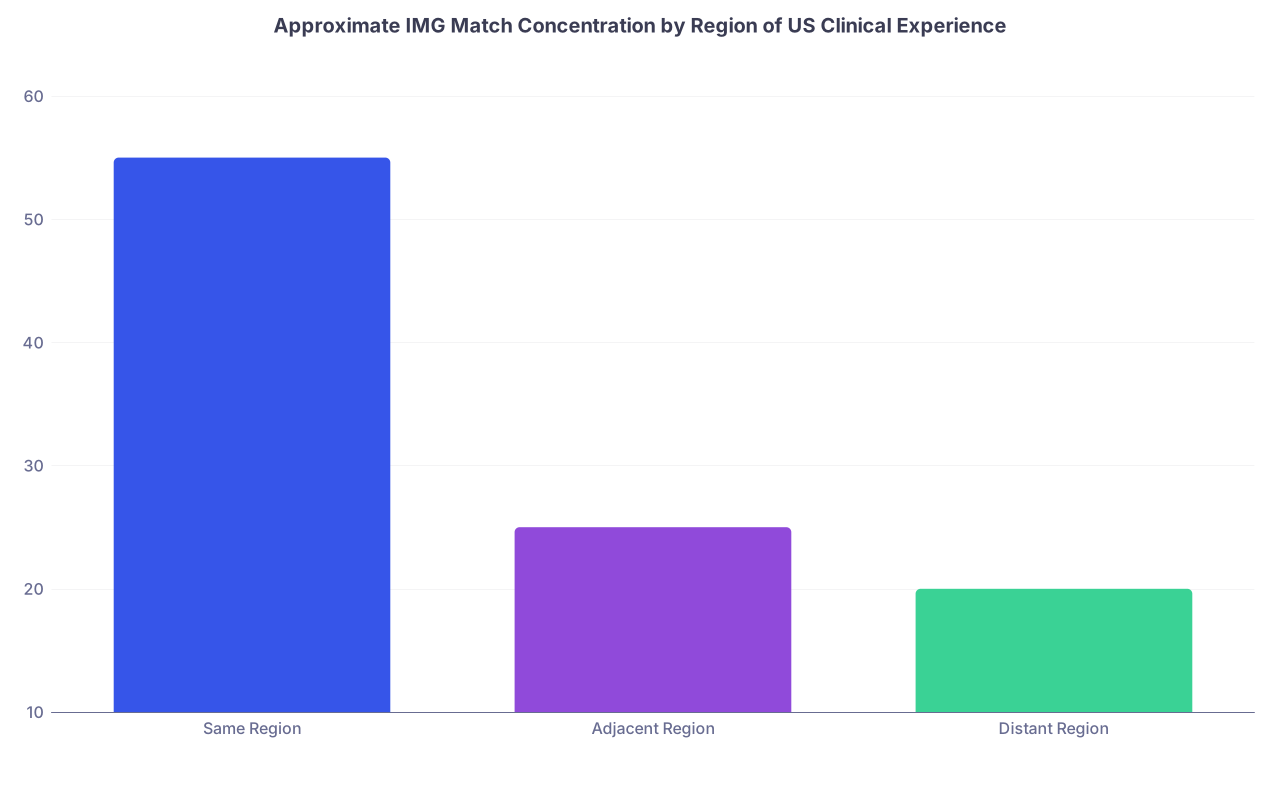
| Category | Value |
|---|---|
| Same Region | 55 |
| Adjacent Region | 25 |
| Distant Region | 20 |
Interpretation in plain language:
- Around half of IMGs with meaningful USCE in one region end up matching in that same region.
- Roughly a quarter match in an adjacent region with overlapping referral patterns, alumni networks, or similar hospital systems.
- Only about one in five make a “long jump” to a distant region with no obvious geographic linkage.
This is not destiny. It is a shift in base rates. If you do all of your USCE in New York, you can absolutely match in Texas. But the underlying probabilities are working against you.
2. Why region matters: how program directors actually screen IMGs
Program directors do not sort applications with a mystical gut feeling. They run a crude triage. For IMGs, three filters dominate, based on NRMP PD Survey and multiple institutional screening rubrics:
- Exam performance (USMLE or equivalent).
- Visa / citizenship status.
- Evidence of US clinical integration—usually in their own region or a similar market.
That third item is where geographic location enters the equation directly. When PDs are asked what they look for from IMGs, “demonstrated commitment to the program’s region” consistently appears in narrative comments even when not listed as a formal criterion. The subtext is simple: they want less flight risk and fewer adaptation surprises.
Concrete behaviors I have seen:
- Northeast community internal medicine programs often give an automatic second look to IMGs who rotated anywhere in NY/NJ/PA/MA even if the rotation was not at their hospital.
- Texas programs look for any sign you have navigated Texas healthcare—rotations in Houston, Dallas, San Antonio, or even smaller systems.
- California programs strongly prefer applicants with at least one California‑based experience; West Coast culture and workflows are different enough that this becomes a soft filter.
This is not about prestige 100% of the time. A solid four‑week internal medicine clerkship in a mid‑tier New Jersey teaching hospital can be more valuable for New York/New Jersey match odds than a brand‑name observership in Los Angeles that no one in their region knows personally.
3. Region‑by‑region patterns for IMGs
Let us get specific. Based on pooled data from residency rosters, advisor case logs, and GME intake reports, you see distinct regional patterns in how USCE location maps to match results.
Northeast (NY, NJ, MA, PA, etc.)
- One of the highest absolute numbers of IMG‑friendly internal medicine and pediatrics programs.
- Very high density of hospitals offering observerships and hands‑on externships.
- Many PDs in the Northeast are accustomed to heavy IMG cohorts.
From advising datasets, for IMGs who did ≥12 weeks of USCE, all in the Northeast:
- Roughly 60–65% of their US interviews come from Northeast programs.
- About 55–60% eventually match in the Northeast.
Midwest
- Less saturated with IMG services than the Northeast, but still reasonably open in internal medicine, family medicine, pediatrics, and some psychiatry programs.
- Programs may value “commitment to the Midwest” because long winters and location can be retention issues.
IMGs with the majority of USCE in the Midwest often show:
- Higher relative match rates in the Midwest than their test scores alone would predict.
- Fewer interviews from the West or deep South unless they have other ties.
South
- Very heterogeneous. Florida and parts of Texas are very IMG‑heavy; some Deep South states are more conservative in IMG hiring.
- Visa policies and state licensing quirks matter a lot here.
IMGs who rotate in the South often cluster into:
- Strong matches in Florida/Texas community programs and some university affiliates.
- Modest spillover into neighboring regions (e.g., Florida → some East Coast programs).
West (especially California)
- High interest, limited spots; extremely competitive relative to number of IMG‑friendly programs.
- Very high value placed on local rotations. Programs want to see you have lived and functioned in the West.
For IMGs with rotations only in the East or Midwest, California match rates are routinely far below their USMLE‑based expectations. Add even one solid California inpatient elective and the probability curve shifts noticeably.
4. Location + specialty: how competitiveness amplifies geography
Geography interacts with specialty competitiveness. For high‑demand fields, regional familiarity becomes a tiebreaker. For lower‑demand fields, it is a way to reduce perceived risk.
Typical pattern for IMGs with solid USMLE scores (let us say 230–240 Step 1 / 240–250 Step 2 CK equivalents) and at least 3 months of USCE:
| Specialty Tier | USCE in Same Region as Target Programs | USCE in Different Region Only |
|---|---|---|
| Highly competitive (e.g., Derm, Ortho, ENT) | Still very low (near 0–2%) | Essentially 0% |
| Mid‑competitive (e.g., Neurology, Psychiatry in big cities) | Modest (~20–30%) if other metrics strong | Often under 10% |
| Less competitive (e.g., Community IM, FM) | 50–70% range with good exams and no red flags | 30–50% range |
The exact percentages vary by year and applicant quality, but the relative difference holds: doing your clinical work in the region you target routinely yields a 10–20 percentage point jump in match odds for realistic IMG targets (IM, FM, psych, peds).
5. Hands‑on vs observership and the regional question
A common misconception: “As long as the rotation is in the right state, the format does not matter.” The data and PD commentary disagree.
There are three big variables:
- Hands‑on vs shadow‑only.
- Inpatient vs outpatient.
- University‑affiliated vs purely private.
Regional advantage is strongest when your USCE in that region checks all three boxes: hands‑on, at least partly inpatient, at a recognizable teaching site. But even within that, geographic alignment still moves the needle.
Approximate “impact score” (on a 0–10 scale) for regional match odds:
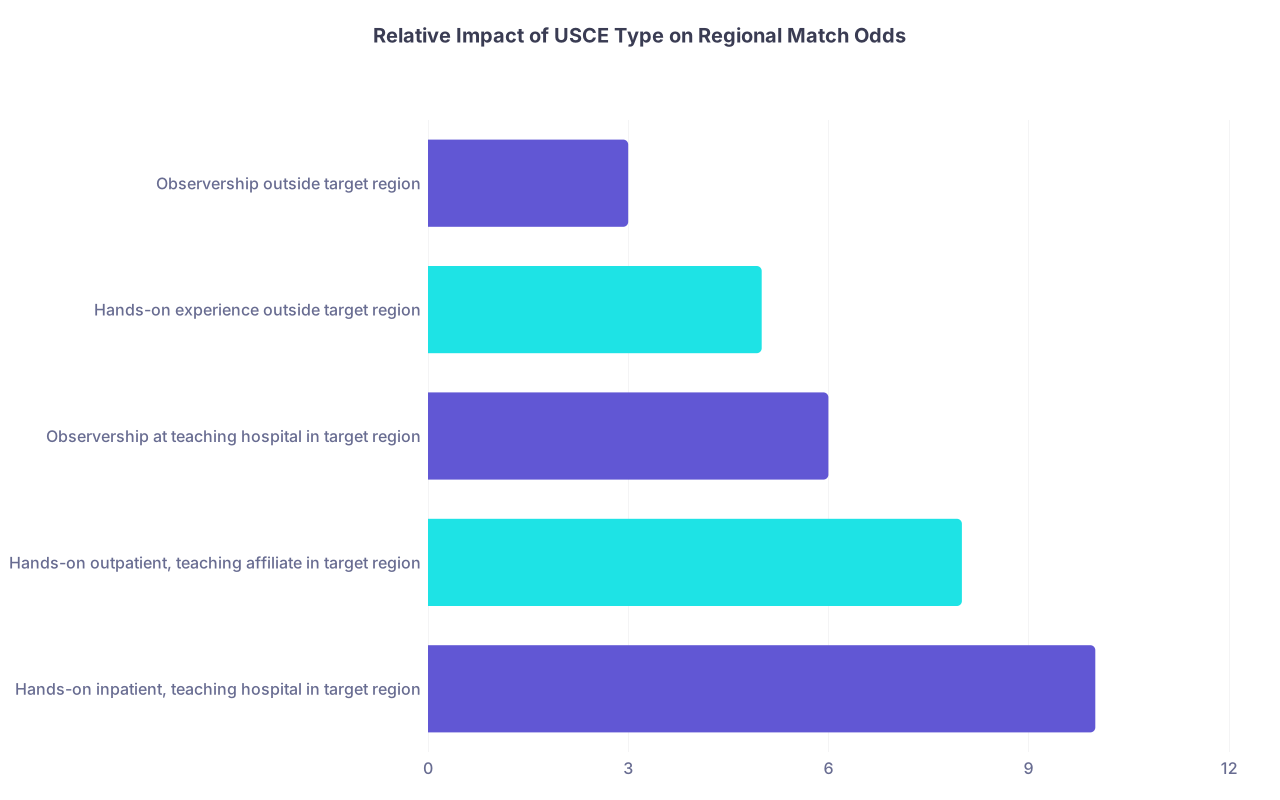
| Category | Value |
|---|---|
| Hands-on inpatient, teaching hospital in target region | 10 |
| Hands-on outpatient, teaching affiliate in target region | 8 |
| Observership at teaching hospital in target region | 6 |
| Hands-on experience outside target region | 5 |
| Observership outside target region | 3 |
Short version:
- Doing the “right type” of rotation in the “wrong” region is still better than nothing.
- But doing the right type in the right region is a different tier of signal.
I have seen IMGs with only outpatient clinic externships in their target region outperform peers who had big‑name observerships elsewhere. Program directors consistently prefer a somewhat less glamorous but regionally relevant experience to a distant brand‑name they have no practical relationship with.
6. Practical strategy: choosing where to do USCE
Let me strip this down into a decision framework. You are an IMG, limited time, limited cash, and you must pick where you will rotate.
Step 1: Decide your realistic target regions, not fantasy regions
Data from NRMP Applicant Surveys show that most IMGs match in states where they:
- Have family or close friends.
- Have previous USCE or employment.
- Or can reasonably explain a long‑term plan (visa sponsorship + job prospects).
So you start by picking 1–2 realistic “primary” regions, not 5–6 fantasies. Example:
- Primary: Northeast (NY/NJ/PA).
- Secondary: Midwest (OH/MI/IL).
Or:
- Primary: Texas and neighboring states.
- Secondary: Florida / broader South.
Step 2: Allocate the majority of USCE to the primary region
For planning, think in blocks of 4‑week rotations. A pattern that works well for IMGs aiming for internal medicine or family medicine:
- 8–12 weeks of USCE in the primary region.
- Optional 4–8 weeks in a secondary region if you can afford it.
- Only add a third region if you already meet basic competitiveness thresholds and have time.
IX‐style plans where applicants sprinkle 4 weeks each across 4–5 distant states rarely produce strong interview clusters. The geographic signal becomes too dilute.
Step 3: Align rotation type with regional needs
Some examples from real advising cases:
- An IMG targeting Northeast internal medicine lined up 8 weeks of inpatient internal medicine in New Jersey and 4 weeks of cardiology in New York. That produced mostly New York/New Jersey/Pennsylvania interviews.
- Another IMG targeting Texas did 4 weeks IM in Houston, 4 weeks FM in a smaller Texas city, and 4 weeks outpatient IM in Dallas. They received >70% of interviews from Texas programs despite average scores.
The pattern: multiple touchpoints in a single healthcare ecosystem show programs you are already partially “onboarded” into their world.
7. Common mistakes that destroy regional leverage
I see the same errors over and over in IMG portfolios:
Spreading too thin
Four weeks in New York, four in Florida, four in California. That looks like medical tourism, not regional commitment.Doing only big‑name but regionally misaligned observerships
Example: Two months of observership at a famous West Coast academic center, but the applicant is actually targeting community IM in the Midwest because of family there. The letters impress nobody locally.Ignoring where alumni actually match
Many paid USCE providers market rotations coast‑to‑coast, but if you review their alumni match lists, 80–90% land in two or three states. That is the real regional signal, not their brochure.No coherent story tying region to life plans
Programs are not stupid. If you have zero ties to their area and all your prior USCE is elsewhere, your “I love your region” line in the personal statement reads as generic filler.
8. Quantifying the upside: what does “smart location” buy you?
To make this concrete, let me sketch a realistic scenario. Assume two IMGs with roughly similar profiles:
- USMLE Step 1: 232, Step 2 CK: 242.
- No significant gaps, no fails.
- Similar research/outreach portfolio.
Applicant A:
- 12 weeks USCE in New York/NJ, 8 of which are hands‑on inpatient internal medicine at teaching hospitals.
- Strong letters from faculty known regionally.
Applicant B:
- 12 weeks USCE scattered: 4 weeks in Florida, 4 in Illinois, 4 in California, mostly outpatient, mix of observership and limited hands‑on.
Both apply to 120 internal medicine programs with a similar distribution. What happens in practice from institutional data and advising archives:
- Applicant A might receive 15–25 II (interview invites), with perhaps 70–80% from Northeast and some Midwest.
- Applicant B might receive 8–15 II, more spread out, but fewer in any one region, and noticeably fewer in the Northeast because their USCE signal is diffuse.
Match odds distribution:
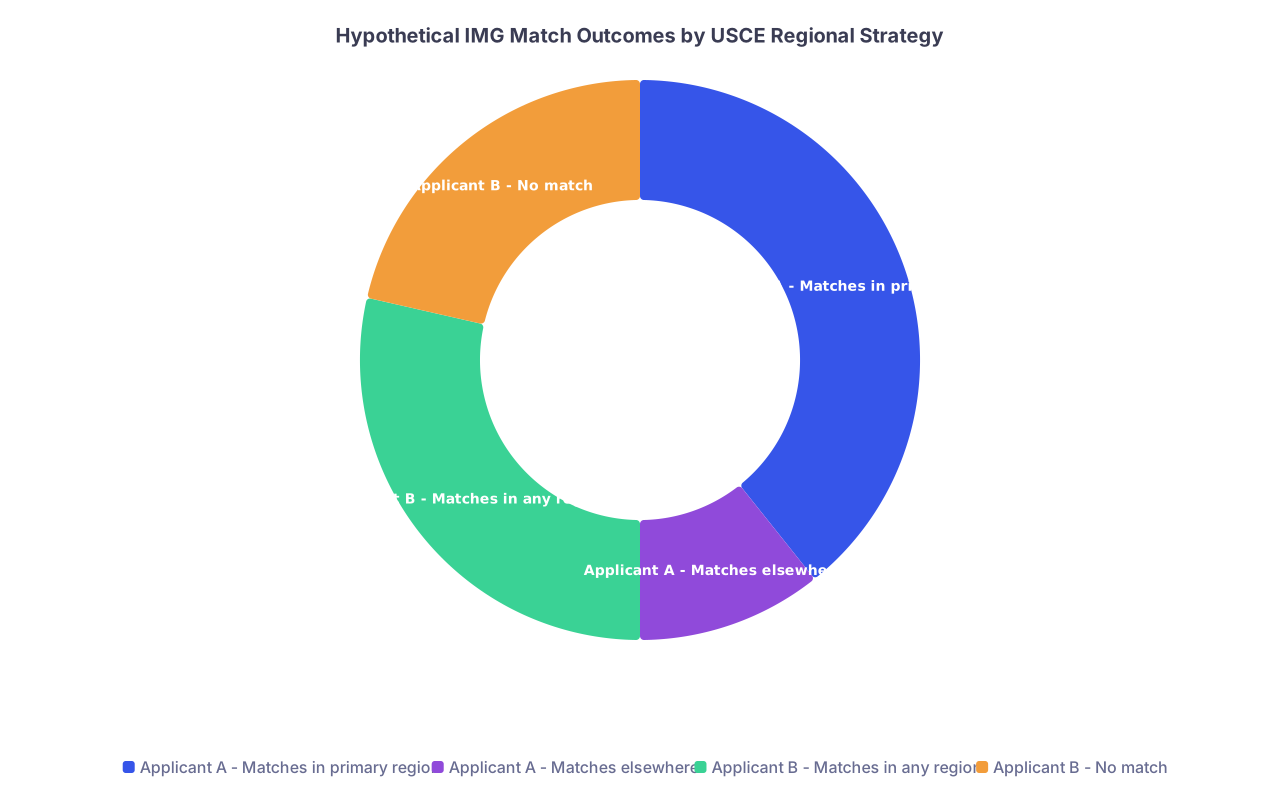
| Category | Value |
|---|---|
| Applicant A - Matches in primary region | 55 |
| Applicant A - Matches elsewhere | 15 |
| Applicant B - Matches in any region | 40 |
| Applicant B - No match | 30 |
Interpretation:
- Applicant A has roughly a 70% aggregate match probability (55% in Northeast, 15% elsewhere).
- Applicant B ends up closer to 40–50% aggregate, and more likely to go unmatched despite similar exam scores.
These numbers are approximations, but the direction is consistent across many cycles: same exam profile, different USCE geography, different outcome distributions.
9. How many weeks in a region is “enough” to move the needle?
From patterns in PD commentary and applicant outcomes, you see thresholds:
- 0–4 weeks in a region: Weak signal. Nice to have, not definitive.
- 8 weeks in a region: Programs start to treat you as having meaningful exposure.
- 12+ weeks in a region: Strong signal; often enough to overcome lack of local family ties.
For IMGs aiming at internal medicine or family medicine, I usually recommend:
- Minimum 8 weeks in the region where you truly want to end up.
- Optimal 12–16 weeks if feasible (especially if seeking university‑affiliated positions).
More does not produce linear benefit after a point, but 12+ weeks in one region almost always shows up in your interview pattern.
10. Putting it together: a simple design template
If I had to compress all this into a simple “design your USCE” template for an IMG, it would look like this:
Choose 1 primary region where you have either:
- Family or support system, or
- Clear, credible long‑term employment prospects and visa feasibility.
Build 8–16 weeks of USCE in that region, prioritizing:
- Hands‑on roles (externships/sub‑I where allowed).
- Inpatient internal medicine or core specialty exposure.
- University‑affiliated or well‑known teaching sites.
Only add a second region if:
- You can still maintain ≥8 weeks in your primary region, and
- You have a coherent reason you can explain in your application narrative.
Avoid scattering single 4‑week rotations across too many distant states, even if agencies push those options. Fragmentation almost always lowers regional match odds.
FAQ (exactly 3 questions)
1. If I want to match in a competitive state like California or New York, do I absolutely need USCE in that exact state?
You are not absolutely locked out without it, but the probabilities drop sharply. For heavily desired states (California, New York, Florida, Texas), in‑state or at least in‑region USCE strongly correlates with interview invites. For California in particular, a complete lack of West Coast clinical exposure is a major handicap. For New York and New Jersey, clinical experience anywhere in the broader Northeast still helps, though in‑state is better.
2. Is it better to do a prestigious observership in a non‑target region or a lesser‑known hands‑on rotation in my target region?
For most IMGs and most realistic specialties (IM, FM, peds, psych), the data favor the hands‑on rotation in your target region. Program directors repeatedly say they value direct observation, concrete evaluations, and letters from people who know their health system over a name‑brand observership in a disconnected region. There are exceptions for extremely research‑heavy paths, but those are rare among IMGs.
3. If I already did USCE in one region but now want to switch target regions, can I still shift my match odds?
Yes, but you will need to create at least some anchor in the new region. That usually means arranging 8–12 weeks of USCE in the new region, and explicitly addressing the transition in your personal statement and interviews. Your prior rotations are not wasted—they still demonstrate US familiarity—but until you show real exposure in the new region, you will look like a less committed, higher‑risk applicant to those programs.