

Home-country clinical experience is not your golden ticket to a US residency. It is your starting line. And the outcomes data makes that painfully obvious.
For years I’ve heard the same line from international graduates:
“I’ve been practicing internal medicine for five years back home. That should compensate for not having USCE, right?”
No. It does not. And program directors say this openly when they’re not on stage giving the “inclusive” talk.
If you’re an IMG trying to match into US residency and you’re banking on your home-country experience to carry you, you’re misreading how the system actually works. Let’s strip away the comforting myths and look at what the numbers — and real selection behavior — actually show.
The Myth: “Strong Home-Country Experience Offsets Lack of USCE”
There’s a very persistent belief in IMG circles: if you’ve done enough hospital work “back home” — internship, residency, practice, even consultant-level work — US programs will see you as more experienced, more “ready,” and overlook your lack of US clinical experience (USCE).
Here’s reality: in most specialties, especially internal medicine, pediatrics, and FM, home-country experience is treated as a bonus line on your CV, not a core competency signal. USCE is the currency. Everything else is foreign money that needs exchanging — and the rate is bad.
You do not have to take my word for it; you can just follow the outcomes.
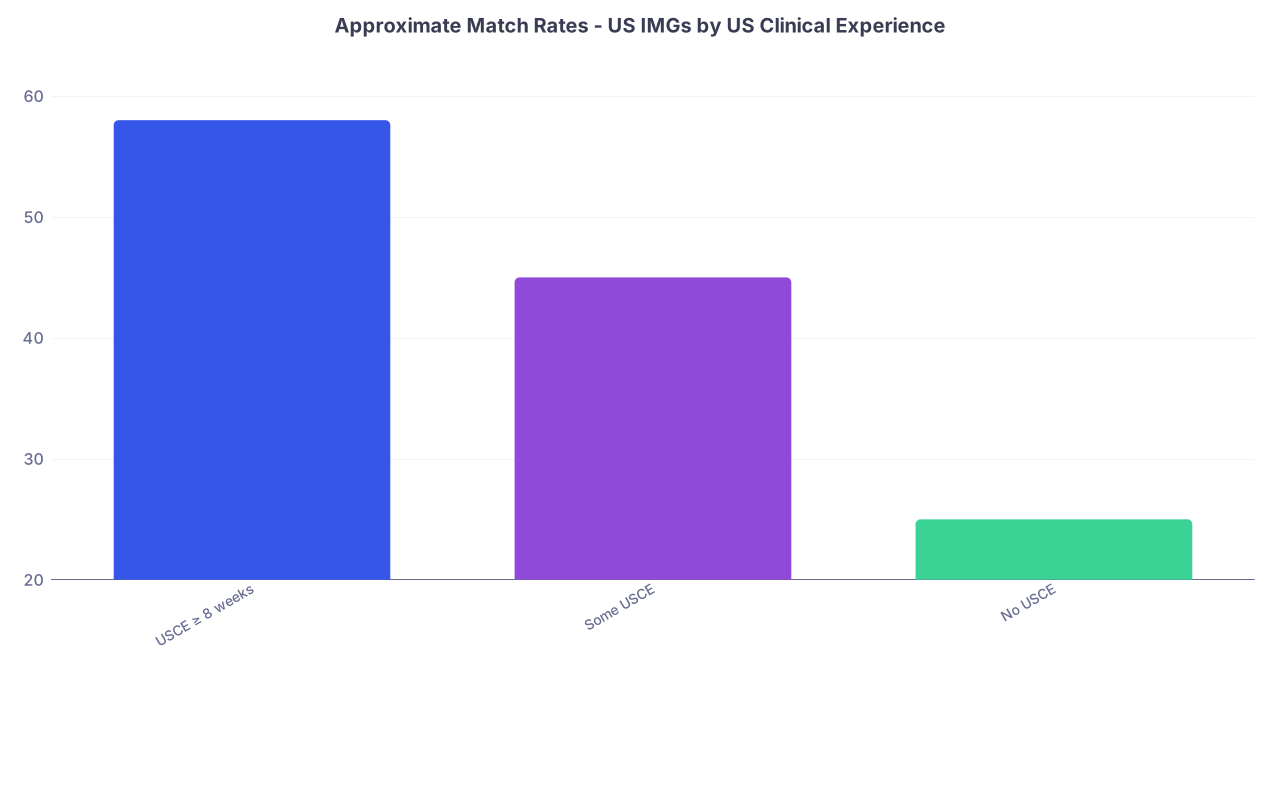
| Category | Value |
|---|---|
| USCE ≥ 8 weeks | 58 |
| Some USCE | 45 |
| No USCE | 25 |
Those percentages are approximate and differ year to year and by specialty, but the pattern is consistent across NRMP data, ECFMG internal surveys, and individual program info sessions:
- US IMGs with substantial, recent USCE reliably match at higher rates.
- Those with only home-country experience routinely underperform, even when they have years of practice.
And here’s the part people do not like: a new graduate with well-structured US observerships and good letters will often outcompete a 10-year home-country attending with no USCE.
Program directors are not blind. They’re bound by incentives: ACGME standards, malpractice reality, hospital throughput, and the simple fact that teaching someone how their system works costs time and money.
So they prioritize what predicts performance in their environment. Not what made you a star in yours.
Why Home-Country Experience Does Not Translate the Way You Think
Let me be blunt: programs are not rejecting your home-country work because they disrespect your country or your skills. They’re rejecting it because they cannot reliably interpret it.
When a PD at a mid-tier IM program in Ohio sees “3 years internal medicine resident – XYZ Hospital, Pakistan” or “MO – District Hospital, Nigeria,” they face several problems.
1. They do not know the standard of training
Was that program rigorous or lax?
Were you supervised closely or left alone early?
Did your assessments actually mean anything or were they rubber-stamped?
They don’t know. And they don’t have the time or context to figure it out. So they default to the data they can interpret: US rotations, US letters, US exam performance, US language and communication samples.
2. They care about system-specific competence
US residency is not just “medicine but in English.” It is:
- US-style documentation in an EMR-heavy environment
- US legal and ethical norms (consent, capacity, end-of-life, opioid prescribing)
- US-style interprofessional teamwork (nurses with more autonomy than in many countries, RTs, PT, case management, etc.)
- US insurance-driven decision making and discharge planning
Your home-country experience may have made you an excellent clinician. It probably did. But they are not hiring just a clinician. They are hiring someone to function in their system, under their liability, with their workflows.
USCE is the only direct evidence of that.
3. Recency and context matter more than length of service
Program directors care far more about what you did in the last 2–3 years than what you did 8 years ago, even if those 8 years were full of practice.
That’s why you see older graduates with strong home-country experience struggling, while younger graduates with 3–4 solid US rotations get interviews.
A PD said it almost word-for-word at a virtual open house I sat in on:
“If you have 10 years of experience abroad but no US exposure, our concern is not that you do not know medicine. It is that you may not adapt quickly to our environment.”
Translation: your long non-US career can actually increase perceived risk.
What the Data Actually Shows About USCE and Match Outcomes
Let’s stop speaking in abstractions and look at patterns.
Across NRMP Charting Outcomes and ECFMG insights (and if you read between the lines in program criteria):
- Programs explicitly listing “US clinical experience required” are not rare; they’re common in IM, psych, and FM.
- Programs that prefer USCE are the norm. “We value US clinical experience” is code for “we filter out most people without it unless their application is exceptional.”
- Many IMGs without interviews each year share a similar profile: good Step scores, okay or strong home-country experience, but little or no USCE or weak US letters.
| Profile Description | Relative Match Outlook |
|---|---|
| Strong USCE + recent grad + decent scores | High |
| Strong home-country only + older grad | Low |
| Mix of both, but USCE weak/short | Moderate |
| Strong USCE + older grad | Moderate–High |
| No USCE + excellent scores + strong research | Variable, specialty-specific |
Another thing I’ve noticed when reviewing lists of programs where IMGs actually matched: the vast majority of program websites either state or strongly imply the importance of USCE. When you look up matched IMGs on LinkedIn, you repeatedly see the same patterns:
- Multiple US observerships/externships
- US LORs from core specialties (IM, FM, psych, peds)
- At least one teaching hospital rotation, not just community office shadowing
The rare ones without USCE? They usually compensate with:
- Exceptional exam scores
- Significant US-based research with publications
- US grad school (MPH, MS, PhD) plus hospital-based involvement
Do some people match with home-country experience only? Yes. Outliers exist. You can also win the lottery. That doesn’t make it a strategy.
What Home-Country Experience Is Actually Good For
Now, do not misinterpret this: your home-country experience is not worthless. It’s just not the lever you think it is.
Used correctly, it can do a few specific things very well.
1. It can make your clinical reasoning sharper
You’ve seen more patients. You’ve made more mistakes. You’ve managed actual responsibility instead of hypothetical cases.
When you’re on a US rotation, this shows up. You ask better questions. You anticipate complications. You think a step ahead. Attendings notice.
But this value only manifests if someone sees you work in the US. Which requires USCE.
2. It can power a compelling narrative — if framed correctly
“I practiced for 5 years, then left everything to retrain in the US” is not a negative. It can demonstrate commitment and maturity. But only if you explain:
- Why you’re switching systems
- What you’ve already done to adapt (US exams, USCE, CME, etc.)
- How your prior experience will help the team, not make you rigid or resistant
PDs are suspicious of people who seem like they’re “downgrading” from an attending role to intern. They worry you’ll be difficult, dismissive, or burned out. You have to explicitly counter that in your personal statement, interview, and letters.
3. It helps during residency — not necessarily in getting in
Once you’re in a program, prior real-world experience absolutely pays off. You’ll transition to autonomy faster. You’ll probably feel less panicked on nights. You might even outshine your peers by PGY2.
But none of that matters if you never get past the filter.
Why Programs Fixate on USCE: The Uncomfortable Truths
There are a few practical, slightly ugly reasons USCE is treated as almost mandatory at many programs.
Legal and communication risk
Residents are frontline documenters in the US. If your notes are off, your orders unclear, your communication with nurses shaky — people get hurt and hospitals get sued. PDs are risk-averse by necessity.
USCE with strong letters proves that in a US setting, your communication, professionalism, and documentation were acceptable. Home-country experience doesn’t reassure them on that front.
Team dynamics and workflow
Nurses, mid-levels, case management — they all talk. A resident who can’t function in the US rhythm slows the entire machine.
I’ve watched this happen. An IMG with great home-country credentials but no USCE started at a community IM program. Smart, hardworking, but totally unfamiliar with US nursing roles, pages, consult etiquette, EMR shortcuts. The nurses complained constantly in the first months. Not about intelligence. About slowing everyone down.
USCE, even as observership, at least gets you familiar with that culture before you’re the one entering orders at 2 a.m.
Filters are brutal and lazy — by design
ERAS applications are a flood. Thousands of files, many from IMGs. PDs and coordinators need easy filters: Step cutoffs, YOG cutoffs, “USCE required” flags.
Your nuanced story about rich home-country experience never even gets seen if you fail those binary screens.
That’s why “I’ll explain my situation in the interview” is fantasy if you do not first give them the checkbox items — USCE being one of the big ones.
How to Use Home-Country Experience Strategically (Instead of Hiding Behind It)
If you’re serious about matching, you need to stop treating home-country experience as a substitute for USCE and start treating it as an amplifier.
Here’s the general order of operations that actually works for most IMGs:
Secure meaningful US clinical experience.
Not just shadowing in someone’s private clinic where you watch them sign prescriptions. Aim for:- Inpatient or at least hospital-affiliated settings
- Attending-level direct supervision
- Opportunities to present cases, discuss plans, practice notes (even if unofficially)
Get letters that explicitly connect your prior and current skills.
A strong US letter might say:
“Dr. X has several years of clinical practice abroad, which was evident in their advanced clinical reasoning. Unlike many students, they required minimal prompting to formulate complete plans.”
Now your home-country experience is verified in a US program director’s language.Use your prior experience to differentiate within USCE.
On your US rotations, volunteer for more complex patients. Offer to pre-round. Present like a sub-I, not a timid observer. Show that you’re “overqualified” in a good way.Frame your story as “experienced but humble,” not “entitled and stuck in old ways.”
Programs are wary of “I’m already an attending; I just need the US stamp.” They prefer:
“I’ve practiced before, and I’m here to relearn your way from the ground up.”

| Step | Description |
|---|---|
| Step 1 | Home-country experience |
| Step 2 | US exams completed |
| Step 3 | Plan USCE rotations |
| Step 4 | Strong US letters referencing prior work |
| Step 5 | Application framed around adaptability |
| Step 6 | Residency interviews |
| Step 7 | Match |
Used this way, home-country experience becomes a plus. But only because it’s filtered through USCE and US references.
The Harsh but Helpful Takeaway
If you’re an IMG planning on or already applying to US residencies, here’s the simplest way to think about it:
- Home-country experience alone: valuable for you, not legible for them.
- USCE alone: legible for them, but may lack depth.
- Both together: that’s when your profile starts looking genuinely strong.
Outcomes do not lie. Year after year, USCE shows up in the background of successful IMG matches, while “excellent home-country experience only” is heavily overrepresented in the unmatched and “no interview” crowd.
You can argue with the fairness of that. You cannot argue with the pattern.
So ask yourself a harder question than, “Is my home-country experience enough?”
Ask: “If a busy program director glanced at my file for 20 seconds, would anything in it reassure them that I can function in their hospital on day one?”
If the answer is no, your next move is obvious: stop hoping your past will be overinterpreted, and start building the kind of US experience that programs are actually willing to bet a residency spot on.
Years from now, you won’t remember how frustrating it felt that your prior work “didn’t count.” You’ll remember whether you swallowed that frustration early, adapted, and gave selection committees the one thing they always trust most: proof you can already do the job their way.


