
It's February 28th. The rank list deadline passed days ago. You’re lying in bed, phone five inches from your face, replaying your list in your head like a horror movie on loop.
“I ranked too aggressively. I didn’t rank enough safety programs. What if I don’t match at all? Like literally: SOAP, no spot, nothing, career over.”
You refresh your email even though you know nothing is coming tonight. You try to remember what your advisor said, but all you can hear is that one line from a co-intern’s story: “Yeah, I had a friend who didn’t match because they ranked too high and not enough programs…”
So now the question that won’t let you sleep:
Did I just screw myself?
Let’s walk through this like two anxious people who’ve both read too many Reddit threads.
First: What “Ranked Too Aggressively” Actually Means
When people say “I ranked too aggressively,” they usually mean one (or more) of these:
- I ranked mostly super competitive programs for my stats.
- I didn’t rank enough total programs.
- I left off “backup” specialties or prelim / TY options.
- I over-weighted location / prestige instead of match probability.
You’re probably sitting somewhere in that mess.
Here’s the part everyone twists in their brain: you literally cannot hurt yourself by ranking programs more “aggressively” as long as you actually rank every program you’d be willing to attend.
The algorithm is applicant-favoring. You don’t lose programs by ranking some “too high.” The problem happens when:
- You didn’t interview widely enough for your competitiveness, or
- You interviewed enough but then only ranked the top half because you “couldn’t see yourself” at the lower ones, or
- You applied to a very competitive specialty with a short list.
So the core danger isn’t that you put MGH and UCSF in your top 5. The danger is that you didn’t also rank the solid mid-tier/community places where you actually had a good shot.
If your “aggressive” list still includes all the programs you truly would attend? That’s not actually aggressive. That’s rational.
How Likely Is It You Won’t Match at All?
You want numbers, not vibes. Let’s get uncomfortable and then honest.
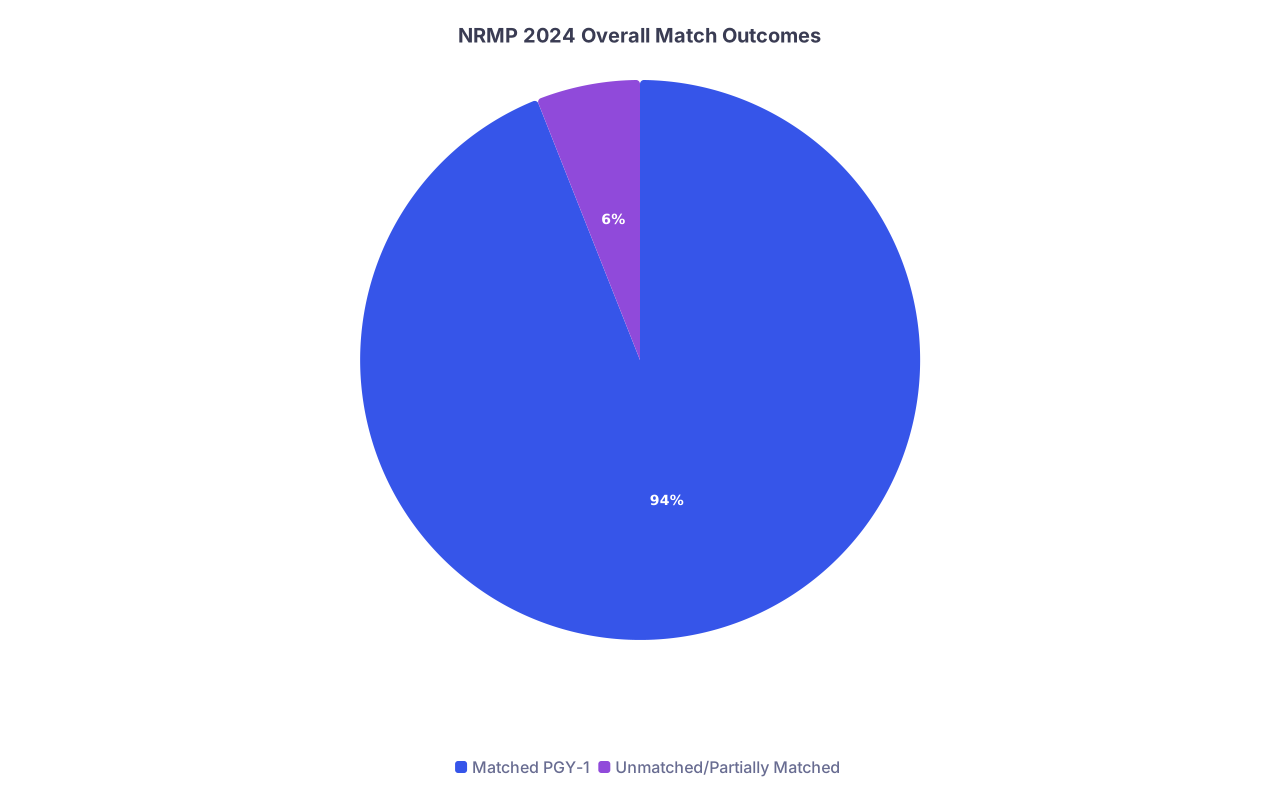
| Category | Value |
|---|---|
| Matched PGY-1 | 94 |
| Unmatched/Partially Matched | 6 |
Rough order-of-magnitude reality for US MD seniors (varies by year, but ballpark):
- Around 92–94% match to a PGY-1 spot.
- Around 6–8% don’t match initially.
But that 6–8% isn’t “just ranked too aggressively.” It’s mostly:
- Applicants in ultra-competitive specialties (derm, ortho, plastics, ENT, optho, urology) with limited spots and brutal selection.
- People with red flags (Step failures, big leaves, professionalism issues).
- People who applied to very few programs, got few interviews, and didn’t SOAP smartly.
For US DOs and IMGs, the unmatched rate is higher, but the pattern is similar: specialty competitiveness + application strategy + number of interviews.
So the real question for you isn’t “Is it possible I won’t match?” (Yes, obviously, that’s why you’re panicking.)
It’s: Given my specific situation, how bad is the risk really?
If you’re a typical US senior going into IM/FM/Peds/psych/OB/anesthesia/EM with a reasonable number of interviews? Your chance of totally not matching is way lower than your brain is telling you at 2 a.m.
The Interview Count Reality Check (This Actually Matters)
The number of ranks matters less than the number of interviews. That’s where people get burned.
| # of Programs Ranked | Very Rough Match Likelihood |
|---|---|
| 1–3 | High risk of not matching |
| 4–6 | Risky, but possible |
| 7–10 | Usually decent |
| 11–15 | Generally pretty safe |
| 16+ | Very strong odds |
This varies intensely by specialty, but here’s the blunt version for relatively less competitive specialties (IM, FM, Peds, Psych, Neurology, etc.):
- Under ~6 ranks → you should be nervous
- ~8–10 ranks → not insane to be anxious, but statistically not horrible
- 12+ ranks → you’re probably okay unless your file has serious red flags
For competitive specialties (Derm, Ortho, ENT, etc.):
- Even 10 ranks might not feel “safe”
- People often rank 12–20+ and still worry (reasonably)
Now, “ranked too aggressively” is only a death blow if it came with a short list.
If you have:
- 10–15+ interviews in a core specialty, and
- You ranked every single program where you interviewed (even the ones you “liked least”),
then your risk of “no match at all” is pretty low.
You might not match at your dream place. But zero match? Unlikely.
Things That Do Raise Your “No Match” Risk
Let me be the voice of your catastrophizing brain, but accurate.
You’re in higher danger if:
Very few interviews
- Like 0–4 total. Especially in a competitive specialty.
- At that point, it’s not aggressive ranking; it’s just a thin application cycle.
You left off places you’d realistically attend
Example:- You had 10 interviews, but only ranked 5 because “I just didn’t vibe” with the others.
- That’s where “aggressive” can hurt you. You voluntarily cut your own safety net.
You went for a hyper-competitive specialty without a backup specialty
- No IM / prelim / TY / categorical backup.
- That’s the story veterans quietly talk about at 2 a.m. on night float.
You have real red flags and not many programs
- Step 1 or 2 fail, professionalism issues, big unexplained gap, etc., plus a short list.
- Programs may be wary; you need more shots on goal.
If, reading this, your stomach drops and you realize you’re in more than one of those buckets… yeah, your risk is higher. I’m not going to sugarcoat that.
But if what you call “aggressive” is:
“I put a lot of reach programs high, but I still have 10–15+ total and I ranked them all”?
That’s not a disaster. That’s just normal.
But What If I Truly Overreached? (The Worst-Case Spiral)
Let’s say your situation is actually kind of bad.
Example:
- US MD
- Applied to EM
- Got 5 interviews
- Only ranked 3 because you didn’t think you’d ever go to the other 2
- Now you’re panicking
Or:
- IMG
- Applied to IM
- Got 6 interviews but only ranked 4 “top” university programs
- Left off two community programs you thought were beneath you
This is where your “aggressive ranking” can absolutely bite you.
Because the algorithm can’t rank you at a program you didn’t list. If those “beneath me” programs were actually your best shots? You gave up real odds of matching.
Honestly? I’ve seen this happen. Someone leaves off a lower-tier but realistic program → doesn’t match the high ones → ends up in SOAP scrambling for a prelim or nothing at all. And later they’d have taken that “beneath me” program in a heartbeat.
So yeah, that scenario you’re afraid of? It’s not imaginary. It happens.
But even then, “no match at all, career over” still isn’t your only trajectory. It’s just the worst branch on the decision tree.
How the Algorithm Actually Treats Your “Aggression”
Quick and dirty recap, because misunderstanding this is half the anxiety:
- The algorithm tries to match you to your highest-ranked program that also ranks you high enough to fit in their slots.
- If you don’t match there, it moves down your list.
- Ranking a “reach” program #1 doesn’t reduce your chances at #2, #3, etc.
Your risk doesn’t come from putting “reach” programs at the top. Your risk comes from:
- Not having enough programs on the list at all.
- Not including the realistic ones you actually interviewed at.
- Not having a backup specialty / prelim / TY cushion.
So your thought spiral of “I ranked MGH first, I’m doomed” is wrong. The correct spiral is:
“Did I cut out programs I’d actually attend because I got picky or scared about being ‘stuck’ somewhere?”
If the answer is no, your aggression is more emotional than mathematical.
What Happens If I Don’t Match? (Because Your Brain Is Already There)
You’re probably already halfway through this scenario in your head, so let me put it clearly.

| Step | Description |
|---|---|
| Step 1 | Dont Match on Monday |
| Step 2 | SOAP Eligible? |
| Step 3 | SOAP List Released |
| Step 4 | Apply to Programs in SOAP |
| Step 5 | Interview Quickly |
| Step 6 | Accept SOAP Offer |
| Step 7 | Post-Match Planning |
| Step 8 | Research Year / MPH / Work |
| Step 9 | Reapply Next Cycle |
If you don’t match on Monday:
- You get that email: “We are sorry to inform you…”
- You enter SOAP (if eligible).
- You apply to unfilled programs, usually in more prelim / IM / FM-heavy spots.
- It’s chaos. It’s fast. It’s emotionally brutal. People still get positions.
If SOAP also doesn’t work out:
- You consider: research year, MPH, another degree, chief year somewhere, or non-clinical work.
- You reapply with a stronger story, often broadening specialty or being less aggressive with safety options.
Does it suck? Yes. Does it end your shot at residency forever? No. I’ve seen people come back from an unmatched year and get solid spots.
That said, nobody should romanticize it. It’s expensive, humbling, and logistically messy.
Real Talk: How To Reality-Check Your Situation Right Now
You can’t change your list. But you can reality-test your panic a little.
Ask yourself, honestly:
- How many programs did I rank?
- Is my specialty hyper-competitive or more middle-of-the-road?
- Did I rank every program where I interviewed that I’d be willing to attend?
- Do I have major red flags?
- Am I a US MD, DO, or IMG? (The risk profile really does change.)
If your answers look like:
- “US MD, IM/FM/Peds/Psych, 12+ ranks, no huge red flags, ranked all interviews” → your odds of not matching anywhere are pretty low.
- “US MD, derm/ortho/etc., 5–8 ranks, no backup specialty, some red flags” → yeah, your fear isn’t crazy.
- “IMG, IM, 4–6 ranks, left off community programs I’d now accept” → you took on real risk.
But notice this: in almost all of those scenarios, your brain jumps straight to “I won’t match anywhere,” when the more likely outcome (even in bad situations) is:
- You match somewhere less ideal than you wanted, or
- You don’t match this year but have realistic options to re-route.
Your brain is graphing an apocalypse. Reality is usually more… annoyingly survivable.
How to Survive the Waiting Time Without Losing Your Mind
You can’t change the list. You can only change what you’re doing with the two weeks of dread.
And no, I’m not going to say “just relax.” That’s useless.
Here’s what actually helps a little:
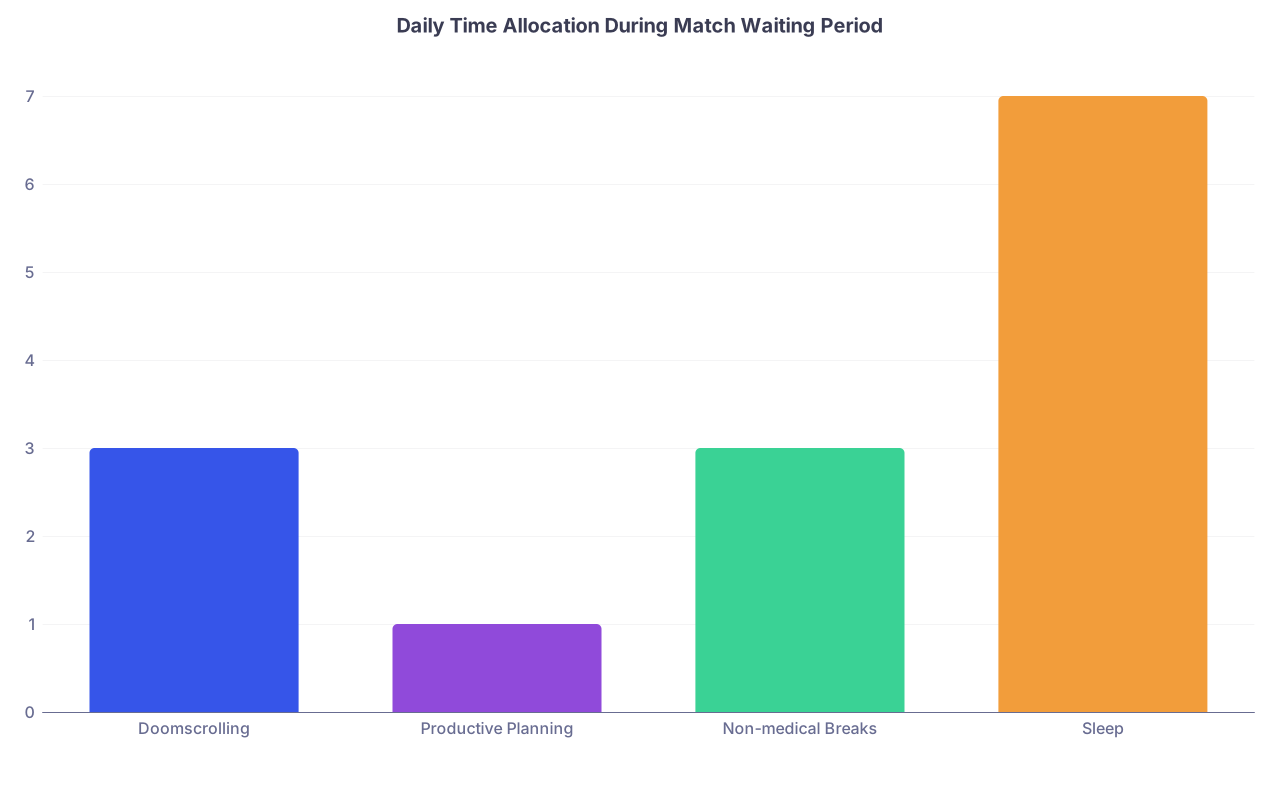
| Category | Value |
|---|---|
| Doomscrolling | 3 |
| Productive Planning | 1 |
| Non-medical Breaks | 3 |
| Sleep | 7 |
- Put a hard time limit on doomscrolling Reddit/SDN. Like: 20–30 minutes daily. That’s it.
- Write down your worst-case scenario on paper. Literally: “If I don’t match, I will…” and list specific actions. Your brain calms down a tiny bit when there’s a plan.
- Tell 1–2 safe people that you’re freaking out. Not the whole group chat. Just the ones who won’t feed the panic with “omg same” for an hour.
- Keep your life slightly structured: workouts, basic meals, one non-medical thing per day (show, book, walk, whatever).
You don’t beat the anxiety. You just try to keep it at “I can function” instead of “collapse on the floor.”
Quick Reality Examples (So You’re Not Just Theoretical)
Example 1: “Aggressive but Actually Fine”
- US MD, Step 2: 247
- Specialty: Internal Medicine
- 14 interviews → ranked all 14, but top 6 are big-name university places
- Freaking out because “I shot too high”
Likely reality: You may not match at the top 3–4. But somewhere in those 14? Very high chance. “Not match at all” is low probability.
Example 2: “Yeah, This Is Risky”
- US MD, Step 2: 243
- Specialty: Ortho
- 7 interviews → ranked all 7
- No backup specialty, no prelim/TY list
Reality: Not matching is a real possibility. Not because you ranked aggressively—because ortho is brutal and your numbers + interview count are modest.
Example 3: “Aggressive by Omission (the real danger)”
- IMG, Specialty: IM
- 8 interviews, mostly community programs
- Only ranked the 5 “best-feeling” ones
- Left off 3 places where you “didn’t see yourself living”
Reality: You significantly increased your risk of not matching. Those 3 might’ve been your highest odds programs. If you don’t match, this decision will haunt you for a while.
One More Thing Nobody Says Out Loud
A lot of people who are terrified right now will, in two months, be complaining about:
- The call schedule
- The EMR
- The cafeteria food
At a place they were once convinced they’d never get into.
Your anxiety right now is not a sign that disaster is coming. It’s a sign that this process is absolutely messed up and designed to make high-functioning people feel powerless.
You’re not crazy for being scared. But fear is a garbage predictor.

FAQ: 5 Questions You’re Probably Still Asking
1. If I ranked a super competitive program #1, did I hurt my chances at my #2–10?
No. That’s not how the algorithm works. The system tries to place you in your highest choice that also wants you. If your #1 can’t take you, it moves to #2, then #3, and so on. You don’t get “penalized” for aiming high on top. The only way you hurt yourself is by not having enough realistic programs somewhere on the list.
2. Is there such a thing as “too many” programs on my rank list?
Not in a way that hurts your match chances. You don’t get punished for a long rank list. The only real caution is: don’t rank a program you truly wouldn’t attend under any circumstance. If they rank you and you match there, you’re going. But in terms of pure math? More realistic programs = better odds.
3. I only ranked 5–6 programs. Am I screwed?
It depends on the specialty and your applicant type. For a US MD going into something like FM or IM with solid scores, 5–6 is risky but not automatically doomed. For derm/ortho/ENT or an IMG with 5–6? Risk is much higher. You’re not guaranteed to not match, but your fear isn’t irrational. Just know that not matching still doesn’t mean your medical career is over—it means your path might get longer and messier than you wanted.
4. I left off a few “safety” programs I didn’t like that much. Big mistake?
Potentially, yes. If you would now be willing to train there rather than not match, then yeah, that was aggressive in a bad way. The algorithm can’t consider places you don’t list. If those were realistic options for you statistically, you gave up some real probability. You can’t fix it now, but you can learn from it if you need to reapply.
5. How will I know on Match Day if I ranked too aggressively?
Honestly, you won’t get a clean, labeled answer. If you match lower than you hoped but still match, you’ll never know if ranking more “safely” would’ve changed anything. If you don’t match at all, “aggressive ranking” is usually just one piece of a bigger puzzle (specialty choice, number of interviews, red flags, etc.). People love to blame the rank list. Reality is almost always more complicated.
Key points, no fluff:
- Ranking “reach” programs high doesn’t hurt you. Not ranking enough realistic programs does.
- Your actual risk of not matching at all depends mostly on interview count, specialty, and whether you ranked everywhere you’d attend.
- If the worst happens, it will suck—but it won’t be the end of your career unless you decide to stop trying.