Your personal statement probably does sound generic right now. That doesn’t mean you’re screwed.
Let’s Say the Quiet Part Out Loud
If you’re reading this, you’ve probably:
- Submitted ERAS already, hit “certify,” and then suddenly realized your personal statement sounds like every other “I love helping patients and value teamwork” essay on the planet.
- Or you’re a week away from submitting, and every time you reread your statement, you feel physically ill because it sounds safe, vague, and weirdly not like you.
And now your brain is doing what mine does: full disaster mode.
“What if this ruins my whole application?”
“What if PDs think I’m boring?”
“What if everyone else wrote some profound life-changing story and I wrote… a glorified school essay?”
Let me be blunt: a generic personal statement won’t win you interviews.
But it usually doesn’t destroy you either.
Still, you’re not wrong to want to fix it. Let’s talk about what you can realistically do right now depending on where you are in the process.
, Personal Statement, MSPE, Research](https://cdn.residencyadvisor.com/images/articles_svg/chart-relative-weight-of-application-components-for-inte-7771.svg "Relative Weight of Application Components for Interviews (Typical Program View)")
| Category | Value |
|---|---|
| USMLE Scores | 30 |
| Clinical Grades | 20 |
| [Letters](https://residencyadvisor.com/resources/common-residency-mistakes/lor-pitfalls-recommendation-letter-mistakes-that-raise-red-flags) | 20 |
| Personal Statement | 10 |
| MSPE | 10 |
| Research | 10 |
First: How Much Does a Generic Personal Statement Actually Matter?
Short answer: it matters less than your anxiety thinks, but more than the people who shrug and say “nobody reads them” admit.
I’ve heard real program directors say things like:
- “I skim them to make sure they’re not weird.”
- “I mainly look for red flags or if they can actually write.”
- “Most are generic. I only remember the very bad or very good ones.”
Here’s how personal statements usually function:
Not a golden ticket
A stunning personal statement won’t save a catastrophically weak application. This is the harsh reality.But it can be a quiet tiebreaker
When you’re in a stack of 40 applicants with similar Step 2 scores and similar clerkship comments, that one paragraph where you sound like a real human instead of a Step 2 robot? That can push you from “meh” to “let’s invite.”Biggest risk of a generic statement
You’re forgettable.
You end up in the mental bucket of “average decent applicant, nothing special.” Not doomed. Just… invisible.True disasters are rare but real
The statements that hurt applicants are usually:- Strange or grandiose (“I will revolutionize neurosurgery”)
- Tone-deaf (mocking patients, sounding arrogant, zero reflection)
- Sloppy (typos, wrong program name, wrong specialty mentioned)
If your statement is just “generic but clean”? That’s not a death sentence.
But if your gut is screaming that something feels off, you’re not crazy for wanting to fix it.
Can You Still Change It? Depends Where You Are in the Process
Let’s separate out the real nightmare question: “Is it too late?”
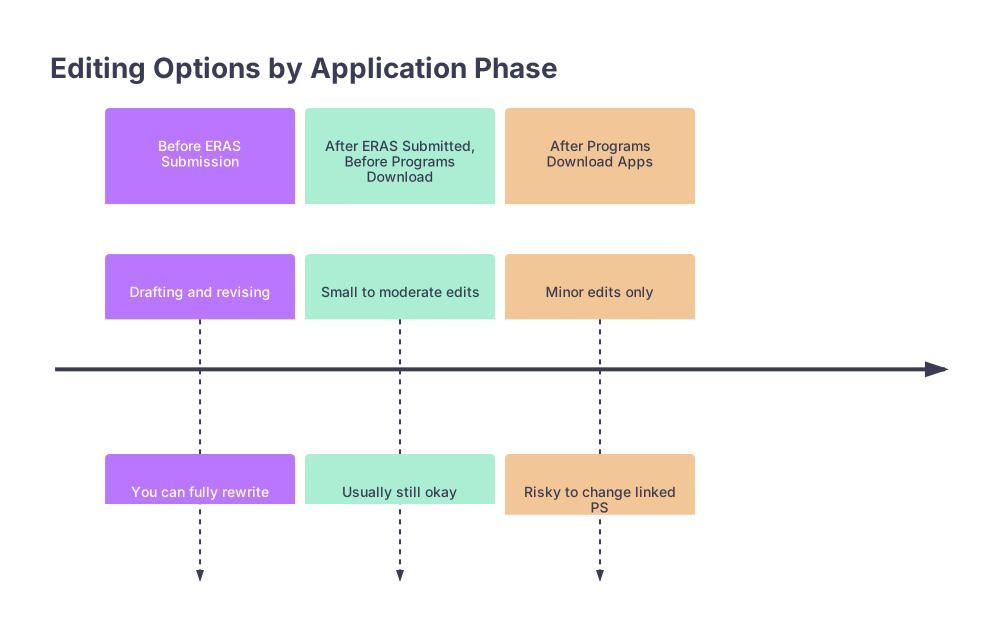
| Period | Event |
|---|---|
| Before ERAS Submission - Drafting and revising | You can fully rewrite |
| After ERAS Submitted, Before Programs Download - Small to moderate edits | Usually still okay |
| After Programs Download Apps - Minor edits only | Risky to change linked PS |
Scenario 1: You Haven’t Submitted ERAS Yet
You are absolutely not too late.
Your anxiety might say: “But it’s already September, everyone else submitted at 8:01 AM on opening day, I’m done for.”
No. Programs don’t fill their entire interview list in 24 hours. Slight delay to fix a weak personal statement is fine.
What you can still do:
- Completely overhaul your statement if needed.
- Change structure, story, tone, everything.
- Tailor slightly by specialty (and sometimes by program if you’re extra motivated).
Here, yeah, you should fix it. Don’t submit something you already know feels generic.
Scenario 2: You Submitted ERAS, But It’s Very Early (Apps Just Opened)
This is the murky zone, and it drives anxious people like us insane.
On ERAS, you can technically edit your personal statement after certification—but any program that already downloaded your application will have the old version.
So you’ll ask: “Will they see I changed it? Will it look shady? Will they think I’m disorganized?”
Reality:
- Some programs download applications in big batches a few days after opening.
- Some do it immediately.
- Some do rolling downloads over weeks.
No one sends you a polite little email saying, “By the way, we pulled your file at 10:03 AM.”
So what do you do?
My honest opinion:
- If it’s early (within the first week or so) and your statement truly feels like a liability (painfully generic, confusing, unclear why you want the specialty), editing is still worth it.
- The worst case? Some programs saw the old version, some see the new. That’s still better than every program seeing the weak version.
Scenario 3: You Submitted Weeks Ago, Already Got a Few Interview Invites
Here’s where I lean conservative.
If you’ve already:
- Seen interview invites roll in
- Maybe even noticed programs mentioning parts of your statement in emails or invites
I’d be careful with major changes.
At this point:
- Completely rewriting it might create weird mismatch between what’s in your PS and what’s in letters/MSPE/etc.
- Programs that downloaded early have one version; later programs get a totally different personality. It’s not catastrophic, but it can feel chaotic.
What I’d do:
- Minor edits only: fix tiny phrases, tighten a sentence, correct grammar.
- Don’t change the overall story, length, or structure at this stage.
The better move now? Prepare to verbally bring the you that your personal statement failed to show.
The Real Problem: Why Your Personal Statement Feels Generic
Let’s be brutally honest. Most of us write generic statements for a few predictable reasons:
- We’re scared to sound “unprofessional,” so we scrub out all actual personality.
- We’ve read 20 sample essays online and subconsciously copy the same structure and phrases.
- We’re exhausted, overworked on rotations, and just want it done.
Classic signs your statement is generic:
- You use phrases like “I have always been passionate about…” or “I quickly realized my love for…”
- You list qualities instead of proving them. (“I am hardworking, dedicated, and empathetic…”)
- Your “story” could belong to 500 other applicants. (“During my third-year internal medicine rotation, I realized…” with no specific details.)
If you can swap your name out for someone else’s and nothing feels off, that’s a problem.
What You Can Actually Fix Last-Minute (Without Starting Over)
Let’s say you don’t have the emotional energy for a full rewrite. You’re tired. You’re on nights. You’re barely eating real food.
You can still do surgical edits that make a big difference.
1. Replace Vague Claims with Concrete Moments
Take this:
“I learned the importance of communication and teamwork during my clinical rotations.”
Change to:
“On a chaotic night shift on surgery, I watched our senior resident calmly re-organize the team after two simultaneous consults and a crashing post-op patient. The way she narrated her decisions out loud changed how I think about communication under pressure.”
Suddenly it’s not generic. It’s yours.
Run through your statement and look for:
- “I learned…”
- “I realized…”
- “I value…”
Then ask: When? With whom? What happened? Add one specific scene or detail.
2. Cut the Resume Rehash
If your statement sounds like your CV with verbs, that’s why it feels empty.
Bad:
“In medical school, I participated in research, teaching, and community service, all of which prepared me for residency.”
Better: Focus on one thing and say something specific and reflective.
“Mentoring first-years in clinical skills lab forced me to confront how bad I was at giving feedback. Over time, I learned to stop talking at them and start asking what they noticed first. That shift—inviting their perspective before correcting—has changed how I work with students and patients.”
You don’t need to mention every activity. They already see your CV. Use the statement to show how you think.
3. Fix the Opening and Closing Paragraphs
You don’t need to rewrite the middle if you can’t. But you can usually upgrade the first and last paragraphs in under 60 minutes.
Openers that feel dead:
- “I have always been interested in medicine since I was young…”
- “During my third year of medical school, I discovered my passion for pediatrics…”
Try:
- Start in the middle of a moment.
- Start with one sharp, concrete observation.
Example:
“The first time a patient fired me, I deserved it.”
Or:
“At 3:17 a.m., I was the only person standing in the hallway when my attending said, ‘You need to decide what you want your role to be here.’”
Then you explain.
For the ending: Avoid:
- “I am confident that my skills and experiences have prepared me well for a residency in X.”
- “Thank you for your consideration.”
Try: Tie back to a theme or moment you used earlier. Something like:
“I’m not the loudest person on rounds, and I’m still learning how to trust my own clinical voice. But every time I walk into a patient’s room and sit down instead of standing in the doorway, I feel myself becoming the intern I’d want to sign out my own family member to. That’s the kind of physician I hope to grow into in your program.”
It doesn’t have to be poetry. It just has to sound like an actual person thinking.
How to Do a 24–48 Hour “Emergency Fix” Rewrite (If You Really Need It)
If your stomach drops every time you reread your statement, a full rewrite might actually take less time than patching a broken one.
Here’s a quick, brutal-but-doable approach:
Step 1: Brain Dump (30–45 min)
Forget structure. Write in a separate document:
- 3 patients you still think about
- 2 times you felt like you failed or messed up
- 2 things you actually like about your chosen specialty day-to-day (not “helping people”)
- 1 attending or resident you want to secretly become
Don’t polish. Just write.
Step 2: Pick ONE Thread (20–30 min)
Look over what you wrote and ask:
- What shows how I think?
- What shows growth or self-awareness?
- What actually makes me feel something?
Pick one story/idea and build your statement around that, instead of trying to shove your entire life in 1 page.
Step 3: Rough Draft (60–90 min)
Structure it roughly like:
- Opening: drop us into a specific moment.
- Middle: what you learned about yourself / your specialty from that and related experiences.
- Ending: who you are now and the kind of resident you’re trying to become.
No fancy vocabulary. Just write like you’d talk to a smart attending you respect.
Step 4: Ruthless Edit (45–60 min)
Cut:
- Repeated clichés
- Any sentence that could’ve been written by 100 other people
- Overly complex words you’d never say out loud
Ask yourself:
“Could my classmate copy-paste this and just change the name?”
If yes, rewrite that sentence.
| Change Type | Impact |
|---|---|
| Add specific patient/resident moments | High |
| Rewrite generic opening/closing | High |
| Remove CV rehash paragraphs | High |
| Change font/spacing/wordiness only | Low |
| Obsess over synonyms for 'passion' | Very Low |
| Stay up all night rereading 40x | Negative |
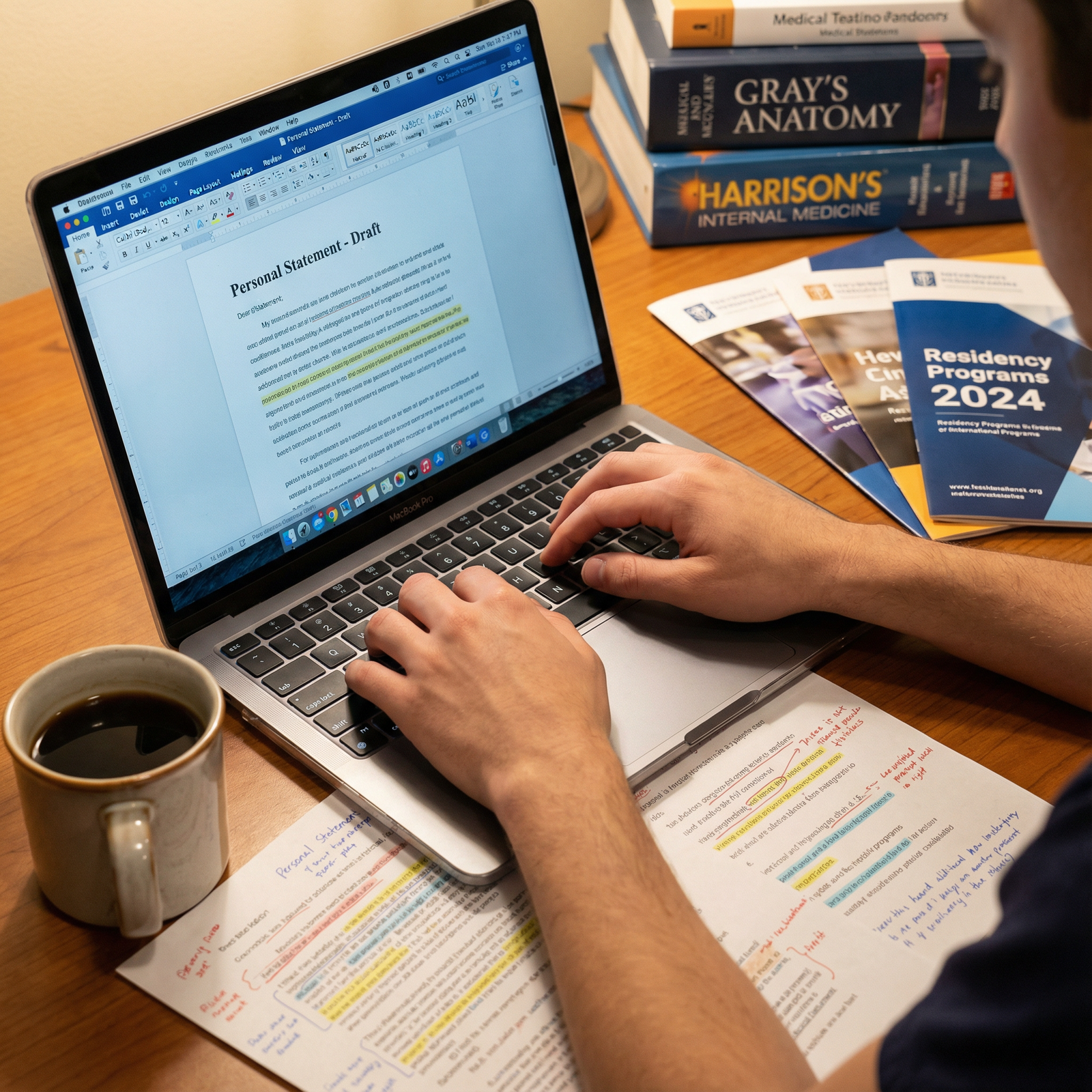
But What If I Can’t Fix It Now? Am I Just Doomed?
No. You’re not doomed.
You might just have to accept two things:
- Your personal statement is going to be “fine but forgettable.”
- You’ll have to compensate somewhere else—especially in interviews.
Here’s what you can control if the PS ship has basically sailed:
Interview prep that actually brings out your story.
When they ask, “Tell me about yourself,” that’s your real personal statement. You can fix in conversation what your essay failed to show.Program signaling in your communication.
In emails, thank-you notes, or even how you talk on interview day, you can show insight about the specialty and who you are as a learner.How you talk about anything written in your PS.
If you mentioned an experience in your statement but wrote about it in a flat way, prepare a richer, more reflective spoken version. They’ll remember the person they talked to more than the paragraph they scanned two weeks ago.
Also, remind yourself: people match every year with generic personal statements. Plenty of them.
They don’t brag about it on Reddit, but it happens.
Final Reality Check (So You Can Maybe Sleep Tonight)
Let me cut through the noise:
A generic personal statement is common, not fatal.
It makes you less memorable, not unmatchable.If you still have time, fix the high-yield stuff.
Add specifics, cut the resume copy, sharpen your opening/closing. That alone can push you from “blah” to “solid.”After a certain point, stop rewriting and start preparing to be good in person.
Interview you > written you. Always.
If something in your gut says, “I can make this clearly better in the next 24–48 hours,” you probably can—and it’s not too late.
If your gut says, “I’m spiraling and just want control over something,” it might be time to step away from the document and put that energy into interview prep instead.
Your personal statement doesn’t have to be perfect. It just has to sound like a real, thinking, learning human. That’s enough.