It’s 11:47 p.m. Your ERAS is submitted, you’ve paid the terrifying credit card bill, and you should be figuring out away rotations or working on that personal statement tweak. Instead, you’re deep in a 7‑year scroll of your own Instagram, staring at a picture from M1 with a red Solo cup and thinking:
“Is this the post that gets me rejected from all my dream programs?”
Welcome to the panic spiral. I live here too.
Let’s be blunt: your social media probably isn’t “perfect.” You’ve got old memes, some slightly questionable comments from college, maybe a sarcastic tweet about burnout, a TikTok from intern year on nights where you look half-dead, and now you’re convinced some 65‑year‑old program director is zooming in, taking screenshots, and forwarding them to the rank committee with the subject line: “ABSOLUTELY NOT.”
So. How worried should you actually be?
How Much Do Programs Really Stalk Your Social Media?
Here’s the part nobody will give you a straight answer on, so I will.
Some programs look. Some don’t. Very few are doing full FBI‑level investigations.
I’ve seen this play out in real time. At one mid-sized IM program, one chief resident would occasionally pull up an applicant’s LinkedIn or Twitter if there was already some concern: vague professionalism issues, weird letter, something odd in the personal statement. It wasn’t routine; it was confirmatory.
At another (very competitive) surgical program, there was an unofficial policy: if they were going to rank you top‑15, someone would at least Google you. Not a deep dive. Just: “Anything horrifying pop up?”
But the important pattern: they’re usually not hunting for minor imperfections. They’re scanning for deal‑breakers.
Think of it like this: if your social media is a little messy, you’re in the same boat as 90% of applicants. If your social media is actively horrifying, then yes, it can absolutely tank you.
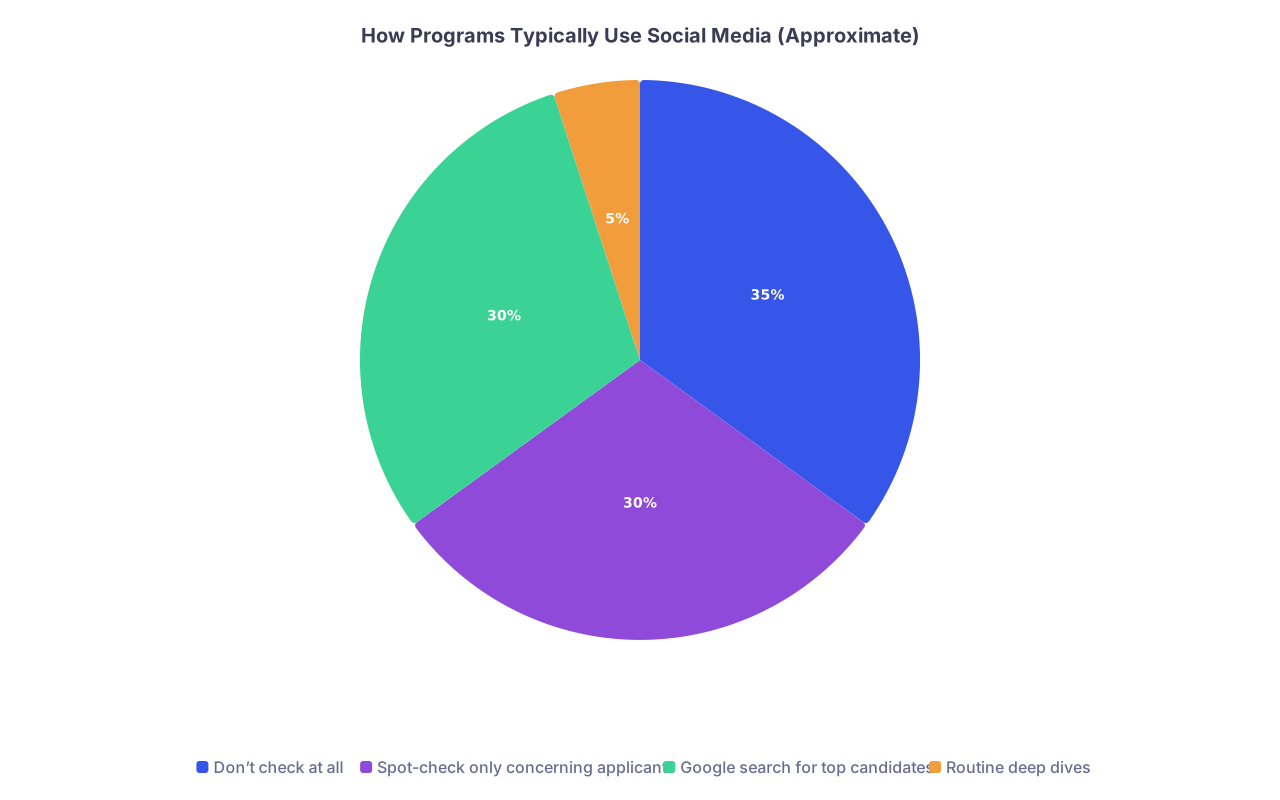
To put some rough structure around the reality:
| Category | Value |
|---|---|
| Don’t check at all | 35 |
| Spot-check only concerning applicants | 30 |
| Google search for top candidates | 30 |
| Routine deep dives | 5 |
No one has universal, perfect data on this, but this rough distribution is what matches what I’ve heard again and again from PD panels, advisors, and residents.
So is someone going to reject you because you once posted you were “so dead after call lol” with a filter? Highly unlikely.
Are they going to side‑eye a public account full of posts mocking patients or featuring you doing shots in what is clearly a hospital ID badge? Yeah. That’s a problem.
What Actually Counts as a Red Flag vs Just… Being Human?
Here’s where the anxiety really spikes, because our brains love to treat everything as catastrophic.
There’s a difference between “not perfectly clean” and “professionally concerning.”
Let me break it down the way attendings actually think about it. Not the fantasy standard in your head. The real one.
Stuff that usually DOES NOT matter (especially if your account isn’t public to the world)
- Old group photos with drinks at a bar, party, wedding, etc., where you’re just… being a normal adult
- A couple of mild rants about being tired, overwhelmed, or frustrated in med school (as long as it’s not targeted or unhinged)
- Slightly cringe college posts that are dumb but not malicious
- Occasional profanity not directed at specific individuals or patient populations
- Political opinions stated vaguely or generally (not personal attacks or hate)
- Goofy TikToks that don’t involve patients, colleagues, or the hospital
Stuff that actually CAN hurt you
- Anything that looks like you’re mocking patients, breaching confidentiality, or trivializing suffering
- Photos from inside clinical areas with any identifiable patient info (or even the appearance of that)
- Openly racist, sexist, homophobic, transphobic, or otherwise discriminatory comments/jokes
- Posts attacking a specific program, institution, or faculty member by name
- Repeated posts about being drunk/high, irresponsible, or unsafe, especially in anything resembling clinical context
- You in scrubs / with a name badge / with hospital logo doing anything wildly unprofessional (drinking, vaping, sexual content, etc.)
That line—scrubs + unprofessional + public—is where attendings suddenly stop being chill and start saying things like, “This is not someone I want representing our program.”
If you want it as a quick mental check:
| Category | Worry Level (0–10) |
|---|---|
| Normal social life photos | 1–2 |
| Mild venting about training | 2–3 |
| Political opinions | 3–5 |
| Hospital/scrubs + risky | 7–9 |
| Patient/privacy issues | 9–10 |
If you’re staring at your account and it’s mostly the top two rows, your anxiety is louder than the reality.
“But I Found Some Old Stuff. Is It Too Late to Fix It?”
Here’s the part where the catastrophizing kicks into high gear. You find:
- A 2015 tweet using language you don’t use anymore and now find gross
- A college photo album titled something terrible
- A Facebook comment thread that went off the rails
Your brain: “Cool. My match is over. I’m going to be unemployed and 400k in debt.”
Let me be clear: it’s almost never too late to clean things up.
If you can still edit, hide, or delete it: do it. Tonight. Not tomorrow. Not “after this rotation calms down.” Now. Don’t make a big public statement, don’t write a Notes app apology for something nobody’s even called you out on. Just quietly clean your stuff.
You’re not “guilty” for having grown as a person. You’re allowed to have been 19 and stupid and then become 27 and not want that version of yourself plastered everywhere.
If it’s something truly bad (like an obviously offensive meme or slur), deleting it is not being “dishonest.” It’s being appropriately professional.
Would I scrub everything that might remotely offend someone, ever? No. That’s how you end up with that Step 1 studying energy where you think you have to know every single fact in First Aid. It’s not realistic and it makes you miserable.
Start with this:
- Google your name with and without “MD” or “medical student”
- Check images, not just web results
- Log into old accounts: Facebook, Instagram, Twitter/X, TikTok, Tumblr, whatever
- Ask a brutally honest friend to take a 10‑minute scroll and flag anything that makes them raise an eyebrow
If you’re still spiraling, create a temporary rule for yourself: if it takes more than 5 seconds to decide if something’s bad, just hide it. You can always unhide later. Right now you need to be able to sleep.
Should I Just Go Completely Private or Delete Everything?
This is the classic overcorrection. You hear one story at a pre‑match meeting about an applicant who “lost a spot because of Instagram” and suddenly you’re ready to nuke your entire online existence.
Going private is fine. Deleting whole platforms? Sometimes fine. But let’s not pretend there aren’t trade‑offs.
Some programs like seeing professional, sane social media. Especially for fields like EM, peds, IM, PM&R, psych—any group where advocacy, education, or public health work is visible. I’ve heard PDs say stuff like, “Their Twitter made me like them more” about people who were thoughtful and normal online.
Where this matters more:
- If you publish or do advocacy and people naturally search your name
- If you have a professional Twitter where you talk about research, DEI, health policy, etc.
- If you’ve done podcasts, YouTube, or public talks
Total social media blackout can look… odd, if you’re relatively active in other public ways. Not a red flag on its own, but it removes a potential plus.
So, quick rule of thumb:
- If your account is mostly personal / chaotic / memes → strongly consider making it private
- If your account is a mix of personal & professional → clean it up and keep it semi‑public
- If your account is fully professional (med Twitter, etc.) → keep it, but be a little paranoid about tone
You don’t owe anyone public access to your life. But don’t let fear convince you that the only safe option is scorched earth.
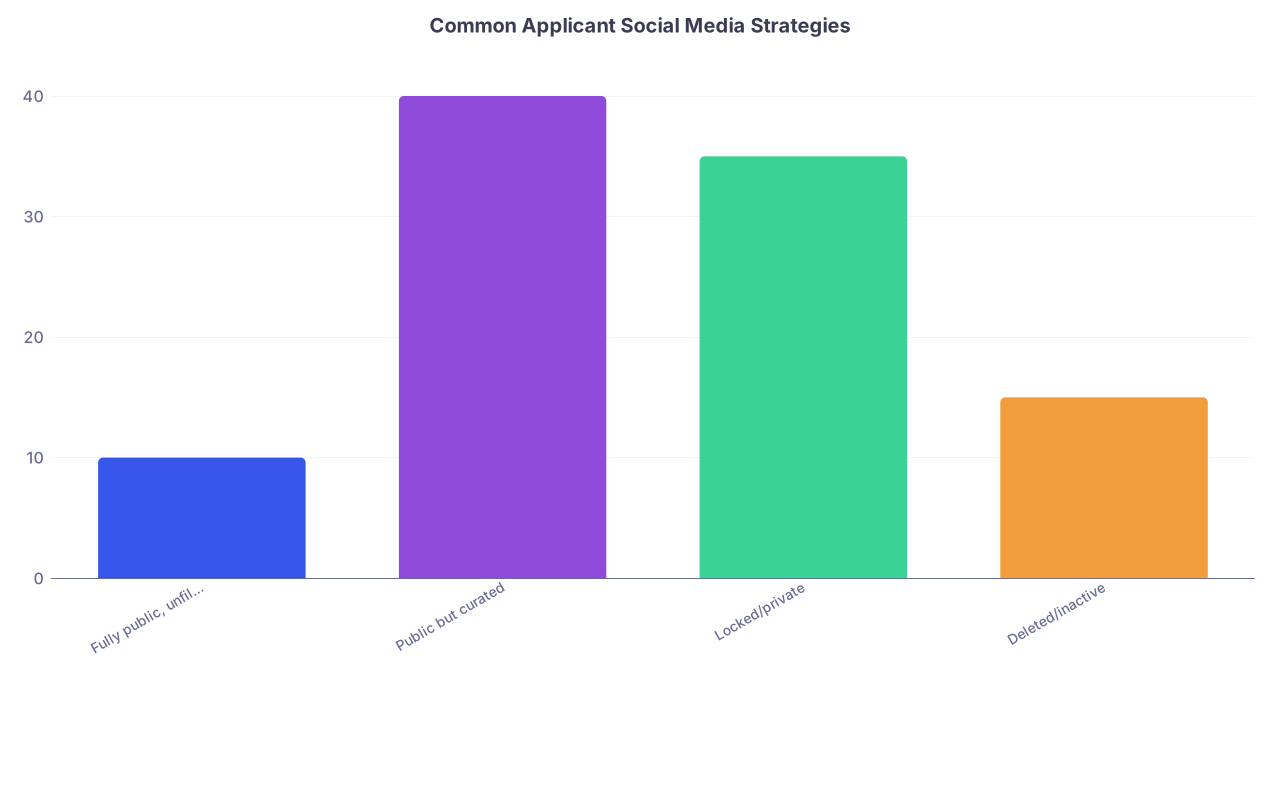
Here’s the spectrum I see in real applicants:
| Category | Value |
|---|---|
| Fully public, unfiltered | 10 |
| Public but curated | 40 |
| Locked/private | 35 |
| Deleted/inactive | 15 |
The middle two are where you probably want to be.
What If They Already Saw Something?
This is the nightmare scenario running on loop in your brain:
A PD has already seen That One Post. They’re sitting in a dark office. They remember your username. They’re waiting to bring it up on interview day.
Deep breath: almost no one has that kind of energy.
Here’s what actually happens when they see something concerning:
- If it’s mild: they roll their eyes and move on
- If it’s borderline: they might mention it offhand in committee
- If it’s bad: they usually just quietly drop you lower or off the rank list
Very rarely do they confront you directly unless it’s something huge and already in public discussion.
If you’re really convinced something legitimately bad was seen—like another student told you they heard PDs talking about it—you have two options:
- Fix/lock everything and move forward like normal (most common, usually fine)
- If it’s very serious and truly public (e.g., viral thread calling you out), talk to your dean’s office or advisor about how to address it
What you should not do is email programs preemptively with, “Hey, you might have seen my tweet from 2017…” That just drags attention back onto something most people weren’t actually looking at.
I’ve seen applicants with a rough online history still match well once they matured, cleaned things up, and had strong in‑person impressions. People care more about who’s showing up now than who you were as a dumb undergrad.
How to Sanity‑Check Yourself Without Losing Your Mind
You don’t need a “perfectly clean” social media. You need “nothing that makes a 50‑year‑old physician say ‘absolutely not.’”
Here’s a simple frame that might calm your brain a bit.
Look at a post and ask:
- Would I be okay if my favorite attending saw this?
- Would I be okay if it was on a projector during Grand Rounds with my name under it?
- Does this show basic respect for patients, colleagues, and the profession?
If your gut clenches at 1 and 2, that’s your answer. Hide it.
If the only discomfort is, “Ugh, I look weird in this photo” or “This is so cringe,” that’s not a professional problem. That’s just being a human with a history.
To visualize the line between acceptable and risky:

| Step | Description |
|---|---|
| Step 1 | Look at a post |
| Step 2 | High risk: delete/hide |
| Step 3 | Consider hiding or going private |
| Step 4 | Probably fine |
| Step 5 | Any patients, PHI, or hospital logo? |
| Step 6 | Hate speech, harassment, or slurs? |
| Step 7 | Clearly drunk/high or unsafe behavior? |
| Step 8 | Just normal life / mild venting? |
You don’t need a committee. You need 30–60 focused minutes, some honesty, and then you need to stop checking the same six photos over and over.
The Part You Probably Don’t Want to Hear
Here’s the uncomfortable truth: if a program is looking for a reason not to like you, they’ll usually find it—on or off social media.
It might be your school. Your letters. Your scores. Your personality on Zoom. Your answer to “Why this program?” The vibe. Humans are biased and messy.
Social media is just one more data point, and usually a pretty small one unless you’ve made it impossible to ignore.
What will matter far more:
- Your letters
- Your interview performance
- Whether people like the idea of working nights with you
- Your reputation from rotations and sub‑Is
You’re not getting matched or rejected solely because of a tagged photo from your cousin’s wedding in 2019 where someone’s holding champagne.
Residency programs know they’re recruiting late‑20s humans, not 1950s catalog models.
FAQs
1. I have a couple of posts complaining about burnout and medicine being broken. Is that dangerous?
Not automatically. A ton of residents and attendings post about burnout and systemic issues. The line is whether you sound thoughtful and grounded… or like you hate patients, hate medicine, and are one bad day away from quitting.
If your posts sound like: “The system is brutal, I’m exhausted, wish we had better support,” that’s normal and relatable. If they sound like: “My patients are idiots, this job is stupid, can’t wait to do the bare minimum until I’m rich,” that’s a problem. If you’re unsure, hide the most negative stuff during application season.
2. Should I change my name/handle so programs can’t find me?
You can, but don’t rely on that as your only layer of protection. Screenshots exist. Friends tag you. Also, if you do anything remotely professional online (research, advocacy, etc.), people might actually want to connect your real identity to that work. Better approach: assume anything truly public should be something you wouldn’t be horrified to see in front of your PD, then lock or pseudo‑anonymize the rest.
3. A friend told me their PD definitely rejected someone over social media. Is that common?
It happens. But when I’ve dug into those stories, it’s almost never because of normal party photos. It’s usually patient privacy issues, slurs, aggressive unprofessionalism, or repeated patterns that make someone seem like a liability.
Is it “common”? No. Is it possible? Yes—if your content is really bad. If what you’re calling “unclean” is mostly harmless normal life, you’re probably worrying way out of proportion to the actual risk.
4. How long do I need to keep everything “clean”? Just until Match Day?
I’d think of this less as “hold my breath until Match” and more as “this is my professional life now.” Once you’re a resident, the stakes go up, not down. Nurses, co‑residents, even patients will occasionally Google you. Bad judgment online can burn you with licensing boards, HR, or hospital leadership, not just programs. So yes, do a focused cleanup now for application season—but try to build a default setting of “would Future Attending Me be okay with this living forever?”
Bottom line:
- You don’t need spotless, you need “nothing clearly unprofessional or discriminatory.”
- Clean up the obvious problems, lock what makes you nervous, then stop doom‑scrolling your own past.
- Your match will be decided far more by your actual performance and how people experience you than by one imperfect Instagram from M1.